What is eHarmony.com?
eHarmony is one of the world’s leading online dating platforms that uses compatibility matching to connect single people seeking long-term relationships and marriage.
Unlike traditional dating sites that rely on searches made by users and swiping, the platform’s curated approach delivers carefully selected matches based on compatibility factors.
The platform’s core philosophy is that lasting relationships are built on compatibility, not just who you are attracted to. By matching people based on their personality, values, and lifestyle, eHarmony believes that it can dramatically increase the likelihood of relationship success.
When did eHarmony Start
eHormony launched on August 22, 2000, making it one of the pioneers and most established in the online dating industry. At that time, most dating sites were essentially digital classified ads. eHarmony introduced something revolutionary: the first algorithm-based matching system designed specifically to facilitate lasting marriages.
The platform gained traction quickly, and within its first three years, eHarmony attracted two million users. By 2004, the company was profitable, and by the end of the decade, over 33 million people had used the service.
eHarmony Founders and Background
eHarmony was co-founded by Dr. Neil Clark Warren and his son-in-law, Greg Forgatch.
Dr. Neil Clark Warren is a clinical psychologist who spent 35 years counseling couples before launching eHarmony. Born in 1934 in Des Moines, Iowa, Warren witnessed his parents’ 70-year marriage, which, despite its longevity, lacked deep communication and compatibility. This observation sparked Warren’s lifelong interest in understanding what makes relationships work.
Warren’s research identified what he called “29 Dimensions of Compatibility” (later refined to 32 dimensions), which became the foundation for eHarmony’s matching algorithm. These dimensions cover everything from core personality traits to values, social styles, and emotional temperament.
Warren served as the platform’s CEO from 2000 to 2007, retired, then returned in 2012 to help turn around the company before stepping down again in 2016.
eHarmony Key Market Areas
While eHarmony started in the United States, the platform has expanded internationally. eHarmony serves millions of users around the world, though its primary markets remain in English-speaking countries.
Eharmony USA
The United States is still eHarmony’s largest market and also most active. Across the 50 states, the platform has millions of marriage-minded users, with particular strength in major metropolitan areas like Los Angeles, New York, Chicago, Houston, and Phoenix. Users in America enjoy the most comprehensive features and the largest pool of potential matches.
Eharmony Canada
In Canada, eHarmony has established a strong presence, particularly in cities such as Toronto, Montreal, and Calgary. The Canadian platform operates with similar features to the US version, but with pricing in Canadian dollars and matches tailored to Canadian geography.
Eharmony UK
In 2025, the United Kingdom is eHarmony’s strongest international market after North America. The platform has adapted to British dating culture while maintaining its core focus on compatibility and long-term relationships. UK users benefit from serious daters across England, Scotland, Wales, and Northern Ireland, with pricing in British pounds.
Eharmony Australia
In Australia, eHarmony serves singles across the continent, from Sydney and Melbourne to Brisbane and Perth. The Australian market has embraced eHarmony’s serious approach to dating, with thousands of active users seeking meaningful connections. Here, the platform helps users find matches within reasonable distances despite the country being so vast in size.
Ready to join millions of serious daters? Start your eHamony journey today.
Is eHarmony. Com Legit?
Absolutely. eHarmony is a legitimate dating site. The platform is actually one of the most established and reputable in the world. To confirm its credibility, let’s look at the following proofs:
- Longevity: The platform has been operating since 2000, surviving competitors and market changes. You won’t find a fly-by-night scam that lasts 25 years.
- Media Recognition: eHarmony has been featured extensively in mainstream media, including The New York Times, Wall Street Journal, CNN, and countless other reputable publications. The platform’s founder has appeared on major TV shows and news programs.
- Success Stories: There are thousands of verified couples who have shared their eHarmony success stories. The platform’s claims of facilitating 2% of US marriages have been independently verified by research organizations.
- Industry Awards: The dating site has received numerous awards and recognition from the dating industry and consumer groups for its innovative matching system and commitment to serious relationships.
That said, being legit doesn’t mean perfect. Like any big company out there, eHarmony faces legitimate criticism concerning their billing, customer service, and transparency around auto-renewals. These are areas where the company needs to improve, but they don’t make the platform a scam.
How Does eHarmony Work?
Most platforms show you everyone who meets your criteria and let you browse freely. In contrast, eHarmony is fundamentally different, using a curated, science-based approach.
Here’s how the process works:
Step 1: Sign Up and Registration
Creating your eHarmony account is free and straightforward. Expect to provide basic information, such as your name, email, location, gender, and the gender you’re interested in matching with.
Step 2: Complete the Compatibility Quiz
Unlike other dating sites that show you matches immediately you sign up, eHarmony requires users to complete a comprehensive personality assessment.
Step 3: Build Your Profile
After the quiz, you’ll create your dating profile by uploading photos, writing a brief introduction, and providing additional details about your lifestyle, interests, and what you’re looking for in a partner.
Step 4: Receive Curated Matches
eHarmony’s algorithm analyzes your quiz results and delivers a daily selection of matches based on compatibility scores.
Step 5: Review Compatibility Insights
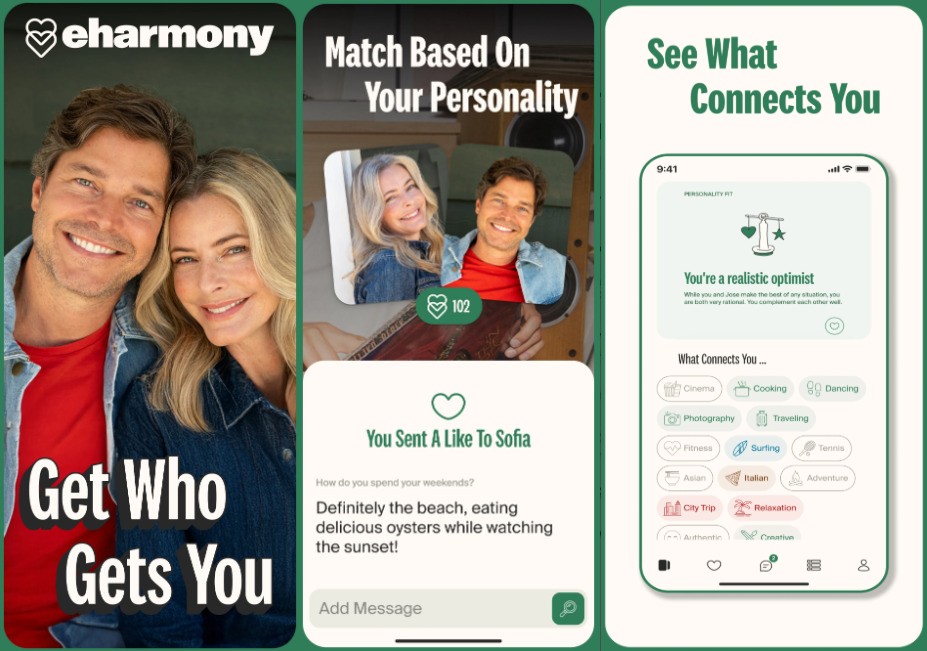
You’ll notice that each match profile has a compatibility score and detailed insights showing where you align and where you differ on key personality dimensions.
Step 6: Initiate Communication
If you’re interested in someone, you can send an icebreaker, like their profile, or start a conversation. If you are a premium member, you get to enjoy full messaging access.
Compatibility Quiz
The eHarmony Compatibility Quiz is the cornerstone of the entire platform. This isn’t a casual “What’s your favorite color?” questionnaire. Expect a comprehensive psychological assessment developed by relationship researchers.
You’ll find approximately 80 questions in the quiz, covering topics such as:
- Your personality type and temperament
- How you handle conflict and disagreement
- Your communication style and preferences
- Core values and beliefs
- Lifestyle habits and preferences
- Relationship expectations and goals
- Emotional intelligence and self-awareness
- What you’re looking for in a partner
Some of the questions are straightforward multiple-choice selections, while are scenario-based inquiries that are meant to reveal the way you would react in specific situations. Some even aim to uncover your subconscious preferences.
The quiz typically takes 15 to 25 minutes, depending on the thoughtfulness you put into your answers. You can actually take breaks if needed, as eHarmony saves your progress.
Be sure to answer honestly and instinctively. The quiz is not about “right” answers: it’s designed to understand who you authentically are and not who you think you should be.
eHarmony Compatibility Score
Once you complete the quiz, all your potential matches will have a compatibility score that typically ranges from 60 to 140. This score shows how you two align based on eHarmony’s 32 dimensions of compatibility.
Let’s break down what the scores mean:
|
SCORE
|
COMPATIBILITY LEVEL
|
INTERPRETATION
|
|
60-80
|
Low compatibility
|
You may share some interests, but fundamental differences could create friction.
|
|
80-100
|
Moderate compatibility
|
If you’re drawn to their profile, it’s worth exploring
|
|
100-110
|
Good compatibility
|
These matches align well with your personality and values.
|
|
110-140
|
Exceptional compatibility
|
These are highly promising matches that eHarmony believes could be excellent long-term partners.
|
Beyond the numbers, you can dive deeper to see exactly where you align and differ. eHarmony will show you the top attributes you share and how you compare on dimensions such as energy, values, intellect, and lifestyle.
We really appreciate this transparency, as it helps you be well-informed when deciding about who to pursue. It also facilitates more meaningful conversations, as you already understand how fundamentally compatible you are.
How eHarmony Uses Psychology to Match Users
If you have tried other AI-driven dating apps before, you must have noticed that most of them prioritize immediate attraction and rely on AI primarily for basic filtering or user engagement tactic. But that’s not the case with eHarmony, as its foundation is in psychological research. The platform’s 32 Dimensions of Compatibility model is based on decades of studies about what makes relationships succeed, including research on how couples who meet online compare to those who meet through traditional methods.
Those dimensions include the following:
- Core Personality Traits: These include things like introversion vs. extroversion, conscientiousness, openness to experience, emotional stability, and agreeableness
- Values and Beliefs: Religious faith, family importance, financial philosophy, and ethical principles
- Emotional Dynamics: How you express and manage emotions, your need for affection, and your conflict resolution style
- Social Style: How you interact with others, your communication preferences, and social needs
- Lifestyle Factors: Energy levels, spontaneity vs. planning, activity preferences, and daily rhythms
- Relationship Philosophy: Views on commitment, expectations about partnership roles, and long-term goals
The platform weighs these dimensions differently depending on their importance to the success of your relationship. There are some factors, such as core values and emotional compatibility, which carry more weight than others, like the hobbies you share.