

DRL 236(B)(3), New York’s One Rule for Prenups and Postnups
Domestic Relations Law section 236, part B, subdivision 3 governs prenups in New York. The state never adopted the Uniform Premarital Agreement Act, and the same subdivision covers agreements signed before or during the marriage, so prenups and postnups follow one execution rule.
A valid agreement is in writing, subscribed by both parties, and acknowledged or proven in the manner required for a deed to be recorded. The table below sums up the main rules and where each one comes from.
Why the Notary Certificate Can Sink a New York Prenup
A New York prenup is valid in a matrimonial action when it satisfies DRL 236(B)(3). The statute requires writing, signatures by both parties, and a deed-style acknowledgment or proof.

Writing, Subscribing and Acknowledging
Each party must subscribe the agreement, and each signature needs a proper acknowledgment. For a prenup, the acknowledgment may be taken by a notary or by a person authorized to solemnize a marriage under DRL 11 subdivisions 1 to 3.
The New York Court of Appeals has treated this formality strictly. In Matisoff v. Dobi, an unacknowledged agreement was unenforceable, and in Galetta v. Galetta, a defective notary certificate made a signed prenup unenforceable.

No Lawyer Required, with One Caveat
No state statute requires each person to have a lawyer for a prenup. Lack of counsel can still matter in an overreaching claim, and Marinakis raised it as one factor.
Ceremony Timing After the License Issues
The statute sets no minimum number of days between signing and the wedding. The marriage license runs on its own clock: no ceremony within 24 hours of issuance unless a court orders otherwise, and the license expires after 60 days.
Galetta, McEvoy and Recent New York Rulings
Local prenup cases often turn on execution details and later hardship. The cases below include a defective acknowledgment, a public charge concern, a maintenance waiver struck while the rest of the agreement stayed in place, and an estate waiver enforced after death.
Galetta shows why the notary certificate is more than a formality. McEvoy and J.M. v. G.V. show how maintenance provisions can receive separate scrutiny, while Matter of Kevelson shows the force of a properly executed waiver of inheritance rights.
Fraud, Overreaching and Unconscionability in New York
A prenup can be set aside for unconscionability, fraud, or manifest unfairness to one spouse because of overreaching by the other. The Appellate Division standard says agreements between spouses or prospective spouses should be closely scrutinized.
State public policy gives prenups presumptive validity. The challenger carries the burden to show a fact-based, particularized inequality, as stated in McEvoy and the cases it quotes.
Unconscionability is a demanding test. Marinakis quoted Christian v. Christian for the rule that the agreement must be one that no person in his or her senses and not under delusion would make, and no honest and fair person would accept.
Overreaching must appear in how the agreement was made. Spiegel described examples such as concealment of facts, misrepresentation, cunning, cheating, sharp practice, or other deception.
A facially fair agreement can be upheld without a hearing. The state also treats maintenance differently from many property terms, because an agreement that was not unconscionable when signed may become unconscionable by the time final judgment is entered.
Our review of appellate prenup disputes found 92 U.S. appellate validity cases from 2021 to 2025, with 43 enforced in full and 18 invalidated in full. The New York Appellate Division decided 9 of them, with 2 enforced in full, 3 invalidated in full, and 4 sent back for a hearing or further proceedings.
- One New York-licensed lawyer per partner
- $799 per partner, on top of the $599 agreement
- The platform requires both lawyers whenever a New York prenup waives maintenance

Maintenance Waivers Face Two Tests
A prenup can change post-divorce maintenance, but the statute applies special review to those terms. DRL 236(B)(6) says the guideline formula does not apply where the parties have an agreement under subdivision 3 providing for maintenance.
Without an agreement, post-divorce maintenance uses a guideline formula on the payor’s income up to an income cap. The courts’ published cap rose from $228,000 to $241,000 on March 1, 2026, and a court may award more on income above the cap after weighing factors.
The advisory duration schedule runs from 15% to 30% of the marriage length for marriages up to 15 years, 30% to 40% for marriages of more than 15 and up to 20 years, and 35% to 50% for marriages of more than 20 years. Non-durational maintenance remains possible.
A maintenance waiver or cap must be fair and reasonable when made and must not be unconscionable when final judgment is entered. General Obligations Law 5-311 also limits agreements that would leave a spouse incapable of self-support and likely to become a public charge.
J.M. v. G.V. is a trial-level decision, so it binds no other court. It struck a maintenance waiver where the self-represented spouse did not knowingly waive the presumptive guideline figure, and HelloPrenup requires lawyers for both partners when a prenup waives maintenance.
Is New York a 50/50 Divorce State?
The state is an equitable distribution state, so divorce property division is not a fixed 50/50 split. DRL 236(B)(5)(c) says marital property shall be distributed equitably between the parties.
Marital property is all property acquired by either or both spouses during the marriage and before a separation agreement or the start of a divorce action, regardless of title. A prenup can change that result by describing property as separate under DRL 236(B)(3).
The court weighs listed factors when dividing marital property. Those include income and property at marriage and at filing, the length of the marriage, age and health, and the custodial parent’s need for the marital home.
Separate property includes property acquired before marriage, property received by bequest, devise, descent, or gift from someone other than the spouse, compensation for personal injuries, and property acquired in exchange for separate property. A written agreement under subdivision 3 can also define property as separate.
Appreciation of separate property stays separate except to the extent the increase in value is due in part to the other spouse’s contributions or efforts. That point matters for businesses, professional practices, investment accounts, and homes owned before marriage.
Without a prenup, title alone does not control marital property. The statute looks at when property was acquired, how it was acquired, and whether the other spouse’s work or contributions helped create value during the marriage.
Renters, Late Marriages and New York Prenups
Couples here who are older at first marriage, own higher-value property, or are blending separate assets have state-specific reasons to consider a prenup. The Census Bureau reports that 16.6% of New Yorkers who have ever married have done so two or more times, against 23.5% nationally.

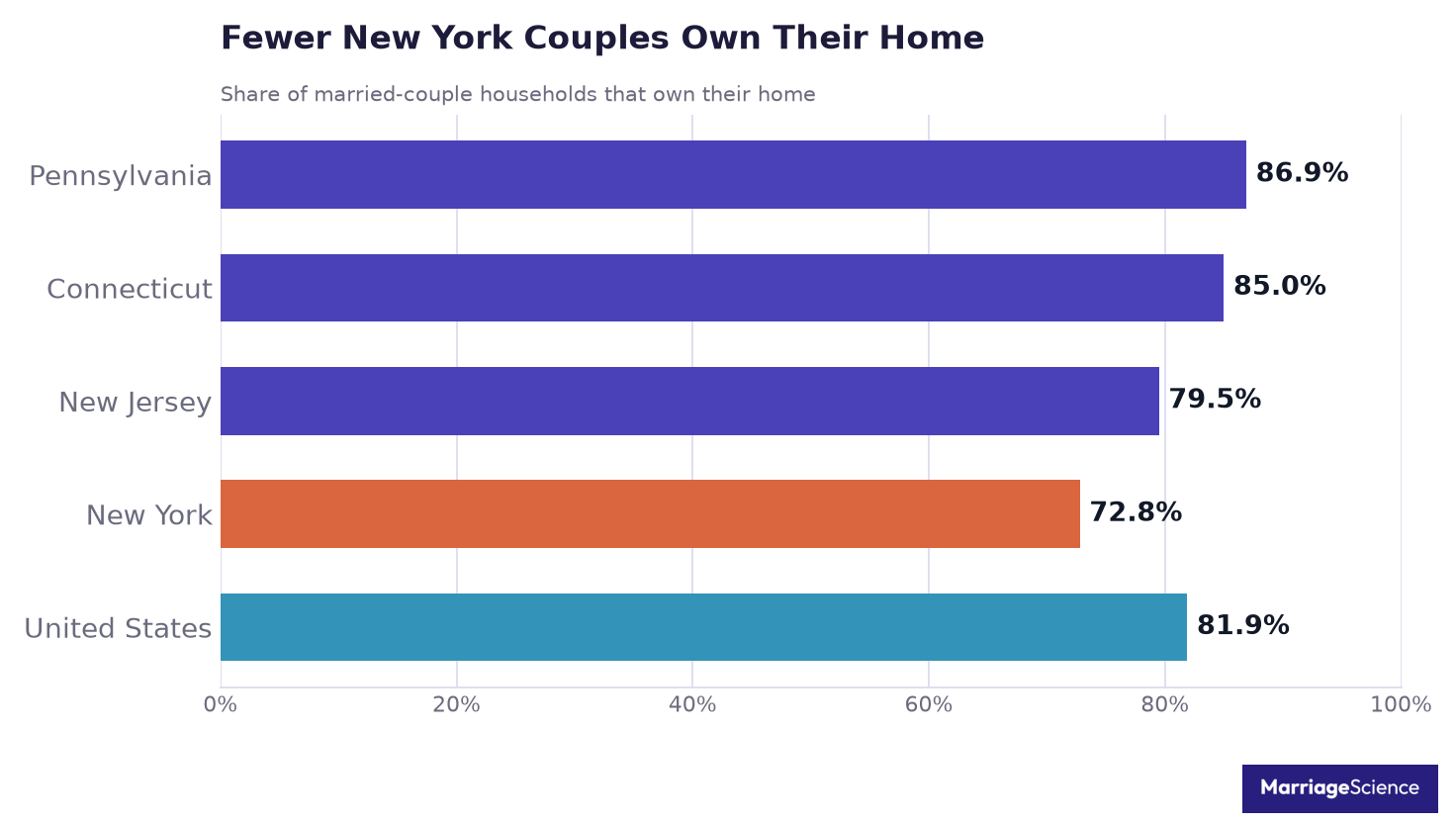
Home ownership looks different here too. Only 72.8% of married couples own their home, against 81.9% nationally, so many couples buy after the wedding, when a new home counts as marital property unless a prenup says otherwise.
Women here have one of the oldest median ages at first marriage among the states. Later first marriages can mean more savings, retirement accounts, equity, or business interests exist before the wedding.
The state’s median home value is $449,800. That figure gives real weight to rules about separate property, appreciation, and whether a spouse’s contributions during marriage can affect the value of a premarital home.
What Cannot Be in a New York Prenup?
A New York prenup cannot rest on an oral promise or skip the deed-style acknowledgment, and it cannot leave a spouse likely to become a public charge. Maintenance terms also stay open to an unconscionability check when the divorce judgment is entered.
A prenup can cover property, maintenance, estate rights, and some child-related subjects, but each category has limits. DRL 236(B)(3) lists the subjects and ties several of them to other state statutes.
Property terms may define ownership, division, or distribution of separate and marital property. This is where couples can address premarital homes, business interests, earnings, appreciation, and accounts opened before or during marriage.
Maintenance terms are allowed, but they face two statutory tests. They must be fair and reasonable when made and must not be unconscionable at the time final judgment is entered.
Estate provisions can be included too. DRL 236(B)(3) lists a contract to make a testamentary provision of any kind, and a waiver of a right to elect against a will.
Child-related terms are subject to DRL 240. That means a prenup can address custody, care, education, and maintenance of a child only within the limits state law applies to children.
Allowed Under DRL 236(B)(3)
- Define separate and marital property.
- Set rules for division or distribution of property.
- Address the amount and duration of maintenance.
- Waive a right to elect against a will.
- Include a contract to make a testamentary provision.
- Address custody, care, education, and maintenance of a child subject to DRL 240.
Where New York Draws the Line
- Use an oral promise as a prenup.
- Skip the deed-style acknowledgment required by DRL 236(B)(3).
- Relieve a spouse of support in a way that is likely to make that spouse a public charge.
- Make maintenance terms immune from the final judgment unconscionability test.
Postnups Follow the Same Acknowledgment Rule
A couple can address prenup changes after the wedding through an agreement made during the marriage under the same statute. DRL 236(B)(3) covers agreements made before or during marriage and applies the same writing, signature, and acknowledgment rule.

That means a later marital agreement needs the same attention to execution as the original prenup. A signed writing with proper acknowledgments is the point local cases return to when deciding enforceability.
For couples comparing a premarital agreement with an agreement signed after the ceremony, this guide to prenups and postnups explains the timing difference.
How Much Does a Prenup Cost in New York?
A prenup can cost more than the national lawyer average because legal rates are higher here. Clio Legal Trends lists the average lawyer here at $420 per hour, compared with $349 in the United States, and family law in the state at $426 per hour.

As an illustration, 8 hours at $426 per hour is $3,408 for one lawyer. That is only an hours example, since actual attorney time depends on drafting, negotiation, revisions, and whether each partner has separate counsel.
HelloPrenup lists the state at $599 per couple, with an attorney for each partner at $799 per partner, or $1,598 total. Its Attorney-Signed package is $2,197, e-notarization is $50, and attorney Q&A is $49.
The platform requires attorney representation for both partners when the prenup waives spousal maintenance. The cost table below separates lawyer time, platform pricing, and add-ons.
| Route | Cost | What you get |
|---|---|---|
| Online prenup | $599 per couple | Built around New York’s signing rules, with a free consultation |
| Online prenup, attorney for each partner | $2,197 per couple | Lawyers for both partners, which the platform requires when the prenup waives maintenance |
| Single attorney add-on | $799 per partner | A New York-licensed attorney for one partner |
| Hourly family lawyer | $426 per hour | Average New York family law rate. Two lawyers billing eight hours each would charge $6,816, shown as an illustration |
Drafting, Signing and Acknowledging a New York Prenup
Getting a prenup here is mainly about clear terms and correct execution. Because of the deed-style acknowledgment rule, the signing appointment is part of the legal work.
- List Separate PropertyEach partner identifies property owned before marriage, inheritances, gifts from others, personal injury compensation, and assets acquired in exchange for separate property.
- Define Marital PropertyThe agreement can state what will count as marital property and how property acquired during marriage will be owned or divided.
- Address Maintenance TermsIf the prenup changes or waives maintenance, the terms face the fair and reasonable test at signing and the unconscionability test at final judgment.
- Review Estate RightsA prenup can waive a surviving spouse’s right of election if the waiver is written, subscribed, and acknowledged or proved like a real property conveyance.
- Sign with AcknowledgmentBoth signatures should be acknowledged with a proper certificate. Galetta shows that a signed and notarized prenup can still fail if the certificate lacks required language.
- Keep Executed CopiesEach partner should keep a complete copy with the signatures, acknowledgments, and any schedules referenced in the agreement.
New York Prenup FAQ
New Yorkers ask most about notarization, maintenance waivers and lawyers. Each answer cites the Domestic Relations Law section or the court decision behind it.
Does a prenup need to be notarized in New York?
A New York prenup must be acknowledged or proven in the manner required to entitle a deed to be recorded. In practice, each signature is acknowledged before a notary with a proper certificate of acknowledgment.
Is New York a UPAA state for prenups?
No. New York did not adopt the Uniform Premarital Agreement Act. Prenups are governed by DRL 236(B)(3), the same statute that covers agreements made during marriage.
Can a New York prenup waive inheritance rights?
Yes. New York law allows this through DRL 236(B)(3), which permits a waiver of a right to elect against a will, and EPTL 5-1.1-A(e)(2) requires the waiver to be written, subscribed, and acknowledged or proved like a real property conveyance.
Can my spouse take my house if I bought it before marriage in New York?
Not the house itself. A home owned before the wedding is separate property under DRL 236(B)(1)(d), but any rise in its value that is due in part to your spouse’s contributions or efforts can be treated as marital, and a prenup can settle that in advance.
Does a prenup protect you 100% in New York?
No. Maintenance terms can still fail if they are unconscionable when the divorce judgment is entered, and General Obligations Law 5-311 bars any waiver that would leave a spouse likely to become a public charge, as happened in McEvoy.
New Jersey, Pennsylvania and Connecticut Rules
New York’s deed-style acknowledgment rule is unusual. New Jersey, Pennsylvania and Connecticut set their own signing formalities, so read their guides if either of you lives across the border.

Sources
The Domestic Relations Law, the Court of Appeals and the Appellate Division supply the rules on this page. Census, Clio and the state court system supply the figures.
- New York Domestic Relations Law section 236 (New York State Senate)
- New York General Obligations Law section 5-311 (New York State Senate)
- New York Domestic Relations Law section 13-b, license timing (New York State Senate)
- New York courts, 2026 maintenance and child support income caps
- Galetta v. Galetta, New York Court of Appeals (CourtListener)
- Matisoff v. Dobi, New York Court of Appeals (CourtListener)
- McEvoy v. McEvoy, Appellate Division, Second Department (CourtListener)
- J.M. v. G.V., Supreme Court, Kings County (New York Official Reports)
- Matter of Kevelson, Appellate Division, Second Department (CourtListener)
- U.S. Census Bureau, American Community Survey 1-year estimates
- Clio Legal Trends, lawyer hourly rates in New York
- Marriage Science, Do Prenups Hold Up in Court? Appellate study
Not legal advice. This article is general information only. Prenup laws differ by state and change over time. Consult a licensed attorney in your state before acting on anything here.