


A.R.S. 25-201: Arizona’s Act for Prenups and Postnups
The Arizona Uniform Premarital Agreement Act, A.R.S. 25-201 to 25-205, governs premarital agreements and postnuptial agreements. The statute defines property to include income and earnings, so the agreement can reach future compensation as well as assets already owned.
The agreement has to be written and signed by both partners, and it takes effect at the wedding. State law does not require consideration, a notary, or witnesses under A.R.S. 25-202(A). The table below collects the main rules in one place.
Can My Wife Take My House If I Bought It Before Marriage in Arizona?
Not the house itself. A home owned before the wedding is separate property under A.R.S. 25-213, along with any increase in its value, rents and profits, and the court assigns separate property back to its owner. Community money spent on it during the marriage can still lead to a claim, which a prenup can settle in advance.
Arizona is a community property state, and divorce courts divide community, joint tenancy and other common property equitably, though the split does not have to be in kind.
A.R.S. 25-211 says all property acquired by either spouse during marriage is community property unless it falls within a statutory exception. The listed exceptions include property acquired by gift, devise, or descent, and property acquired after service of a dissolution petition that results in a decree.
Section 25-213 keeps separate property separate. Property owned before marriage is separate property, and so is property acquired during marriage by gift, devise, or descent.
State law also protects the increase, rents, issues, and profits of separate property as separate property. That detail matters for a spouse who enters marriage with a business interest, rental property, brokerage account, or inherited asset that may grow during the marriage.
At divorce, A.R.S. 25-318(A) directs the court to assign each spouse’s separate property to that spouse. The court then divides community, joint tenancy, and other common property equitably, though not necessarily in kind, and without regard to marital misconduct.
A prenup can change how the spouses classify, manage, and divide property, including property whenever and wherever acquired. Without an agreement, the property statutes supply the starting point for the court’s division.
What Voids a Prenup in Arizona?
An Arizona prenup gets thrown out if the person resisting enforcement proves one of the grounds in A.R.S. 25-202(C). The spouse resisting enforcement carries that burden.
Involuntary signing is ground one. The statute does not enforce an agreement against a person who did not execute it voluntarily.
The second ground combines unconscionability and disclosure. The agreement must have been unconscionable when executed, and before execution the resisting spouse must also show all three disclosure failures in the statute.
Those three points are lack of fair and reasonable disclosure of the other party’s property or financial obligations, no voluntary and express written waiver of further disclosure, and no adequate knowledge, or no reasonable ability to have adequate knowledge.
Unconscionability is decided by the court as a matter of law under A.R.S. 25-202(E). In Fadlon v. Cleverly, the Arizona Court of Appeals enforced an agreement where an express written waiver of further disclosure defeated the wife’s nondisclosure claim.
A.R.S. 25-205 tolls limitation periods during marriage. The same section leaves laches and estoppel available, so delay and reliance can still matter in the right case.
Our appellate prenup study reviewed 92 U.S. appellate prenup validity disputes from 2021 to 2025 and found no Arizona appellate decision on a prenup’s validity during that period.
- An Arizona attorney for one or both of you
- $799 each, on top of the $599 agreement
- Helps when the prenup waives maintenance and the public assistance rule could apply

Fadlon, Alulddin and Recent Arizona Rulings
Recent prenup cases here turn on concrete drafting and trial records. Fadlon v. Cleverly involved a written waiver of further disclosure, while Alulddin v. Alfartousi enforced a religious marriage contract as a premarital agreement under neutral principles of law.
The cases below show that local courts can enforce both conventional financial prenups and an Islamic mahr when the claim is framed under contract and premarital agreement rules. They also show how waiver and preserved arguments can decide the appeal.
The Public Assistance Override for Maintenance Waivers
State law lets spouses modify or eliminate spousal maintenance in a prenup, but A.R.S. 25-202(D) gives the court a limited public assistance override.
Without a prenup, A.R.S. 25-319(A) allows maintenance when the requesting spouse lacks sufficient property for reasonable needs, lacks adequate earning ability, is caring for a child whose age or condition keeps the parent home, made significant contributions to the other spouse’s education or career, or had a long marriage and is of an age that may preclude adequate employment.
A.R.S. 25-319(B) says the Arizona Supreme Court’s Spousal Maintenance Guidelines set amount and duration unless the court finds in writing that applying them would be inappropriate or unjust. Those rules supply the default maintenance framework.
If a prenup modifies or eliminates support and that makes one spouse eligible for public assistance at separation or dissolution, the court may require the other spouse to provide support to the extent needed to avoid that eligibility.
Fadlon v. Cleverly explained the steps. The requesting party shows eligibility for public assistance, the court considers whether maintenance would be available under the Arizona Spousal Maintenance Guidelines without the waiver, the party shows the amount needed to avoid eligibility, and the court still has discretion to decline.
What Cannot Be in an Arizona Prenup?
An Arizona prenup cannot reduce a child’s right to support or include terms that violate public policy or a criminal statute. A maintenance waiver also gives way if it would leave a spouse eligible for public assistance and the court decides to step in.
State law allows broad financial planning in a prenup. A.R.S. 25-203(A) covers property rights whenever and wherever acquired, along with management, transfer, and disposition of property.
The statute also permits terms about separation, dissolution, death, wills, trusts, life insurance death benefits, choice of law, and modification or elimination of spousal support. It also permits any other matter that does not violate public policy or a criminal statute.
The statute does not mention infidelity clauses, so any such term has to stay within public policy and criminal law limits.
Child support has its own statutory protection. A.R.S. 25-203(B) says a child’s right to support may not be adversely affected by a premarital or postnuptial agreement.
Religious marriage contracts can be enforced here when the court can apply neutral legal principles. In Alulddin v. Alfartousi, the Arizona Court of Appeals enforced an Islamic mahr as a premarital agreement and affirmed a $25,000 judgment.
Allowed Under A.R.S. 25-203
- Classify property rights whenever and wherever acquired
- Set rules to buy, sell, use, transfer, manage, and control property
- State how property is disposed of on separation, dissolution, death, or another event
- Modify or eliminate spousal support, subject to the state’s public assistance rule
- Create obligations tied to wills or trusts
- Address life insurance death benefits
- Choose governing law
Outside an Arizona Prenup
- Adversely affect a child’s right to support
- Add terms against public policy
- Add terms that break a criminal statute
- Force enforcement of a support waiver when A.R.S. 25-202(D) allows the court to require support to avoid public assistance eligibility
Signing Rules Under A.R.S. 25-202
An Arizona prenup is valid only if it satisfies the statute’s written and signed agreement rule, then survives any later enforcement challenge. The statute also says the agreement is enforceable without consideration and becomes effective on marriage.

Writing and Two Signatures
A.R.S. 25-202(A) requires a premarital agreement to be in writing and signed by both parties. State law has no notary or witness requirement for the agreement under that section.

Can I Just Write My Own Prenup?
The statute does not make separate lawyers a formal requirement. Still, a lawyer can affect how disclosure, waiver language, support terms, and property classifications are drafted and understood before signing.
Timing Before the Wedding
State law does not set a fixed number of days before the wedding for signing. The agreement becomes effective on marriage, and any later challenge focuses on voluntariness, unconscionability at execution, and the disclosure record described in A.R.S. 25-202(C).
Remarriage, Retirees and Home Values in Arizona
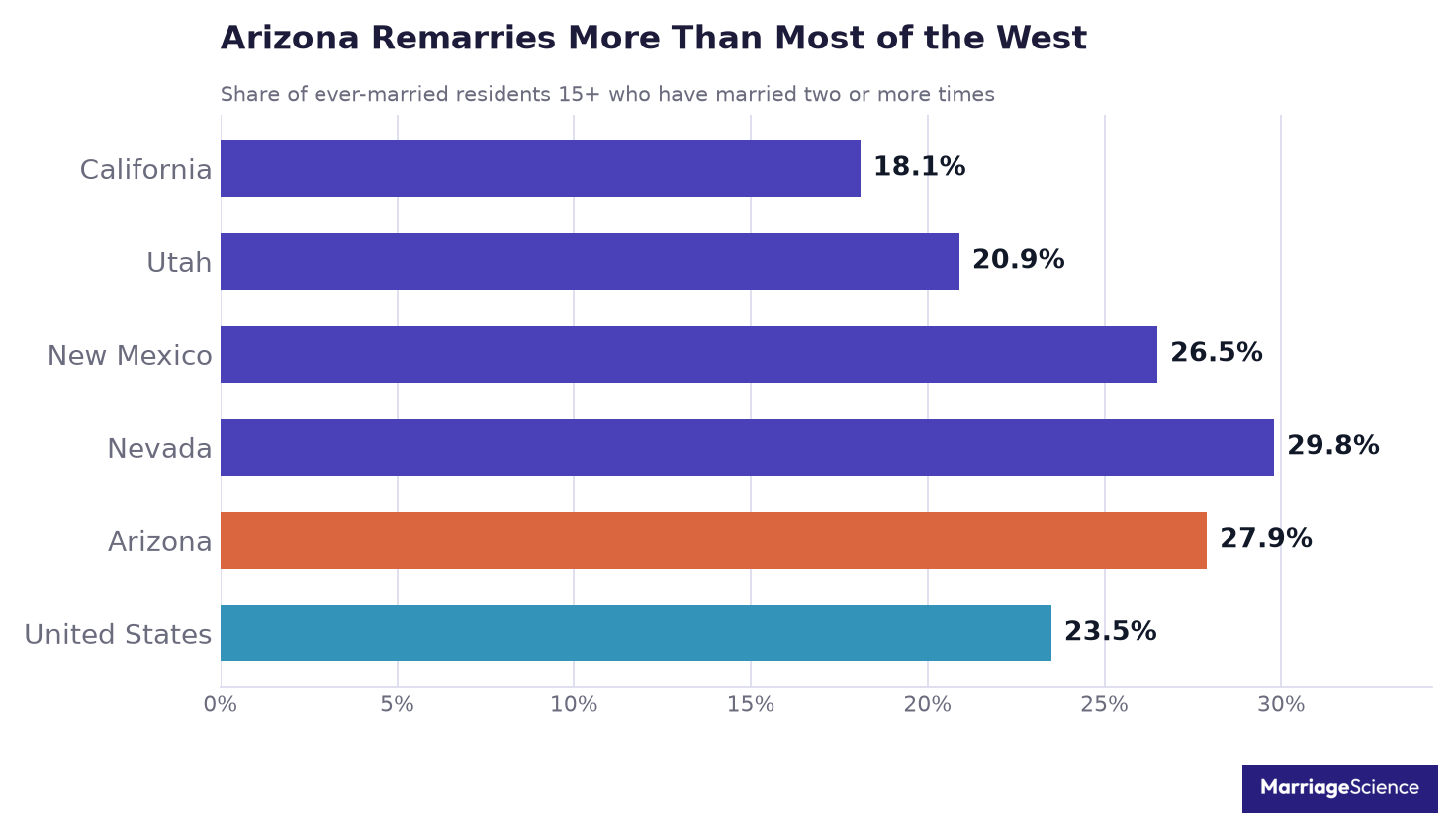
Remarriage is common in Arizona. The Census Bureau reports that 27.9% of people in the state who have ever married have done so two or more times, against 23.5% nationally.

That share is higher than California, Utah, and New Mexico, and lower than Nevada. A prenup can state which assets stay separate, how future earnings are treated, and what happens if one spouse dies or the marriage ends.
Home ownership also matters here. The Census Bureau reports that the married-couple owner share is slightly above the national share, while the state’s median home value is $426,000.
For a couple buying together, or for one partner who already owns a house, the agreement can address title, mortgage payments, improvements, and the division of sale proceeds. Those choices are especially useful in a community property state where the default rules can affect assets acquired during marriage.
Arizona Postnups Under the Same Act
State law allows spouses to change or revoke a prenup after the wedding only by a written agreement signed by both parties. A.R.S. 25-204 says the amendment or revocation is enforceable without consideration.

The act also covers postnuptial agreements. A.R.S. 25-201 defines a postnuptial agreement as an agreement entered into during marriage to divide or delineate one or both spouses’ property interests.
Because A.R.S. 25-203 to 25-205 apply to both premarital and postnuptial agreements, the same enforcement themes carry over. Couples comparing timing can read about prenups and postnups.
How Much Does a Prenup Cost in Arizona?
Prenup costs here depend on whether the couple uses lawyers, an online platform, or both. Clio Legal Trends reports a family law average of $298 per hour in the state, with lawyers overall averaging $287 and typically ranging from $134 to $536.

Eight lawyer hours at that rate, as an example only, would cost $2,384. A more complex agreement can take more time if it involves businesses, real estate, trusts, or detailed support terms.
HelloPrenup lists pricing for the state at $599 per couple. It also lists an attorney for each partner at $799 per partner, an Attorney-Signed package at $2,197, e-notarization for $50, and attorney Q&A for $49, although notarization is not required by A.R.S. 25-202(A).
Couples comparing online drafting with lawyer involvement can read our HelloPrenup review. The cost table below separates platform pricing, lawyer time, and optional add-ons.
| Route | Cost | What you get |
|---|---|---|
| Online prenup | $599 per couple | Arizona agreement with a written disclosure waiver option and a free consultation |
| Online prenup, attorney for each partner | $2,197 per couple | Arizona-licensed review and signature on both sides |
| Single attorney add-on | $799 per partner | One Arizona lawyer for one of you |
| Hourly family lawyer | $298 per hour | Average Arizona family law rate. Sixteen lawyer hours split across both sides would come to $4,768, as an illustration |
Six Steps to an Arizona Prenup
The cleanest process is built around disclosure, written terms, and signatures before marriage. The steps below follow the statute’s enforcement issues and the community property default.
- List Separate PropertyEach partner lists property owned before marriage, plus gifts, inheritances, and expected income or earnings. State law treats many of these categories differently from community property.
- Exchange Financial DisclosureShare property and financial obligations before signing. Local cases show that if one partner waives further disclosure, the waiver should be express and in writing.
- Choose Property TermsDecide how income, earnings, real estate, retirement accounts, business interests, and debt will be classified. The agreement can address property whenever and wherever acquired.
- Address Support CarefullyA prenup can modify or eliminate spousal maintenance. The public assistance rule can still let a court require limited support in the circumstances described by A.R.S. 25-202(D).
- Review Before SigningState law does not require separate lawyers, but each partner can get legal advice before signing. For online preparation issues, MarriageScience has an online prenup guide.
- Sign the Written AgreementEach partner signs the final written version before the wedding. The agreement becomes effective when the marriage occurs.
Arizona Couples Often Ask
Arizona couples ask about notaries, property bought later, religious contracts and amendments. The answers point to Title 25 and the cases above.
Do Arizona prenups have to be notarized?
No. A.R.S. 25-202(A) asks only for a written agreement signed by both partners, enforceable without consideration.
Can an Arizona prenup cover property bought during marriage?
Yes. A.R.S. 25-203(A) lets spouses contract about property rights whenever and wherever acquired, and Arizona’s definition of property includes income and earnings.
Is a religious marriage contract a prenup in Arizona?
It can be. In Alulddin v. Alfartousi, the Court of Appeals enforced the dowry terms of an Islamic marriage contract as a premarital agreement, applying neutral principles of law.
Can Arizona spouses amend a prenup later?
Yes, but only in a written agreement both spouses sign. A.R.S. 25-204 makes the amendment or revocation enforceable without consideration.
Does a prenup protect you 100% in Arizona?
No. A spouse can still void it for involuntary signing, or unconscionability plus missing disclosure, a maintenance waiver can be overridden to keep a spouse off public assistance, and child support stays protected.
Nevada, New Mexico and Utah Rules
Nevada and New Mexico are community property states like Arizona, while Utah divides property equitably. Compare the rules if either of you lives next door.

Sources
Title 25 of the Arizona Revised Statutes and two recent Court of Appeals opinions supply the rules here. Census and Clio supply the figures.
- A.R.S. 25-201 to 25-205, Uniform Premarital Agreement Act (Arizona Legislature)
- A.R.S. 25-211 and 25-213, community and separate property (Arizona Legislature)
- A.R.S. 25-318, disposition of property (Arizona Legislature)
- A.R.S. 25-319, spousal maintenance (Arizona Legislature)
- Fadlon v. Cleverly, Arizona Court of Appeals (CourtListener)
- Alulddin v. Alfartousi, Arizona Court of Appeals (CourtListener)
- U.S. Census Bureau, American Community Survey 1-year estimates
- Clio Legal Trends, lawyer hourly rates in Arizona
- Marriage Science, Do Prenups Hold Up in Court? Appellate study
Not legal advice. This article is general information only. Prenup laws differ by state and change over time. Consult a licensed attorney in your state before acting on anything here.