

Section 61.079, Florida’s Premarital Agreement Act
Florida law enforces premarital agreements under the Uniform Premarital Agreement Act, Florida Statutes section 61.079, enacted by chapter 2007-171. The agreement must be in writing and signed by both parties, and marriage itself is enough consideration.
Section 61.079 says a prenup becomes effective upon marriage. The table below separates the family-law rules from the separate estate-waiver rule, which can add a two-witness requirement for waivers of surviving-spouse rights.
Signatures, Witnesses and the Estate Waiver Rule
A Florida prenup is valid when it satisfies the statute’s writing and signature rules and avoids the statutory grounds for nonenforcement. Section 61.079 itself does not require a notary, witnesses, or a lawyer for family-law enforceability.

What Section 61.079(3) Requires
Section 61.079(3) requires a premarital agreement to be in writing and signed by both parties. It is enforceable without consideration other than the marriage, and section 61.079(5) says it becomes effective upon marriage.

Is a Florida Lawyer Required?
Section 61.079 does not say each person needs a lawyer. Counsel can still matter in a later dispute because voluntariness, disclosure, waiver of disclosure, and adequate knowledge can all be litigated if enforcement is challenged.
Signing Too Close to the Wedding
The statute does not set a minimum number of days before the wedding. Timing can still matter because a party may later argue lack of voluntariness, duress, coercion, or overreaching, and state appellate courts have reviewed agreements signed close to the ceremony.
Bates, Stevens and the Florida Appeals Record
Florida prenup cases turn on pressure, timing, disclosure, estate-waiver language, and whether the party resisting enforcement raised a recognized ground. The cases below show both family-law disputes and a probate dispute over a surviving spouse’s rights.
Bates involved duress and coercion findings. Stevens involved a prenup signed hours before the wedding. De Holguin enforced an antenuptial estate release where the wife did not argue fraud, duress, or unfairness.
Three Grounds Florida Courts Use to Void a Prenup
A Florida prenup can be thrown out if the party resisting enforcement proves one of the statutory grounds in section 61.079(7)(a). The burden is on the party against whom enforcement is sought.
The first ground is that the person did not execute the agreement voluntarily. Courts look at the surrounding facts, including pressure, the timing of signing, and the circumstances that led to the signature.
The second ground is that the agreement was the product of fraud, duress, coercion, or overreaching. The statute includes that ground as a separate basis for nonenforcement.
The third ground applies when the agreement was unconscionable when executed and the disclosure test is also met. The resisting party must show lack of fair and reasonable disclosure of the other party’s property or financial obligations, no voluntary and express written waiver of disclosure, and no adequate knowledge that the party had or reasonably could have had.
Unconscionability is decided by the court as a matter of law. Courts also still cite Casto v. Casto, which recognized fraud, deceit, duress, coercion, misrepresentation or overreaching, and a separate ground for an unfair agreement resulting from concealment or nondisclosure of finances.
State law tolls statutes of limitation during the marriage. Laches and estoppel remain available, so delay and reliance can still matter in a later fight.
In our appellate prenup study of 92 validity disputes from 2021 to 2025, district courts of appeal decided 7 cases, with 3 enforced in full, 3 invalidated in full, and 1 sent back undecided. That was a higher invalidation share than the national figure.
- A Florida-licensed attorney for each partner
- $799 per partner, added to the $599 online agreement
- Useful when the prenup waives alimony or estate rights

Alimony Waivers and the Public Assistance Exception
A Florida prenup can waive or change spousal support because section 61.079(4)(a)4 allows agreements on the establishment, modification, waiver, or elimination of spousal support.
Without a prenup, section 61.08 allows temporary, bridge-the-gap, rehabilitative, or durational alimony. Permanent alimony is not listed among the current statutory forms.
The default statute also sets time limits. Bridge-the-gap alimony may not exceed 2 years, rehabilitative alimony may not exceed 5 years, and durational alimony has percentage caps tied to the length of the marriage, with an exceptional-circumstances exception.
Courts may consider adultery under section 61.08. A prenup can change alimony exposure, but it cannot fully displace the public-assistance rule in section 61.079(7)(b).
If a support waiver or modification causes one party to be eligible for public assistance at separation or dissolution, the court may require the other party to provide support to the extent necessary to avoid that eligibility.
Is Florida a 50/50 Divorce State?
Florida is an equitable distribution state. Section 61.075 says the court sets apart each spouse’s nonmarital assets and liabilities before distributing marital assets.
The statute says the court must begin with the premise that marital distribution should be equal. The court can make an unequal distribution when the statutory factors justify it.
Those factors include contributions to the marriage, including homemaking and child care. The court can also weigh each spouse’s economic circumstances, the duration of the marriage, career interruptions, and whether a business should be kept intact.
State law also lets the court consider whether the marital home should be kept for a child. That rule can matter when a divorcing couple owns a house and one parent will be the child’s primary residential parent.
Without a prenup, marital assets include assets acquired during the marriage. They also include the enhancement in value of nonmarital assets that came from either spouse’s efforts or marital funds.
The state can also treat part of the passive appreciation of nonmarital real property as marital when marital funds paid down the mortgage. That is one reason a premarital home can still create divorce issues.
Nonmarital assets include assets owned before marriage, gifts from third parties, bequests and inheritances, income from nonmarital assets unless treated as marital, and assets excluded by a valid written agreement of the parties.
What Cannot Be in a Florida Prenup?
A Florida prenup cannot limit child support or stop a court from ordering the support that keeps a spouse off public assistance. It also cannot include terms that violate public policy or a criminal law.
Florida lets a prenup cover property rights whenever and wherever property is acquired. The agreement can also address management and control of property during the marriage and disposition at separation, dissolution, death, or another event.
Spousal support can be established, modified, waived, or eliminated in a prenup here. That power is subject to the public-assistance rule discussed in the alimony section.
A prenup here can require wills, trusts, or life insurance arrangements to carry out the agreement. It can also choose governing law and include personal rights and obligations if the terms do not violate public policy or a criminal law.
Child support is different. Section 61.079(4)(b) says the right of a child to support may not be adversely affected by a premarital agreement.
Estate rights need special care here. Section 732.702 allows waivers of elective share, intestate share, homestead, exempt property, family allowance, and preference as personal representative, but waivers by state residents must be signed by the waiving party in the presence of two subscribing witnesses.
For a waiver executed before marriage, section 732.702(2) says no disclosure is required. Section 61.079(10) says the premarital-agreement statute does not change section 732.702.
Allowed Under Section 61.079(4)
- Set rights in property whenever and wherever acquired
- Assign rights to buy, sell, use, transfer, manage, and control property
- Decide property disposition at separation, dissolution, death, or another event
- Establish, modify, waive, or eliminate spousal support
- Require wills, trusts, or life insurance death benefits to carry out the agreement
- Choose the law that governs the agreement
- Include personal rights and obligations that do not violate public policy or a criminal law
Not Allowed in Florida
- Adversely affect a child’s right to support
- Include terms that violate public policy or a criminal law
- Use section 61.079 to avoid section 732.702’s witness rule for covered estate waivers
- Stop a court from ordering support needed to avoid public-assistance eligibility
How Much Does It Cost to Do a Prenup in Florida?
Prenup costs here depend on attorney time, whether each partner hires counsel, and whether the couple uses an online platform. Clio reports an average state lawyer rate of $353 per hour and a state family-law rate of $375 per hour.

As an illustration, 8 hours of attorney time at $375 per hour equals $3,000 per lawyer. More drafting, negotiation, or financial complexity can add time.
HelloPrenup lists pricing here at $599 per couple, with an attorney for each partner at $799 per partner, and an Attorney-Signed package at $2,197. E-notarization is listed at $50, and attorney Q&A is listed at $49.
The cost table below compares these figures with attorney-time illustrations. For more background on the platform model, read our HelloPrenup review.
| Route | Cost | What you get |
|---|---|---|
| Online prenup | $599 per couple | Flat couple price for an agreement drafted under section 61.079, free consultation included |
| Online prenup, attorney for each partner | $2,197 per couple | Florida attorney review and signature for both partners |
| Single attorney add-on | $799 per partner | A Florida attorney for one partner only |
| Hourly family lawyer | $375 per hour | Average Florida family law rate. Illustration: eight hours for each of two lawyers is $6,000 |
Second Marriages and Retirees in Florida
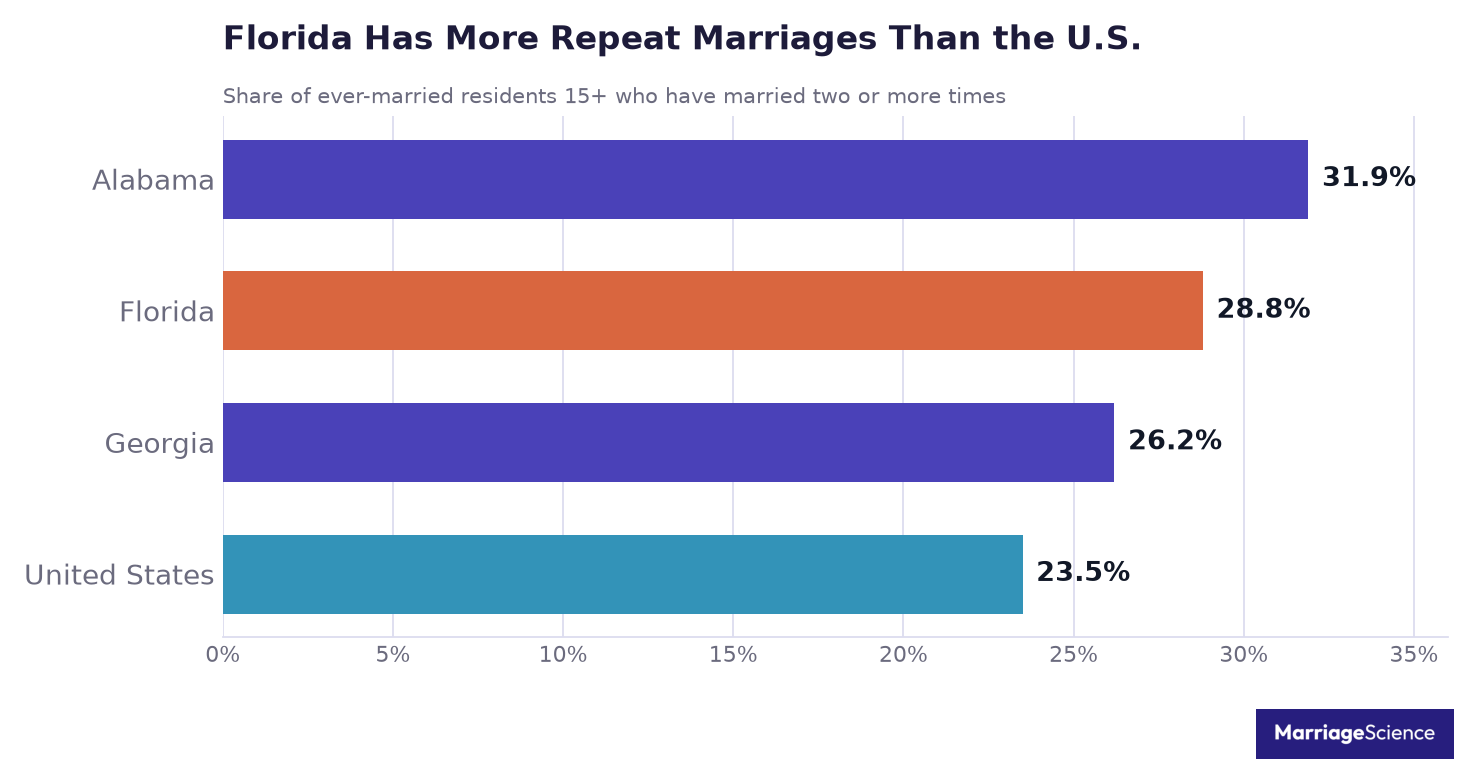
Florida couples may look at a prenup when a marriage involves prior marriages, later first marriages, or a high-value home. The Census Bureau reports that 28.8% of Floridians who have ever married have done so two or more times, compared with 23.5% nationally.

The state’s remarriage share is higher than Georgia’s and lower than Alabama’s. Remarriage can bring adult children, prior support obligations, separate property, and estate plans that a couple may want to address before the wedding.
First marriages here also occur later than the national median for both men and women. Later marriage can mean more time to build retirement accounts, business interests, or a down payment before the wedding.
The Census Bureau reports a state median home value of $396,900. A house can raise questions about mortgage paydown, passive appreciation, and whether a written agreement should classify the property before marital funds are used. The data strip below gives the state comparisons.
From First Draft to Signed Florida Prenup
A Florida prenup usually starts with property classification and financial disclosure, then moves to drafting, review, signature, and storage. These steps track the issues state courts examine when an agreement is later challenged.
- List Separate PropertyEach partner can list premarital assets, debts, gifts, inheritances, and business interests. The state’s default rules make classification important when marital funds later increase value or pay down debt.
- Exchange Financial InformationDisclosure matters because unconscionability challenges can turn on fair and reasonable disclosure, written waiver, and adequate knowledge. Written schedules can also reduce later disputes over what each person knew.
- Choose Core TermsThe agreement can address property control, division at divorce, death-related transfers, spousal support, choice of law, and other permitted terms. Child support cannot be adversely affected.
- Review Estate WaiversIf the prenup waives surviving-spouse rights here, section 732.702 may require two subscribing witnesses. Before-marriage estate waivers do not require disclosure under that section.
- Sign Before MarriageSection 61.079 makes the agreement effective upon marriage. The state has no statutory minimum signing period, but timing can be evidence in a later voluntariness or duress dispute.
- Store Final CopiesBoth spouses should have the signed final version and any attached schedules. For online preparation background, see our online prenup guide.
Amending, Revoking or Abandoning It Later
After marriage, a Florida prenup can be amended, revoked, or abandoned only by a written agreement signed by the parties. Section 61.079(6) says that later written agreement is enforceable without consideration.

This means an oral change after the wedding is not the method described by the statute. Couples who want a new agreement after marriage may need a postnuptial agreement instead.
Our guide compares prenups and postnups.
More Florida Prenup Questions
Florida couples ask most about witnesses, alimony and timing. Every answer below traces back to a Florida statute or appeals decision.
Can a Florida prenup protect a house owned before marriage?
A Florida prenup can classify property and set rights in property whenever and wherever acquired. Without an agreement, a premarital house can still raise issues if marital funds pay down the mortgage or either spouse’s efforts increase value.
Can a Florida prenup cover inheritance?
Yes. Florida law treats bequests and inheritances as nonmarital assets by default, and a prenup can also set property rights and death-related dispositions. A waiver of covered surviving-spouse rights may need two subscribing witnesses under section 732.702.
Can a Florida prenup be signed right before the wedding?
Florida’s statute does not set a minimum number of days before the wedding. Signing close to the ceremony can still matter if one spouse later claims the agreement was involuntary, the product of duress, coercion, or overreaching.
Are prenups enforceable in Florida?
Generally yes, under section 61.079. Recent appeals show how often they still fail, though: in our study, three of seven Florida cases ended with the prenup thrown out, including one signed hours before the ceremony.
Does a prenup protect you 100% in Florida?
No. Even a valid alimony waiver gives way if it would leave a spouse eligible for public assistance, because section 61.079(7)(b) lets the court order support to prevent that. Child support can never be limited by the agreement.
Georgia and Alabama Prenup Guides
Georgia and Alabama border Florida, and each sets its own prenup rules. Check them if either of you lives or owns property there.

Sources
The Florida Statutes and district court of appeal opinions below support each rule. Census and Clio data supply the figures.
- Florida Statutes 61.079, Uniform Premarital Agreement Act (Florida Legislature)
- Florida Statutes 732.702, waiver of spousal rights (Florida Legislature)
- Florida Statutes 61.075, equitable distribution (Florida Legislature)
- Florida Statutes 61.08, alimony (Florida Legislature)
- Bates v. Bates, Florida Third District Court of Appeal (CourtListener)
- Stevens v. Travers, Florida First District Court of Appeal (CourtListener)
- De Holguin v. Holguin Lourido, Florida Third District Court of Appeal (CourtListener)
- Casto v. Casto, 508 So. 2d 330 (CourtListener)
- U.S. Census Bureau, American Community Survey 1-year estimates
- Clio Legal Trends, lawyer hourly rates in Florida
- Marriage Science, Do Prenups Hold Up in Court? Appellate study
Not legal advice. This article is general information only. Prenup laws differ by state and change over time. Consult a licensed attorney in your state before acting on anything here.