


O.C.G.A. 19-3-62 and Georgia’s Prenup Case Law
Georgia law treats a prenup as an antenuptial agreement governed by O.C.G.A. 19-3-62, an Article 3 provision revised in 2018. The state has not adopted the Uniform Premarital Agreement Act, so couples here should not rely on UPAA section numbers.
The statute says an antenuptial agreement shall be in writing, signed by both parties who agree to be bound, and attested by at least two witnesses, one of whom shall be a notary public. The table below summarizes the state rules that matter before the cases get involved.
Two Witnesses and a Notary
A Georgia prenup is validly formed when it follows O.C.G.A. 19-3-62 and has an enforcement record that can satisfy Scherer. The statute also says antenuptial agreements shall be liberally construed to carry out the parties’ intention, and no want of form or technical expression invalidates them.

What 19-3-62 Requires
O.C.G.A. 19-3-62 requires the agreement to be in writing and signed by both parties who agree to be bound. It must also be attested by at least two witnesses, one of whom shall be a notary public.
The witness rule has real force in state history. In Sullivan v. Sullivan, an agreement attested by only one witness failed the older two-witness rule, while Dove v. Dove held the old witness rule did not reach agreements settling alimony.

Can You Draft a Prenup Without a Lawyer?
No Georgia statute requires a lawyer for a prenup. Still, lawyer involvement can matter in the enforcement record.
In Pickren v. Campbell, the wife had her own attorney, reviewed financial disclosures and deliberated for a week before signing. The Court of Appeals of Georgia treated those facts as support for enforcement.
Signing Close to the Wedding
State law sets no fixed number of days before the wedding. The cases look at the circumstances around signing, including review time, disclosure and pressure.
Barron v. Pritchett enforced an agreement signed less than a week before the wedding. Pickren enforced an agreement after a week of deliberation with counsel, especially over the alimony waiver.
The Scherer Test Georgia Courts Apply
A prenup here gets thrown out only if the court applying Scherer finds a reason that defeats enforcement. The trial court asks three questions under Scherer v. Scherer, as quoted in recent Court of Appeals of Georgia decisions.
First, was the agreement obtained through fraud, duress or mistake, or through misrepresentation or nondisclosure of material facts? Second, is the agreement unconscionable? Third, have the facts and circumstances changed since the agreement was executed, so as to make its enforcement unfair and unreasonable?
The party asking for enforcement bears the burden of proof on these criteria. That burden matters because the enforcing spouse has to show the court why the agreement should be applied.
Disclosure arguments depend on material facts. In Barron v. Pritchett, the husband argued nondisclosure of finances, but the wife was generally aware of his income and retirement savings, and the agreement was enforced.
In Pickren v. Campbell, the wife argued that the husband hid a romantic relationship. The Court of Appeals of Georgia held that an undisclosed relationship was not a material fact that could void the agreement.
State public policy also controls enforceability when a prenup chooses another state’s law. In Arlotta v. Arlotta, a Minnesota choice-of-law clause did not stop local law from deciding enforceability.
In our appellate prenup study, 43 of 92 U.S. appellate prenup validity disputes were enforced in full and 18 were invalidated in full. The appeals court decided four of them, with three enforced in full and one dismissed without reaching validity.
- Your own Georgia attorney, and one for your partner
- $799 per lawyer added to the $599 agreement
- Counsel and time to deliberate helped the wife’s agreement hold in Pickren

Barron, Arlotta, Pickren and Scherer
Georgia prenup cases turn on signing formalities, disclosure, counsel, waivers and the Scherer test. The cases below show courts enforcing agreements even when the wedding was close, the estates were unequal or the agreement chose another state’s law.
Scherer supplies the test, while Barron, Arlotta and Pickren show how that test works in current appeals. The outcomes turned on material facts, review time, separate counsel and state public policy.
Waivers and Terms a Georgia Prenup Can Hold
A Georgia prenup can address property division, alimony and statutory benefits that a spouse could otherwise claim. Arlotta v. Arlotta says state law permits parties to waive in a prenup benefits they would otherwise have by statute.
Property terms are especially useful in an equitable division state. A prenup can identify premarital assets, gifts, inheritances, marital earnings and appreciation so a court has the parties’ agreed framework.
Alimony waivers are also part of local prenup practice. Barron and Pickren both involved waivers of alimony, and the agreements were enforced.
Child support and custody remain with the court under the child’s best interest. A prenup can express parenting expectations, but courts retain authority over child-related outcomes.
Infidelity clauses need careful wording under state law. Pickren held that an undisclosed romantic relationship was not a material fact that could void the agreement, while O.C.G.A. 19-6-1(b) has a separate rule for alimony when separation was caused by adultery or desertion.
Terms Georgia Courts Have Enforced
- Keep premarital assets separate
- State how marital property will be divided
- Address appreciation, income and retirement contributions
- Waive alimony or set agreed alimony terms
- Waive statutory benefits that state law would otherwise give a spouse
- Confirm treatment of gifts and inheritances to one spouse
Still Up to the Court
- Bind a court on child custody
- Bind a court on child support
- Avoid the Scherer review for fraud, duress or mistake, misrepresentation or nondisclosure of material facts, unconscionability, or unfair changed circumstances
- Skip the two-witness, one-notary attestation rule for antenuptial agreements
Alimony Waivers and the Adultery Bar
Georgia alimony is discretionary unless a statutory bar applies. O.C.G.A. 19-6-1(b) says a party is not entitled to alimony if it is established by a preponderance of the evidence that the separation was caused by that party’s adultery or desertion.
If that bar does not apply, the state has no alimony formula. A court has discretion, which makes the agreed text of an alimony clause especially important.
A prenup can waive alimony. Barron v. Pritchett involved each spouse waiving alimony, and Pickren v. Campbell enforced an agreement after the wife deliberated for a week, especially over the alimony waiver.
Arlotta also supports waiver language because state law permits parties to waive benefits they would otherwise have by statute. The enforcement question still returns to Scherer, including disclosure, unconscionability and changed circumstances.
Is Georgia a 50/50 Divorce State?
Georgia is an equitable division state, with no 50/50 rule for divorce property. There is no property-division statute for divorce, and trial courts have broad discretion to divide marital property equitably based on all relevant circumstances.
That discretion matters because a judge is not working from an equal-split starting point. The court looks at the circumstances of the marriage and the property at issue, then decides what division is equitable.
Arlotta v. Arlotta describes this system while citing Zekser v. Zekser. The Court of Appeals of Georgia also made clear that a prenup can be enforced even if it preserves an existing disparity between the spouses’ estates.
Without a prenup, property owned before marriage is generally separate. Gifts or inheritances to one spouse are also generally separate.
Marital property is the category exposed to equitable division. That can include assets built during the marriage, and a court has discretion over how those assets are divided.
A prenup can change the practical result by identifying what each person keeps, how marital gains are treated and whether either spouse waives claims that state law might otherwise allow. That drafting also has to survive the Scherer enforcement test.
Remarriage and Home Values in Georgia
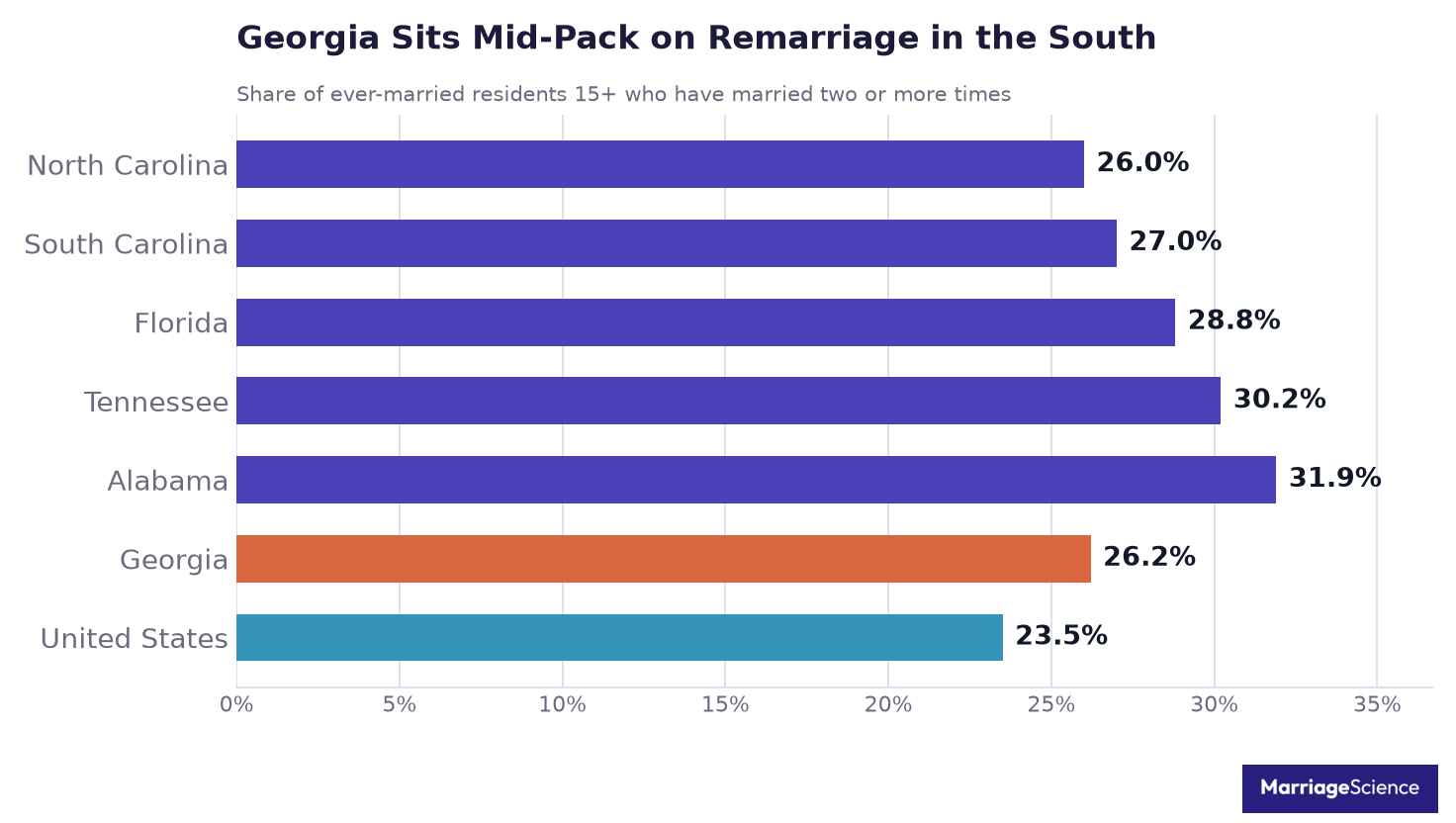
Three Census figures frame prenup planning in Georgia. Of Georgians who have ever married, 26.2% have done so two or more times, against 23.5% nationwide.

Remarriage matters because a new marriage can bring prior assets, retirement accounts, separate inheritances and children from an earlier family. A prenup can state which assets stay separate and which rights each spouse waives.
The Census Bureau also reports a state median home value of $343,300. A house can raise prenup questions about premarital equity, mortgage payments during marriage and whether appreciation is separate or marital.
Married-couple families here have a median income of $116,922, a little below the national $120,217.
How Much Does a Prenup Cost in Georgia?
A prenup cost here depends on lawyer time, review depth and whether the couple uses an online platform with attorney help. Clio Legal Trends lists family law in Georgia at an average of $313 per hour, while lawyers statewide average $340, typically $103 to $557.

As an illustration, eight hours at $313 per hour equals $2,504 for one lawyer. If each partner has separate counsel, the total depends on each lawyer’s time and rate.
HelloPrenup lists pricing here at $599 per couple, with an attorney for each partner in the state at $799 per partner, or $1,598 total. Its Attorney-Signed package is $2,197, e-notarization is an extra $50 and attorney Q&A is $49.
The two-witness, one-notary rule still matters when using an online process. Our HelloPrenup review covers the platform in more detail.
| Route | Cost | What you get |
|---|---|---|
| Online prenup | $599 per couple | A Georgia agreement with disclosure schedules and a free consultation |
| Online prenup, attorney for each partner | $2,197 per couple | Georgia lawyers for both partners, the setup Pickren pointed to |
| Single attorney add-on | $799 per partner | Counsel for one partner only |
| Hourly family lawyer | $313 per hour | Average Georgia family law rate. Two lawyers at eight hours each would cost $5,008, for illustration |
Getting the Signing Right in Georgia
Getting a Georgia prenup means building the agreement around O.C.G.A. 19-3-62 first, then preparing for a Scherer review if enforcement is later disputed.
- List Separate PropertyEach partner identifies premarital assets, gifts, inheritances, accounts, real estate and debts. State law generally treats premarital property and gifts or inheritances to one spouse as separate.
- Exchange Financial InformationThe Scherer test includes misrepresentation or nondisclosure of material facts. Clear financial disclosure helps create the record a court will later review.
- Choose Core TermsThe agreement can address property division, alimony and waivers of statutory benefits. Child support and custody remain with the court under the child’s best interest.
- Review with CounselThe state does not require a lawyer, but separate counsel can support enforcement. Pickren treated the wife’s attorney review and deliberation as facts favoring enforcement.
- Sign with WitnessesO.C.G.A. 19-3-62 requires a writing signed by both parties. The agreement must be attested by at least two witnesses, one of whom shall be a notary public.
- Keep Final CopiesEach partner should have the signed agreement and any financial schedules. The enforcement record can matter years later if a court applies Scherer.
What Is Better, a Prenup or Postnup in Georgia?
A prenup, when there is time to sign before the wedding, because O.C.G.A. 19-3-62 is written for agreements made before marriage. A postnup is still possible afterward, but it is a different agreement that this statute does not cover.

Changing a Georgia prenup after the wedding raises a different agreement question than forming an antenuptial agreement before marriage. O.C.G.A. 19-3-62 addresses antenuptial agreements, which are signed before the marriage.
A post-wedding agreement is usually discussed as a postnup, and the rules can differ from a prenup. For background on that distinction, see our guide to prenups and postnups.
Any later change should also be drafted with state enforcement themes in mind: clear terms, real disclosure and a record that can answer the Scherer questions if challenged.
Georgia Couples’ Prenup Questions
Georgia couples ask about notaries, the uniform act, last-minute signing and what voids an agreement. The answers cite the Georgia Code and the cases above.
Do you need a notary for a Georgia prenup?
Yes, as one of two witnesses. O.C.G.A. 19-3-62 says an antenuptial agreement shall be in writing, signed by both parties and attested by at least two witnesses, one of whom shall be a notary public.
Does Georgia follow the Uniform Premarital Agreement Act?
No. Formation is governed by O.C.G.A. 19-3-62, and enforceability mainly by Scherer v. Scherer and later Georgia appellate cases.
Can a prenup be signed right before a Georgia wedding?
Georgia sets no fixed waiting period. Barron v. Pritchett enforced an agreement signed less than a week before the wedding, while Pickren v. Campbell relied in part on a week of deliberation with counsel.
What makes a Georgia prenup unenforceable?
Failing the Scherer test or the signing rule. A court asks about fraud, duress, mistake, misrepresentation or nondisclosure of material facts, unconscionability, and changed circumstances, and an agreement without the required attestation is also at risk.
Does a prenup protect you 100% in Georgia?
No. Even a well-drafted Georgia agreement has to pass the Scherer review, including whether changed circumstances make enforcement unfair, and it needs the two-witness, one-notary attestation.
Florida, Alabama and South Carolina Rules
Florida adopted a version of the uniform act, while Alabama and South Carolina did not. None of them uses Georgia’s two-witness, one-notary rule, so check the rules where each of you lives.

Sources
The Official Code of Georgia and decisions of the Supreme Court and Court of Appeals of Georgia supply the rules here. The figures come from the Census Bureau and Clio.
- O.C.G.A. 19-3-62, antenuptial agreements (Justia)
- Pickren v. Campbell, Court of Appeals of Georgia (CourtListener)
- Arlotta v. Arlotta, Court of Appeals of Georgia (CourtListener)
- Barron v. Pritchett, Court of Appeals of Georgia (CourtListener)
- Sullivan v. Sullivan, Supreme Court of Georgia (CourtListener)
- Dove v. Dove, Supreme Court of Georgia (CourtListener)
- Scherer v. Scherer, Supreme Court of Georgia (CourtListener)
- U.S. Census Bureau, American Community Survey 1-year estimates
- Clio Legal Trends, lawyer hourly rates in Georgia
- Marriage Science, Do Prenups Hold Up in Court? Appellate study
Not legal advice. This article is general information only. Prenup laws differ by state and change over time. Consult a licensed attorney in your state before acting on anything here.