


750 ILCS 10, the Act That Governs Illinois Prenups
The Illinois Uniform Premarital Agreement Act, 750 ILCS 10, governs prenup law for agreements executed on or after January 1, 1990. The Act says a premarital agreement must be in writing and signed by both parties, and it is enforceable without consideration.
Below, the table tracks the rules couples ask about most, including what can be covered, when the agreement takes effect, and the limits on child support. Older agreements are judged under prior case law, as Kranzler shows for a 1984 agreement.
Maintenance Waivers Under Illinois Law
A prenup here can modify or eliminate spousal maintenance, but the waiver must be explicit and may face the Act’s hardship exception. Maintenance is treated as an important statutory right in state appellate law.
Under the default statute, the court first decides whether maintenance is appropriate at all. If guideline maintenance applies, 750 ILCS 5/504(b-1) uses a formula based on 33 1/3% of the payor’s net annual income minus 25% of the payee’s net annual income, with a cap tied to 40% of combined net income.
The guideline applies only when combined gross annual income is under $500,000 and the payor has no prior-relationship support obligation. Duration is based on the length of the marriage, with a factor that rises for longer marriages and special treatment for marriages of 20 years or more.
A prenup can replace those default rules if the support clause is enforceable. In Escamilla, the Fourth District held that waiving an interest in a spouse’s property was not a waiver of the right to seek maintenance.
750 ILCS 10/7(b) lets a court require support despite a waiver if eliminating or modifying support causes undue hardship due to circumstances that were not reasonably foreseeable when the agreement was executed. Amyette applied that rule to health and housing circumstances.
Involuntary Signing, Unconscionability and Disclosure
A prenup here gets thrown out if the party opposing enforcement proves one of the Act’s statutory grounds. Under 750 ILCS 10/7(a), the burden is on the party against whom enforcement is sought.
The first ground is lack of voluntary execution. Courts can examine the signing setting, timing, access to advice, and pressure alleged by the person challenging the agreement.
The second ground has two parts. The agreement must have been unconscionable when executed, and before execution the challenger must also meet the Act’s disclosure test.
That disclosure test has three conditions. The challenger must show no fair and reasonable disclosure of the other party’s property or financial obligations, no voluntary and express written waiver of further disclosure, and no adequate knowledge that the challenger had or reasonably could have had.
Unconscionability is decided by the court as a matter of law under 750 ILCS 10/7(c). Woodrum says the disclosure test looks at the content of the information disclosed, and an agreement may be unenforceable if procedurally unconscionable, substantively unconscionable, or both.
The state also has timing defenses after marriage. Under 750 ILCS 10/9, statutes of limitation are tolled during the marriage, while laches and estoppel remain available.
In our review of 92 U.S. appellate prenup validity disputes from 2021 to 2025, 43 were enforced in full and 18 were invalidated in full. The Illinois Appellate Court decided Amyette, which enforced the agreement in part and refused to enforce its maintenance waiver.
- One Illinois-licensed attorney per partner
- $799 each, added to the $599 online agreement
- Helps when the prenup waives or caps maintenance

Amyette, Escamilla and Other Illinois Rulings
Local prenup cases turn on the specific clause being enforced, the signing circumstances and the statutory limits on support. The cases below show full enforcement, partial enforcement, and a blocked maintenance waiver.
Amyette applied the hardship exception to a maintenance waiver while enforcing the house terms. Escamilla required an explicit maintenance waiver, Heinrich rejected a child-related fee clause on public policy grounds, and Kranzler enforced an older agreement under prior case law.
Is Illinois a 50/50 Divorce State?
The state uses equitable distribution, with no 50/50 rule in the divorce property statute. A court divides marital property in just proportions and assigns each spouse’s non-marital property to that spouse.
Under 750 ILCS 5/503(a), marital property is all property, including debts, acquired by either spouse after the marriage unless it falls into a non-marital category. Non-marital property includes property acquired before marriage, property acquired by gift, legacy or descent, and property excluded by a valid premarital or postnuptial agreement.
The statute also treats property acquired in exchange for property acquired before marriage as non-marital. That matters for a spouse who sells a premarital asset and buys another asset with the proceeds.
When the court divides marital property, 750 ILCS 5/503(d) says the division is made without regard to marital misconduct. The court considers statutory factors, including each spouse’s contributions, contributions as a homemaker, and dissipation.
A prenup can change the classification and treatment of property because the Act allows parties to contract about rights in property whenever and wherever acquired. It can also address sale, transfer, management and control of property.
Without a prenup, premarital assets, gifts and inheritances begin in the non-marital column if they meet the statute’s categories. Assets acquired during the marriage are marital property unless a statutory exception applies.
Signing an Illinois Prenup: Writing, Signatures, Timing
A prenup here is valid only if it meets the Act’s signing rules and avoids the statutory enforcement problems. The agreement becomes effective upon marriage under 750 ILCS 10/5.

Section 3: Writing and Both Signatures
750 ILCS 10/3 says the agreement must be in writing and signed by both parties. The Act does not require consideration, so marriage is enough to make the agreement operative once the wedding happens.
There is no notary or witness requirement under the Act. A notarized signature can still help prove identity and execution, but validity does not turn on notarization under the Act.

Can I Write My Own Prenup in Illinois?
State law does not state that each person needs a lawyer for a prenup to be valid. Legal representation can matter in a later dispute because courts look at voluntariness and the circumstances of signing.
Turano Solano enforced an agreement signed before a December 31, 2000 wedding where the husband had the draft for about three months and had an attorney. The case shows that time with the draft and access to counsel can support enforcement.
Signing Before the License Takes Effect
There is no fixed number of days before the wedding for signing. The timing question is part of voluntariness, disclosure and the overall contract setting.
The marriage license rule is separate. Under 750 ILCS 5/207, a license becomes effective one day after issuance unless a court orders immediate effect, and it expires 60 days after it becomes effective.
What Cannot Be in an Illinois Prenup?
An Illinois prenup cannot reduce a child’s right to support or include terms that break public policy or a criminal statute. A maintenance waiver also has to be explicit, because Illinois courts will not read one into a general property waiver.
A prenup here can cover property, support, estate planning duties, life insurance benefits, choice of law, and certain personal obligations. The Act allows broad contracting, but public policy, criminal law and child support limits still apply.
750 ILCS 10/4(a) allows agreements about rights in property of either or both parties whenever and wherever acquired. It also allows terms about buying, selling, using, transferring, managing and controlling property.
The Act allows terms about disposition of property on separation, dissolution, death or another event. It also allows modification or elimination of spousal support, subject to the hardship rule in 750 ILCS 10/7(b).
Personal rights and obligations may be included if they do not violate public policy or a criminal statute. Infidelity clauses fall under the same limit, so any such clause has to stay within it.
Child support is treated differently. 750 ILCS 10/4(b) says a child’s right to support may not be adversely affected, and Heinrich held that a ban on shifting attorney fees for child-related litigation violated public policy as to those issues.
What Section 4 Permits
- Classify and divide property acquired before or during marriage.
- Set rights to buy, sell, use, transfer, manage or control property.
- Decide how property is handled on separation, dissolution, death or another event.
- Modify or eliminate spousal support, subject to the Act’s hardship exception.
- Require wills, trusts or life insurance beneficiary terms to carry out the agreement.
- Choose the law that governs the agreement.
- Include personal rights and obligations that do not violate public policy or a criminal statute.
Limits Illinois Courts Enforce
- Adversely affect a child’s right to support.
- Rely on a property waiver as a maintenance waiver unless the maintenance waiver is explicit.
- Enforce a child-related attorney fee bar that violates public policy.
- Use a term that violates public policy or a criminal statute.
Later First Marriages and Illinois Homeowners
People here marry later than the national average and remarry less often. The Census Bureau reports that 19.6% of residents who have ever married have done so two or more times, against 23.5% nationally.

For a first marriage, a prenup can still define earnings, debts, homes and business assets before the wedding.
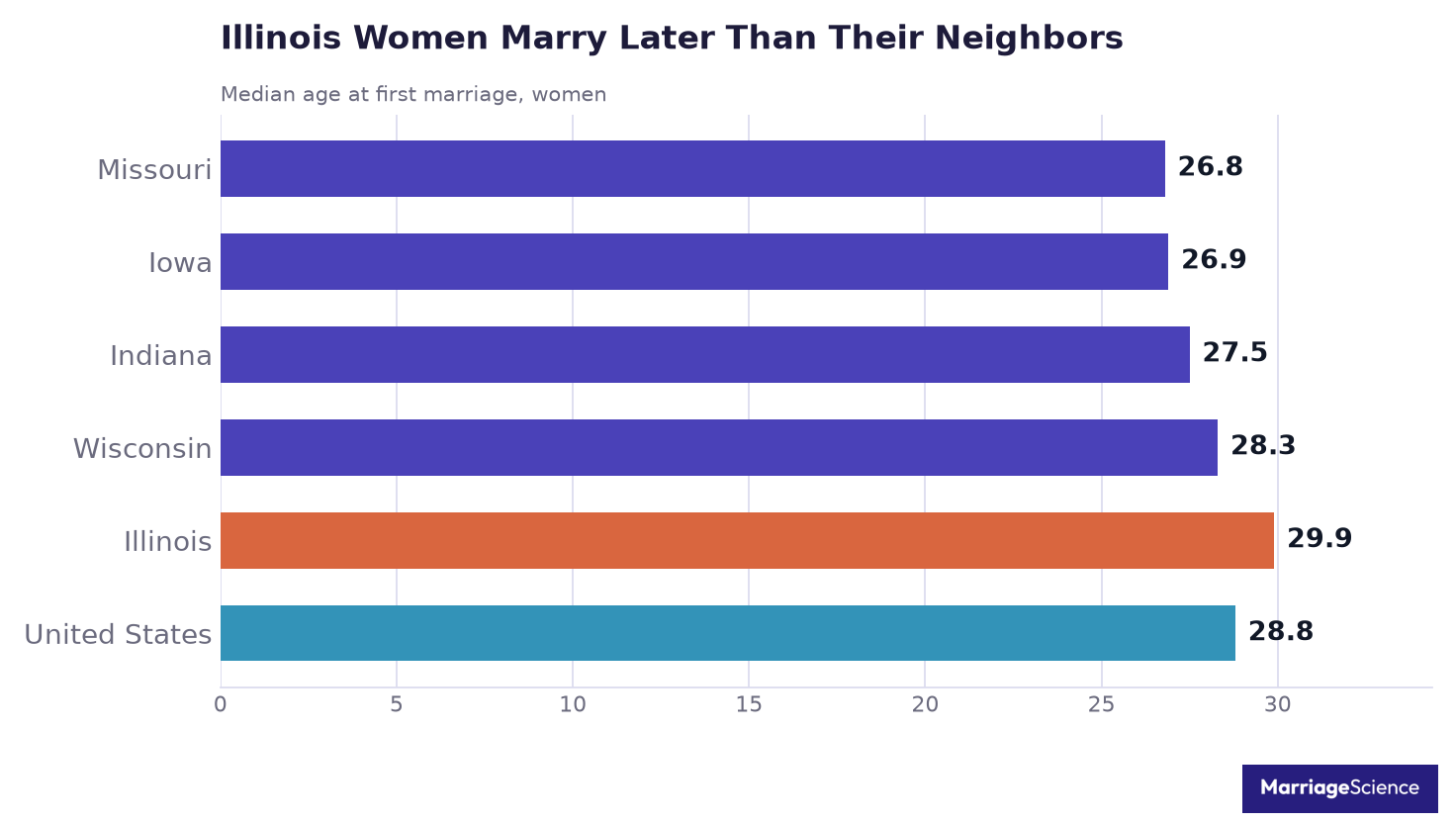
Women here have a median age at first marriage of 29.9, the 8th oldest among the states. Later first marriage can mean more premarital savings, retirement accounts, student debt or a home purchase before the wedding.
The married owner share is 85.9%, and the median home value is $280,700. With most married couples owning their home, an agreement can settle who owns the residence and how mortgage payments and equity are treated.
How Much Does a Prenup Cost in Illinois?
Prenup cost here depends on attorney time, drafting complexity and whether the couple uses an online platform. Clio reports a family law average of $341 per hour in the state, with lawyers overall typically charging $179 to $570 per hour.

As an illustration, eight hours of attorney time at $341 per hour is $2,728 per lawyer. That figure is only a time example, since actual bills depend on the work needed and the lawyer’s rate.
HelloPrenup lists pricing here at $599 per couple, with an attorney for each partner at $799 per partner, totaling $1,598. Its Attorney-Signed package is listed at $2,197, with e-notarization at $50 and attorney Q&A at $49.
Notarization is not required under the Premarital Agreement Act. Couples comparing attorney drafting with an online option can read our HelloPrenup review for platform details.
| Route | Cost | What you get |
|---|---|---|
| Online prenup | $599 per couple | Drafted for the Illinois Act, with a free consultation |
| Online prenup, attorney for each partner | $2,197 per couple | Illinois attorney review and signature on both sides |
| Single attorney add-on | $799 per partner | Counsel for one partner, added to the online agreement |
| Hourly family lawyer | $341 per hour | Average Illinois family law rate. Eight hours for each of two lawyers comes to $5,456, as an illustration |
Amending or Revoking the Agreement After Marriage
A prenup here can be changed after the wedding only by a written agreement signed by both parties. Under 750 ILCS 10/6, an amendment or revocation after marriage is enforceable without consideration.

The same written-signature discipline matters if the spouses want to replace premarital terms with a new marital agreement. State property law also recognizes property excluded by a valid premarital agreement or a postnuptial agreement.
Couples comparing the two can read our guide to prenups and postnups. If the marriage is void, 750 ILCS 10/8 enforces the agreement only to the extent necessary to avoid an inequitable result.
Six Steps to an Enforceable Illinois Prenup
Getting a prenup here starts with the statute’s writing and signature rules, then moves to disclosure, support terms and timing before the license window closes. The steps below keep the focus on enforceability under state law.
- List Separate PropertyIdentify property acquired before marriage, gifts, inheritances and assets acquired in exchange for premarital property. State law already treats those categories as non-marital when the statute applies.
- Gather Financial DisclosuresPrepare fair and reasonable information about property and financial obligations. The disclosure challenge looks at the content of what was disclosed before execution.
- Choose Property TermsDecide how earnings, debts, homes and future purchases will be classified. The Act allows rights in property whenever and wherever acquired.
- Draft Support LanguageUse explicit language if the agreement modifies or eliminates maintenance. Escamilla says a property waiver does not waive the right to seek maintenance.
- Review Before SigningBuild in time for review before the wedding. Turano Solano enforced an agreement where the husband had the draft for about three months and had an attorney.
- Sign Before MarriageBoth parties sign the written agreement before marriage. The agreement becomes effective upon marriage under the Act.
Illinois Prenup Questions and Answers
Illinois couples ask about timing, notaries, the marital home and older agreements. Each answer names the section of the Act or the appeals decision behind it.
When should you sign a prenup in Illinois?
Illinois has no fixed signing deadline before the wedding. Timing can still affect voluntariness, and in Turano Solano (2019) the husband had the draft for about three months and his own attorney before he signed, which helped the agreement hold.
Is notarization required for an Illinois prenup?
No. Section 3 of the Act asks only for a writing signed by both partners, with no notary or witnesses. A notarized signature can still help prove who signed and when.
Does Illinois count a house I owned before marriage as marital property?
A house owned before the wedding is non-marital under 750 ILCS 5/503(a), and so is a home bought later in exchange for it. A prenup can also settle how a residence bought during the marriage is owned.
Do prenups signed before 1990 follow the same Illinois rules?
No. The Act covers agreements executed on or after January 1, 1990. Older agreements are judged under earlier case law, which is how Kranzler (2018) reviewed a prenup signed in 1984.
Does a prenup protect you 100% in Illinois?
No. A court can still order maintenance despite a waiver to prevent undue hardship that was not reasonably foreseeable at signing, and a waiver that is not explicit may not cover maintenance at all (Escamilla, 2026). Child support can never be limited.
Indiana, Wisconsin and Missouri Compared
Indiana and Wisconsin border Illinois to the east and north, Missouri to the southwest. Wisconsin is a marital property state with its own agreement statute, so compare before either of you signs there.

Sources
The Illinois Compiled Statutes and four published appellate opinions supply the rules here. The figures come from the Census Bureau and Clio.
- Illinois Uniform Premarital Agreement Act, 750 ILCS 10 (Illinois General Assembly)
- 750 ILCS 5/503, disposition of property (Illinois General Assembly)
- 750 ILCS 5/504, maintenance (Illinois General Assembly)
- 750 ILCS 5/207, effective date of marriage license (Illinois General Assembly)
- In re Marriage of Amyette, Illinois Appellate Court (CourtListener)
- In re Marriage of Escamilla, Illinois Appellate Court (CourtListener)
- In re Marriage of Kranzler, Illinois Appellate Court (CourtListener)
- In re Marriage of Heinrich, Illinois Appellate Court (CourtListener)
- In re Marriage of Woodrum, Illinois Appellate Court (CourtListener)
- U.S. Census Bureau, American Community Survey 1-year estimates
- Clio Legal Trends, lawyer hourly rates in Illinois
- Marriage Science, Do Prenups Hold Up in Court? Appellate study
Not legal advice. This article is general information only. Prenup laws differ by state and change over time. Consult a licensed attorney in your state before acting on anything here.