


MCL 557.28 and Michigan’s Court-Made Prenup Rules
Michigan law recognizes written premarital property contracts through MCL 557.28, which says a contract relating to property made in contemplation of marriage remains in full force after marriage. The state has not adopted the Uniform Premarital Agreement Act, so Court of Appeals cases do much of the work.
MCL 566.132(1)(c), the statute of frauds, requires an agreement made upon consideration of marriage to be in writing and signed by the party to be charged. The table below separates those writing rules from the court-made defenses that can defeat enforcement.
Do Prenups Hold Up in Michigan?
Usually. The spouse attacking one carries the burden of proving fraud, duress, mistake or nondisclosure of a material fact, unconscionability at signing, or an unforeseeable change that makes enforcement unfair.
A Michigan prenup can be thrown out under the three grounds stated in Reed v. Reed and quoted in Allard. An antenuptial agreement may be voided when obtained through fraud, duress, mistake, or misrepresentation or nondisclosure of a material fact.
The second Reed ground is unconscionability when the agreement was executed. That asks about the agreement at signing, instead of judging it only by how it feels at divorce.
The third Reed ground applies when facts and circumstances have changed so much since execution that enforcement would be unfair and unreasonable. Woodington v. Shokoohi says the focus is whether the change was reasonably foreseeable before or during signing.
The party challenging validity carries the burden of proof and persuasion. That burden matters because courts begin by asking whether the challenger has proved one of the recognized grounds.
Allard shows how these defenses are applied. The Court of Appeals found no duress, no unconscionability, and no unforeseeable change of circumstances, but later held that the agreement could not remove the trial court’s power under MCL 552.23(1) and MCL 552.401.
Our review of 92 U.S. appellate prenup validity disputes from 2021 to 2025 found no appellate decision from the state on a prenup’s validity in that period. See the appellate prenup study for the national data.
- Michigan-licensed counsel for each partner
- $799 per lawyer on top of the $599 agreement
- Missing separate counsel weighed against the agreement in Allard

Allard, Skaates and Reed
Local prenup law is built from Court of Appeals decisions as much as from statutes. The cases below show the main fault lines, including wedding pressure, counsel, disclosure, unconscionability, and later changes in circumstances.
Allard is the case couples usually need to understand first because it enforced the agreement on validity grounds while preserving a judge’s limited power over separate property. Skaates then used the contrast with Allard to enforce a negotiated postnup.
Separate Property and the Allard Exception
Michigan is an equitable distribution state, so divorce does not start from an automatic 50/50 split. The court divides marital property under case law and related statutes using a just and reasonable standard.
MCL 552.19 says that, on divorce, the court may restore to either party the real and personal estate that came to them by reason of the marriage, as just and reasonable. That statute gives the judge discretion instead of a fixed percentage.
Separate property generally stays with its owner here. A prenup can identify separate property, describe how appreciation is treated, and set rules for property acquired during the marriage.
That separate-property rule has an important limit. MCL 552.23(1) allows a court to award part of the other party’s real and personal estate, and spousal support, if the estate awarded to either party is insufficient for suitable support of that party and any children in that party’s care.
MCL 552.401 adds another route into separate property. If one spouse contributed to the acquisition, improvement, or accumulation of the other spouse’s property, the court may award part of that property.
Allard v. Allard and Skaates v. Kayser matter because they keep that narrow judicial power alive even when spouses signed an agreement. A prenup here can set property rules, but it cannot take away the trial court’s equitable discretion under MCL 552.23(1) and MCL 552.401.
What Cannot Be in a Michigan Prenup?
A Michigan prenup cannot take away a judge’s power to reach separate property when a spouse needs support or helped build that property, under MCL 552.23(1) and 552.401. It also cannot survive fraud, duress, nondisclosure of a material fact, or unconscionability at signing.
A Michigan prenup can cover property, attorney fees, and spousal support because Allard treated attorney-fee and spousal-support provisions as contracts relating to property under MCL 557.28. That gives couples room to write financial rules before marriage.
Property terms can identify what each person owns before marriage and how later growth will be handled. They can also address assets acquired during the marriage, debts, and business interests if the agreement is in writing and signed.
Spousal-support terms are allowed here, but they operate against the background of MCL 552.23(1). A court may still award part of the other party’s estate and spousal support when the awarded estate is insufficient for suitable support of a party and any children in that party’s care.
The strongest limit is Allard’s separate-property holding. Parties cannot, by antenuptial agreement, deprive the trial court of its equitable discretion under MCL 552.23(1) and MCL 552.401.
State law has no specific rule on infidelity clauses, so conduct-based financial terms are judged by the general contract principles courts apply to antenuptial agreements.
Terms Michigan Allows
- Identify property owned before marriage
- State how appreciation of separate property will be treated
- Allocate responsibility for debts
- Address attorney-fee obligations between spouses
- Set spousal-support terms
- Classify property acquired during the marriage
Limits Allard Set
- Remove the court’s power under MCL 552.23(1) for suitable support
- Remove the court’s power under MCL 552.401 for contribution to property
- Defeat enforcement rules for fraud, duress, mistake, misrepresentation, nondisclosure, unconscionability, or unfair changed circumstances
Spousal Support Terms in Michigan
Spousal maintenance here is discretionary, and MCL 552.23(1) uses a just and reasonable standard. The court considers the ability of either party to pay, the character and situation of the parties, and all the circumstances.
The state has no statutory formula for spousal support. That makes the wording of a prenup more important when a couple wants a known support rule.
Allard held that agreements on spousal support are contracts relating to property under MCL 557.28. That means a premarital agreement can address support, including limits or waivers, subject to the state’s enforcement tests.
The same Allard line also limits support waivers. A prenup cannot deprive the trial court of its equitable discretion under MCL 552.23(1), including the power to award spousal support as just and reasonable when the statutory conditions are met.
Writing It Down: The Statute of Frauds
A Michigan prenup is valid when it meets the writing rule and survives the Court of Appeals tests for fairness, disclosure, and changed circumstances.

Writing and the Signature Rule
MCL 566.132(1)(c) makes an agreement made upon consideration of marriage void unless the agreement, or a note or memorandum of it, is in writing and signed by the party to be charged. The state’s prenup statute, MCL 557.28, then keeps a property contract made in contemplation of marriage in force after the wedding.
State law does not state a notary requirement for premarital agreements. In Allard, witnesses from the drafting attorney’s office signed the agreement, but the formal rule stated in the statute of frauds is writing and signature.

Separate Counsel in Michigan Cases
Separate lawyers are not a formal requirement for a prenup. Lawyer involvement still mattered in the cases, because courts looked at pressure, negotiation, and whether each spouse had a fair chance to understand the agreement.
Skaates enforced a post-wedding agreement after months of negotiation with separate independent counsel on both sides. The Court of Appeals contrasted Allard, where the wife saw the agreement shortly before the wedding, signed under wedding pressure, and had no separate counsel.
Wedding-Day Pressure
State law sets no deadline for signing a prenup before the wedding. Timing still matters because it can bear on duress, misrepresentation, and changed circumstances.
Allard involved a signing two days before the wedding, and the Court of Appeals held the agreement enforceable on the validity issues before it. The court’s analysis turned on the evidence about pressure and understanding.
Homeowners and Second Marriages in Michigan
Married couples here own their home more often than almost anywhere. The U.S. Census Bureau puts the share at 89.7%, the second highest among the states.

That home-ownership figure matters because a house can raise questions about title, mortgage payments, appreciation, and contributions during the marriage. A prenup can state whether a residence stays separate, becomes marital, or follows a buyout rule.
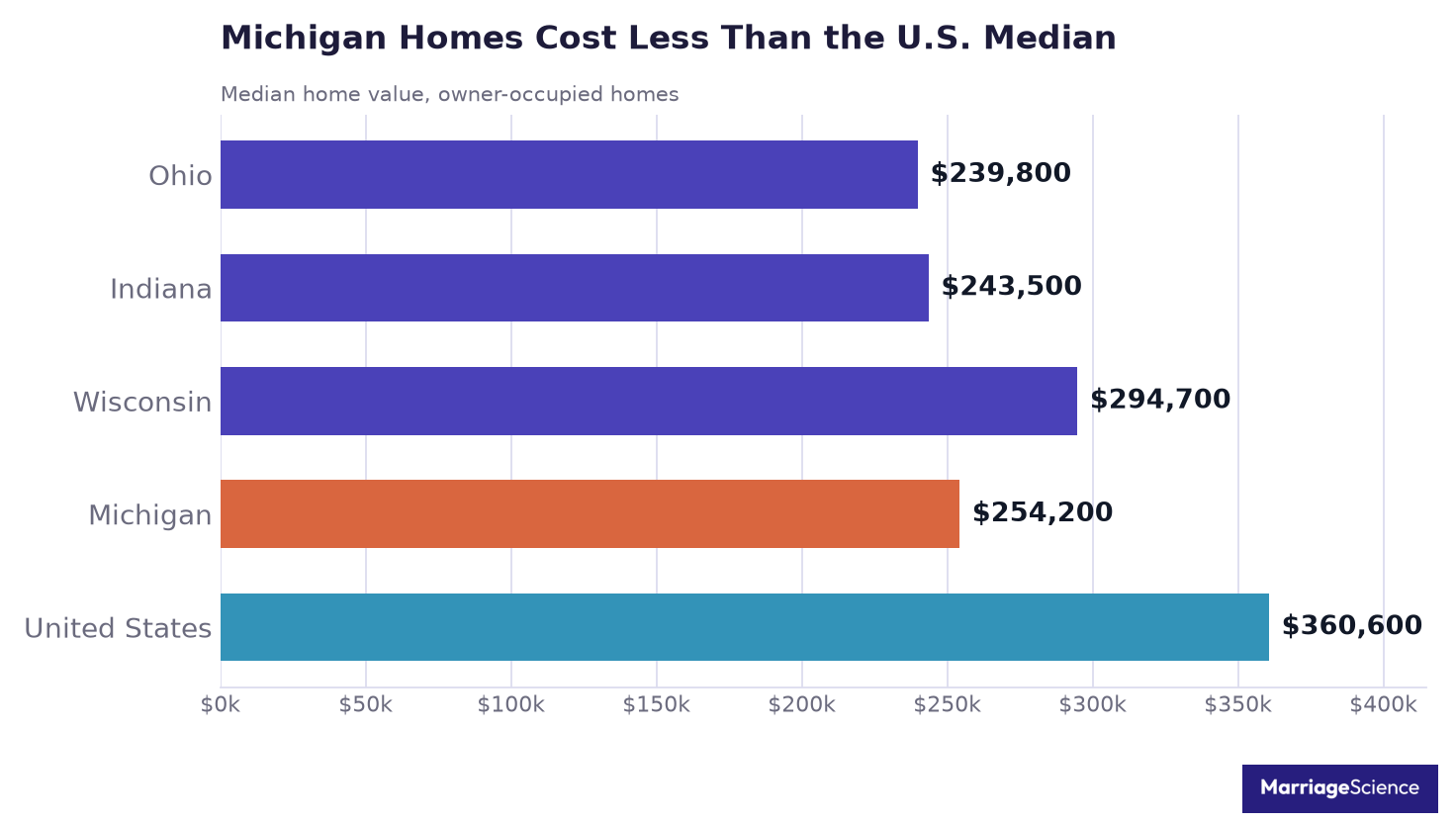
The median home value is $254,200, lower than the national median, but home equity can still be the largest asset in a divorce. That makes the treatment of equity growth a practical drafting issue for couples who already own property.
Of Michiganders who have ever married, 23.5% have married two or more times, the same as the national share. Remarriage can bring prior assets, children from an earlier relationship, and existing estate plans into the same property discussion.
Postnups After Skaates V. Kayser
Changing the financial rules after the wedding can be done through a postnuptial agreement when the facts support enforcement. Skaates v. Kayser enforced a postnup signed after the wedding following months of negotiation with separate independent counsel on both sides.

The Court of Appeals contrasted that process with Allard, where the wife saw the agreement shortly before the wedding, signed under wedding pressure, and had no separate counsel. That comparison makes negotiation, timing, and independent advice especially relevant for a post-wedding agreement.
Couples comparing premarital and post-wedding contracts can read more in our prenup vs postnup guide.
How Much Does a Prenup Cost in Michigan?
A Michigan prenup cost depends mainly on attorney time, the number of assets, and whether the couple uses an online platform with attorney review. Clio’s Legal Trends data lists family law in the state at an average of $306 per hour.

Eight lawyer hours at that rate, an example and no quote, total $2,448. That illustration is only a time-and-rate example, since a simple agreement and a contested negotiation use different amounts of work.
HelloPrenup lists pricing in the state at $599 per couple, with an attorney for each partner at $799 per partner, for $1,598. The Attorney-Signed package runs $2,197, and e-notarization and attorney Q&A cost $50 and $49.
The cost table below puts those prices beside the attorney-hour illustration. Couples comparing methods can also read our HelloPrenup review.
| Route | Cost | What you get |
|---|---|---|
| Online prenup | $599 per couple | Drafted for Michigan’s case-law test, with a free consultation |
| Online prenup, attorney for each partner | $2,197 per couple | Separate Michigan counsel, the setup that helped in Skaates |
| Single attorney add-on | $799 per partner | Michigan review for one of you |
| Hourly family lawyer | $306 per hour | Michigan family law average. Eight hours for each of two lawyers would add up to $4,896, as an illustration |
Steps to a Michigan Prenup That Holds
Getting a Michigan prenup starts with written property terms and enough time for review before the ceremony. The safest process matches the issues courts discuss, including disclosure, pressure, counsel, and changed circumstances.
- List Current PropertyEach partner should identify real estate, accounts, debts, business interests, and other property. Disputes here often turn on what was known and disclosed when the agreement was signed.
- Choose Property RulesDecide what will stay separate and what will become marital. Include how appreciation, mortgage payments, and contributions during marriage will be treated.
- Discuss Support TermsIf the agreement addresses spousal support, tie the language to the state’s discretionary support system. Allard allows support terms but preserves the court’s limited statutory power.
- Use Separate ReviewState law does not require separate lawyers, but Skaates treated separate independent counsel and months of negotiation as helpful facts. Separate review can reduce later claims of pressure or misunderstanding.
- Sign a Written AgreementThe statute of frauds requires a writing signed by the party to be charged. State law does not state a notary requirement for prenups.
- Keep Wedding Timing CleanThe state sets no fixed signing deadline. Signing after fair review is better evidence than presenting terms under wedding-day pressure.
Michigan Couples’ Prenup FAQ
Michigan couples ask about common law marriage, license timing, notaries and support. The answers cite the Michigan Compiled Laws and the cases above.
Are you considered married after 7 years in Michigan?
No. Michigan has not recognized new common law marriages since January 1, 1957. MCL 551.2 requires a license and solemnization, however long a couple lives together.
How long is a Michigan marriage license good for?
It cannot be delivered within 3 days including the application date unless the county clerk waives the wait for a fee, and it is void unless the marriage takes place within 33 days of applying, under MCL 551.103a.
Is notarization needed for a Michigan prenup?
No statute requires it. The statute of frauds asks for a writing signed by the party to be charged, and some couples add witnesses or a notary for proof.
Can a Michigan prenup limit spousal support?
Yes. Allard treated support terms as contracts relating to property under MCL 557.28, but the court keeps its power under MCL 552.23(1) to award support when a spouse’s share is not enough to live on.
Does a prenup protect you 100% in Michigan?
No. Even a valid Michigan prenup cannot stop a judge from reaching separate property under MCL 552.23(1) or 552.401, and it can still be voided for fraud, duress, nondisclosure or unforeseeable change.
Ohio, Indiana and Wisconsin Next Door
Ohio, Indiana and Wisconsin each handle prenups differently: Indiana uses the uniform act, Ohio its own case-law test, and Wisconsin a marital property statute. Read their guides if one of you lives in a neighboring state.

Sources
The Michigan Compiled Laws and Court of Appeals decisions in Allard, Skaates and Reed supply the rules. The figures come from the Census Bureau and Clio.
- MCL 557.28, contracts made in contemplation of marriage (Michigan Legislature)
- MCL 566.132, statute of frauds (Michigan Legislature)
- MCL 552.23, support and invasion of separate property (Michigan Legislature)
- MCL 552.401, contribution to the other spouse’s property (Michigan Legislature)
- MCL 551.103a, marriage license timing (Michigan Legislature)
- Allard v. Allard, Michigan Court of Appeals 2014 (CourtListener)
- Allard v. Allard (On Remand), Michigan Court of Appeals 2017 (CourtListener)
- Skaates v. Kayser, Michigan Court of Appeals (CourtListener)
- Reed v. Reed, Michigan Court of Appeals (CourtListener)
- U.S. Census Bureau, American Community Survey 1-year estimates
- Clio Legal Trends, lawyer hourly rates in Michigan
- Marriage Science, Do Prenups Hold Up in Court? Appellate study
Not legal advice. This article is general information only. Prenup laws differ by state and change over time. Consult a licensed attorney in your state before acting on anything here.