


Gross V. Gross and Ohio’s 2023 Postnup Law
The state has not adopted the Uniform Premarital Agreement Act, so prenups here come from Ohio Supreme Court case law. Gross v. Gross and Fletcher v. Fletcher control antenuptial agreements, while ordinary contract rules still matter.
R.C. 3103.06 and R.C. 3103.061, effective March 23, 2023, now allow spouses to sign postnuptial agreements and set Gross-style conditions for postnups and for modifying or ending an antenuptial agreement. The table below summarizes the main state rules.
What Makes a Prenup Valid in Ohio?
Three conditions from Gross v. Gross: it was signed freely without fraud, duress, coercion or overreaching, with full disclosure or full knowledge of the other’s property, and its terms do not encourage divorce or profiteering by divorce.
A prenup here gets thrown out when the Gross v. Gross test is not satisfied. The agreement is valid and enforceable only if entered into freely without fraud, duress, coercion or overreaching, with full disclosure or full knowledge and understanding of the nature, value and extent of the prospective spouse’s property, and with terms that do not promote or encourage divorce or profiteering by divorce.
These conditions sit on top of general contract law. Property terms are judged by the circumstances when the agreement was signed, while spousal support provisions receive an added conscionability review at the time of divorce or separation.
The burden can depend on the issue being litigated. In Maloney, the wife claimed duress and overreaching and the court held she had not proved them, while in Fordeley the court held the husband did not meet his burden of full disclosure about the nature, value and extent of his businesses and property.
Courts look at the signing setting in concrete terms. Timing, who prepared the document, whether the other partner had seen it before signing, whether a wedding would go forward without it, and the presence or absence of asset information can all affect the result.
The cases also show that disclosure is more than naming an asset in passing. Fordeley voided the agreement because the court found the husband had not made full disclosure of his businesses and property.
In our review of appellate prenup disputes, courts of appeals in the state decided 9 of 92 validity disputes from 2021 to 2025, among the most of any state in the study. The outcomes included 5 enforced in full, 3 invalidated in full and 1 partly enforced.
- An Ohio-licensed lawyer for each partner
- $799 per partner on top of the $599 agreement
- The opposite of Hubbard, where the drafter had been the wife’s own attorney

Hubbard, Fordeley, Maloney and Menkhaus
Prenup cases here tend to turn on timing, disclosure and overreaching. The cases below include agreements enforced after long marriages and agreements voided because the signing process or property disclosure failed the Gross test.
Maloney shows that a seven-week signing window and an attached asset list can support enforcement. Hubbard and Fordeley show the other side of the rule, where last-day pressure, a prior attorney relationship or incomplete disclosure can defeat the agreement.
Signing Day: Timing, Disclosure and Who Drafted It
A prenup here is valid when it meets the Gross v. Gross conditions on top of ordinary contract law. The agreement must be free of fraud, duress, coercion or overreaching, must rest on full disclosure or full knowledge, and must avoid terms that promote divorce or profiteering by divorce.

A Written Agreement and a Clear Record
Case law expects a written, signed antenuptial agreement. No Ohio statute requires a notary for a prenup, although Maloney involved a signing before a witness and notary at a bank.
The better legal question here is usually what the signing record shows. Asset lists, disclosure statements and signed schedules can matter more than a stamp when a court later reviews disclosure and overreaching.

Lawyers and the Hubbard Problem
State law does not state that each partner has to have a lawyer for a prenup to be valid. Courts still examine whether the agreement was entered into freely and whether each side had full disclosure or full knowledge of the other’s property.
The Hubbard case shows why the relationship between the drafter and the other partner can matter. The husband prepared the agreement, had previously been the wife’s attorney, and the court affirmed invalidation for overreaching.
Why Seven Weeks Beat One Day
Courts look closely at last-minute signing. Fletcher discussed an agreement presented on the eve of the wedding, and later appellate cases continue to treat timing as part of the overreaching analysis.
Maloney enforced an agreement signed seven weeks before a small wedding with an asset list attached. Hubbard voided an agreement signed the day before the wedding when the wife first saw it that day and the wedding would not have gone ahead without it.
Does My Wife Get Half of Everything in a Divorce in Ohio?
Of the marital property, Ohio starts from an equal split for either spouse. Separate property, such as assets owned before the wedding and inheritances, stays out of that split, and a court can move away from equal when an equal split would be inequitable.
The state is an equitable division state with an equal-split starting point. R.C. 3105.171(C)(1) says marital property shall be divided equally unless an equal division would be inequitable, then the court divides it equitably after considering factors.
That rule does not mean every divorce ends with each spouse receiving the same property item or the same account. It means equality is the starting point for marital property, and the court can depart from it when equal division would be inequitable.
R.C. 3105.171(C)(2) also says each spouse is considered to have contributed equally to producing and acquiring marital property. That presumption matters when one spouse earned more income and the other contributed in different ways during the marriage.
Separate property is treated differently. R.C. 3105.171(A)(6)(a) includes property acquired before marriage, an inheritance during the marriage, passive income and appreciation from separate property, and gifts proven by clear and convincing evidence to be to one spouse only.
Separate property can also include personal injury compensation, except for lost marital earnings, and property excluded by a valid antenuptial or postnuptial agreement. A prenup can identify what each partner brings into the marriage and say how future appreciation or income from that property will be treated.
Commingling alone does not destroy separate property under R.C. 3105.171(A)(6)(b), but the property has to remain traceable. That is where a prenup, account records, schedules and clear titling can reduce later disputes over what is marital and what is separate.
Spousal Support and the Conscionability Check
Courts decide spousal maintenance under R.C. 3105.18(C)(1), and there is no formula. The court considers income from all sources, relative earning abilities, ages and health, retirement benefits, duration of the marriage, custodial duties, standard of living, education, assets and liabilities, contributions to the other’s education or earning ability, and time needed for education or training.
Property division comes first. R.C. 3105.171(C)(3) says property is divided before any spousal support award, so the support analysis happens after the court has addressed marital and separate property.
A prenup can limit or waive spousal support here. Menkhaus enforced a spousal support waiver and the treatment of the husband’s businesses as separate property.
Spousal support terms receive extra review under Gross. Even when the property provisions are judged as of signing, maintenance provisions are reviewed for conscionability at the time of divorce or separation.
That later review is specific to support. That is why property clauses and maintenance clauses are worth drafting separately, with each partner’s disclosures attached.
Property and Support Terms Ohio Courts Uphold
A prenup can change how property is classified and divided if the agreement satisfies Gross. R.C. 3105.171(A)(6)(a) also recognizes property excluded by a valid antenuptial or postnuptial agreement as separate property.
That means a couple can identify premarital property, businesses, passive appreciation, inheritances and gifts, then state how those items will be handled if the marriage ends. Clear schedules matter because separate-property rules still depend on tracing when assets are commingled.
A prenup can also address spousal support, including limits or waivers, as Menkhaus enforced. Gross adds a further review for spousal support provisions, so the court looks at conscionability at the time of divorce or separation.
The content limit here is direct. The terms cannot promote or encourage divorce or profiteering by divorce, and the agreement cannot rest on fraud, duress, coercion, overreaching or inadequate disclosure.
The state has no specific rule on infidelity clauses, so conduct-based terms are measured against the Gross limits on encouraging divorce and profiteering by divorce.
Terms That Have Held in Ohio
- Mark premarital assets as separate
- Exclude identified property from the marital estate
- Address businesses owned before or during the marriage
- State how passive income and appreciation will be treated
- Protect inheritances and gifts intended for one spouse
- Limit or waive spousal support, subject to later conscionability review
Terms Gross Rules Out
- Use terms that promote or encourage divorce
- Use terms that create profiteering by divorce
- Rely on fraud, duress, coercion or overreaching
- Count on a spousal support term that is unconscionable at divorce or separation
Remarriage and Homeownership in Ohio
Of residents who have ever married, 25.0% have married two or more times, according to the Census Bureau, against 23.5% nationally.

Remarriage can bring prior obligations, adult children, separate homes or retirement accounts into the planning discussion.
Home ownership is another local reason to write things down. The Census Bureau reports that 87.2 percent of married-couple households in the state own their homes, one of the higher shares among the states, so a residence may be the largest asset in the relationship.
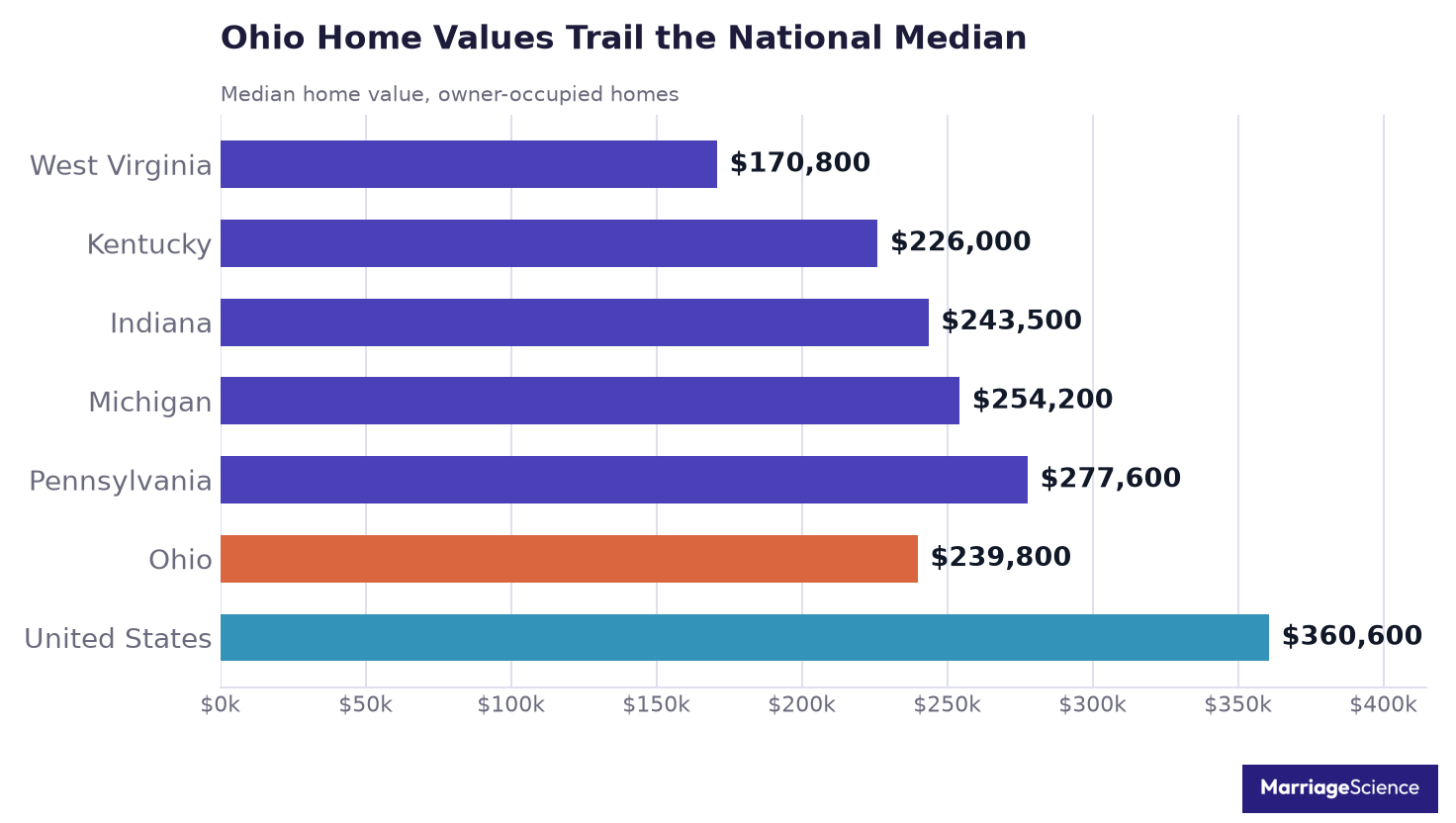
The median home value is $239,800, well below the national median, yet a home can still carry equity, debt, family contributions and premarital funds that need tracing if the marriage ends.
Postnups Under R.C. 3103.061
Spouses can change the legal effect of a prenup after marriage under R.C. 3103.061. The statute applies to an agreement altering legal relations between spouses, including a postnup and a modification or termination of an antenuptial agreement.

R.C. 3103.061 says the agreement is valid and enforceable, with or without consideration, if it is in writing and signed by both spouses. It also must be entered into freely without fraud, duress, coercion or overreaching, with full disclosure or full knowledge and understanding of both spouses’ property, and terms that do not promote divorce or profiteering by divorce.
For a comparison of timing and use cases, see our guide to prenups and postnups.
How Much Does a Prenup Cost in Ohio?
Prenup cost here depends on attorney time, whether the couple uses an online platform, and whether each partner adds legal advice. Clio Legal Trends lists the family law average in the state at $233 per hour.

As an illustration, 8 hours of attorney time at $233 per hour is $1,864 per lawyer. That is only a time example, since drafting, review, negotiations and revisions can vary by the agreement.
The flat online price from HelloPrenup is $599 per couple. The attorney option is $799 per partner, or $1,598 for two attorneys, and the Attorney-Signed package is $2,197.
The platform also lists e-notarization at $50 and attorney Q&A at $49. A notary is not required by prenup law here, so that add-on is optional.
| Route | Cost | What you get |
|---|---|---|
| Online prenup | $599 per couple | An Ohio agreement with attached disclosure schedules and a free consultation |
| Online prenup, attorney for each partner | $2,197 per couple | Ohio counsel on both sides, the opposite of the Hubbard setup |
| Single attorney add-on | $799 per partner | A lawyer for one partner, often the one waiving support |
| Hourly family lawyer | $233 per hour | Average Ohio family law rate. Two lawyers at eight hours apiece would run $3,728, as an illustration |
Building an Ohio Prenup That Passes Gross
A prenup process here should create a record that answers the Gross questions before anyone is in a last-minute signing setting. The steps below focus on disclosure, time and signed writing.
- Start the Asset ListList premarital property, businesses, accounts, debts, inheritances and expected gifts. Include values where available so the disclosure record is specific.
- Choose the Property TermsDecide what stays separate and what becomes marital. Address passive appreciation and income from separate property if those issues matter.
- Discuss Spousal SupportDecide whether the agreement will limit, waive or leave maintenance to Ohio law. Remember that support terms receive conscionability review at divorce or separation.
- Exchange Full DisclosureShare enough information for full disclosure or full knowledge and understanding of the nature, value and extent of each partner’s property. Attach disclosure statements or schedules to the agreement.
- Leave Signing TimeAvoid a last-day signing. Courts look hard at timing, especially when one partner first sees the agreement right before the wedding.
- Sign the Written AgreementCase law expects a written, signed prenup. A notary is optional under prenup law here, although some couples use one for the signing record.
Ohio Prenup Answers
Ohio couples ask about notaries, enforceability, later changes and support waivers. The answers rely on Gross, the Revised Code and the recent appeals above.
Does a notary need to sign an Ohio prenup?
No Ohio statute requires a notary for a prenup. Ohio case law expects a written, signed agreement, and some couples still use a witness or notary to document the signing.
Is a prenup enforceable in Ohio?
Yes, when it satisfies Gross v. Gross and ordinary contract law. Ohio’s appeals courts enforced five of nine prenups in full in our 2021 to 2025 study and threw out three.
Can we change a prenup after marriage in Ohio?
Yes. Since March 2023, R.C. 3103.061 lets spouses modify or end an antenuptial agreement in a signed writing that meets the statute’s freedom, disclosure and divorce-profiteering conditions.
Can an Ohio prenup waive spousal support?
Yes. Menkhaus enforced a support waiver, but Gross adds a later review, so a court checks whether the support terms are unconscionable at the time of divorce or separation.
Does a prenup protect you 100% in Ohio?
No. A support waiver can still be set aside if it is unconscionable at divorce, and the whole agreement fails if it was signed under overreaching or without full disclosure, as in Hubbard and Fordeley.
Pennsylvania, Michigan and Kentucky Compared
Pennsylvania, Michigan and Kentucky never adopted the uniform act either, but each built its own test. Compare them if either of you lives across the line.

Sources
The Ohio Revised Code, the Ohio Supreme Court’s Gross decision and recent courts of appeals rulings supply the rules. Census and Clio supply the numbers.
- R.C. 3103.06 and 3103.061, agreements between spouses (Ohio Laws)
- R.C. 3105.171, division of marital and separate property (Ohio Laws)
- R.C. 3105.18, spousal support (Ohio Laws)
- Hubbard v. Hubbard, Ohio Court of Appeals (CourtListener)
- Fordeley v. Fordeley, Ohio Court of Appeals (CourtListener)
- Maloney v. Maloney, Ohio Court of Appeals (CourtListener)
- Menkhaus v. Menkhaus, Ohio Court of Appeals (CourtListener)
- U.S. Census Bureau, American Community Survey 1-year estimates
- Clio Legal Trends, lawyer hourly rates in Ohio
- Marriage Science, Do Prenups Hold Up in Court? Appellate study
Not legal advice. This article is general information only. Prenup laws differ by state and change over time. Consult a licensed attorney in your state before acting on anything here.