Home / Breakup Recovery
Breakup Recovery: Guides, Tools and Support

This page brings together Marriage Science’s breakup guides, quizzes and tools, as well as the research behind them. If you’re hurting, start with the question that feels closest to what you’re experiencing right now.
Rhoades, Kamp Dush, Atkins, Stanley and Markman (2011) found that 36.5% of 1,295 unmarried young adults experienced a breakup over a 20-month period. Breakups are common, but that doesn’t make your own experience or the time you need to heal any less personal.
Start Here: How Breakups Actually Heal
In a 2008 study, Eastwick, Finkel, Krishnamurti and Loewenstein followed first-year college students as they dealt with relationship breakups. The participants expected to feel more distress than they ultimately reported. The researchers measured their distress at 0, 2, 6 and 10 weeks and found that it decreased over time.

How to Get Over a Breakup
A first guide for the early days, mixed feelings and what to do next.
Read More about How to Get Over a Breakup
What tracked studies say about time, distress and why averages can mislead.

The No Contact Rule
No verified study has shown that a 30, 60 or 90-day no-contact rule works. However, Sbarra and Emery (2005) found that staying in touch with a former partner slowed the decline of feelings of love and sadness.

The No Contact Rule
What it means, how people use it and what contact studies can actually tell us.
Read More about The No Contact Rule

How Long Should No Contact Last?
How to choose a break length without treating a day count like science.
Read More about How Long Should No Contact Last?

Signs No Contact Is Working
What progress can look like after you stop checking, chasing or reopening the wound.
Read More about Signs No Contact Is Working

The Male and Female Mind During No Contact
What gender studies do and do not say about breakup pain.
Read More about The Male and Female Mind During No Contact

Breaking No Contact: Should You Text Your Ex?
A steadier way to decide before sending the message.
Read More about Breaking No Contact: Should You Text Your Ex?

Hoovering
How the popular term is used, and why it is different from a diagnosis.
Read More about Hoovering
Getting Over Someone
Verhallen, Alonso-Martínez, Renken, Marsman and ter Horst (2022) followed 87 adults for 30 weeks after a breakup. They identified four recovery patterns. About 44% of participants fell into a resilience group, while 9% belonged to a chronic-distress group.

How to Get Over Someone You Love
Help with attachment, longing and the slow return of your own life.
Read More about How to Get Over Someone You Love

How to Get Over Someone You Never Dated
For situationships, crushes and unreturned love that still hurt.
Read More about How to Get Over Someone You Never Dated

How to Stop Thinking About Someone
Why forced suppression can backfire, and what to try instead.
Read More about How to Stop Thinking About Someone

Why Do I Miss My Ex?
Why missing someone can keep returning after the decision is clear.
Read More about Why Do I Miss My Ex?

Why Do I Keep Dreaming About My Ex?
What dream studies can say, and why dreams do not prove your ex wants you back.
Read More about Why Do I Keep Dreaming About My Ex?

The Stages of a Breakup
Where the five stages came from and why breakup grief rarely follows a neat script.
Read More about The Stages of a Breakup

Rebound Relationships
What rebound studies say about dating again, longing and emotional readiness.
Read More about Rebound Relationships

Can You Be Friends with Your Ex?
How motives, boundaries and unresolved desire shape post-breakup friendship.
Read More about Can You Be Friends with Your Ex?
Limerence
Psychologist Dorothy Tennov introduced the term limerence in 1979 to describe an involuntary, obsessive longing for another person. In 2026, Evans and colleagues studied 1,647 people experiencing impairing limerence, making it the largest study of its kind so far. Even so, limerence is not currently a diagnosis.

What Is Limerence?
The meaning of the word, where it came from and what research says about it.
Read More about What Is Limerence?

Limerence vs Love
Eight ways an anxious longing differs from a love that can settle.
Read More about Limerence vs Love

Limerence vs Crush vs Infatuation
How the three compare on intensity, focus and how much control you keep.
Read More about Limerence vs Crush vs Infatuation

Signs of Limerence
The twelve features Dorothy Tennov described, each with an everyday example.
Read More about Signs of Limerence

What Causes Limerence?
Uncertainty, the reward system, attachment and timing, and what is still unproven.
Read More about What Causes Limerence?

The Stages of Limerence
From the first spark through crystallization to how an episode resolves.
Read More about The Stages of Limerence

Can Limerence Turn Into Love?
When the feelings are mutual, what usually fades and what can grow.
Read More about Can Limerence Turn Into Love?

Autistic Limerence
What the phrase describes, how it meets special interests and where to find support.
Read More about Autistic Limerence

Limerence and ADHD
Hyperfocus, rejection sensitivity and what the thin research does and does not show.
Read More about Limerence and ADHD

Limerence and OCD
How limerence differs from relationship OCD, and when to see a specialist.
Read More about Limerence and OCD

Limerence and BPD
The favorite person experience, fear of abandonment and getting support.
Read More about Limerence and BPD

Limerence in Marriage
When it is someone else, or when the early intensity with your spouse fades.
Read More about Limerence in Marriage

Books on Limerence
Tennov's classic, newer psychology books and novels about obsessive love.
Read More about Books on Limerence
Thinking About Getting Back Together
In 2013, Halpern-Meekin, Manning, Giordano and Longmore studied 792 daters and people living with a partner, all between the ages of 17 and 24, in one Ohio county. Nearly half had broken up with their current or most recent partner and later reconciled.

Will My Ex Come Back?
What reconciliation studies can and cannot predict about your ex.
Read More about Will My Ex Come Back?

How to Get Your Ex Back
A guide that starts with repair, accountability and consent.
Read More about How to Get Your Ex Back

Should I Get Back with My Ex? Quiz
A reflection tool for patterns, safety, regret and real change.
Read More about Should I Get Back with My Ex? Quiz
Before You Break Up
Doherty, Harris and Wilde (2016) described discernment counseling, an approach for couples who feel differently about whether to continue their relationship. One partner may be leaning toward leaving, while the other wants to stay. A Northwestern Family Institute summary reported that 47% chose reconciliation, 41% chose separation or divorce, and 12% remained undecided.

Questions for sorting doubt, safety, effort and repeated problems.

How to end a relationship with care, clarity and firm boundaries.
Free Tools
Heartstreak is a no-contact app designed to support people in the weeks following a breakup. This section includes its tracker, one recovery quiz and the two quizzes mentioned above.

No Contact Tracker
Track your streak, urges and contact patterns without turning recovery into a game.
Read More about No Contact Tracker

Am I Over My Ex? Quiz
A quick check on longing, rumination, acceptance and daily functioning.
Read More about Am I Over My Ex? Quiz
Free no contact tracker
Count Your Days Without Them
- A day counter that starts from your last contact
- Milestones from day 1 to day 90
- An SOS button in the Heartstreak app for the moment you want to text
When to Get Professional Help
Kendler, Hettema, Butera, Gardner and Prescott (2003) found that being left by a partner can involve both humiliation and loss. Together, these experiences predicted depression more strongly than events involving loss alone.
If you think you might hurt yourself, call or text 988, or visit 988lifeline.org to use the chat service. If you’re in immediate, life-threatening danger, call 911.

What breakup anxiety can feel like, and when extra help makes sense.

Therapy After a Breakup
How therapy can help after heartbreak, separation or divorce.
Read More about Therapy After a Breakup
Talk it through
Weekly Sessions With a Matched Expert
OurRitual has an Individual plan: one 40-minute video session a week with a matched Expert, plus exercises between sessions. It is relationship coaching and is not covered by insurance.
$54a week on the 24-week Individual plan
See OurRitual Plans
Breakup Research
Marriage Science’s analysis of the Stanford How Couples Meet and Stay Together panel found that 14.9% of couples who were together in 2017 had separated by 2020. The findings varied by relationship type: dating couples were more likely to break up than married couples.
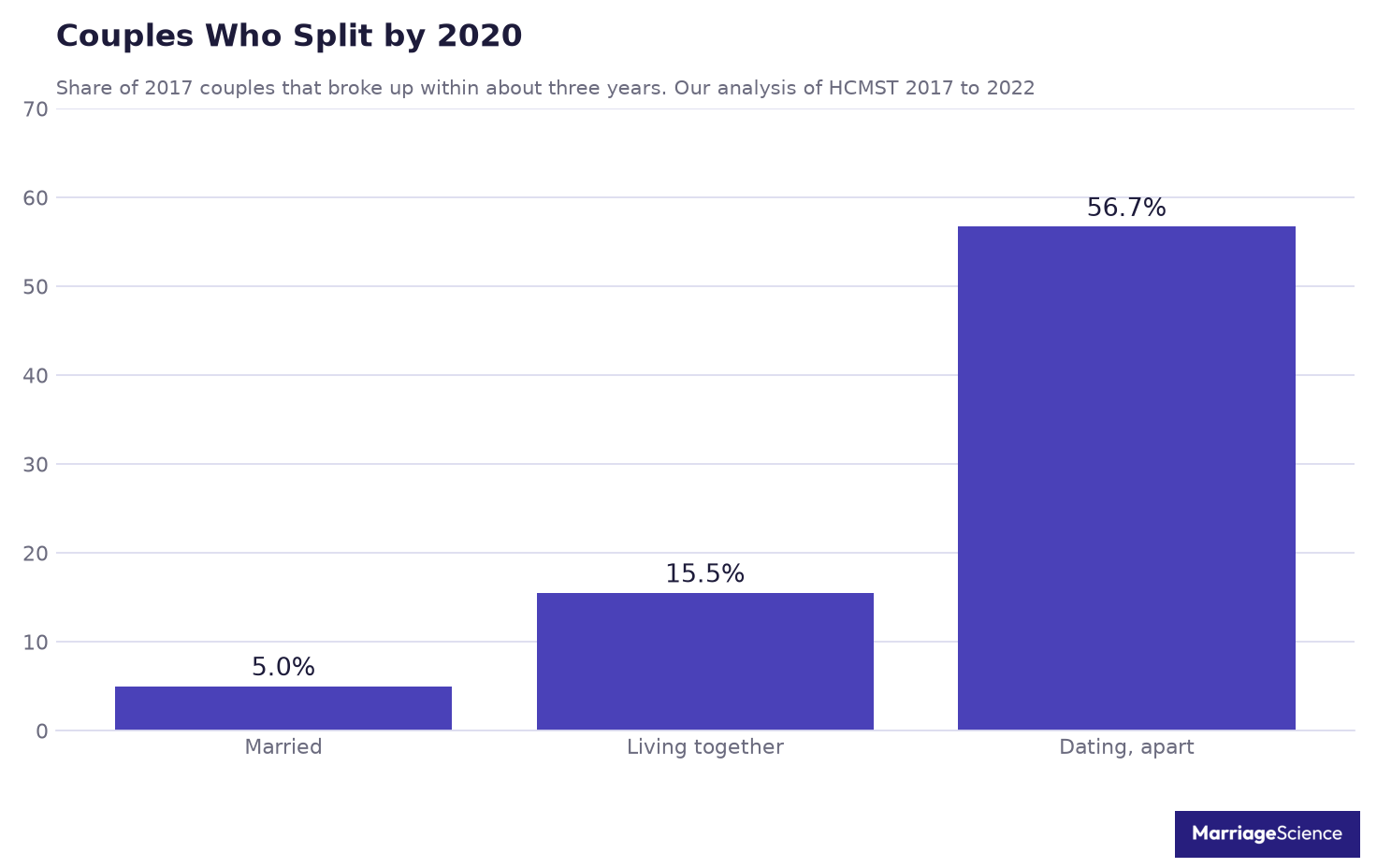
A source-led roundup of breakup rates, getting back together and recovery findings.