

Short answer: no study has measured a single recovery time for getting over a breakup. The studies that followed people after a breakup found distress falling within weeks to a few months for most, while a large minority hardly changed at all.
That is why the familiar timelines are shaky. They are often repeated as if they are direct measures of healing, but their origins are different.
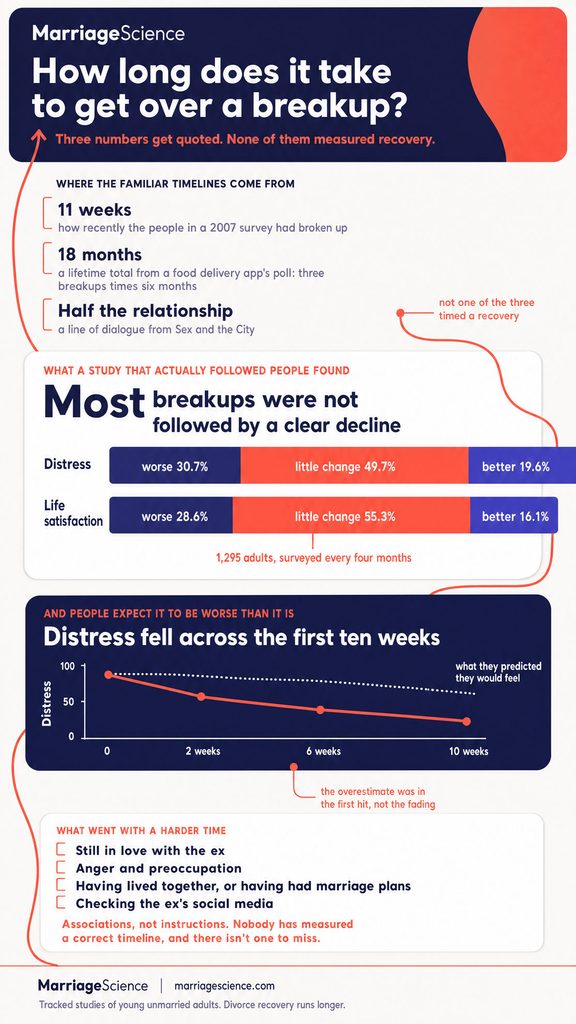
The “11 weeks” figure describes how recently the people in a 2007 one-time survey had broken up. The “18 months” figure is a lifetime total from a marketing poll for a food delivery app: three breakups times six months.
“Half the length of the relationship” is usually credited to a line in Sex and the City.
The best tracked evidence comes from Rhoades and colleagues, 2011. In a study of 1,295 unmarried adults surveyed every four months, 43.4% of breakups were followed by a clear drop in well-being, and in 36% of breakups the person was already dating someone new by the next survey.
This page separates the slogans from the measurements. It covers where each popular timeline comes from, what the follow-up studies measured, who recovers faster, and what slows it down.
Key Statistics on Getting Over a Breakup
Each figure below names the source that measured it. The list mixes research that followed people over time with one-time surveys and marketing polls, and each item says what kind of evidence it came from.
- 36.5% of 1,295 unmarried U.S. adults aged 18 to 35 went through at least one breakup in 20 months, according to Rhoades and colleagues in the Journal of Family Psychology, 2011.
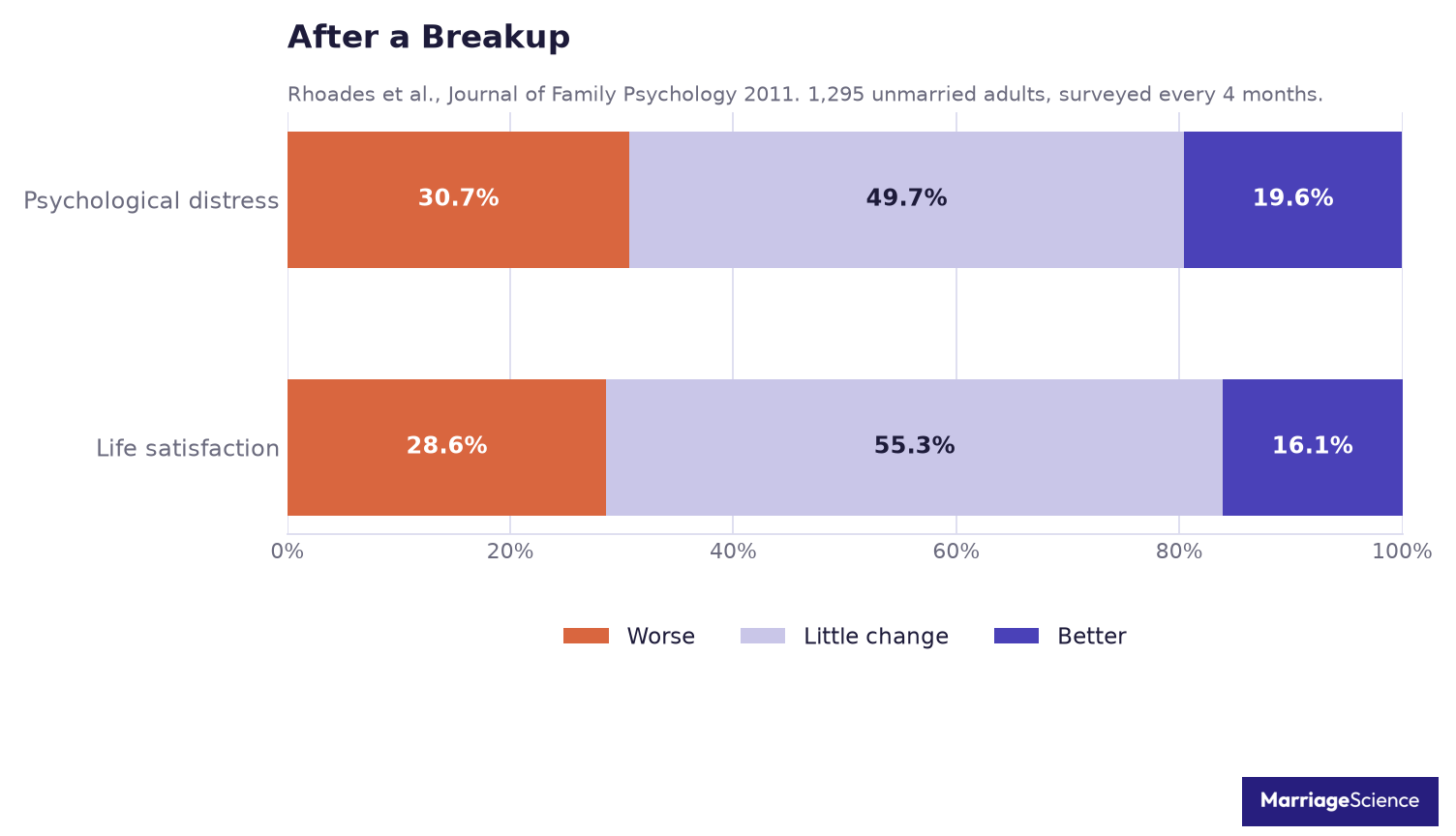
- After a breakup in the same study, 30.7% had a clear rise in psychological distress, 49.7% had little change, and 19.6% had a fall.
- Life satisfaction fell clearly in 28.6% of breakups and rose in 16.1% in the same Rhoades and colleagues study.
- In 36% of breakups, the person was dating someone new by the next survey, at most four months later.
- Students who broke up predicted more distress than they felt across the 3 months that followed, in Eastwick and colleagues, 2008, which tracked 26 breakups every two weeks.
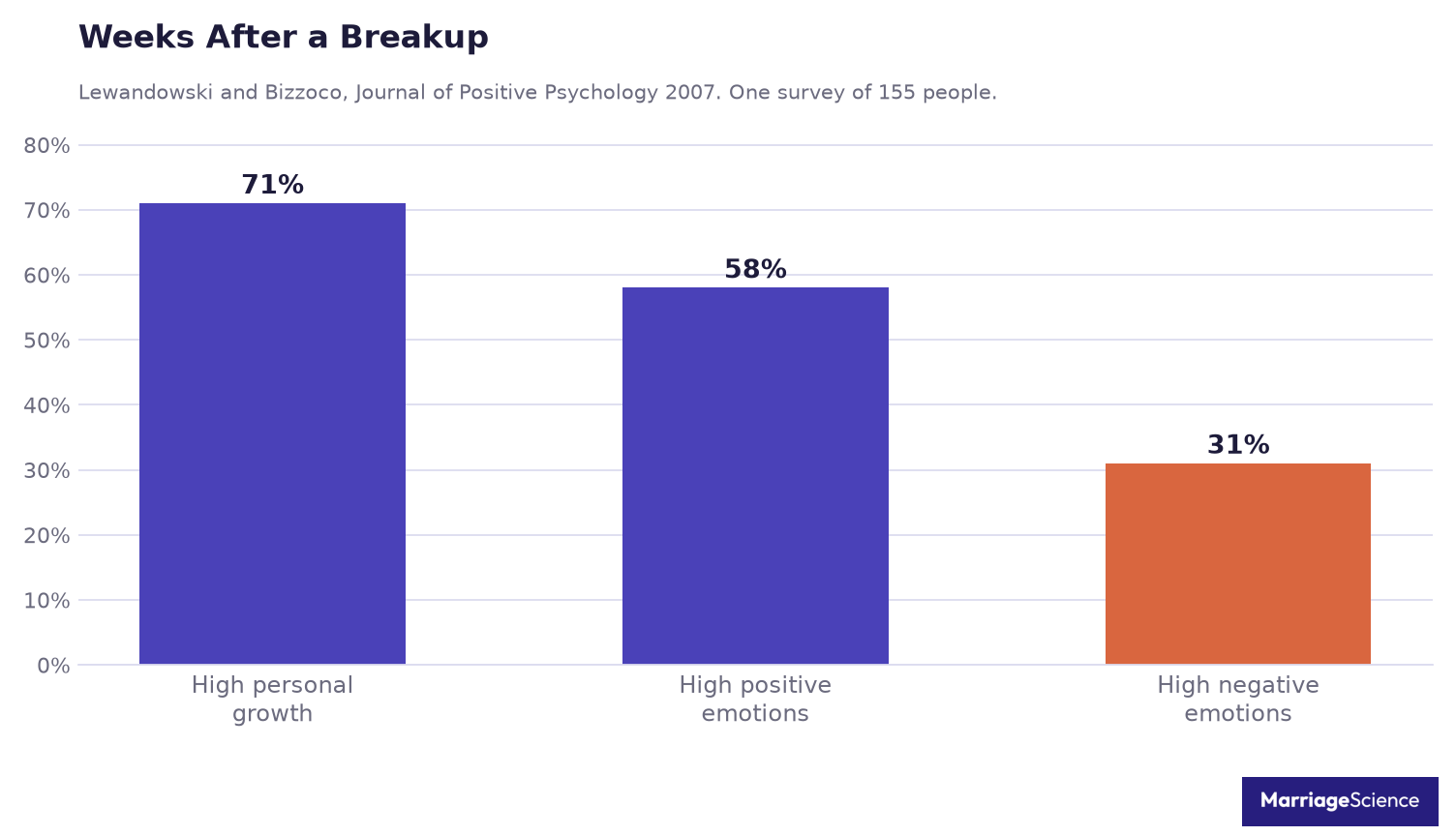
- 71% of 155 young adults surveyed weeks after a breakup reported high personal growth, and 31% reported high negative emotion, in Lewandowski and Bizzoco, 2007, a one-time survey.
- The 11 weeks in news coverage of the Lewandowski and Bizzoco study describes how recent the breakups were, instead of a recovery time.
- The 18 months figure is three breakups times six months, from a 2,000-person OnePoll survey for the food delivery app Yelp Eat24.
- The same OnePoll survey put the time to stop crying at about six weeks and the time to date someone new at 13.5 weeks.
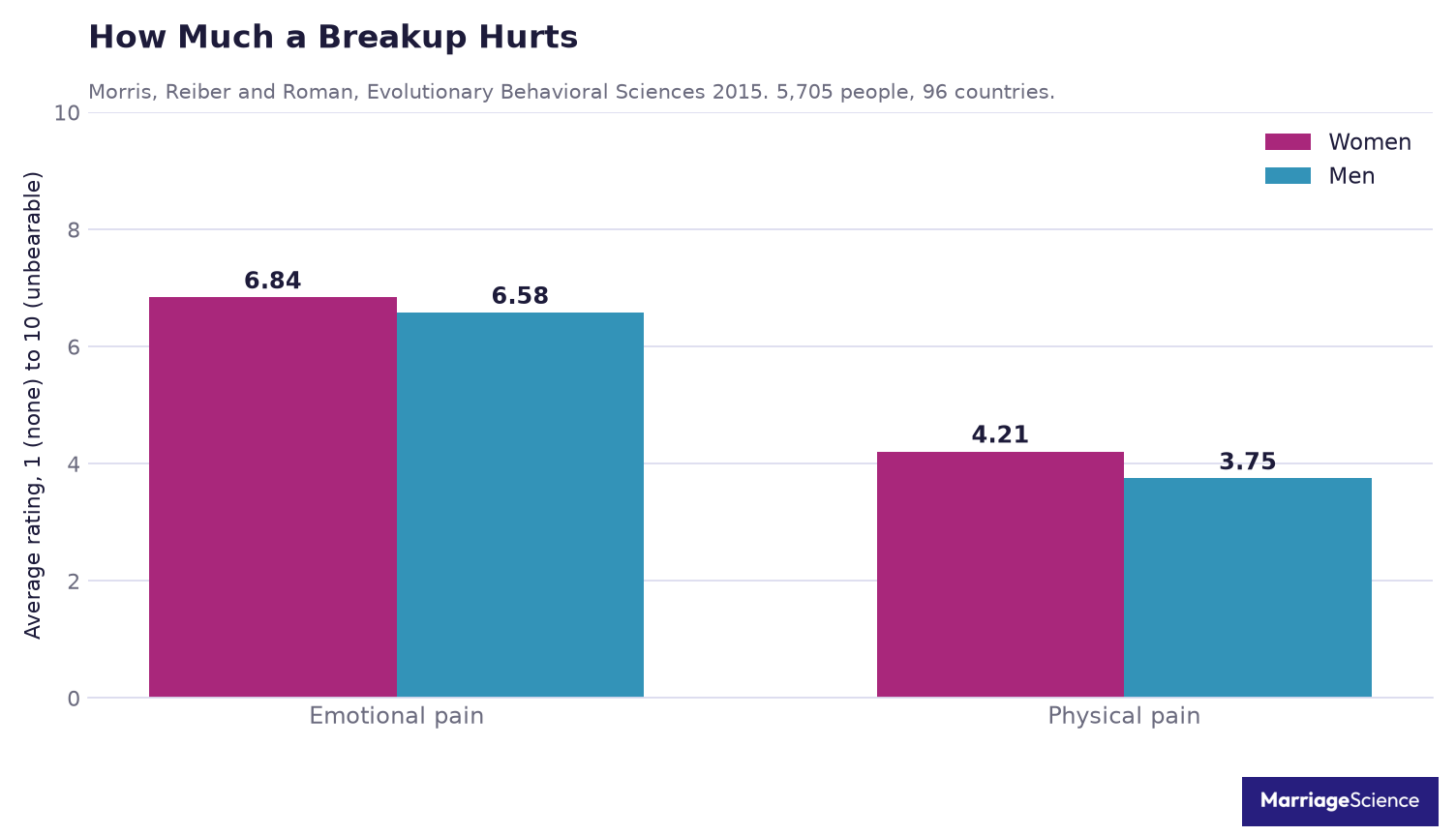
- Women rated a breakup’s emotional pain 6.84 out of 10 and men rated it 6.58, in a survey of 5,705 people in 96 countries by Morris and colleagues, 2015.
- For physical pain in the same survey, women reported 4.21 and men reported 3.75.
- Checking an ex’s Facebook was linked to more distress and less personal growth in a study of 464 people by Marshall, 2012.
- After divorce, life satisfaction recovered gradually but did not fully return to its earlier level, in 18 years of German panel data on more than 30,000 people in Lucas, 2005.
Is There an Average Time to Get Over a Breakup
No study has published an average breakup recovery time in weeks or months. That is partly a measurement problem.
Recovery would need a clear end point, and researchers usually measure moods, distress and life satisfaction at set intervals instead.
The closest evidence comes from Eastwick, Finkel, Krishnamurti and Loewenstein in the Journal of Experimental Social Psychology, 2008. They followed 69 first-year students who were in relationships of at least two months, using surveys every two weeks.
In that group, 26 broke up within six months.
After the breakup, distress was measured at 0, 2, 6 and 10 weeks. Distress fell over that period.
Before the breakup, the students had predicted that they would feel more distressed than they later reported across the whole 3 months.
The forecasting error was concentrated in the first reaction. Students guessed that the initial hit would be bigger than it was.
Their guesses about the rate of fading were about right.
The largest overestimates came from students who were more in love, students who thought a new relationship was unlikely, and students who did not start the breakup. That does not mean the breakup was easy for them.
It means their later reports were less severe than their earlier predictions.
A fair reading is weeks to a few months for a college dating relationship, with wide variation. The study does not give a universal recovery clock.
It gives a measured pattern in one group, followed over time, where distress declined during the first 10 weeks after the breakup.
Who is most exposed to living without close ties is set out in our loneliness statistics.
Where the 11 Weeks Figure Comes From
The 11 weeks line comes from Lewandowski and Bizzoco, published in the Journal of Positive Psychology in 2007. The paper was titled “Addition through subtraction: Growth following the dissolution of a low quality relationship.” It was one survey of 155 people aged 18 to 32.
The British Psychological Society Research Digest summarized the sample as people who had experienced a breakup in the last 11 weeks. That wording is easy to remember, which is probably one reason it traveled so far.
But the wording described who was in the sample. It said nothing about the length of recovery.
The survey asked about positive emotion, personal growth, and negative emotion after a breakup. The headline findings were mixed, with personal growth being the most common high report.
| Measure | Share of the 155 |
| High positive emotion | 58% |
| High personal growth | 71% |
| High negative emotion | 31% |
Those numbers can be useful, but the design puts a hard limit on what they mean. The researchers surveyed each person once.
A single survey can describe what people reported at that moment, but it cannot show how long recovery takes from the day of the breakup to a later point.
The popular version blurred that limit. News coverage turned the sample description into claims that science says it takes 11 weeks, or three months, to get over a breakup.
Other write-ups describe the same sample as breakups within the past six months, which is another sign that no recovery time was ever published.
A cleaner reading is simpler. In this sample, growth was the most common report soon after a breakup, especially after a relationship the person rated as low quality.
The breakup had been ended by the partner for 25%, which also matters when reading the findings, because the sample was not one uniform breakup experience.
Where the 18 Months Figure Comes From
The 18 months figure did not come from a clinical study of breakup recovery. It came from OnePoll, a market research firm, which surveyed 2,000 Americans for Yelp Eat24, a food delivery service.
Coverage in 2017 reported that people spend “an average of 18 months of our lives” getting over breakups.
That number is easy to misread. It was a lifetime total, built from three major breakups times about six months each.
In other words, the poll was not saying that one breakup takes 18 months to get over.
Even the about six months per breakup figure has weak footing. No methodology, questions or margin of error were published, so readers cannot see how breakup, getting over, or major breakup were defined.
The poll was promotional, which matters when a number starts traveling as relationship science.
The same poll also gave smaller breakup milestones. These are the reported timings from OnePoll for Yelp Eat24.
| Milestone | Weeks, OnePoll for Yelp Eat24 |
| Stop crying | about six weeks |
| Delete the ex’s number | 6.5 weeks |
| Delete photos | 7.5 weeks |
| Date someone new | 13.5 weeks |
| Get over one major breakup | about six months each |
The table shows why the headline number is so sticky. It gives a tidy story, with crying ending first, digital cleanup coming next, and dating someone new later.
What it does not give is a checkable study design.
The other common rule, half the length of the relationship, has even less behind it. It is usually credited to Charlotte York in Sex and the City, and no study has tested it.
It may describe how a television character talked about breakup timing, but it is not a research finding.
The safer reading is narrow. The 18 months claim is a lifetime estimate from a promotional poll.
It is not the expected length of one breakup. The per-breakup six months estimate comes from the same poll, and nobody can check how it was produced.
What Happens After a Breakup, Tracked Over Time
One of the clearer views of breakup recovery comes from a 2011 Journal of Family Psychology study that followed people before and after the relationship ended. Rhoades, Kamp Dush, Atkins, Stanley and Markman surveyed 1,295 unmarried U.S. adults aged 18 to 35, every four months for 20 months.
The design matters because the study did not ask people to estimate how long recovery took after the fact. It compared the same person’s distress and life satisfaction at the survey before a breakup with the same measures at the survey after it.
During the study period, 36.5% (473 people) broke up at least once. Among those who broke up, 74.4% broke up once and 19.7% broke up twice.
The aftereffects were mixed. Comparing the survey before and after a breakup, distress rose clearly, by more than half a standard deviation, after 30.7% of breakups.
Distress fell clearly after 19.6%, and barely moved after 49.7%.
| Outcome | Worse | Little Change | Better |
| Distress | 30.7% | 49.7% | 19.6% |
| Life satisfaction | 28.6% | 55.3% | 16.1% |
Life satisfaction followed a similar pattern. It fell clearly after 28.6% of breakups, rose after 16.1%, and barely moved after 55.3%.
The table is a useful guardrail against a single breakup clock. Most breakups were not followed by a clear decline by the next survey, while 43.4% of breakups were followed by a clear decline on at least one of the two measures.
Some people looked better by these measures after the relationship ended. In this section, better means lower distress or higher life satisfaction at the next survey.
The study did not measure every part of grief, attachment, loneliness, or day to day functioning.
The predictors were uneven. Larger drops in life satisfaction went with having lived together and having had plans to marry.
Smaller drops went with having started to date someone new and, unexpectedly, with higher quality in the relationship before it ended.
Distress was different. Nothing about the relationship predicted how much distress changed, even though relationship features were linked with changes in life satisfaction.
The timing also matters. In 36% of breakups, the person was already dating someone new by the next survey, at most four months on.
That helps explain why one recovery average can hide very different situations, including people who were still absorbing the breakup, people whose scores barely changed, and people who were already in a new relationship.
What Slows Recovery Down
The same pattern appears across several breakup datasets. Recovery looked slower when attachment to the former partner was still high, when the relationship had more shared life structure, and when contact kept the ex present in everyday life.
These findings are associations, so they describe what went together in the data.
Sbarra followed 58 young adults who reported their emotions daily for four weeks after the end of a serious relationship. In that daily record, accepting that the relationship was over was the link between secure attachment and recovery from sadness.
More love for the ex, more anger and more preoccupation went with a lower chance of sadness recovery within the four weeks.
That finding matters because it separates attachment from acceptance. A person could have a secure attachment style, but the measured recovery link was the degree to which the breakup had been accepted.
The slower pattern clustered around continuing love for the ex, anger and mental preoccupation.
Rhoades and colleagues found another kind of drag on recovery. Cohabiting and marriage plans went with bigger drops in life satisfaction.
In plain terms, relationships that had become more practically and future oriented were linked with a harder hit after they ended.
Eastwick and colleagues looked at what people expected their breakup reaction to be. Those more in love and less involved in ending it made the largest forecasting errors, and they expected the worst.
This does not measure recovery time directly, but it points to the same attachment pattern. Stronger investment was tied to more intense expectations about the loss.
Marshall studied 464 people and focused on Facebook contact after a breakup. Checking the ex’s Facebook page was linked to more distress, more negative feelings, more longing and less personal growth, after accounting for offline contact.
Staying Facebook friends went with less longing but also less growth.
| Factor | Linked to | Study |
| More love for the ex | Lower chance of sadness recovery within the four weeks | Sbarra |
| More anger | Lower chance of sadness recovery within the four weeks | Sbarra |
| More preoccupation | Lower chance of sadness recovery within the four weeks | Sbarra |
| Cohabiting and marriage plans | Bigger drops in life satisfaction | Rhoades and colleagues |
| Checking the ex’s Facebook page | More distress, more negative feelings, more longing and less personal growth | Cyberpsychology, Behavior, and Social Networking, 2012 |
The table keeps the wording cautious because the studies did not prove that these factors caused slower healing. They show what traveled with more distress, bigger life satisfaction drops, lower growth, or a lower chance of sadness recovery in the measured periods.
Silence after a relationship ends has its own research record, covered in our ghosting statistics.
Do Women or Men Get Over a Breakup Faster
The cleanest answer is that we did not find a study that measured women and men recovering at different speeds. The best known gender comparison in the breakup literature measured pain, then commentary around it stretched that finding into a recovery claim.
Morris, Reiber and Roman, in Evolutionary Behavioral Sciences, 2015, with Binghamton University and University College London, ran an online survey of 5,705 people in 96 countries. Respondents rated breakup pain from 1 (none) to 10 (unbearable).
That design gives a broad snapshot of reported pain after a breakup.
In that survey, women reported emotional pain of 6.84, compared with 6.58 for men. Women reported physical pain of 4.21, compared with 3.75 for men.
The gaps on a ten point scale are a quarter of a point for emotional pain and under half a point for physical pain.
A press release said women “recover more fully” and that men “never full recover.” That sentence is the source of a large public claim, but the reported results behind it were pain ratings.
The survey did not report a recovery measure that timed how long women or men took to feel better.
That distinction matters for this question. A person can report higher pain and still recover over a similar period, while another person can report lower pain and remain affected for longer.
The survey measured how intense the pain felt. It did not measure how quickly the breakup stopped shaping daily life.
None of the tracked studies here measured a gap in recovery speed between women and men. The claim that one sex gets over a breakup faster rests on interpretation.
No study here timed it. The available gender finding is narrower: women in one large online survey reported slightly higher breakup pain.
Getting Over a Divorce
For divorce, the honest answer is measured in years. Lucas’s Psychological Science paper, “Time Does Not Heal All Wounds,” used 18 years of German panel data on more than 30,000 people.
That design matters because it followed life satisfaction before and after divorce, instead of asking people once to remember how long recovery took.
The pattern was clear and sober. Life satisfaction dropped as divorce approached, then rebounded gradually after the marriage ended.
On average, the return to the earlier level was not complete.
That finding does not mean every divorced person stays stuck. It means the average line in this long panel did not climb all the way back to where it had been.
Divorce recovery, in this evidence, is slower and less tidy than a simple timeline can make it sound.
Lucas also found a selection pattern that is easy to miss. People who later divorced were already less happy than people who stayed married, even before they married.
The breakup itself mattered, but the years before marriage and the years before divorce were also part of the measured story.
Divorce also ends more than the romantic bond. A marriage can include a shared home, money, children, social ties, legal decisions, and daily routines.
Those pieces can keep changing after the relationship decision has already been made.
Rhoades and colleagues found the same direction in unmarried couples. When couples lived together or had marriage plans, the later drop was bigger.
That fits the plain idea that a more embedded relationship can leave more life structure to reorganize after it ends.
For readers comparing roles in the split, our related analysis covers who initiates divorce. Divorce recovery is often a years-long process, and for some people the old baseline does not fully return.
How Long Before People Date Again
The cleanest research answer is that dating again can happen fairly soon for a sizable share of people, but the evidence does not set a correct waiting period. A breakup timeline measures distress, contact with an ex, new dating, and life satisfaction in different ways, so the numbers do not all describe the same experience.
Rhoades and colleagues found that in 36% of breakups, the person was already dating someone new by the next survey, at most four months after the breakup. People who had started dating again also had smaller drops in life satisfaction.
The study cannot say which came first, the new dating or the smaller decline in life satisfaction.
The Rhoades result is useful for timing because it ties new dating to a survey window after a reported breakup. Its limit is equally clear: the next survey could catch people at different points inside that window, and the result shows only whether dating had started.
A consumer poll gives a different kind of estimate. OnePoll for Yelp Eat24 reported 13.5 weeks on average before dating someone new.
In the same marketing poll, 1 in 4 said their dating was mainly to get over the breakup. The poll did not provide methodology, so it is weaker evidence than a study that follows the same people over time.
Taken together, the evidence supports a narrow point: some people date again within the early months, and some of that dating is rebound-oriented by self-report. It does not show that dating sooner is healthier, or that waiting is healthier.
No study sets a right waiting time.
For readers who are ready to compare options, we keep a ranking of free dating sites. We also track what research says about how often online dating leads to a relationship in our online dating success rate coverage.
Methodology and Sources
We read each study at the source: the paper, its abstract, or for the 2007 study the British Psychological Society’s summary. When a result came from a marketing poll, we label it as a marketing poll.
That matters because the article mixes peer-reviewed papers with public-facing survey data.
We gave more weight to studies that followed the same people over time than to one-time surveys. A follow-up design can show how distress or life satisfaction changed across intervals in the same sample.
A one-time survey can describe what people remembered or reported at one point.
The evidence has limits. Most tracked samples here are young, unmarried and American or German.
Nearly all of the papers measure distress or life satisfaction at intervals, so none can date the exact moment someone is “over” a breakup.
We left out coach and therapist “internal research,” AI-generated estimates, and claims that did not trace back to a usable source. We also left out the claim that the average American has three major breakups, because it came from the same marketing poll and was not a clinical or longitudinal finding.
- Rhoades, Kamp Dush, Atkins, Stanley and Markman, Journal of Family Psychology, 2011.
- Eastwick, Finkel, Krishnamurti and Loewenstein, Journal of Experimental Social Psychology, 2008.
- Lewandowski and Bizzoco, Journal of Positive Psychology, 2007.
- Sbarra, Personality and Social Psychology Bulletin, 2006.
- Marshall, Cyberpsychology, Behavior, and Social Networking, 2012.
- Morris, Reiber and Roman, Evolutionary Behavioral Sciences, 2015.
- Lucas, Psychological Science, 2005.
- OnePoll for Yelp Eat24, 2017.