


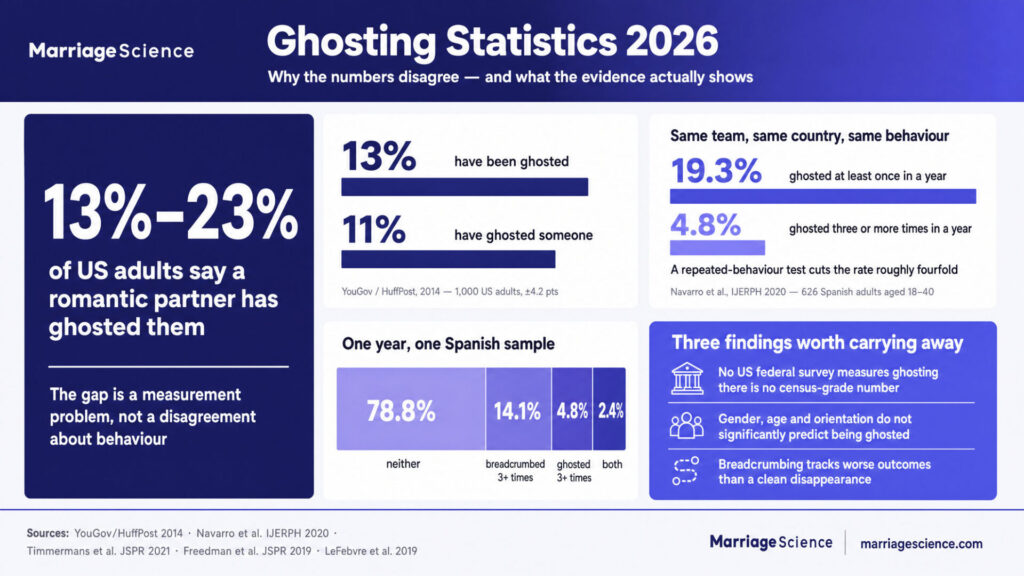
TL;DR: Somewhere between 13% and 23% of American adults say a romantic partner has ghosted them, and the gap between those two figures is a measurement problem and not a disagreement about behaviour. No government survey measures ghosting at all, so every number on this page comes from a poll or an academic sample.
13% of US adults said they had been ghosted by someone they were dating, and 11% said they had ghosted someone in a poll of 1,000 adults with a margin of error of 4.2 percentage points (YouGov and the Huffington Post, October 2014).
Academic samples put the figure higher, up to 23%, and a Spanish study using a much stricter test, three or more times in a single year, found 4.8% (Navarro and colleagues, IJERPH 2020). All three describe the same behaviour and count it differently.
We pulled the numbers below from the YouGov topline tables and from four peer-reviewed papers in the Journal of Social and Personal Relationships, the International Journal of Environmental Research and Public Health and Imagination, Cognition and Personality. Where a widely quoted figure could not be traced to its source, it is not here, and we say which ones those are.
Key Ghosting Statistics
- 13% of US adults have been ghosted by someone they were dating (YouGov and the Huffington Post, October 2014, 1,000 adults).
- 11% admit to having ghosted someone they were dating (same poll).
- 5% were not sure whether they had been ghosted, and 6% were not sure whether they had done it (same poll).
- Published prevalence for US adults ranges from 13% to 23% depending on the study (Navarro and colleagues, IJERPH 2020, reviewing the literature).
- 4.8% of Spanish adults aged 18 to 40 were ghosted three or more times in one year, the rate under a repeated-behaviour definition (Navarro and colleagues, IJERPH 2020, 626 adults).
- 14.1% were breadcrumbed three or more times in the same year, three times the rate of repeated ghosting (same study).
- 78.8% had experienced neither under that definition (same study).
- 19.3% of Spanish adults report being ghosted at least once in a year, four times the repeated-behaviour rate (Navarro and colleagues, cited in the 2020 paper).
- Ghosting rates did not differ significantly by gender, age, sexual orientation or relationship status in the Spanish sample (Navarro and colleagues, 2020).
- Being ghosted on a dating app measurably affects self-esteem and mental wellbeing, from a mixed-methods study of 328 mobile daters (Timmermans, Hermans and Opree, JSPR 2021).
- The majority of one 99-person sample had been on both sides of it, reporting that they had ghosted and been ghosted (LeFebvre and colleagues, Imagination, Cognition and Personality 2019).
- People who believe in soulmates judge ghosting more acceptable than people who believe relationships are built (Freedman, Powell, Le and Williams, JSPR 2019).
- No US federal survey measures ghosting, so there is no census-grade number and no official trend line.
How Common Is Ghosting in Dating?
The honest answer is a range, and the range is wide.
The most conservative national figure comes from a 2014 YouGov poll of 1,000 US adults, which asked directly whether anyone the respondent was dating had ever ceased all communication instead of ending things.
| Question | Yes | No | Not sure |
| Have you ever been ghosted by someone you were dating? | 13% | 81% | 5% |
| Have you ever ghosted someone you were dating? | 11% | 83% | 6% |
| Had ever used a dating app or online dating site | 22% | 76% | 2% |
That poll is old, and its own third row shows why. Only 22% of respondents had ever used a dating app or site.
On current numbers roughly three in ten American adults have, which is a different dating population from the one polled in 2014. See our online dating statistics for the adoption figures.
The academic literature sits higher. Reviewing the published work in 2020, Navarro and colleagues put the range for US adults ghosted by a romantic partner at 13% to 23%, with the top of that range from Freedman, Powell, Le and Williams, JSPR 2019.
Why There Is No Better National Number
No US federal survey asks about ghosting. The Census Bureau, the National Center for Health Statistics and the Bureau of Justice Statistics all run large household and relationship instruments, and none contains a question about ending contact without explanation.
That is less an oversight than a definitional problem. A survey agency has to define what it counts before it can count it, and ghosting has no agreed threshold.
The practical consequence is that the ceiling on quality here is a thousand-person poll from more than a decade ago, or an academic convenience sample of a few hundred people.
Both are worth citing. Neither is a national statistic in the sense that the marriage rate is one.
Why the Numbers Disagree So Much
Three design choices move the answer more than any real change in behaviour does, and almost no popular article naming a single ghosting percentage tells you which choices its source made.
The Four Choices That Move the Number
Recall is the fifth problem, and it runs in both directions.
A lifetime question asks people to remember every match who stopped replying, which understates it, while the word itself has become common enough that people now apply it to conversations that simply ended.
The 2014 poll predates that drift, which is one argument for its low figure and one argument against comparing it with anything measured since.
| Design choice | Effect on the number | Example |
| Ever versus last 12 months | Lifetime questions produce far larger numbers | 19.3% ghosted in a year against 13% ever, in different populations |
| Once versus repeatedly | A three-or-more test cuts the rate roughly fourfold | 19.3% at least once against 4.8% three or more times, same research group |
| Whole population versus daters | Dater-only samples raise it sharply | 328 mobile daters against 1,000 general adults |
| Who counts as a partner | Including one-date matches raises it | App studies count matches, breakup studies count relationships |
The clearest illustration is inside a single research group. Navarro and colleagues report 19.3% of Spanish adults ghosted at least once in a year, and 4.8% ghosted three or more times in a year.
Same country, same team, same behaviour, and the second number is a quarter of the first. Both appear in the full text on PubMed Central.
So a headline claiming one national ghosting rate is quoting a single study’s definition and presenting it as a fact about the world.
Ghosting on Dating Apps
Two features of app dating change the calculation for the person doing the ghosting. The match has no route back to you once you unmatch, and in most cases the two of you share no friends, no workplace and no venue.
The social cost that would normally enforce an explanation is absent, and what remains is the effort of writing one.
App-based dating is where ghosting is most studied, because the platform makes it costless. Unmatch, and the other person cannot contact you, cannot see your profile and has no mutual friend to ask.
The most detailed study is Timmermans, Hermans and Opree, who surveyed 328 mobile daters, 63% of them women and 86% heterosexual, using both open and closed questions.
Their quantitative models predicted both the likelihood of ghosting someone and how painful being ghosted felt.
| Finding | Detail | Source |
| Sample | 328 mobile dating app users | Timmermans and colleagues, 2021 |
| Composition | 63% women, 86% heterosexual | same study |
| Effect on the ghosted | Measurable impact on self-esteem and mental wellbeing | same study |
| Motive | Frequently not malicious or consciously intended | same study |
| Method | Thematic analysis plus regression models | same study |
The motive finding is the one worth carrying away, because it contradicts how ghosting is written about. The authors argue for a more measured reading of the behaviour on the grounds that it is often not done with harmful intent.
That does not make it painless, and the same paper measures the harm. Our dating app statistics cover how large these platforms are.
Who Ghosts, and Does Gender Matter?
Search demand around this topic runs heavily toward gender comparisons, and the evidence does not support the story people are looking for. A null result on gender is still a result, and it is the one the best-powered sample produced.
This is the most-searched question about ghosting after prevalence, and the best available answer is that the gap between men and women is smaller than the coverage implies.
Navarro and colleagues found no significant differences in ghosting by gender, sexual orientation, age or current relationship status across 626 adults, 303 men and 323 women. The one significant result they did find was for breadcrumbing, which single participants reported more often.
The roles also overlap heavily. In LeFebvre and colleagues’ study of 99 emerging adults, the majority reported having been both the person who ghosted and the person who was ghosted. Treating ghosters and ghostees as two different groups of people does not match what the data shows.
What does predict attitudes is belief about relationships. Freedman, Powell, Le and Williams, JSPR 2019 found that people holding a destiny theory, the belief that partners are either meant to be or not, judge ghosting more acceptable than people holding a growth theory, who see relationships as built over time.
If you want the age dimension, our Gen Z dating statistics page covers the generation most exposed to app dating.
Why People Ghost
There is no representative survey of ghosters ranking their reasons.
What exists is qualitative work in which researchers coded what people said in their own words, which is a weaker basis for a percentage and a stronger one for understanding the behaviour.
Two qualitative studies asked ghosters directly, and their reasons cluster more around avoidance than around cruelty.
- LeFebvre and colleagues identified five distinct themes behind the decision to ghost and three separate themes describing how the other person worked out what had happened.
- Timmermans and colleagues found motives that were frequently not conscious or harmful in intent, including simple disengagement from a low-investment match.
- Koessler, Kohut and Campbell 2019 places ghosting inside the wider set of breakup strategies, and not in a category of its own.
- Across all three, the absence of a shared social network is the enabling condition. Ghosting a colleague or a friend of a friend carries a cost that ghosting a match does not.
Nobody has published a clean ranked list of ghosting reasons from a representative sample. The lists that circulate online, five or six reasons with tidy percentages beside them, do not trace to any study we could find.
What Ghosting Does to the Person Ghosted
Every finding in this section is correlational. These studies measured wellbeing and ghosting experience at the same moment, so they cannot separate the harm ghosting causes from the possibility that lonelier people are ghosted more often.
Both readings fit the data, and the researchers say so.
This is the best-evidenced part of the topic, and the findings are consistent across independent samples in different countries.
| Outcome | Finding | Source |
| Life satisfaction | Lower among people who experienced breadcrumbing or both behaviours | Navarro and colleagues, 2020 |
| Helplessness | Higher among the same groups | same study |
| Loneliness | Higher self-perceived loneliness | same study |
| Self-esteem | Measurable impact after app ghosting | Timmermans and colleagues, 2021 |
| Mental wellbeing | Reported impact, painful for many respondents | same study |
One detail in the Spanish results deserves more attention than it gets. The strongest effects attached to breadcrumbing, the intermittent contact that keeps someone on the hook, and to the combination of both behaviours, more than to ghosting alone.
Being dropped cleanly appears to be easier to recover from than being kept in partial contact.
If contact continues and money enters the conversation, the pattern is a different problem entirely. Our romance scam statistics page covers that.
Ghosting in Hiring and the Job Market
The behaviour transferred from dating to hiring quickly, and the word came with it.
A candidate stops replying mid-process, or an employer goes quiet after a final interview. Both directions are now common enough that recruitment software vendors publish surveys about them.
Ghosting between candidates and employers is now a substantial share of the searches around this topic, and it is also the part of the subject with the weakest evidence.
The figures that circulate come from job-board and recruitment-vendor surveys. We could not reach the source pages for any of them, and none of the ones we found publishes a full methodology, a sampling frame or a margin of error. We have left those numbers out, and we will add them here when a source states its own methodology.
The peer-reviewed literature on the topic is close to empty. A Crossref search for academic work on candidate or applicant ghosting returns nothing with a defensible sample.
So while the behaviour is real and widely reported, anyone quoting an exact percentage of job seekers who ghost employers is quoting a vendor survey, and should say so.
What Would Settle This
One question on an existing federal relationship survey would produce a national figure within a year, and a panel that asked the same people twice would separate cause from selection.
Neither is expensive by the standards of the surveys already running. Until one of them happens, the range at the top of this page is the honest answer.
Summary: Ghosting by the Numbers
| Metric | Value | Source |
| US adults ever ghosted by someone they were dating | 13% | YouGov and Huffington Post, 2014 |
| US adults who have ghosted someone | 11% | same poll |
| Unsure whether they had been ghosted | 5% | same poll |
| Unsure whether they had ghosted | 6% | same poll |
| Poll sample and margin of error | 1,000 US adults, 4.2 points | same poll |
| Published prevalence range, US adults | 13% to 23% | Navarro and colleagues, 2020 |
| Spanish adults ghosted 3+ times in a year | 4.8% | Navarro and colleagues, 2020 |
| Spanish adults breadcrumbed 3+ times in a year | 14.1% | same study |
| Experienced both, 3+ times | 2.4% | same study |
| Experienced neither | 78.8% | same study |
| Spanish adults ghosted at least once in a year | 19.3% | Navarro and colleagues, earlier study |
| Spanish study sample | 626 adults aged 18 to 40 | Navarro and colleagues, 2020 |
| Gender effect on ghosting | none significant | same study |
| Mobile dater study sample | 328 app users, 63% women | Timmermans and colleagues, 2021 |
| Emerging adult study sample | 99 participants | LeFebvre and colleagues, 2019 |
| People reporting both ghosting roles | the majority of that sample | same study |
| Predictor of finding ghosting acceptable | destiny beliefs about relationships | Freedman and colleagues, 2019 |
| US government measurement of ghosting | none exists | no federal survey asks |
| Ranked reasons for ghosting from a representative sample | not published | no source located |
Key Takeaways
- Between 13% and 23% of US adults say they have been ghosted, and the spread comes from how each study words the question, not from conflicting evidence about behaviour.
- Asking about repeated ghosting cuts the rate about fourfold, from 19.3% at least once a year to 4.8% three or more times, within the same research group.
- Gender does not significantly predict being ghosted, and the same people turn up on both sides of it.
- Breadcrumbing tracks worse outcomes than ghosting alone. Intermittent contact is associated with lower life satisfaction and more loneliness than a clean disappearance.
- The hiring-side figures are vendor surveys. No peer-reviewed or government source measures candidate ghosting.
Methodology and Sources
We used primary sources only. Poll figures were read from the published topline tables, never from coverage of the poll. Academic figures were read from the papers themselves.
- YouGov and the Huffington Post, October 2014. Survey of 1,000 US adults fielded 23 to 26 October 2014, margin of error 4.2 percentage points.
- Navarro and colleagues, IJERPH 2020, “Psychological Correlates of Ghosting and Breadcrumbing Experiences”, volume 17, article 1116. 626 adults aged 18 to 40. Open access, full text on PubMed Central.
- Timmermans, Hermans and Opree, JSPR 2021, “Gone with the Wind: Exploring Mobile Daters’ Ghosting Experiences”, volume 38, pages 783 to 801. 328 mobile daters.
- Freedman, Powell, Le and Williams, JSPR 2019, “Ghosting and Destiny: Implicit Theories of Relationships Predict Beliefs About Ghosting”, volume 36, pages 905 to 924.
- LeFebvre and colleagues, Imagination, Cognition and Personality 2019, “Ghosting in Emerging Adults’ Romantic Relationships”, volume 39, pages 125 to 150. 99 participants.
- Koessler, Kohut and Campbell 2019, “When Your Boo Becomes a Ghost”.
- Excluded: hiring and recruitment ghosting percentages from job-board vendor surveys whose source pages we could not reach and whose methodology is not published; ranked lists of “reasons people ghost” with percentages that trace to no study.
We update this page when a new dataset lands. More of our research sits on the statistics hub.