

Online dating is bigger than ever – a $12 billion industry with over 380 million users worldwide – but the cracks are showing. More than a third of U.S. adults have tried a dating app, yet fewer young people are actively dating, scams cost Americans over $1 billion a year, and the biggest platforms are losing paying subscribers. Below, we break down the latest data from 30+ primary sources to give you the full picture of online dating in 2026.
Key Takeaways
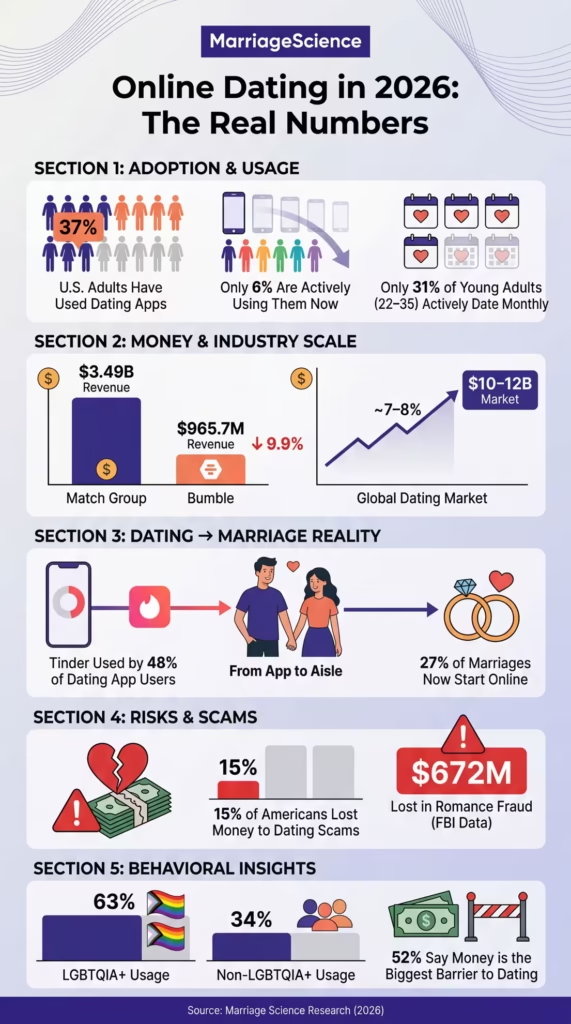
- 37% of U.S. adults have ever used a dating site or app; 6% are currently using one (SSRS, Opinion Panel Omnibus, January 2026).
- Only 31% of unmarried young adults ages 22-35 are actively dating once a month or more (Institute for Family Studies / Wheatley Institute, 2025 National Dating Landscape Survey, 2026).
- Match Group earned $3.49 billion in full-year 2025 revenue; Bumble earned $965.7 million, a 9.9% decline (Match Group SEC Filing, February 2026; Bumble SEC Filing, March 2026).
- 27% of couples who married in 2024-2025 first met through an online dating site or app (The Knot, 2025 Real Weddings Study / 2026 Real Weddings Study).
- 1 in 7 American adults (15%) say they have lost money to an online dating or romance scam (McAfee, 2026 Valentine’s Day Research, January 2026).
- The FBI recorded nearly 18,000 confidence and romance fraud complaints in 2024, totaling $672 million in losses (FBI, IC3 Annual Report, 2024).
- 63% of LGBTQIA+ adults have used dating sites or apps, compared with 34% of non-LGBTQIA+ adults (SSRS, Opinion Panel Omnibus, January 2026).
- 52% of young adults say not having enough money is the biggest barrier to dating (IFS / Wheatley Institute, 2025 National Dating Landscape Survey, 2026).
- The global online dating market is valued at approximately $10-12 billion in 2025-2026, growing at 7-8% annually (Straits Research, 2025; Mordor Intelligence, 2026).
- Tinder remains the most-used platform among ever-users at 48%, followed by Plenty of Fish (30%) and Facebook Dating (30%) (SSRS, Opinion Panel Omnibus, January 2026).
37% of U.S. adults have used an online dating site or app at some point in their lives, yet only 1 in 3 young adults ages 22-35 are actively dating.
That paradox – widespread adoption paired with widespread fatigue – defines the 2026 online dating landscape.
The global market generates roughly $12 billion annually and serves over 380 million users, but romance scams now cost Americans more than $1 billion a year, and paying subscriber counts are declining across the industry’s two largest companies.
We aggregated data from SSRS, the FBI Internet Crime Complaint Center, McAfee, Match Group and Bumble SEC filings, The Knot Real Weddings Study, the Institute for Family Studies, Pew Research Center, and dozens of other primary sources to build the most comprehensive online dating statistics resource available.
Whether you’re evaluating the best dating sites or researching the industry, the numbers below tell the full story.
1. Adoption and Usage Rates
The portion of American adults who have tried online dating has remained remarkably stable. 37% of U.S. adults have ever used a dating site or app, with 6% currently using one (SSRS, Opinion Panel Omnibus, January 2026).
Among younger adults, adoption is far higher: 51% of 18-29-year-olds and 53% of 30-49-year-olds have tried online dating, compared to just 20% of adults 50 and older.
These numbers have barely budged over the past three years, suggesting the market has reached a plateau among its core demographics. The real growth frontier is the 50-plus segment, which – while still small – is expanding at the fastest rate across major platforms.
LGBTQIA+ adults use dating platforms at nearly twice the rate of the general population: 63% have used a dating site or app, including 14% who are current users. Tinder remains the most commonly used platform overall, with 48% of ever-users reporting they have used it. Among 18-29-year-olds specifically, Tinder dominance is even more pronounced at 74%, with Bumble (49%) and Hinge (44%) rounding out the top three.
| Metric | Value | Source |
| U.S. adults who have ever used a dating site/app | 37% | SSRS, Opinion Panel Omnibus, Jan 2026 |
| U.S. adults currently using a dating site/app | 6% | SSRS, Opinion Panel Omnibus, Jan 2026 |
| Adults 18-29 who have ever used dating apps | 51% | SSRS, Opinion Panel Omnibus, Jan 2026 |
| Adults 30-49 who have ever used dating apps | 53% | SSRS, Opinion Panel Omnibus, Jan 2026 |
| Adults 50+ who have ever used dating apps | 20% | SSRS, Opinion Panel Omnibus, Jan 2026 |
| LGBTQIA+ adults who have ever used dating sites/apps | 63% | SSRS, Opinion Panel Omnibus, Jan 2026 |
| Most-used platform among ever-users: Tinder | 48% | SSRS, Opinion Panel Omnibus, Jan 2026 |
| Global dating app users worldwide | ~380 million | Business of Apps, Dating App Report, Jan 2026 |
Note: SSRS surveyed 2,012 U.S. adults in January 2026 via a probability-based panel. Margin of error is ±2.5 percentage points.
For a full breakdown of which platforms perform best, see our best dating sites guide. The SSRS report is available at ssrs.com.
2. Market Size and Revenue
The global online dating industry generates substantial revenue, but growth has stalled among the two Western market leaders.
Match Group – owner of Tinder, Hinge, and Match – posted $3.49 billion in full-year 2025 revenue, essentially flat year-over-year (Match Group, SEC 8-K Filing, February 2026). Bumble’s decline was more dramatic: full-year 2025 revenue fell 9.9% to $965.7 million, with paying users declining 11.5% (Bumble Inc., SEC 8-K Filing, March 2026).
The company recorded $1.04 billion in non-cash impairment charges and cut 30% of its workforce mid-year.
These revenue pressures mask a significant strategic shift.
Both companies are increasing revenue per payer – Match Group’s RPP rose 5% year-over-year to $20.09 in 2025 – even as total payer counts shrink. The industry is moving from a volume model to a value model, extracting more from a smaller base of committed subscribers. Market research firms estimate the global online dating market at $10-12 billion in 2025-2026, with projected growth of 7-8% annually through the early 2030s.
| Metric | Value | Source |
| Match Group full-year 2025 revenue | $3.49 billion | Match Group, SEC 8-K Filing, Feb 2026 |
| Bumble Inc. full-year 2025 revenue | $965.7 million | Bumble Inc., SEC 8-K Filing, Mar 2026 |
| Bumble 2025 revenue decline (YoY) | −9.9% | Bumble Inc., SEC 8-K Filing, Mar 2026 |
| Match Group revenue per payer (RPP), FY 2025 | $20.09 | Match Group, SEC 8-K Filing, Feb 2026 |
| Tinder direct revenue, FY 2025 | ~$1.9 billion | Match Group, SEC 8-K Filing, Feb 2026 |
| Global online dating market size (2025 est.) | $10.3-$11.6 billion | Straits Research, 2025; NMSC, 2026 |
| Projected global market CAGR (2025-2033) | 7.3% | Straits Research, Online Dating Market Report, 2025 |
| Dating app industry mobile revenue (2024) | $6+ billion | Business of Apps, Dating App Report, Jan 2026 |
Note: Global market size estimates vary by firm and scope (apps-only vs. all online dating services). Match Group and Bumble financials are from audited SEC filings.
Match Group’s Q4 2025 earnings press release is available at sec.gov.
3. Demographics and User Behavior
A “dating recession” has emerged as one of the most-discussed findings of 2026. Only 31% of unmarried young adults ages 22-35 are actively dating once a month or more, according to the 2025 National Dating Landscape Survey of 5,275 respondents (Institute for Family Studies / Wheatley Institute, State of Our Unions, February 2026).
Three-quarters of young women (74%) and nearly two-thirds of young men (64%) said they had not dated or had dated only a few times in the past year – despite 86% saying they expect to marry someday.
The barriers are more practical than philosophical. 52% of young adults named insufficient money as the biggest obstacle. Lack of confidence (49%) and bad past dating experiences (48%) followed close behind. Only about one-third of young adults expressed much faith in their own dating skills.
These findings complicate the simple narrative that apps have solved the meeting problem – the infrastructure exists, but the confidence and economic conditions to use it effectively do not.
Among dating app users, the most important matching criterion is shared family values (51% rated it “very important”), followed by shared political beliefs (33%) and religious/spiritual beliefs (31%). Only 9% rated a partner’s income as very important (SSRS, Opinion Panel Omnibus, January 2026).
| Metric | Value | Source |
| Young adults (22-35) actively dating monthly or more | 31% | IFS / Wheatley Institute, 2025 National Dating Landscape Survey, 2026 |
| Young women who dated rarely or not at all in the past year | 74% | IFS / Wheatley Institute, 2025 National Dating Landscape Survey, 2026 |
| Young men who dated rarely or not at all in the past year | 64% | IFS / Wheatley Institute, 2025 National Dating Landscape Survey, 2026 |
| Unmarried young adults who expect to marry someday | 86% | IFS / Wheatley Institute, 2025 National Dating Landscape Survey, 2026 |
| “Not enough money” as biggest barrier to dating | 52% | IFS / Wheatley Institute, 2025 National Dating Landscape Survey, 2026 |
| Users rating shared family values as “very important” in matching | 51% | SSRS, Opinion Panel Omnibus, Jan 2026 |
| Women rating shared family values as “very important” | 59% | SSRS, Opinion Panel Omnibus, Jan 2026 |
The full State of Our Unions 2026 report is available at wheatley.byu.edu. For more on building successful relationships from app matches, see our relationship guide.
4. Safety, Scams, and Trust
Romance fraud has become the single largest trust crisis facing the dating industry. 1 in 7 American adults (15%) say they have lost money to an online dating or romance scam – and of those who lost money, only 24% were able to recover all of it (McAfee, 2026 Valentine’s Day Research, January 2026).
The financial damage is enormous: the FBI’s Internet Crime Complaint Center recorded nearly 18,000 confidence and romance fraud complaints in 2024 with losses exceeding $672 million (FBI, IC3 Annual Report, 2024). FTC data shows consumers reported $1.16 billion in romance scam losses in just the first nine months of 2025 (FTC, Consumer Sentinel Network, 2025).
AI is accelerating the threat on both sides. McAfee Labs reported that fake AI dating bots surged during peak dating season, with some users receiving more than 60 bot messages in 12 hours – even without a profile photo. 1 in 4 Americans has encountered a fake profile or AI-generated bot, and 35% have spotted AI-generated or modified photos on dating or social apps. On the defense side, platforms are responding: Tinder’s facial verification feature (Face Check) reduces exposure to potential bad actors by over 60% and lowers bad-actor reports by 40% (Match Group, 2025). For help evaluating platform safety features, see our dating site reviews.
| Metric | Value | Source |
| Americans who have lost money to an online dating/romance scam | 1 in 7 (15%) | McAfee, 2026 Valentine’s Day Research, Jan 2026 |
| Scam victims who recovered all their money | 24% | McAfee, 2026 Valentine’s Day Research, Jan 2026 |
| FBI confidence/romance fraud complaints (2024) | ~18,000 | FBI, IC3 Annual Report, 2024 |
| FBI confidence/romance fraud losses (2024) | $672+ million | FBI, IC3 Annual Report, 2024 |
| FTC-reported romance scam losses (Jan-Sep 2025) | $1.16 billion | FTC, Consumer Sentinel Network, 2025 |
| Americans who have encountered a fake profile or AI bot | 25% | McAfee, 2026 Valentine’s Day Research, Jan 2026 |
| Americans asked to send money/share financial info by a dating match | 53% | McAfee, 2026 Valentine’s Day Research, Jan 2026 |
| Total U.S. internet crime losses (2024) | $16.6 billion | FBI, IC3 Annual Report, 2024 |
Note: Romance scam losses are widely considered underreported. The FBI estimates actual losses far exceed reported figures because many victims do not come forward.
McAfee’s 2026 Valentine’s Day research is available at mcafee.com.
5. Success Rates and Relationship Outcomes
27% of couples who married in 2024-2025 first met through an online dating site or app, making it the single most common way modern couples connect (The Knot, 2025 Real Weddings Study; The Knot, 2026 Real Weddings Study, February 2026).
Among those online-met couples, Hinge accounted for roughly 36% of matches, followed by Tinder at 25% and Bumble at 20%. These figures come from surveys of nearly 17,000 and 10,474 U.S. couples respectively, though the sample skews toward couples already using a wedding-planning platform.
The broader SSRS data paints a more cautious picture: 58% of adults believe relationships that begin on dating apps are just as successful as those formed offline, with 5% considering them more successful.
Stanford’s long-running “How Couples Meet and Stay Together” dataset, led by sociologist Michael Rosenfeld, found that online channels became the dominant meeting method for heterosexual couples around 2013 – and by its 2017 wave, 39% of new heterosexual couples and 60-65% of same-sex couples had met online (most recent available data). For couples exploring the next step after meeting online, Marriage Science’sprenup huboffers research-backed guidance.
| Metric | Value | Source |
| Newlyweds (2024-2025) who met via online dating | 27% | The Knot, 2025 & 2026 Real Weddings Studies |
| Share of online-met couples via Hinge | ~36% | The Knot, 2025 Real Weddings Study |
| Share of online-met couples via Tinder | ~25% | The Knot, 2025 Real Weddings Study |
| Adults who believe app relationships are equally successful | 58% | SSRS, Opinion Panel Omnibus, Jan 2026 |
| U.S. couples married in 2025 | ~2 million | The Knot, 2026 Real Weddings Study, Feb 2026 |
Note: The Knot samples consist of couples who used the wedding-planning platform; results may skew toward digitally engaged couples.
The 2026 Real Weddings Study is available at theknot.com.
6. App Fatigue, AI, and Future Trends
The dominant industry narrative in 2026 is a pivot away from volume-based swiping toward AI-curated, intentionality-driven matching. Nearly 70% of dating app users say they want AI-powered features to improve their profiles, yet 64% say they distrust matches who use AI-generated images (Statista, 2024; McAfee, 2024). That tension – wanting AI help while fearing AI deception – defines the next era of product development.
Match Group is betting on this shift with Tinder’s “Chemistry” feature, which replaces traditional swiping with AI-curated daily selections and interactive questions.
Bumble invested heavily in a new AI engineering organization throughout 2025 and is developing Bumble 2.0, scheduled for Q2 2026. 32% of Americans say it is possible to develop romantic feelings toward an AI bot, and 9% say they have personally experienced romantic feelings for an AI chatbot (McAfee, 2026 Valentine’s Day Research).
The boundary between AI as tool and AI as companion is blurring – a trend that platforms catering to AI girlfriend experiences are already capitalizing on.
Meanwhile, paying subscriber counts continue to decline. Match Group’s total payers fell 5% year-over-year in 2025 to 13.8 million in Q4. Bumble’s total paying users dropped 20.5% in Q4 2025 to 3.3 million. The free-to-use model is straining: apps must prove they deliver results worth paying for, or risk becoming utilities people tolerate but refuse to fund.
| Metric | Value | Source |
| Users who want AI features to improve profiles | ~70% | Statista, Global Survey, 2024 |
| Users who distrust matches using AI-generated images | 64% | McAfee Research, 2024 |
| Americans who say romantic feelings for an AI bot are possible | 32% | McAfee, 2026 Valentine’s Day Research, Jan 2026 |
| Match Group total payers, Q4 2025 | 13.8 million | Match Group, SEC 8-K Filing, Feb 2026 |
| Match Group payer decline (YoY) | −5% | Match Group, SEC 8-K Filing, Feb 2026 |
| Bumble total paying users, Q4 2025 | 3.3 million | Bumble Inc., SEC 8-K Filing, Mar 2026 |
| Bumble paying user decline, Q4 2025 (YoY) | −20.5% | Bumble Inc., SEC 8-K Filing, Mar 2026 |
| Tinder monthly active users (Q3 2025) | ~47 million | Match Group, SEC 8-K Filing, Nov 2025 |
7. By Country and Region
North America accounts for approximately 30-36% of global online dating revenue, making it by far the largest regional market (Grand View Research, Online Dating Market Report, 2023; Straits Research, Online Dating Market Report, 2025).
The U.S. alone is projected to generate $1.45 billion in dating app revenue in 2026 (Statista, 2026). But the fastest growth is elsewhere: Asia-Pacific is expanding rapidly, led by China ($884 million market, 9.5% CAGR), India ($236 million, 11.8% CAGR), and Southeast Asia ($136 million, 11.0% CAGR) (Cognitive Market Research, 2026).
Platform preferences vary sharply by region. Tinder and Bumble dominate in English-speaking markets. In Japan, Pairs is the market leader.
In China, Momo and Tantan command the largest user bases. Grindr, which serves the LGBTQ+ community, reported 25% revenue growth in Q1 2025 and reached 14.5 million monthly active users globally.
An unexpected outlier: Belgium is projected to record the highest dating-app user penetration rate in the world at 19.7%.
| Metric | Value | Source |
| North America share of global dating revenue | ~30-36% | Grand View Research, 2023; Straits Research, 2025 |
| U.S. projected dating app revenue (2026) | $1.45 billion | Statista, 2026 |
| China online dating market size | $884 million | Cognitive Market Research, 2026 |
| India online dating market size | $235.7 million | Cognitive Market Research, 2026 |
| India online dating CAGR | 11.8% | Cognitive Market Research, 2026 |
| Grindr monthly active users (Q1 2025) | 14.5 million | Mordor Intelligence, 2025 |
| Highest user penetration rate globally | Belgium (19.7%) | Statista, 2026 |
Online Dating by the Numbers
| Metric | Value | Source |
| U.S. adults who have ever used a dating site/app | 37% | SSRS, Opinion Panel Omnibus, Jan 2026 |
| Global dating app users | ~380 million | Business of Apps, Dating App Report, Jan 2026 |
| Match Group FY 2025 revenue | $3.49 billion | Match Group, SEC 8-K Filing, Feb 2026 |
| Bumble Inc. FY 2025 revenue | $965.7 million | Bumble Inc., SEC 8-K Filing, Mar 2026 |
| Global online dating market size (2025 est.) | $10.3-$11.6 billion | Straits Research, 2025; NMSC, 2026 |
| Newlyweds who met via online dating (2024-2025) | 27% | The Knot, 2025 & 2026 Real Weddings Studies |
| Americans who lost money to romance scams | 15% (1 in 7) | McAfee, 2026 Valentine’s Day Research, Jan 2026 |
| FTC-reported romance scam losses (Jan-Sep 2025) | $1.16 billion | FTC, Consumer Sentinel Network, 2025 |
| FBI romance fraud losses (2024) | $672+ million | FBI, IC3 Annual Report, 2024 |
| LGBTQIA+ adults who have used dating apps | 63% | SSRS, Opinion Panel Omnibus, Jan 2026 |
| Young adults (22-35) actively dating monthly+ | 31% | IFS / Wheatley Institute, 2025 National Dating Landscape Survey, 2026 |
| Unmarried young adults expecting to marry | 86% | IFS / Wheatley Institute, 2025 National Dating Landscape Survey, 2026 |
| Most-used dating platform (ever-users): Tinder | 48% | SSRS, Opinion Panel Omnibus, Jan 2026 |
| Match Group total payers, Q4 2025 | 13.8 million | Match Group, SEC 8-K Filing, Feb 2026 |
| Bumble total paying users, Q4 2025 | 3.3 million | Bumble Inc., SEC 8-K Filing, Mar 2026 |
| U.S. projected dating app revenue (2026) | $1.45 billion | Statista, 2026 |
| Adults who believe app relationships are equally successful | 58% | SSRS, Opinion Panel Omnibus, Jan 2026 |
| India online dating CAGR | 11.8% | Cognitive Market Research, 2026 |
| Americans encountering fake profiles or AI bots | 25% | McAfee, 2026 Valentine’s Day Research, Jan 2026 |
| “Not enough money” as #1 barrier to dating | 52% | IFS / Wheatley Institute, 2025 National Dating Landscape Survey, 2026 |
For a closer look at the biggest app, our Tinder statistics go deeper on match rates and revenue.
Methodology and Sources
This article draws from the following primary sources. All statistics were traced to original reports, surveys, or financial filings. No stat was taken from a secondary blog without verification against the primary source.
- SSRS, “The Public and Online Dating 2026,” Opinion Panel Omnibus, January 2-20, 2026. Nationally representative sample of 2,012 U.S. adults. Margin of error ±2.5 pp.
- Institute for Family Studies / Wheatley Institute at Brigham Young University, “State of Our Unions 2026: The Dating Recession,” February 2026. Based on the 2025 National Dating Landscape Survey (n = 5,275 unmarried adults ages 22-35).
- Match Group, SEC Form 8-K, Fourth Quarter and Full-Year 2025 Results, February 3, 2026.
- Bumble Inc., SEC Form 8-K, Fourth Quarter and Full-Year 2025 Results, March 11, 2026.
- McAfee, “Love, Actually? Romance Scams Are Now Part of the Online Dating Experience,” 2026 Valentine’s Day Research, January 2026. Online survey of 7,000 adults across 7 countries.
- McAfee Labs, URL and mobile app telemetry analysis, December 1, 2025 – January 22, 2026.
- FBI, Internet Crime Complaint Center (IC3), 2024 Annual Report, released April 2025.
- FTC, Consumer Sentinel Network data, romance scam losses January-September 2025.
- The Knot Worldwide, “2025 Real Weddings Study,” February 2025. Survey of 16,956 U.S. couples married in 2024.
- The Knot Worldwide, “2026 Real Weddings Study,” February 18, 2026. Survey of 10,474 U.S. couples married in 2025.
- Pew Research Center, “From Looking for Love to Swiping the Field: Online Dating in the U.S.,” February 2023. Survey of 6,034 U.S. adults (July 2022).
- Straits Research, “Online Dating Market Size, Growth, Trends & Share Report,” 2025.
- Grand View Research, “Online Dating Market Size, Share & Growth Report, 2030,” 2023.
- Mordor Intelligence, “Global Online Dating Services Market Size & Share Analysis,” 2026.
- Next Move Strategy Consulting (NMSC), “Dating App Market Size and Share Analysis, 2026-2035,” March 2026.
- Cognitive Market Research, Asia-Pacific online dating market data, 2026.
- Business of Apps, “Dating App Report 2026,” January 2026.
- Statista, dating app revenue and user projections, 2024-2026.
- Rosenfeld, Michael J. et al., “How Couples Meet and Stay Together” dataset, Stanford University. Most recent wave: 2017.
- Norton, Cyber Safety Insight Report, 2025.
- Match Group, Tinder Face Check verification data, 2025.
Last updated: April 2026. We update this page quarterly to reflect the latest available data. The FBI’s 2025 IC3 Annual Report with full-year romance scam data is expected later in 2026. The next SSRS Opinion Panel Omnibus online dating poll is expected in early 2027.