

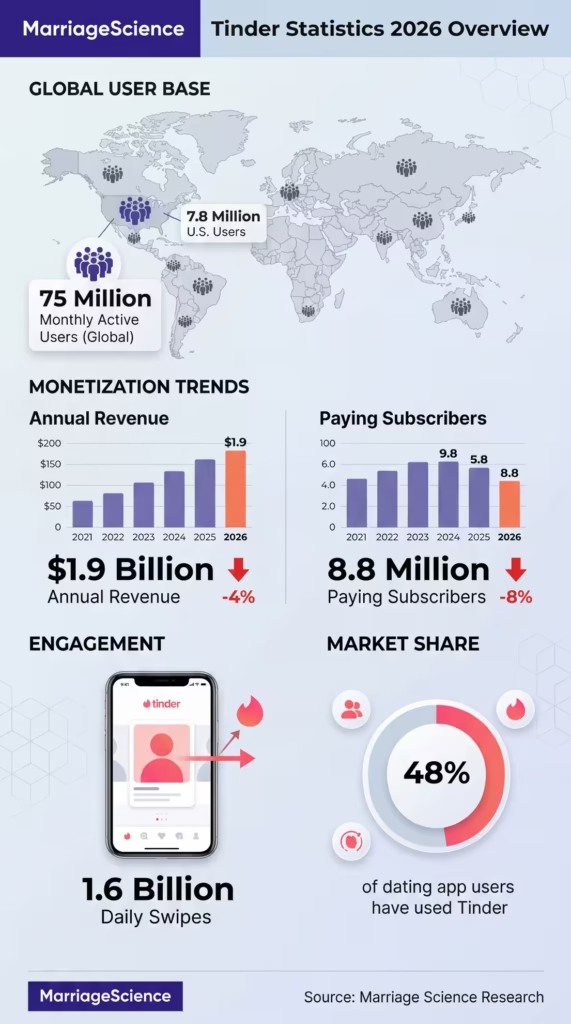
Tinder generated $1.9 billion in direct revenue in 2025 while losing 8% of its paying subscribers in a single quarter. That tension – enormous revenue from a shrinking subscriber base – captures the state of the world’s most recognizable dating app. Tinder still processes 1.6 billion swipes per day across 190 countries, remains the most-used dating platform among 48% of all dating app ever-users, and commands 75 million monthly active users globally. But the gender ratio remains lopsided at roughly 75% male, match rates differ by an order of magnitude between men and women, and the app is pivoting from volume-based swiping toward AI-curated matching. We aggregated data from Match Group SEC filings, SSRS, Pew Research Center, McAfee, SwipeStats user data, The Knot Real Weddings Study, Statista, and Business of Apps to build the most comprehensive Tinder statistics resource available. Whether you’re choosing among the best dating sites or analyzing the industry, every stat below is sourced to a primary report.
Among Americans who have used a dating site or app, 46% say they have used Tinder, making it the most widely used platform, ahead of Match (31%) and Bumble (28%).
Key Takeaways
- Tinder full-year 2025 direct revenue: $1.9 billion, down 4% year-over-year
- Tinder paying subscribers: 8.8 million in Q4 2025, down 8% year-over-year
- 75 million monthly active users globally; 7.8 million in the U.S.
- 1.6 billion daily swipes across approximately 190 countries
- Tinder’s gender ratio: approximately 75% male, 24% female, 1% non-binary/undisclosed
- Men’s average match rate: 5.26%; women’s average match rate: 44.4% – an 8.4× gap
- 48% of all dating app ever-users say they have used Tinder, the highest of any platform
- 27% of couples who married in 2024–2025 met through an online dating site or app; among online-met couples, Tinder accounted for ~25%
- Tinder revenue per payer (RPP) rose 5% year-over-year to $17.63 in Q4 2025
- Tinder’s “Chemistry” feature replaces traditional swiping with AI-curated daily selections
1. Tinder Users and Monthly Active Users
Tinder has approximately 75 million monthly active users (MAU) globally and 7.8 million active users in the United States alone. Match Group’s Q3 2025 SEC filing reported 47 million MAU for Tinder, down 9% year-over-year – the company’s official, more conservative figure. The discrepancy exists because Match Group counts only logged-in active users in its SEC disclosures, while industry trackers include broader app-open metrics.
The U.S. leads Tinder usage by a wide margin. The U.K. follows with 4–5 million users, then Brazil, India, Mexico, France, Canada, Germany, and Australia.
Tinder is available in roughly 190 countries and 40 languages. Among all dating app ever-users in the U.S., Tinder is the most commonly used platform at 48%, with dominance particularly strong among 18–29-year-olds (74%) (SSRS, Opinion Panel Omnibus, January 2026).
| Metric | Value | Source |
|---|---|---|
| Global monthly active users (MAU) | ~75 million | Business of Apps, Tinder Statistics, Jan 2026 |
| MAU per Match Group SEC filing (Q3 2025) | 47 million | Match Group, SEC 8-K Filing, Nov 2025 |
| U.S. active users | 7.8 million | Business of Apps, Tinder Statistics, Jan 2026 |
| Paying subscribers (Q4 2025) | 8.8 million | Match Group, SEC 8-K Filing, Feb 2026 |
| Total downloads (2024) | 63.58 million | DemandSage, Tinder Statistics, Mar 2026 |
| Downloads (Dec 2025) | 6.3 million | DemandSage, Tinder Statistics, Mar 2026 |
| Countries available | ~190 | Match Group, company data |
| Tinder as most-used platform among dating app ever-users | 48% | SSRS, Opinion Panel Omnibus, Jan 2026 |
Note: Match Group’s official MAU figure (47M in Q3 2025) counts only in-app active users and has been trending down ~9% YoY. Industry estimates (~75M) use broader measurement criteria.
2. Tinder Revenue and Financials
Tinder remains the revenue engine of Match Group, but growth has stalled. Tinder’s full-year 2025 direct revenue was $1.9 billion, down 4% year-over-year (Match Group, SEC 8-K Filing, February 2026). Q4 2025 direct revenue came in at $464 million, down 3%.
The decline is entirely driven by subscriber loss: paying users fell 8% to 8.8 million in Q4 2025 compared to 9.5 million in Q4 2024. Revenue per payer (RPP), however, rose 5% to $17.63 – the same pattern visible across the broader dating app industry of fewer but higher-spending subscribers.
Tinder still accounts for approximately 54–57% of Match Group’s total revenue. Adjusted EBITDA for Tinder came to $941 million in FY 2025, representing a 49% margin – highly profitable by any consumer app standard.
The business model is shifting from mass acquisition to monetization depth. Tinder introduced “Chemistry” in late 2025, an AI-driven feature that replaces infinite swiping with curated daily matches, signaling a strategic pivot toward quality over quantity.
| Metric | Value | Source |
|---|---|---|
| Tinder FY 2025 direct revenue | $1.9 billion | Match Group, SEC 8-K Filing, Feb 2026 |
| Tinder FY 2025 revenue change (YoY) | −4% | Match Group, SEC 8-K Filing, Feb 2026 |
| Tinder Q4 2025 direct revenue | $464 million | Match Group, SEC 8-K Filing, Feb 2026 |
| Tinder FY 2024 direct revenue | $1.94 billion | Match Group, SEC 8-K Filing, Feb 2025 |
| Revenue per payer (RPP), Q4 2025 | $17.63 | Match Group, SEC 8-K Filing, Feb 2026 |
| Tinder FY 2025 adjusted EBITDA | $941 million | Match Group, Q4 2025 Earnings Call, Feb 2026 |
| Tinder share of Match Group total revenue | ~54–57% | Match Group, SEC 8-K Filings, 2025–2026 |
3. Tinder Gender Ratio: Male vs. Female
The gender imbalance on Tinder is the single most important statistic shaping user experience. Approximately 75% of Tinder users are male and 24% are female, with about 1% identifying as non-binary or undisclosed.
That ratio is more skewed than competitors: Bumble sits at roughly 54% male / 46% female, and Hinge at about 60% male / 40% female.
The imbalance varies by region. In India, the male-to-female disparity is even larger. In parts of Europe, the split approaches 50/50.
SwipeStats, which analyzes voluntarily uploaded Tinder data from 7,079 profiles, found a 67% male / 33% female split in its dataset – though they note women may be underrepresented in voluntary data uploads.
Men account for 89% of all right swipes but only 81% of all matches – a gap that directly drives the vastly different match rate experiences between men and women on the platform.
| Metric | Value | Source |
|---|---|---|
| Male users | ~75% | Business of Apps / DemandSage, 2026 |
| Female users | ~24% | Business of Apps / DemandSage, 2026 |
| Non-binary / undisclosed | ~1% | DemandSage, Tinder Statistics, Mar 2026 |
| SwipeStats sample gender split | 67% male / 33% female | SwipeStats, 7,079 profiles, 2020–2025 |
| Male share of all right swipes | 89% | SwipeStats, 7,079 profiles, 2020–2025 |
| Male share of all matches | 81% | SwipeStats, 7,079 profiles, 2020–2025 |
Note: Tinder does not publicly disclose exact gender ratios in SEC filings. Industry estimates come from app analytics firms (App Ape, Statista) and self-reported user data (SwipeStats). Figures vary between 67–78% male depending on methodology.
For more on how different platforms compare for specific user groups, see our dating site reviews.
4. Tinder Match Rate and Swipe Statistics: Men vs. Women
No Tinder statistic generates more conversation than the match rate gap. The average male match rate on Tinder is 5.26%; the average female match rate is 44.4% – women are 8.4× more likely to match (SwipeStats, analysis of 7,079 Tinder profiles and 294 million swipes, 2020–2025).
The median is even more revealing: half of all men on Tinder get a match rate below 2.04%. Even the bottom 10% of women (15.87% match rate) outperform the top 10% of men (12.5%).
Swipe behavior is equally asymmetric. Men swipe right on approximately 40% of profiles they see; women swipe right on roughly 7% (SwipeStats, 2025).
Men compensate with volume – swiping 7.4× more frequently – but women still accumulate 69% more total matches. The platform processes an estimated 1.6 billion swipes per day globally. Despite the stark gender disparity in matching, 43% of men’s matches result in zero or just one message. Only 15% become what SwipeStats defines as a “real conversation.”
| Metric | Value | Source |
|---|---|---|
| Men’s average match rate | 5.26% | SwipeStats, 7,079 profiles, 2020–2025 |
| Women’s average match rate | 44.4% | SwipeStats, 7,079 profiles, 2020–2025 |
| Men’s median match rate | 2.04% | SwipeStats, 7,079 profiles, 2020–2025 |
| Women’s median match rate | 41% | SwipeStats, 7,079 profiles, 2020–2025 |
| Men’s average right-swipe rate | ~40% | SwipeStats, 2025 |
| Women’s average right-swipe rate | ~7% | SwipeStats, 2025 |
| Daily swipes globally | ~1.6 billion | Match Group, company data |
| Men’s matches resulting in 0–1 messages | 43% | SwipeStats, 7,079 profiles, 2020–2025 |
Note: SwipeStats data is self-selected – users voluntarily upload their Tinder data exports. The 7,079-profile sample overrepresents men (88% of uploads) and may skew toward more engaged users. Match Group does not publicly disclose match rate breakdowns by gender.
5. Tinder Demographics and User Behavior
61.2% of Tinder users fall within the 18-to-34 age bracket, with the 25–34 segment as the single largest group (DemandSage, Tinder Statistics, March 2026). Usage patterns differ sharply by gender. Users log into Tinder an average of 11 times per day and spend approximately 90 minutes total on the app daily, with each session lasting 7–9 minutes. Men log in more frequently; women spend more time per session.
Income distribution among U.S. Tinder users skews toward middle and upper-middle brackets: 52% of users report household income of $60K–$100K (Business of Apps, 2026).
The app supports 50+ gender identities and 9 sexual orientations. Tinder reports 6.8 billion LGBTQA+ matches since launch. Among U.S. dating app ever-users aged 18–29, Tinder (74%) leads Bumble (49%) and Hinge (44%) – but among users 50 and older, Plenty of Fish (36%) and Match (33%) outrank Tinder (SSRS, Opinion Panel Omnibus, January 2026).
| Metric | Value | Source |
|---|---|---|
| Users aged 18–34 | 61.2% | DemandSage, Tinder Statistics, Mar 2026 |
| Average daily logins per user | 11 | Resourcera, Tinder Users Statistics, Feb 2026 |
| Average daily time spent | ~90 minutes | Resourcera, Tinder Users Statistics, Feb 2026 |
| Users with household income $60K–$100K | 52% | Business of Apps, Tinder Statistics, Jan 2026 |
| Tinder usage among 18–29-year-old ever-users (U.S.) | 74% | SSRS, Opinion Panel Omnibus, Jan 2026 |
| Total matches since launch | 100+ billion | Match Group / Tinder, company data |
For insights on how Tinder user behavior compares to other platforms and which might suit your relationship goals, see our guide.
6. Tinder Success Rates and Relationship Outcomes
27% of couples who married in 2024–2025 met through a dating site or app, and Tinder accounted for roughly 25% of those online-formed matches – making it the second-most common platform for finding a spouse behind Hinge at 36% (The Knot, 2025 Real Weddings Study; The Knot, 2026 Real Weddings Study, February 2026). That data comes from surveys of nearly 17,000 and 10,474 U.S. couples, respectively.
58% of U.S. adults believe relationships that begin on dating apps are just as successful as those formed offline (SSRS, Opinion Panel Omnibus, January 2026). Tinder’s own Year in Swipe report highlighted emotional honesty as the top dating priority among its users, reflecting a shift from casual browsing toward intentionality. Gen Z users in particular are driving this change: over half say they prefer monogamy and treat dating apps as a legitimate path to serious relationships.
Still, the match-to-conversation-to-date funnel remains steep. SwipeStats data shows only 15% of men’s matches become real conversations, and the match-to-date conversion rate is lower still. For couples who do make it past the first date, the prenup hub at Marriage Science covers the financial planning side of marriage.
| Metric | Value | Source |
|---|---|---|
| Newlyweds (2024–2025) who met through online dating | 27% | The Knot, 2025 & 2026 Real Weddings Studies |
| Tinder share among online-met couples | ~25% | The Knot, 2025 Real Weddings Study |
| Adults who believe app relationships are equally successful | 58% | SSRS, Opinion Panel Omnibus, Jan 2026 |
| Men’s matches leading to real conversations | 15% | SwipeStats, 7,079 profiles, 2020–2025 |
7. Tinder Safety, Fake Profiles, and Scams
Trust and safety have become existential concerns for Tinder. McAfee Labs found that malicious Tinder clones accounted for 55% of all fake dating app detections between December 2025 and January 2026 (McAfee, 2026 Valentine’s Day Research, January 2026).
1 in 4 Americans has encountered a fake profile or AI-generated bot on dating or social platforms, and 35% have spotted AI-generated or modified photos.
The scam problem extends well beyond Tinder: FBI data shows nearly 18,000 confidence and romance fraud complaints in 2024 totaling $672 million in losses (FBI, IC3 Annual Report, 2024), while FTC data reports $1.16 billion in romance scam losses in just the first nine months of 2025.
Tinder’s response includes Face Check, a facial verification feature that the company says reduces exposure to potential bad actors by over 60% and lowers bad-actor reports by 40% (Match Group, 2025). The company is also investing in AI-powered content moderation.
48% of dating app users have reported experiencing some form of unwanted behavior on platforms, including unsolicited explicit messages and continued contact after rejection – a problem disproportionately affecting women (Pew Research Center, 2023). AI-related concerns are rising: some users reported receiving more than 60 AI bot messages in 12 hours, even without a profile photo (McAfee Labs, 2026).
| Metric | Value | Source |
|---|---|---|
| Share of malicious fake dating app detections: Tinder clones | 55% | McAfee Labs, Dec 2025 – Jan 2026 |
| Americans who have encountered a fake profile or AI bot | 25% | McAfee, 2026 Valentine’s Day Research, Jan 2026 |
| Face Check reduction in bad-actor exposure | >60% | Match Group, 2025 |
| Face Check reduction in bad-actor reports | 40% | Match Group, 2025 |
| FBI romance fraud losses (2024) | $672+ million | FBI, IC3 Annual Report, 2024 |
| FTC romance scam losses (Jan–Sep 2025) | $1.16 billion | FTC, Consumer Sentinel Network, 2025 |
| Dating app users reporting unwanted behavior | 48% | Pew Research Center, Feb 2023 |
Tinder by the Numbers
| Metric | Value | Source |
|---|---|---|
| Global monthly active users | ~75 million | Business of Apps, Jan 2026 |
| U.S. active users | 7.8 million | Business of Apps, Jan 2026 |
| FY 2025 direct revenue | $1.9 billion | Match Group, SEC Filing, Feb 2026 |
| Paying subscribers (Q4 2025) | 8.8 million | Match Group, SEC Filing, Feb 2026 |
| Revenue per payer, Q4 2025 | $17.63 | Match Group, SEC Filing, Feb 2026 |
| Gender ratio (male / female) | ~75% / ~24% | Business of Apps / DemandSage, 2026 |
| Men’s average match rate | 5.26% | SwipeStats, 7,079 profiles, 2020–2025 |
| Women’s average match rate | 44.4% | SwipeStats, 7,079 profiles, 2020–2025 |
| Daily swipes globally | ~1.6 billion | Match Group, company data |
| Total matches since launch | 100+ billion | Match Group / Tinder, company data |
| Newlyweds who met through online dating (2024–2025) | 27% | The Knot, 2025 & 2026 Real Weddings Studies |
| Tinder share among online-met couples | ~25% | The Knot, 2025 Real Weddings Study |
| Most-used dating platform among ever-users | 48% | SSRS, Opinion Panel Omnibus, Jan 2026 |
| Users aged 18–34 | 61.2% | DemandSage, Mar 2026 |
| Tinder clone share of fake dating app detections | 55% | McAfee Labs, Dec 2025 – Jan 2026 |
| Face Check reduction in bad-actor exposure | >60% | Match Group, 2025 |
| FY 2025 adjusted EBITDA | $941 million | Match Group, Q4 2025 Earnings Call, Feb 2026 |
| Tinder usage among 18–29-year-old ever-users | 74% | SSRS, Opinion Panel Omnibus, Jan 2026 |
| FBI romance fraud losses (2024) | $672+ million | FBI, IC3 Annual Report, 2024 |
| Payer decline, Q4 2025 (YoY) | −8% | Match Group, SEC Filing, Feb 2026 |
Tinder is only one slice of a much bigger market. For the wider view, see our online dating statistics.
Methodology and Sources
This article draws from the following primary sources. All statistics were traced to original reports, surveys, financial filings, or first-party data analyses. No stat was taken from a secondary blog without verification against the underlying source.
- Match Group, SEC Form 8-K, Fourth Quarter and Full-Year 2025 Results, February 3, 2026.
- Match Group, SEC Form 8-K, Third Quarter 2025 Results, November 4, 2025.
- Match Group, SEC Form 8-K, Fourth Quarter and Full-Year 2024 Results, February 4, 2025.
- Match Group, Q4 2025 Earnings Call Transcript, February 3, 2026.
- SSRS, “The Public and Online Dating 2026,” Opinion Panel Omnibus, January 2–20, 2026. Nationally representative sample of 2,012 U.S. adults. Margin of error ±2.5 pp.
- SwipeStats.io, “Tinder Statistics 2025: Real Data from 7,079 Profiles,” analysis of 294 million swipes, profiles uploaded 2020–2025.
- McAfee, “Love, Actually? Romance Scams Are Now Part of the Online Dating Experience,” 2026 Valentine’s Day Research, January 2026. Online survey of 7,000 adults across 7 countries.
- McAfee Labs, URL and mobile app telemetry analysis, December 1, 2025 – January 22, 2026.
- The Knot Worldwide, “2025 Real Weddings Study,” February 2025. Survey of 16,956 U.S. couples married in 2024.
- The Knot Worldwide, “2026 Real Weddings Study,” February 18, 2026. Survey of 10,474 U.S. couples married in 2025.
- FBI, Internet Crime Complaint Center (IC3), 2024 Annual Report, released April 2025.
- FTC, Consumer Sentinel Network data, romance scam losses January–September 2025.
- Pew Research Center, “From Looking for Love to Swiping the Field: Online Dating in the U.S.,” February 2023. Survey of 6,034 U.S. adults (July 2022).
- Business of Apps, “Tinder Revenue and Usage Statistics (2026),” January 2026.
- DemandSage, “Tinder Statistics 2026 – Users, & Revenue (Global Data),” March 2026.
- Resourcera, “Tinder Users Statistics 2026: Usage Trends & Key Insights,” February 2026.
- Statista, Tinder topic page and dating app market data, 2024–2026.
Last updated: April 2026. We update this page quarterly to reflect the latest available data. Match Group’s Q1 2026 earnings are expected in May 2026 and will provide the first revenue and payer data for the “Chemistry” era. The FBI’s full-year 2025 IC3 Annual Report is expected later in 2026.