


The U.S. crude divorce rate has dropped 42% since 2000, falling from 4.0 per 1,000 people to just 2.3 in 2024 (CDC/NCHS National Vital Statistics System, provisional data 2023; U.S. Census Bureau ACS, 2024). Nearly 987,000 women divorced in 2024, a slight decrease from 993,000 in 2023 (NCFMR Family Profile FP-25-31, 2025). Meanwhile, the marriage-to-divorce ratio reached 2.42, meaning for every divorce filed, more than two marriages were recorded (NCFMR Family Profile FP-25-32, 2025). The widely cited claim that “50% of marriages end in divorce” no longer holds: about 41% of first marriages end in divorce today, while the refined divorce rate sits at its lowest level in decades.
In 2022 the U.S. recorded 673,989 divorces, a rate of 2.4 per 1,000 population, continuing a long-term decline. (Figures exclude California, Hawaii, Indiana, Minnesota, and New Mexico.)
We aggregated data from the CDC’s National Center for Health Statistics, the U.S. Census Bureau’s American Community Survey, Bowling Green State University’s National Center for Family & Marriage Research (NCFMR), the Bureau of Labor Statistics, Pew Research Center, the OECD Family Database, and dozens of other primary sources to compile this reference.
How Many Marriages End in Divorce
The best short answer is that somewhere between 4 and 5 in 10 first marriages end in divorce, depending on when people married and how the question is measured. That range is more useful than a single slogan, because divorce risk changes by cohort, marriage order, and the time window being counted.
The often-quoted claim that half of all marriages end in divorce is higher than each current estimate here. Second and later marriages end in divorce more often than first ones.
The Bureau of Labor Statistics gives one of the clearest long-term views. In a Monthly Labor Review 2024 report using the National Longitudinal Survey of Youth 1979, people born 1957 to 1964 were followed to age 55.
Among them, 46.0% of first marriages had ended in divorce, with 42.7% for men and 49.2% for women. By 55, 87% had married and 40% had divorced at least once.
The National Center for Health Statistics gives a different kind of estimate. In National Health Statistics Report 49, based on the National Survey of Family Growth 2006 to 2010, 52% of women’s first marriages and 56% of men’s first marriages were expected to last 20 years.
That means about 48% and 44% ended within 20 years by divorce, separation or death, so this measure is broader than divorce alone.
Our analysis of Census American Community Survey microdata for 2023 and 2024 looks at current yearly divorce rates instead. If those rates were applied to one imagined couple, 7.7% of first marriages would end in divorce by year 5, 16.7% by year 10, 29.4% by year 20 and 42.5% by year 40.
This method ignores death and separation.
Each measure answers a different question. The long-followed BLS group shows what happened to one birth cohort by midlife.
The NSFG estimate asks how long first marriages are expected to remain intact. Our ACS estimate applies today’s rates to a simplified marriage path.
| Measure | Who it covers | Share ending in divorce |
|---|---|---|
| NLSY79 by 55 | People born 1957 to 1964 followed to age 55 | 46.0% of first marriages |
| NSFG within 20 years, including separation | Women’s and men’s first marriages in the National Survey of Family Growth 2006 to 2010 | About 48% of women’s and 44% of men’s first marriages ended within 20 years by divorce, separation or death |
| Our ACS by year 40 | One imagined couple at today’s yearly divorce rates, using Census American Community Survey microdata for 2023 and 2024 | 42.5% of first marriages by year 40 |
The main pattern is steady across these sources. First-marriage divorce risk is substantial, but marriages that started more recently are on track to end in divorce less often, partly because people marry later.
Couples who want to beat those odds can start with online couples therapy, which one partner can often begin alone.
Key Takeaways
- The U.S. crude divorce rate fell to 2.3 per 1,000 in 2024, down from 4.0 in 2000, a 42% decline over 24 years (CDC/NCHS; U.S. Census Bureau ACS, 2024).
- 986,810 women divorced in 2024, a nominal decrease of 5,867 from 2023 (NCFMR Family Profile FP-25-31, 2025).
- The refined divorce rate dropped to 14.2 per 1,000 married women in 2024, down from 14.4 in 2023 and a peak of 22.6 in 1980 (NCFMR, 2025).
- The marriage-to-divorce ratio reached 2.42, 2,390,482 marriages vs. 986,810 divorces in 2024 (NCFMR Family Profile FP-25-32, 2025).
- Women initiate roughly 69% of all divorces (Stanford University study by Michael Rosenfeld, ~2,000 heterosexual couples).
- Gray divorce (age 50+) now accounts for 36% of all U.S. divorces, up from 8.7% in 1990 (Brown & Lin, Bowling Green State University; Pew Research Center, October 2025).
- By age 55, 46% of those who had ever married experienced at least one divorce (Bureau of Labor Statistics, NLSY79, September 2024).
- Oklahoma had the highest state-level refined divorce rate at 20.7 per 1,000 married women; Maine had the lowest at 10.0 (NCFMR FP-25-31, ACS 2024).
- The median length of marriages ending in divorce reached 12 years in 2023, up from 10 years in 2008 (Pew Research Center analysis of ACS data, October 2025).
- Lack of commitment is the most often cited reason for divorce in checklist surveys: 75% of the 52 divorced people in Scott et al. (2013), and 85% in Oklahoma’s 2001 statewide survey.
- The average cost of a U.S. divorce is $11,300 (median $7,000), rising sharply in contested cases (Martindale-Nolo Research, 2024).
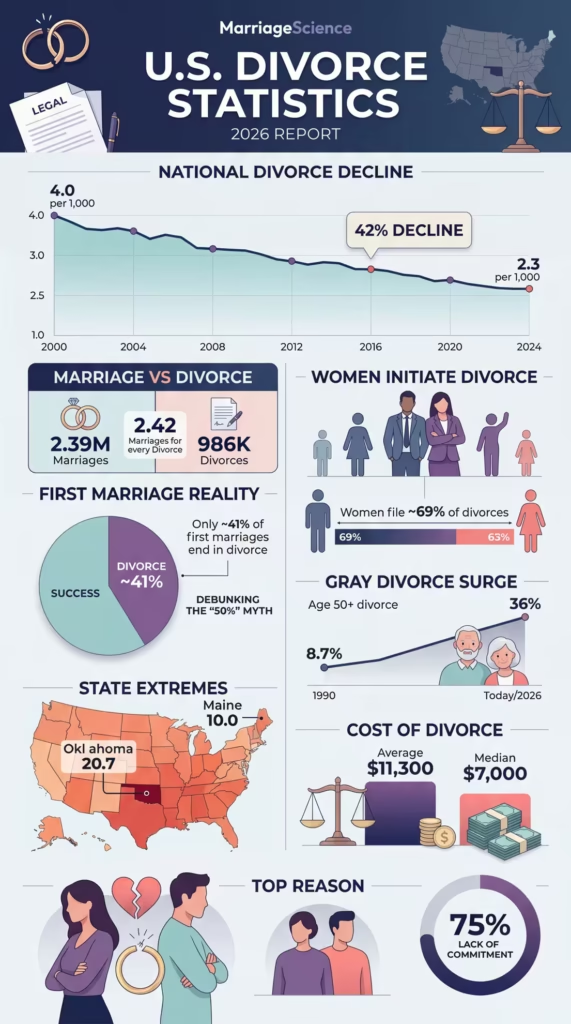
1. U.S. Divorce Rate: The Multi-Decade Decline
The headline story across every credible data source is the same: Americans are divorcing at dramatically lower rates than they were a generation ago.
The 42% decline in the crude divorce rate since 2000 isn’t driven by a single event, it reflects structural shifts in who marries, when they marry, and how educated they are when they do.
The refined divorce rate, considered the most accurate demographic measure because it counts divorces per 1,000 married women rather than per total population, fell to 14.2 in 2024. That figure peaked at 22.6 in 1980, making the current rate nearly 37% below the historic high.
Researchers consistently attribute the decline to later marriage (the median age at first marriage reached 30.2 for men and 28.6 for women in 2024, per the Census Bureau ACS), higher educational attainment among those who do marry, and declining overall marriage rates that effectively filter out higher-risk unions.
| Metric | Value | Source |
|---|---|---|
| U.S. crude divorce rate, 2024 | 2.3 per 1,000 population | CDC/NCHS; U.S. Census Bureau ACS, 2024 |
| U.S. crude divorce rate, 2000 | 4.0 per 1,000 population | CDC/NCHS National Vital Statistics System |
| Refined divorce rate, 2024 | 14.2 per 1,000 married women | NCFMR Family Profile FP-25-31, 2025 |
| Peak refined divorce rate (1980) | 22.6 per 1,000 married women | NCFMR/NCHS historical analysis |
| Total divorces, 2024 | 986,810 | NCFMR FP-25-31 (ACS 2024 data) |
| Total marriages, 2024 | 2,390,482 | NCFMR FP-25-32 (ACS 2024 data) |
| Marriage-to-divorce ratio, 2024 | 2.42 | NCFMR FP-25-32, 2025 |
| Median age at first marriage (men), 2024 | 30.2 years | U.S. Census Bureau ACS, 2024 |
| Median age at first marriage (women), 2024 | 28.6 years | U.S. Census Bureau ACS, 2024 |
Couples exploring evidence-based approaches to relationship health may find that the same factors driving lower national divorce rates, communication skills, financial preparedness, and delayed marriage, also apply at the individual level.
As marriage patterns evolve and divorce rates continue to decline, many Americans are becoming more intentional about partner selection from the very beginning. Choosing compatible relationships earlier can significantly reduce long-term separation risk, which is why exploring trusted platforms through our research-backed guide to the best dating sites can help singles make smarter, safer decisions before marriage.2. Demographics: Who Divorces and Who Doesn’t
Divorce risk is not distributed evenly. Age, education, race, income, and even religious affiliation all correlate strongly with the likelihood that a marriage ends in dissolution. College-educated adults are roughly 30% less likely to divorce than those without a degree, a finding replicated across CDC, Census Bureau, and BLS datasets.
Among ever-married women in 2022, those with a bachelor’s degree or higher had the lowest separation/divorce rate at 16%, compared with 22–23% for those with a high school diploma or some college (NCFMR FP-24-11, 2024).
Age at marriage remains one of the strongest predictors. Couples who marry before age 18 face a 48% divorce rate within 10 years; those who wait until after age 25 reduce their likelihood by 24% (BLS/NLSY data).
The average divorced person is 45.8 years old, with 30.1% holding a bachelor’s degree or higher and 11.9% living below the poverty line (CDC/NCHS demographics of divorced population).
| Metric | Value | Source |
|---|---|---|
| First marriages ending in divorce (lifetime estimate) | ~41% | Pew Research Center analysis, October 2025 |
| Second marriages ending in divorce | ~60% | American Psychological Association |
| Third marriages ending in divorce | ~73% | American Psychological Association |
| Divorce rate, married before age 18 (within 10 yrs) | 48% | BLS, NLSY79, September 2024 |
| Divorce risk reduction, married after age 25 | 24% lower | BLS/NLSY data analysis |
| Average age of divorced persons | 45.8 years | CDC/NCHS |
| Median length of first marriage ending in divorce | 12 years (2023) | Pew Research Center, ACS data, October 2025 |
| Average marriage duration before divorce | ~19.9 years | U.S. Census Bureau, 2024 |
| Divorces initiated by women | ~69% | Rosenfeld, Stanford University |
Understanding your relationship’s unique risk factors can help couples address challenges before they escalate, particularly the communication patterns and financial disagreements that drive most separations.
3. Divorce by State and Region
Geography matters enormously. Oklahoma recorded the highest refined divorce rate in 2024 at 20.7 per 1,000 married women, more than double Maine’s rate of 10.0, the nation’s lowest (NCFMR FP-25-31, ACS 2024).
Southern states dominate the high-divorce quartile: 76% of states in the Census Bureau’s Southern region fell in the third or fourth quartile for divorce rates.
The pattern correlates with younger marriage ages, lower educational attainment, and different economic conditions in the South compared with the Northeast and West.
Using crude rates from CDC/NCHS data (which measure divorces per 1,000 total population rather than per 1,000 married women), Nevada led at 3.8, followed by Wyoming and Idaho tied at 3.4. Louisiana reported the lowest crude rate at 0.9. Note that California, Hawaii, Indiana, Minnesota, and New Mexico are excluded from some CDC state-level crude rate tables due to reporting differences.
| State | Refined Divorce Rate (per 1,000 married women) | Source |
|---|---|---|
| Oklahoma | 20.7 (highest) | NCFMR FP-25-31, ACS 2024 |
| Nevada | 19.9 | NCFMR FP-25-31, ACS 2024 |
| Mississippi | 19.2 | NCFMR FP-25-31, ACS 2024 |
| Wyoming | 18.7 | NCFMR FP-25-31, ACS 2024 |
| Alabama | 18.0 | NCFMR FP-25-31, ACS 2024 |
| South Carolina | 11.7 (tied 4th lowest) | NCFMR FP-25-31, ACS 2024 |
| Idaho | 11.2 | NCFMR FP-25-31, ACS 2024 |
| New Jersey | 11.0 | NCFMR FP-25-31, ACS 2024 |
| Wisconsin | 10.8 | NCFMR FP-25-31, ACS 2024 |
| Maine | 10.0 (lowest) | NCFMR FP-25-31, ACS 2024 |
4. Reasons for Divorce and Risk Factors
Marriages don’t collapse from a single cause, but certain patterns emerge with striking consistency across peer-reviewed research. Lack of commitment tops checklist surveys: 75% of divorced people named it in Scott et al. (2013), a study of 52 people, and 85% did in Oklahoma’s 2001 statewide survey.
Infidelity follows closely: roughly 60% of couples identify it as a factor, while persistent conflict and arguing played a role in a similar proportion.
Financial problems, including debt, job loss, and disagreements about spending, appear in approximately 37% of cases.
The “last straw” that triggers the actual filing differs from the underlying reasons. Among study participants who identified a tipping point, 24% cited infidelity, 21% cited domestic violence, and 12% cited substance abuse (Scott et al., 2013).
Since infidelity remains one of the most cited factors, it’s worth understanding the platforms involved, see our comparison of the best discreet dating sites.
| Reason for Divorce | % of Couples Citing | Source |
|---|---|---|
| Lack of commitment | 75% | Scott et al., 2013 (52 people) |
| Infidelity / adultery | ~60% | Scott et al.; Forbes Advisor, 2022 tracking |
| Too much conflict / arguing | ~58% | Scott et al., 2013 (52 people) |
| Financial problems | ~37% | Multiple surveys; OECD analysis |
| Substance abuse | ~35% | Scott et al., 2013 (52 people) |
| Domestic violence | ~24% | Scott et al., 2013 (52 people) |
| Lack of family support | ~12% | Scott et al., 2013 (52 people) |
| Religious differences | ~10% | Scott et al., 2013 (52 people) |
5. Gray Divorce: The Over-50 Trend That Bucks the National Decline
While nearly every other age group saw divorce rates fall over the past three decades, adults 50 and older moved in the opposite direction.
The gray divorce rate roughly doubled from 5 per 1,000 married persons in 1990 to 10 per 1,000 by 2010 (Brown & Lin, Bowling Green State University, published in Journals of Gerontology).
As of 2023, the rate held at 10.3 per 1,000 married women ages 50+ (Pew Research Center analysis, October 2025). The only age group with a still-increasing divorce rate is adults 65 and older, for whom the rate has roughly tripled since 1990.
The composition shift is dramatic: in 1990, only 8.7% of all U.S. divorces involved someone aged 50+. By 2019, that figure reached 36% (Brown & Lin, NCFMR, 2022).
Nearly half (48%) of those divorcing at 50+ in 2015 were ending a second or subsequent marriage, which carries inherently higher dissolution risk (Pew Research Center, 2017).
The financial consequences of gray divorce are particularly severe. Women aged 50+ experience a 45% decline in standard of living post-divorce, compared with 21% for men (Journals of Gerontology, 2021). Divorced women aged 63+ have a poverty rate of 27%, nine times higher than married couples of the same age.
| Metric | Value | Source |
|---|---|---|
| Gray divorce rate, 2023 (age 50+) | 10.3 per 1,000 married women | Pew Research Center, October 2025 |
| Gray divorce rate, 1990 (age 50+) | 3.9 per 1,000 married women | Pew Research Center / NCHS |
| Share of all divorces involving 50+ adults, 2019 | 36% | Brown & Lin, NCFMR, 2022 |
| Share in 1990 | 8.7% | Brown & Lin, NCFMR, 2022 |
| Divorce rate tripling since 1990 (age 65+) | ~6 per 1,000 (2015) vs. ~2 (1990) | Pew Research Center, 2017 |
| Standard of living decline, women 50+ post-divorce | 45% | Journals of Gerontology, 2021 |
| Poverty rate, divorced women aged 63+ | 27% | Government Accountability Office, 2014 |
Tools that help couples assess compatibility and relationship dynamics may be especially relevant for long-term marriages, where assumptions about shared goals can drift apart over decades without either partner recognizing the shift.
6. Financial Impact and Cost of Divorce
Divorce carries a financial price tag that extends far beyond attorney fees. The average cost of a U.S. divorce is $11,300, with a median of $7,000 (Martindale-Nolo Research, 2024).
Uncontested divorces with no disputed issues average around $4,100, while cases going to trial on two or more issues can exceed $23,000. Attorney hourly rates average $270 nationally, with total attorney costs averaging $11,300 for contested cases.
The long-term financial ripple effects are substantial. Families with children who were not poor before divorce see household income drop by as much as 50% (multiple academic studies). 60% of people below poverty guidelines are divorced women and children.
Divorce-related stress costs U.S. employers an estimated $6 billion annually in lost productivity (Forbes, 2024 analysis). And approximately 115,000 women lose private health insurance coverage annually due to divorce (University of Michigan study).
| Metric | Value | Source |
|---|---|---|
| Average divorce cost (U.S.) | $11,300 | Martindale-Nolo Research, 2024 |
| Median divorce cost | $7,000 | Martindale-Nolo Research, 2024 |
| Uncontested divorce average cost | ~$4,100 | Martindale-Nolo Research |
| Contested divorce (trial) cost | $23,300+ | Martindale-Nolo Research |
| Average attorney hourly rate | $270 | Martindale-Nolo Research, 2024 |
| Divorce cost with children | ~$15,000 | Prudential Financial, 2024 |
| Divorce cost without children | ~$10,100 | Prudential Financial, 2024 |
| Employer productivity loss from divorce stress (annual) | $6 billion | Forbes, 2024 |
7. Global Divorce Rates by Country
International comparisons reveal enormous cultural and legal variation. The OECD average crude divorce rate stands at approximately 1.8 per 1,000 people, with rates ranging from 0.6 in Colombia to 3.6 in Chile (OECD Society at a Glance, 2024).
The U.S. rate of 2.3 sits above the OECD average but below several post-Soviet states. Russia, Belarus, and Kazakhstan consistently report among the highest crude divorce rates globally, driven by a combination of social change, economic transition, and evolving family structures.
OECD marriage rates have declined from approximately 5.1 per 1,000 in 2000 to about 3.8 per 1,000 by 2025, a 25% drop that reduces the denominator for divorce calculations.
The average age at first marriage across OECD countries rose to about 32 for women and 34 for men by 2021, up from 25 and 28 respectively in 1990 (OECD Family Database, 2024).
| Country / Region | Crude Divorce Rate (per 1,000) | Source |
|---|---|---|
| Kazakhstan | ~4.6 | UN Demographic Yearbook; World Population Review |
| Russia | ~3.9 | UN Demographic Yearbook |
| Chile | 3.6 (2022) | OECD Society at a Glance, 2024 |
| Belarus | ~3.4 | UN Demographic Yearbook |
| United States | 2.3 (2024) | CDC/NCHS; U.S. Census Bureau ACS |
| Latvia / Lithuania | ~2.8–2.9 | Eurostat |
| OECD average | ~1.8 | OECD Society at a Glance, 2024 |
| United Kingdom | ~1.6 | ONS; Eurostat |
| India | ~0.01 (estimated) | UN Demographic Yearbook |
| Colombia | 0.6 (2022) | OECD Society at a Glance, 2024 |
Summary Table: 20 Essential Divorce Statistics for 2026
| Statistic | Value | Source |
|---|---|---|
| U.S. crude divorce rate, 2024 | 2.3 per 1,000 | CDC/NCHS; Census Bureau ACS 2024 |
| Decline in crude divorce rate since 2000 | 42% (4.0 → 2.3) | CDC/NCHS |
| Total women who divorced in 2024 | 986,810 | NCFMR FP-25-31, ACS 2024 |
| Refined divorce rate, 2024 | 14.2 per 1,000 married women | NCFMR FP-25-31, 2025 |
| Marriage-to-divorce ratio, 2024 | 2.42 | NCFMR FP-25-32, 2025 |
| First marriages ending in divorce (lifetime) | ~41% | Pew Research Center, October 2025 |
| Second marriages ending in divorce | ~60% | American Psychological Association |
| Third marriages ending in divorce | ~73% | American Psychological Association |
| Median duration of divorcing marriages, 2023 | 12 years | Pew Research Center, ACS data |
| Divorces initiated by women | ~69% | Rosenfeld, Stanford University |
| Highest state refined divorce rate (Oklahoma) | 20.7 | NCFMR FP-25-31, ACS 2024 |
| Lowest state refined divorce rate (Maine) | 10.0 | NCFMR FP-25-31, ACS 2024 |
| Gray divorces as share of all divorces (2019) | 36% | Brown & Lin, NCFMR |
| Gray divorce rate doubled since 1990 (age 50+) | 3.9 → 10.3 | Pew Research Center, 2025 |
| Top reason for divorce: lack of commitment | 75% of couples cite | Scott et al., 2013 (52 people) |
| Average cost of divorce | $11,300 (median $7,000) | Martindale-Nolo Research, 2024 |
| Median age at first marriage, men (2024) | 30.2 years | Census Bureau ACS, 2024 |
| Median age at first marriage, women (2024) | 28.6 years | Census Bureau ACS, 2024 |
| OECD average crude divorce rate | ~1.8 per 1,000 | OECD Society at a Glance, 2024 |
| By age 55, share of ever-married who divorced at least once | 46% | BLS, NLSY79, September 2024 |
Numbers only tell half the story. If you’re trying to keep a marriage on track, our relationship advice digs into what actually helps.
Infidelity drives a meaningful share of these splits. See how it breaks down by gender in who cheats more.
Methodology and Sources
This article draws exclusively from primary research sources and secondary reputable aggregators with disclosed methodology. All statistics are traced to their original datasets. We do not cite secondary blogs or AI-generated roundups as primary sources.
Primary Sources Cited:
- CDC/NCHS National Vital Statistics System, National Marriage and Divorce Rate Trends, 2000–2023 (provisional data, last reviewed March 2025). U.S. crude marriage and divorce rates.
- U.S. Census Bureau, American Community Survey (ACS), 1-year estimates, Tables B12001, B12501, B12503, B12007 (2024 release). Refined rates, marital status, median age at first marriage.
- National Center for Family & Marriage Research (NCFMR), Bowling Green State University, Family Profiles FP-25-31 (refined divorce rate, 2024), FP-25-32 (marriage-divorce ratio, 2024), FP-26-01 (median age at first marriage, 2024), FP-24-11 (century of divorce change, 1900–2022), FP-25-06 (first divorce rate by age/race).
- Pew Research Center, “8 Facts About Divorce in the United States,” October 2025. Analysis of NCHS, ACS, and SIPP federal data.
- Bureau of Labor Statistics, “Patterns of Marriage and Divorce from Ages 15 to 55: Evidence from the NLSY79,” Monthly Labor Review, September 2024.
- OECD, Society at a Glance 2024: OECD Social Indicators; OECD Family Database SF3.1 (marriage and divorce rates).
- Brown, S. L. & Lin, I.-F., “The Graying of Divorce: A Half Century of Change,” Journals of Gerontology, 2022. Gray divorce trends 1970–2019.
- Rosenfeld, M., Stanford University study on divorce initiation (~2,000 heterosexual couples). Women initiate ~69%.
- Scott, S. B. et al., National survey of divorced individuals, reasons for divorce (published in Journal of Divorce & Remarriage).
- Martindale-Nolo Research, Divorce cost survey, 2024. Average and median costs, attorney fees.
- Prudential Financial, “The Cost of Divorce in 2024.” Divorce costs with/without children.
- Forbes Advisor, 2022 divorce trends tracking, top reasons.
- Government Accountability Office, 2014 report to Senate Special Committee on Aging (gray divorce financial impact).