

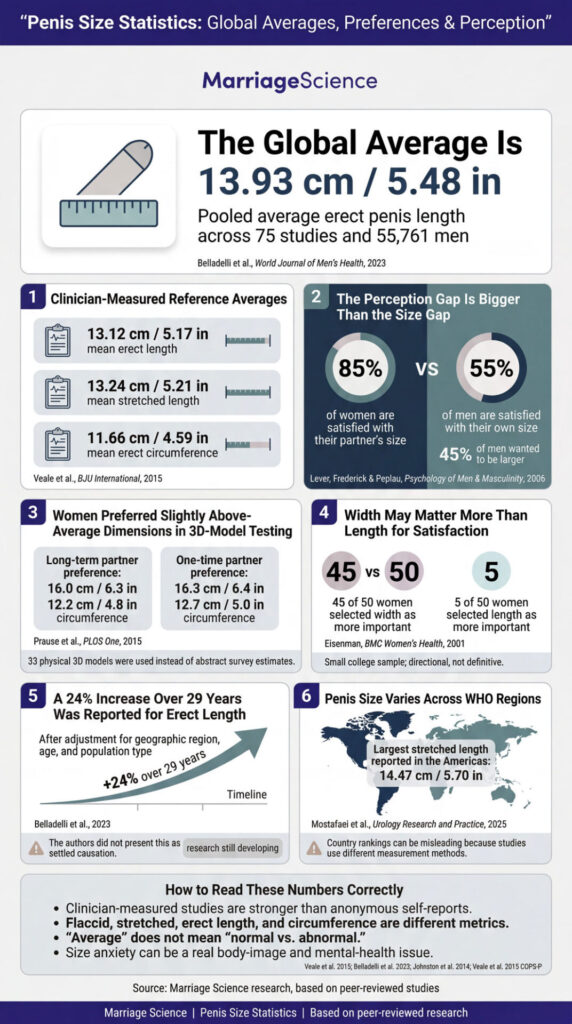
13.93 cm (5.48 in) is the pooled global average erect penis length across 75 studies and 55,761 men, making the 2023 Belladelli meta-analysis the most current large-scale benchmark for penis size statistics in 2026 (Belladelli et al., World Journal of Men’s Health 2023). The older but still clinically important Veale et al. nomograms place mean erect length at 13.12 cm (5.17 in), stretched length at 13.24 cm (5.21 in), and erect circumference at 11.66 cm (4.59 in) (Veale et al., BJU International 2015).
Across 17 studies of 15,521 men, the average erect penis measured 13.12 cm (about 5.2 inches) in length, with a standard deviation of 1.66 cm.
The perception gap is larger than the anatomical gap. 85% of women reported satisfaction with their partner’s penis size, while only 55% of men reported satisfaction with their own (Lever, Frederick & Peplau, Psychology of Men & Masculinity 2006). Belladelli et al. also reported a 24% increase in adjusted erect length over 29 years, a finding the authors note may partly reflect changing measurement protocols rather than population change alone. All measurement figures below come from clinical assessment by health professionals unless noted, drawn from peer-reviewed studies indexed in PubMed and PMC and published in BJU International, World Journal of Men’s Health, PLOS One, Psychology of Men & Masculinity, and Archives of Sexual Behavior.
Key Takeaways
- 13.93 cm (5.48 in) is the pooled mean erect penis length across 75 studies and 55,761 men (Belladelli et al., World Journal of Men’s Health 2023).
- 13.12 cm (5.17 in) is the clinician-measured mean erect length in the Veale et al. nomograms (Veale et al., BJU International 2015).
- 11.66 cm (4.59 in) is the clinician-measured mean erect circumference in Veale et al. (Veale et al., BJU International 2015).
- 24% is the reported increase in erect penis length over 29 years after adjustment for region, age, and population type (Belladelli et al., World Journal of Men’s Health 2023).
- 85% of women reported satisfaction with their partner’s penis size, compared with 55% of men satisfied with their own size (Lever, Frederick & Peplau, Psychology of Men & Masculinity 2006).
- 16.0 cm (6.3 in) length and 12.2 cm (4.8 in) circumference were selected by women as the preferred long-term partner dimensions in a 3D-model study (Prause et al., PLOS One 2015).
- 16.3 cm (6.4 in) length and 12.7 cm (5.0 in) circumference were selected for a one-time partner in the same 3D-model study (Prause et al., PLOS One 2015).
- 45 of 50 women in Eisenman’s small college sample rated width as more important than length for sexual satisfaction (Eisenman, BMC Women’s Health 2001).
- 66% of men rated their own penis size as average, but 45% still wanted to be larger (Lever, Frederick & Peplau, Psychology of Men & Masculinity 2006).
- Penis size varies significantly across WHO regions, with stretched length largest in the Americas at 14.47 cm (5.70 in) in Mostafaei et al.’s WHO-region meta-analysis (Mostafaei et al., Urology Research and Practice 2025).
- Lower male genital self-image is associated with higher depression and anxiety scores, making size perception a documented mental-health topic, not only a sexual-anatomy topic (Sonbahar et al., 2024).
1. Global Averages and Nomograms
A nomogram is a clinical reference chart that shows where an individual measurement falls within a broader distribution.
Veale et al.’s 15,521-man synthesis remains the clinical reference standard because it used standardized health-professional measurements and excluded men with penile abnormality, previous surgery, erectile dysfunction, or explicit small-penis complaints.
That makes it more useful for counseling than anonymous self-reported data, which tends to run higher than clinician-measured estimates and is vulnerable to overestimation.
The practical takeaway is that “average” is not a single fixed point. Belladelli et al. gives the most current pooled estimate, while Veale et al. gives the most clinically interpretable nomogram. Use both, but do not mix clinician-measured, self-reported, flaccid, stretched, and erect measurements as if they describe the same variable. Source link: Veale et al., BJU International 2015.
| Metric | Value | Source |
| Flaccid length | 9.16 cm (3.61 in) | Veale et al., BJU International 2015 |
| Stretched length | 13.24 cm (5.21 in) | Veale et al., BJU International 2015 |
| Erect length, clinician-measured | 13.12 cm (5.17 in) | Veale et al., BJU International 2015 |
| Pooled erect length | 13.93 cm (5.48 in) | Belladelli et al., World Journal of Men’s Health 2023 |
| Flaccid circumference | 9.31 cm (3.67 in) | Veale et al., BJU International 2015 |
| Erect circumference | 11.66 cm (4.59 in) | Veale et al., BJU International 2015 |
| Pooled flaccid length by WHO-region meta-analysis | 9.10 cm figure reported for pooled flaccid circumference; use Mostafaei table carefully by measurement type | Mostafaei et al., Urology Research and Practice 2025 |
| Micropenis clinical threshold | Commonly defined as stretched length 2.5 SD below the mean; avoid using this article as a diagnostic tool | Wessells et al., Journal of Urology 1996 / clinical convention |
Keep In Mind
Do not present a single “micropenis cutoff” without age, pubertal status, and measurement method. In adult research, the threshold is usually defined statistically as stretched length more than 2.5 standard deviations below the mean, but diagnosis belongs in clinical care, not online self-measurement.
Readers weighing up what they want in a partner often find it helpful to see where real-world dating actually happens, which is where our guide to the best dating sites comes in.
What Counts as “Normal” Penis Size?
The strongest clinical answer is percentile-based, not a single number. Veale et al. built nomograms from up to 15,521 men, which means the practical question is not whether someone is above or below average, but where they fall in the distribution.
A man below the mean can still be well within the normal anatomical range, which is why nomograms are useful in urology and psychosexual counseling (Veale et al., BJU International 2015).
| Metric | Value | Source |
| Total men included across nomograms | Up to 15,521 | Veale et al., BJU International 2015 |
| Simulated observations used to generate nomograms | 20,000 | Veale et al., BJU International 2015 |
| Minimum sample size per eligible study | 50 participants | Veale et al., BJU International 2015 |
| Mean erect length | 13.12 cm (5.17 in) | Veale et al., BJU International 2015 |
| SD for erect length | 1.66 cm (0.65 in) | Veale et al., BJU International 2015 |
| Mean erect circumference | 11.66 cm (4.59 in) | Veale et al., BJU International 2015 |
| SD for erect circumference | 1.10 cm (0.43 in) | Veale et al., BJU International 2015 |
| Strongest consistent correlation | Height with stretched or erect length, r = 0.2–0.6 | Veale et al., BJU International 2015 |
Transparent math: Using Veale’s mean erect length of 13.12 cm and SD of 1.66 cm, one standard deviation below the mean is 11.46 cm (4.51 in), and one standard deviation above is 14.78 cm (5.82 in). That means many men substantially below or above the mean remain within a statistically ordinary range.
2. Regional and Country Variation
Mostafaei et al.’s WHO-region meta-analysis found significant variation across all six WHO regions, with stretched length largest in the Americas at 14.47 cm (5.70 in).
This does not mean country rankings are clinically precise. Regional figures are highly sensitive to study inclusion, measurement protocol, recruitment setting, and whether measurements were flaccid, stretched, erect, or circumferential. Source link: Mostafaei et al., Urology Research and Practice 2025.
| Metric | Value | Source |
| WHO regions analyzed | 6 regions | Mostafaei et al., Urology Research and Practice 2025 |
| Largest stretched length by region | Americas: 14.47 cm (5.70 in) | Mostafaei et al., 2025 |
| Largest flaccid length by region | Americas: 10.98 cm (4.32 in) | Mostafaei et al., 2025 |
| Largest flaccid circumference by region | Americas: 10.00 cm (3.94 in) | Mostafaei et al., 2025 |
| Pooled flaccid circumference sample | n = 30,117 | Mostafaei et al., 2025 |
| Pooled erect circumference sample | n = 5,168 | Mostafaei et al., 2025 |
| Main conclusion | Penis size varies across WHO regions | Mostafaei et al., 2025 |
Country-level penis size lists are often misleading because they combine different study designs. For a clinical or educational article, WHO-region estimates are safer than ranking countries by isolated datasets.
Penis Size by Country: What National Studies Measured
No study has measured men in every country with one method, so a true country ranking does not exist. The closest evidence is national studies that measured large samples of local men.
| Country | Method | Average Length | Source |
| United States (1,661 men) | Erect, self-measured | 14.15 cm (5.57 in) | Herbenick et al., J Sex Med 2014 |
| Turkey (2,276 men) | Stretched | 13.98 cm (5.50 in) | Söylemez et al., Int J Impot Res 2012 |
| China (5,196 men) | Stretched | 12.9 cm (5.08 in) | Chen et al., Int J Impot Res 2014 |
| Italy (3,300 men, aged 17 to 19) | Stretched, median | 12.5 cm (4.92 in) | Ponchietti et al., Eur Urol 2001 |
| Iran (1,500 men) | Stretched | 11.58 cm (4.56 in) | Mehraban et al., Int J Impot Res 2007 |
| India (301 men) | Stretched | 10.88 cm (4.28 in) | Promodu et al., Int J Impot Res 2007 |
Stretched length in these studies runs from 10.88 cm in India to 13.98 cm in Turkey. The studies differ in age range, recruitment and how they report the average (the Italian study gives a median), so a gap between two countries is not a clean biological difference.
The US figure is the only erect, self-measured result in the table. It lines up with the erect averages elsewhere on this page. The stretched figures above it measure a different thing.
3. The 24% Temporal Increase: What Belladelli 2023 Found
Belladelli et al.’s 24% temporal increase is one of the most discussed findings in penis size research because it appeared specifically for erect length, not for flaccid or stretched length. The authors used meta-regression and reported that erect length increased significantly over time after adjustment for geographic region, age, and population type.
They did not present the finding as settled causation; they suggested that environmental and developmental factors, including endocrine-disrupting exposures, deserve investigation in parallel with broader male reproductive-health trends. Source link: Belladelli et al., PubMed.
| Metric | Value | Source |
| Studies included | 75 studies | Belladelli et al., World Journal of Men’s Health 2023 |
| Men included | 55,761 | Belladelli et al., 2023 |
| Publication years covered | 1942 to 2021 | Belladelli et al., 2023 |
| Pooled flaccid length | 8.70 cm (3.43 in) | Belladelli et al., 2023 |
| Pooled stretched length | 12.93 cm (5.09 in) | Belladelli et al., 2023 |
| Pooled erect length | 13.93 cm (5.48 in) | Belladelli et al., 2023 |
| Temporal change | 24% increase in erect length over 29 years | Belladelli et al., 2023 |
| Statistical signal | Erect length increased over time; QM = 4.49, df = 2, p = 0.04 | Belladelli et al., 2023 |
Methodological caveat: Flaccid size is especially variable because temperature, anxiety, recent activity, and autonomic state can affect measurement. This is one reason clinical research separates flaccid, stretched, and erect metrics.
Penis Girth and Circumference Statistics
Circumference receives less public attention than length, but several partner-preference studies suggest girth may be at least as salient as length in subjective sexual satisfaction. Clinician-measured circumference data are thinner than length data, especially for erect circumference, which is why Veale’s erect-circumference sample of 381 men should be treated as useful but smaller than the length nomograms (Veale et al., BJU International 2015).
| Metric | Value | Source |
| Mean erect circumference | 11.66 cm (4.59 in) | Veale et al., BJU International 2015 |
| SD for erect circumference | 1.10 cm (0.43 in) | Veale et al., BJU International 2015 |
| Erect circumference sample size | 381 men | Veale et al., BJU International 2015 |
| Mean flaccid circumference | 9.31 cm (3.67 in) | Veale et al., BJU International 2015 |
| SD for flaccid circumference | 0.90 cm (0.35 in) | Veale et al., BJU International 2015 |
| Flaccid circumference sample size | 9,407 men | Veale et al., BJU International 2015 |
| Preferred long-term partner circumference | 12.2 cm (4.8 in) | Prause et al., PLOS One 2015 |
| Preferred one-time partner circumference | 12.7 cm (5.0 in) | Prause et al., PLOS One 2015 |
Context note: In Eisenman’s 50-participant college sample, 45 of 50 women reported width as more important than length for sexual satisfaction, but the study is old and narrow, so it should be framed as directional, not definitive (Eisenman, BMC Women’s Health 2001).
Women’s Preferences: What 3D-Model Research Actually Found
The strongest preference study is not a survey asking women to imagine numbers; Prause et al. used 33 three-dimensional models to make size selection more concrete. The result was not an extreme preference. Women selected dimensions modestly above average, with slightly larger preferred dimensions for one-time partners than long-term partners (Prause et al., PLOS One 2015).
| Metric | Value | Source |
| Models used | 33 3D models | Prause et al., PLOS One 2015 |
| Long-term preferred length | 16.0 cm (6.3 in) | Prause et al., PLOS One 2015 |
| Long-term preferred circumference | 12.2 cm (4.8 in) | Prause et al., PLOS One 2015 |
| One-time preferred length | 16.3 cm (6.4 in) | Prause et al., PLOS One 2015 |
| One-time preferred circumference | 12.7 cm (5.0 in) | Prause et al., PLOS One 2015 |
| Direction of preference | Slightly larger than average | Prause et al., PLOS One 2015 |
| Key methodological advantage | Haptic 3D selection rather than abstract rating | Prause et al., PLOS One 2015 |
Transparent math: Compared with Belladelli’s pooled erect average of 13.93 cm (5.48 in), the Prause long-term preference of 16.0 cm (6.3 in) is 2.07 cm (0.81 in) longer. Compared with Veale’s clinician-measured erect average of 13.12 cm (5.17 in), it is 2.88 cm (1.13 in) longer.
Partner Satisfaction vs. Male Self-Perception
The satisfaction gap is one of the clearest patterns in the literature: men are more concerned about their own penis size than women report being about their partner’s penis size. In Lever, Frederick & Peplau’s 52,031-person survey, 84% to 85% of women were satisfied with their partner’s size, while only 55% of men were satisfied with their own size (Lever, Frederick & Peplau, Psychology of Men & Masculinity 2006).
| Metric | Value | Source |
| Total survey sample | 52,031 heterosexual men and women | Lever, Frederick & Peplau, Psychology of Men & Masculinity 2006 |
| Men rating their penis average | 66% | Lever, Frederick & Peplau, 2006 |
| Men rating their penis large | 22% | Lever, Frederick & Peplau, 2006 |
| Men rating their penis small | 12% | Lever, Frederick & Peplau, 2006 |
| Men satisfied with their penis size | 55% | Lever, Frederick & Peplau, 2006 |
| Men wanting to be larger | 45% | Lever, Frederick & Peplau, 2006 |
| Women satisfied with partner’s penis size | 84% to 85% | Lever, Frederick & Peplau, 2006 |
| Women wanting partner to be larger | 14% | Lever, Frederick & Peplau, 2006 |
Context note: This was an Internet survey, not a clinician-measured anatomical study. Its value is perception and satisfaction, not objective size distribution.
With so much of the concern rooted in perception rather than anatomy, it’s no surprise more men are exploring lower-pressure, private ways to build intimacy and confidence – from dating apps to AI companions like Candy AI.
Width vs. Length: What Preference Studies Suggest
The length-only framing is incomplete. Eisenman’s small but frequently cited study found that 45 of 50 sexually active female undergraduates selected width over length as more important for sexual satisfaction, and earlier work cited by Lever et al. found that 33% of women rated girth as important compared with 21% rating length as important (Eisenman, BMC Women’s Health 2001; Lever, Frederick & Peplau, Psychology of Men & Masculinity 2006).
| Metric | Value | Source |
| Eisenman sample size | 50 sexually active female undergraduates | Eisenman, BMC Women’s Health 2001 |
| Women selecting width as more important | 45 of 50 | Eisenman, 2001 |
| Women selecting length as more important | 5 of 50 | Eisenman, 2001 |
| Result significance | p < .001 | Eisenman, 2001 |
| Women rating length important in cited prior study | 21% | Francken et al., cited in Lever et al. 2006 |
| Women rating girth important in cited prior study | 33% | Francken et al., cited in Lever et al. 2006 |
Context note: Eisenman’s sample was small, young, and undergraduate-based. It should not be generalized to all women, all age groups, or all relationship contexts.
Penis Size, Body Image, and Self-Esteem
Penis size is part of male body image, not just sexual anatomy. Tiggemann, Martins & Churchett found that heterosexual men reported dissatisfaction across six body domains and worried especially about body weight, penis size, and height. Johnston, McLellan & McKinlay found that penile dissatisfaction was related to comfort with others seeing the penis and likelihood of seeking medical advice for penile or sexual function (Tiggemann et al., Journal of Health Psychology 2008; Johnston, McLellan & McKinlay, Psychology of Men & Masculinity 2014).
| Metric | Value | Source |
| Tiggemann sample | 200 heterosexual men | Tiggemann et al., Journal of Health Psychology 2008 |
| Body domains studied | Weight, muscularity, height, penis size, head hair, body hair | Tiggemann et al., 2008 |
| Primary worry domains | Body weight, penis size, height | Tiggemann et al., 2008 |
| Domains linked to appearance self-esteem | Weight, muscularity, height, penis size | Tiggemann et al., 2008 |
| Johnston sample | 110 heterosexual individuals | Johnston, McLellan & McKinlay, 2014 |
| Men in Johnston sample | 67 men | Johnston, McLellan & McKinlay, 2014 |
| Women in Johnston sample | 43 women | Johnston, McLellan & McKinlay, 2014 |
| Key finding | Men showed penile dissatisfaction despite perceiving themselves as average | Johnston, McLellan & McKinlay, 2014 |
A contextual internal link can fit here if the article discusses relationship anxiety and sexual confidence: Marriage Science’s broader relationship statistics content can support readers who want non-anatomical relationship context.
Penile Dysmorphic Disorder, Small Penis Anxiety, and Clinical Distress
Penile dysmorphic disorder is best understood as a penis-focused presentation within the body dysmorphic disorder spectrum, while small penis anxiety describes clinically relevant anxiety about size that may not meet BDD-level severity. Veale et al. developed the COPS-P screening scale to distinguish men with PDD from men with small penis anxiety and controls, emphasizing that distress can be clinically significant even when measurements fall in the normal range (Veale et al., Journal of Sexual Medicine 2015).
| Metric | Value | Source |
| Condition | Penile dysmorphic disorder | Veale et al., Journal of Sexual Medicine 2015 |
| Related construct | Small penis anxiety | Veale et al., 2015 |
| Screening tool | COPS-P | Veale et al., 2015 |
| Final scale length | 9 items | Veale et al., 2015 |
| Validation purpose | Distinguish PDD, small penis anxiety, and controls | Veale et al., 2015 |
| Clinical use case | Referral decisions in urology, psychosexual counseling, psychiatric settings | Veale et al., 2015 |
Clinical note: Size-related distress should not be trivialized. The literature links penile dissatisfaction with avoidance, shame, reduced comfort being seen, and medical help-seeking behavior; this is a mental-health and sexual-health issue, not a punchline (Johnston, McLellan & McKinlay, Psychology of Men & Masculinity 2014; Veale et al., Journal of Sexual Medicine 2015).
Methodology: Why Self-Reported Penis Size Is Less Reliable
The strongest anatomical figures come from clinician-measured studies. Self-report data are still useful for perception and satisfaction, but not for establishing biological averages. Veale et al. required health-professional measurement and standard procedures; Belladelli et al. required investigator measurement from the pubo-penile junction to the glans tip on the dorsal surface. That is materially stronger than anonymous self-estimation (Veale et al., BJU International 2015; Belladelli et al., World Journal of Men’s Health 2023).
| Methodological issue | Why it matters | Stronger source type |
| Self-report | Can overestimate due to social desirability and recall error | Clinician-measured studies |
| Small samples | Increase uncertainty and reduce generalizability | Meta-analyses |
| Volunteer recruitment | Attracts people unusually interested in size | Population-diverse sampling |
| Erect measurement rarity | Harder to collect clinically | Larger pooled meta-analyses |
| Flaccid variability | Temperature and stress affect size | Separate flaccid/stretched/erect categories |
| Regional rankings | Sensitive to study mix and measurement method | Region-adjusted meta-analysis |
40+ Penis Size Statistics for 2026
Most of what people think they know about penis size comes from locker-room talk, porn, and bad survey data. The statistics below come from a different place: peer-reviewed meta-analyses with tens of thousands of clinically measured men, large preference studies, and validated body-image research. Here is what the actual evidence shows.
Global averages
- Global average erect penis length is 13.93 cm (5.48 in), pooled across 75 studies and 55,761 men.
- Global average stretched length is 12.93 cm (5.09 in).
- Global average flaccid length is 8.70 cm (3.43 in).
- A separate large study found mean erect length of 13.12 cm (5.17 in).
- The same study found mean stretched length of 13.24 cm (5.21 in).
- Mean flaccid length was 9.16 cm (3.61 in).
- Mean erect circumference is 11.66 cm (4.59 in).
- Mean flaccid circumference is 9.31 cm (3.67 in).
- Height correlates with stretched and erect length at r = 0.2 to 0.6.
Change over time
- Average erect length increased by 24% over 29 years after adjustment.
What women prefer
- For a long-term partner, women selected an average length of 16.0 cm (6.3 in).
- For a long-term partner, women selected an average circumference of 12.2 cm (4.8 in).
- For a one-time partner, women selected an average length of 16.3 cm (6.4 in).
- For a one-time partner, women selected an average circumference of 12.7 cm (5.0 in).
- Researchers concluded women prefer only slightly above-average dimensions.
- 45 out of 50 women rated width as more important than length for sexual satisfaction.
Men’s self-perception (survey of 52,031)
- 66% of men rated their penis as average.
- 22% of men rated their penis as large.
- 12% of men rated their penis as small.
- 55% of men were satisfied with their penis size.
- 45% of men wanted a larger penis.
- 0.2% of men wanted a smaller penis.
How women see their partners
- 84 to 85% of women were satisfied with their partner’s penis size.
- 14% of women wanted their partner to be larger.
- 2% of women wanted their partner to be smaller.
- 67% of women rated their partner’s penis as average.
- 27% of women rated their partner’s penis as large.
- 6% of women rated their partner’s penis as small.
Mental health and body image
- Men’s top three appearance worries are body weight, penis size, and height.
- Penis size is related to overall appearance self-esteem in men.
- Penile dissatisfaction occurs even among men who correctly perceive themselves as average.
- A validated 9-item tool (COPS-P) distinguishes penile dysmorphic disorder, small penis anxiety, and normal concern.
Regional variation
- Penis size varies significantly across WHO regions.
- The Americas region has the largest mean flaccid length at 10.98 cm (4.32 in).
- The Americas region has the largest mean flaccid circumference at 10.00 cm (3.94 in).
FAQ
What is the average erect penis size in 2026?
The best current pooled estimate is 13.93 cm (5.48 in) for erect length, based on Belladelli et al.’s 75-study meta-analysis of 55,761 men (Belladelli et al., World Journal of Men’s Health 2023). Veale et al.’s clinician-measured nomogram gives a lower mean of 13.12 cm (5.17 in), which remains one of the most clinically useful references (Veale et al., BJU International 2015).
What is the average penis girth?
Veale et al. reported mean erect circumference of 11.66 cm (4.59 in) and mean flaccid circumference of 9.31 cm (3.67 in) (Veale et al., BJU International 2015).
Do women prefer a much larger-than-average penis?
No. In the strongest 3D-model study, women preferred dimensions only modestly above average: 16.0 cm (6.3 in) length and 12.2 cm (4.8 in) circumference for long-term partners, and 16.3 cm (6.4 in) length and 12.7 cm (5.0 in) circumference for one-time partners (Prause et al., PLOS One 2015).
Are men more worried about penis size than partners are?
Yes. In a 52,031-person survey, 84% to 85% of women were satisfied with their partner’s penis size, while only 55% of men were satisfied with their own penis size (Lever, Frederick & Peplau, Psychology of Men & Masculinity 2006).
Is small penis anxiety a real clinical concern?
Yes. Small penis anxiety and penile dysmorphic disorder are documented in clinical literature. Veale et al. developed the COPS-P screening scale to distinguish penile dysmorphic disorder from small penis anxiety and control groups (Veale et al., Journal of Sexual Medicine 2015).
Source Notes
The most reliable anatomical estimates come from clinician-measured studies and meta-analyses. The most useful preference and perception estimates come from survey and experimental studies, but these answer different questions.
Self-reported penis size should not be used as the primary benchmark for anatomical averages. It is better used to understand perception, dissatisfaction, and body-image concerns.
Older studies such as Eisenman 2001, Lever/Frederick/Peplau 2006, Tiggemann 2008, and Veale 2015 remain cited because they are among the most comprehensive or methodologically relevant sources available for specific questions. They should be labeled as “most comprehensive available” where newer primary data are limited.
A final internal link can fit in a closing paragraph about body image, dating confidence, and relationship behavior: readers interested in broader dating and attraction trends can compare this topic with Marriage Science’s online dating statistics and Tinder statistics reports.