


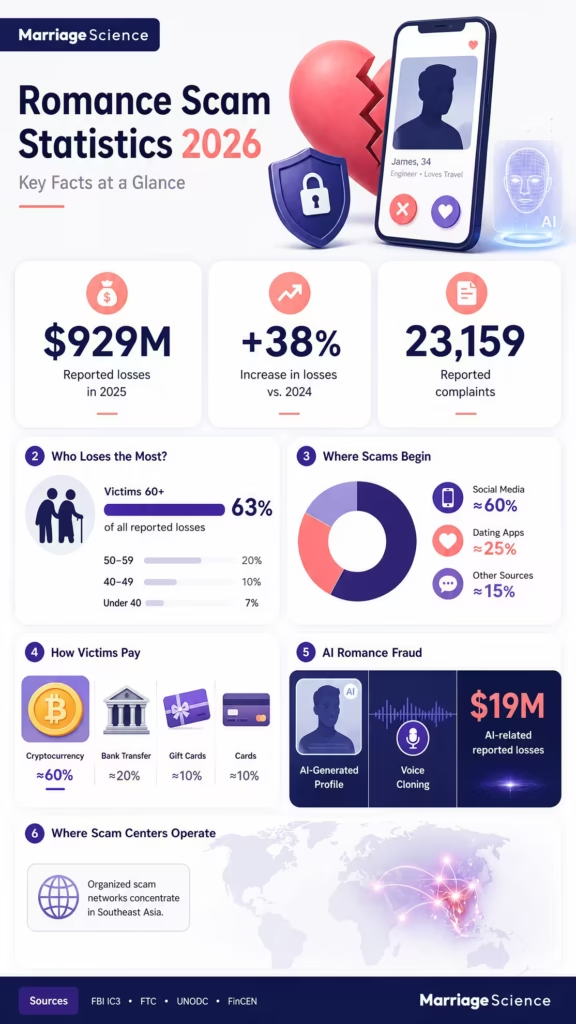
Americans reported losing $929,287,469 to confidence and romance fraud in 2025, the highest annual total the FBI has ever recorded for the category (FBI Internet Crime Complaint Center, 2025 Internet Crime Report). That total is 38% higher than 2024, against a 29% rise in complaint volume. Victims aged 60 and over accounted for $584,032,745 of the total, roughly 63 cents of every dollar. Romance fraud now ranks fifth among all cyber-enabled crime types by loss, ahead of government impersonation and ransomware.
We aggregated data from the FBI Internet Crime Complaint Center, the FTC Consumer Sentinel Network, the Financial Crimes Enforcement Network, the United Nations Office on Drugs and Crime, and peer-reviewed research to compile this reference. Every figure below is traced to the agency or study that produced it.
Confidence/Romance Fraud: An individual believes they are in a relationship (family, friendly, or romantic) and are tricked into sending money, personal and financial information, or items of value to the perpetrator.
Key Takeaways
- $929,287,469 was lost to confidence and romance fraud in 2025, up from $672,009,052 in 2024 and $652,544,805 in 2023 (FBI IC3, 2025 Internet Crime Report).
- 23,159 romance fraud complaints were filed in 2025, compared with 17,910 in 2024 (FBI IC3, 2025 Internet Crime Report).
- Victims 60 and over lost $584,032,745, which is 63% of all reported romance fraud losses from 44% of the complaints (FBI IC3, 2025 Elder Fraud data).
- Nearly 60% of people who lost money to a romance scam in 2025 said the first contact came through a social media platform (FTC Data Spotlight, April 2026).
- $298 million was lost to romance scams that originated on social media platforms in 2025 (FTC Data Spotlight, April 2026).
- Cryptocurrency was involved in 5,925 romance fraud complaints in 2025, worth $394,787,515 in losses, or 42% of the category total (FBI IC3, 2025 Internet Crime Report).
- Romance scams with a documented artificial intelligence component cost victims $19,041,653 across 626 complaints in 2025 (FBI IC3, 2025 Internet Crime Report).
- The median reported loss to a romance scam was $2,000 in 2023, the highest of any imposter scam category tracked by the FTC (FTC, Consumer Sentinel Data Book analysis 2024).
- Cryptocurrency and bank wires accounted for more than 60% of reported romance scam losses, while gift cards were the most frequently reported method at 24% of loss reports (FTC Data Spotlight, February 2023).
- Cyber-enabled fraud in East and Southeast Asia caused losses of $18 billion to $37 billion in 2023, most of it attributed to organized crime groups running scam compounds (UNODC, Inflection Point 2025).
- The United States reported $10 billion in losses to scam operations based in Southeast Asia in 2024 (UNODC, March 2026).
- Only 4.8% of people who experience mass-market consumer fraud report it to a government entity or the Better Business Bureau, so every figure on this page describes a fraction of the real harm (Anderson, K. B., FTC Bureau of Economics, 2021).
- Victims 60 and over lost $540,505,980 to follow-up recovery scams run by fictitious law firms promising to retrieve stolen funds (FBI IC3, 2025 Internet Crime Report).
1. Reported Losses and Report Volume
Losses grew 38% in a single year against a 29% rise in complaints, so the average loss per victim rose as well. The category has roughly doubled since 2019 by the FTC’s count and has risen every year since the FBI began separating confidence fraud into its own crime type.
The two federal datasets on this page are not additive. The FBI counts complaints filed with the Internet Crime Complaint Center under “Confidence/Romance,” a definition that also captures grandparent and distress scams. The FTC counts romance scams as a subcategory of imposter fraud inside the Consumer Sentinel Network, which ingests IC3 reports along with submissions from state attorneys general and the Better Business Bureau. Adding the two totals together double counts every report that reached both systems.
| Metric | Value | Source |
| Reported losses to confidence/romance fraud, 2025 | $929,287,469 | FBI IC3, 2025 Internet Crime Report |
| Reported losses, 2024 | $672,009,052 | FBI IC3, 2025 Internet Crime Report |
| Reported losses, 2023 | $652,544,805 | FBI IC3, 2025 Internet Crime Report |
| Complaints filed, 2025 | 23,159 | FBI IC3, 2025 Internet Crime Report |
| Complaints filed, 2024 | 17,910 | FBI IC3, 2025 Internet Crime Report |
| Rank among all crime types by loss, 2025 | 5th of 27 | FBI IC3, 2025 Internet Crime Report |
| FTC-tracked romance scam losses, 2023 | $1.14 billion across 64,003 reports | FTC, Consumer Sentinel analysis 2024 |
| FTC-tracked romance scam losses, 2019 | $493 million | FTC Data Spotlight, February 2023 |
| Median reported loss per victim, 2023 | $2,000 | FTC, Consumer Sentinel analysis 2024 |
For scale, all cyber-enabled crime reported to the FBI in 2025 totaled $20.877 billion across 1,008,597 complaints, so romance fraud is about 4.5% of reported losses (FBI IC3, 2025 Internet Crime Report).
2. Who Gets Targeted: Age and the Victim Profile
Complaint counts climb steadily with age, but losses climb far faster. People in their twenties filed 1,886 romance fraud complaints in 2025 and lost $25.1 million, an average of about $13,300. People 60 and over filed 10,188 complaints and lost $584 million, an average of about $57,300. The gap is not explained by gullibility. Older victims hold retirement accounts, home equity, and life savings that a scammer can drain in a single transfer, and they are likelier to be socially isolated during the grooming phase.
Losses among victims 60 and over grew 50% year over year, from $389,312,356 in 2024. Elder fraud across all crime types reached $7.748 billion in 2025, a 59% increase, with an average loss of $38,500 per victim.
| Metric | Value | Source |
| Losses, victims under 20 | $3,057,718 across 393 complaints | FBI IC3, 2025 Internet Crime Report |
| Losses, victims 20 to 29 | $25,097,693 across 1,886 complaints | FBI IC3, 2025 Internet Crime Report |
| Losses, victims 30 to 39 | $42,460,967 across 2,501 complaints | FBI IC3, 2025 Internet Crime Report |
| Losses, victims 40 to 49 | $74,644,395 across 3,010 complaints | FBI IC3, 2025 Internet Crime Report |
| Losses, victims 50 to 59 | $131,385,454 across 3,745 complaints | FBI IC3, 2025 Internet Crime Report |
| Losses, victims 60 and over | $584,032,745 across 10,188 complaints | FBI IC3, 2025 Internet Crime Report |
| Growth in 60+ romance losses, 2024 to 2025 | 50% | FBI IC3, 2025 Internet Crime Report |
| Total elder fraud losses, all crime types, 2025 | $7.748 billion, up 59% | FBI IC3, 2025 Elder Fraud data |
Peer-reviewed work on the victim profile is thinner than the loss data and older. A study comparing romance scam victims with people who had never been defrauded found victimization associated with impulsivity, an addictive disposition, and a tendency to idealize romantic partners, with middle-aged and well-educated women overrepresented (Whitty, M. T., “Do You Love Me? Psychological Characteristics of Romance Scam Victims,” 2018). Sample sizes in this literature are small, and the finding on education runs against the intuition that scam victims are unsophisticated.
The behavioral signals that precede a financial request overlap heavily with the relationship red flags that show up in legitimate but unhealthy relationships, which is part of why the grooming phase works.
3. Where Romance Scams Start
Dating apps are no longer the primary hunting ground. Nearly 60% of people who reported losing money to a romance scam in 2025 said the contact began on a social media platform.
In 2022 that share was 40%, with another 19% starting on a website or app. The shift matters for prevention advice: platform verification features, profile reporting tools, and photo checks are concentrated on dating services, while an unsolicited direct message on Instagram or Facebook arrives with none of that friction.
Reported losses to all social media scams reached $2.1 billion in 2025, roughly eight times the 2020 figure, and romance scams were the second largest component behind shopping fraud.
| Metric | Value | Source |
| Romance scam loss reports starting on social media, 2025 | Nearly 60% | FTC Data Spotlight, April 2026 |
| Romance scam losses originating on social media, 2025 | $298 million | FTC Data Spotlight, April 2026 |
| Romance scam loss reports starting on social media, 2022 | 40% | FTC Data Spotlight, February 2023 |
| Romance scam loss reports starting on a website or app, 2022 | 19% | FTC Data Spotlight, February 2023 |
| Total social media scam losses, 2025 | $2.1 billion | FTC Data Spotlight, April 2026 |
| Share of 18 to 29 year olds whose scam loss started on social media | 40% | FTC Data Spotlight, April 2026 |
| Share of people 80 and over whose scam loss started on social media | 14% | FTC Data Spotlight, April 2026 |
| Growth in sextortion reports since 2019 | More than eightfold | FTC Data Spotlight, February 2023 |
Sextortion follows a different age curve than the rest of the category. People aged 18 to 29 reported sextortion at over six times the rate of people 30 and over, and 58% of those reports named social media as the point of contact, with Instagram and Snapchat most frequently cited (FTC Data Spotlight, February 2023).
Platform choice also shapes exposure, a pattern visible in the wider dating app statistics on user age and volume.
4. How the Money Moves
Payment method decides whether money can be clawed back, and romance scammers steer victims toward the two channels with the weakest reversal rights. Cryptocurrency and bank wires together accounted for more than 60% of reported romance scam losses. Gift cards show the opposite pattern: most frequently reported at 24% of loss reports, but smaller per incident.
The crypto share reflects a structural merge between romance fraud and investment fraud. In the pattern regulators call a relationship investment scam, the romance is the acquisition channel and the fake trading platform is the extraction mechanism. FinCEN issued a dedicated alert on it in September 2023 and received more than 8,600 suspicious activity reports referencing that alert.
| Metric | Value | Source |
| Share of romance scam losses paid via crypto and bank wire | More than 60% | FTC Data Spotlight, February 2023 |
| Share of romance scam loss reports involving gift cards | 24% | FTC Data Spotlight, February 2023 |
| Romance fraud complaints with a cryptocurrency nexus, 2025 | 5,925 | FBI IC3, 2025 Internet Crime Report |
| Romance fraud losses with a cryptocurrency nexus, 2025 | $394,787,515 | FBI IC3, 2025 Internet Crime Report |
| Share of romance fraud losses involving crypto, 2025 | 42% | Calculated from FBI IC3, 2025 |
| US crypto scam losses attributed to pig butchering, 2023 | $4.4 billion of $5.6 billion | UNODC, Inflection Point 2025 |
| Suspicious activity reports citing the FinCEN pig butchering alert | More than 8,600 | FinCEN, 2024 |
| Share of romance scam reports where the scammer claimed investment success, 2022 | 18% | FTC, Consumer Sentinel analysis 2024 |
The most common excuse for requesting money is still the oldest one. In 2022 reports, 24% of romance scammers claimed that they or a family member were sick, hurt, or in jail (FinCEN Alert FIN-2023-Alert005 documents the investment variant in detail).
5. AI-Enabled Romance Fraud
The FBI recorded $19,041,653 in romance fraud losses with a documented artificial intelligence component in 2025, across 626 complaints. That figure is a floor. A victim only knows AI was involved if something exposed it, and the FBI notes that victims often never learn how the profile or the voice was produced. Investment fraud shows the same gap at larger scale: $632 million in AI-linked losses inside a category totaling $8.6 billion.
The reported uses are consistent: generated profile photos, chat scripts that hold a conversation across time zones, cloned voices for phone calls, and forged identification documents when a victim asks for proof. Distress scams, where a cloned voice imitates a relative in an emergency, cost victims more than $5 million in 2025 and are counted inside the same category.
| Metric | Value | Source |
| Romance fraud losses with an AI nexus, 2025 | $19,041,653 | FBI IC3, 2025 Internet Crime Report |
| Romance fraud complaints with an AI nexus, 2025 | 626 | FBI IC3, 2025 Internet Crime Report |
| Losses to voice-cloning distress scams, 2025 | More than $5 million | FBI IC3, 2025 Internet Crime Report |
| Investment fraud losses with an AI nexus, 2025 | $632,041,188 | FBI IC3, 2025 Internet Crime Report |
| Total complaints flagged as AI related, all crime types, 2025 | 22,364 | FBI IC3, 2025 Internet Crime Report |
| AI-linked complaints with a cryptocurrency nexus, 2025 | 7,623 | FBI IC3, 2025 Internet Crime Report |
6. The Global Scam-Center Economy
Individual romance scams are the retail end of an industrial operation. UNODC estimates that cyber-enabled fraud caused $18 billion to $37 billion in losses across East and Southeast Asia in 2023, the majority attributed to organized crime groups running fortified compounds in the Mekong region. The United States alone reported $10 billion in losses to scam operations based in that region in 2024.
Much of the labor is coerced. The people sending the messages are frequently trafficking victims recruited with fake job listings, held in compounds, and given quotas. That fact rarely appears in consumer-facing scam advice, and it explains why blocking one account changes nothing. The next shift logs in from the same compound.
| Metric | Value | Source |
| Cyber-enabled fraud losses, East and Southeast Asia, 2023 | $18 billion to $37 billion | UNODC, Inflection Point 2025 |
| US losses to Southeast Asia based scam operations, 2024 | $10 billion | UNODC, March 2026 |
| US crypto scam losses, 2023 | More than $5.6 billion | UNODC, Inflection Point 2025 |
| Australian scam losses, 2024 | More than AU $2 billion | UNODC, Inflection Point 2025 |
| Australians contacted by a single raided scam operation | More than 5,000 | UNODC, Inflection Point 2025 |
| Share of reported fraud in England and Wales that is cyber-enabled | 89% | UK National Crime Agency, cited in UNODC 2025 |
Enforcement has started to register. The FBI reports that Operation Level Up, which contacts crypto investment fraud victims before they finish transferring funds, has prevented more than $500 million in potential losses since 2024 (UNODC, Inflection Point 2025, documents the criminal infrastructure on the other side).
7. Underreporting and Second-Wave Recovery Scams
Only 4.8% of people who experience mass-market consumer fraud report it to any government entity or the Better Business Bureau. Applied to romance fraud, where shame and the reluctance to admit a relationship was fabricated add another barrier, the reported totals on this page are plausibly a small share of actual losses. That research came from an FTC economist. The agency publishing the loss totals is also the source documenting how incomplete they are.
Victims who do come forward often get targeted a second time. Fake law firms and asset recovery services contact people who have already lost money, promising to trace and return funds for an upfront fee. The scale is not marginal. Victims 60 and over lost $540,505,980 to recovery scams in 2025, which is more than the entire romance fraud category cost every victim under 60 that year ($276,646,227).
| Metric | Value | Source |
| Share of mass-market fraud victims who report to authorities | 4.8% | Anderson, K. B., FTC Bureau of Economics, 2021 |
| Recovery scam losses, victims 60 and over | $540,505,980 across 2,529 complaints | FBI IC3, 2025 Internet Crime Report |
| Recovery scam losses, victims 50 to 59 | $298,233,813 across 1,706 complaints | FBI IC3, 2025 Internet Crime Report |
| Recovery scam losses, victims 40 to 49 | $194,670,794 across 1,977 complaints | FBI IC3, 2025 Internet Crime Report |
| Recovery scam losses, victims 20 to 29 | $22,498,411 across 841 complaints | FBI IC3, 2025 Internet Crime Report |
| FTC report collection status, 2025 | Interrupted by the government shutdown | FTC Data Spotlight, April 2026 |
Anyone who has lost money can report to the FBI at ic3.gov and to the FTC at reportfraud.ftc.gov. Reporting speed matters: the FBI’s Recovery Asset Team can sometimes freeze a domestic wire transfer if it is notified quickly. The same caution applies to platform choice at the start, which is covered in our online dating statistics research on adoption and safety.
Summary Table: 20 Essential Romance Scam Statistics
| Metric | Value | Source |
| Reported romance fraud losses, 2025 | $929,287,469 | FBI IC3, 2025 |
| Romance fraud complaints, 2025 | 23,159 | FBI IC3, 2025 |
| Year over year loss growth | 38% | FBI IC3, 2025 |
| Rank among crime types by loss | 5th | FBI IC3, 2025 |
| Losses, victims 60 and over | $584,032,745 | FBI IC3, 2025 |
| Share of losses borne by victims 60 and over | 63% | Calculated from FBI IC3, 2025 |
| Average loss, victims 60 and over | About $57,300 | Calculated from FBI IC3, 2025 |
| Average loss, victims 20 to 29 | About $13,300 | Calculated from FBI IC3, 2025 |
| Median reported loss, 2023 | $2,000 | FTC, 2024 |
| FTC-tracked losses, 2023 | $1.14 billion | FTC, 2024 |
| Reports starting on social media, 2025 | Nearly 60% | FTC, April 2026 |
| Losses from social media origin, 2025 | $298 million | FTC, April 2026 |
| Crypto and wire share of losses | More than 60% | FTC, February 2023 |
| Gift card share of loss reports | 24% | FTC, February 2023 |
| Crypto-linked romance losses, 2025 | $394,787,515 | FBI IC3, 2025 |
| AI-linked romance losses, 2025 | $19,041,653 | FBI IC3, 2025 |
| Voice-cloning distress scam losses, 2025 | More than $5 million | FBI IC3, 2025 |
| Regional fraud losses, East and Southeast Asia, 2023 | $18 billion to $37 billion | UNODC, 2025 |
| US losses to regional scam operations, 2024 | $10 billion | UNODC, March 2026 |
| Share of fraud victims who report it | 4.8% | Anderson, FTC, 2021 |
Methodology and Sources
Every figure on this page comes from a government agency, an intergovernmental body, or peer-reviewed research. Aggregator roundups and secondary blog citations were excluded. Where a number required arithmetic, such as average loss per victim or the crypto share of category losses, the calculation is labeled and the inputs are shown.
- FBI Internet Crime Complaint Center, 2025 Internet Crime Report. Confidence/Romance complaint counts and losses, three year comparison, crime types by age group, elder fraud section, AI descriptors, cryptocurrency nexus tables, recovery scam data.
- Federal Trade Commission, Data Spotlight, April 2026. Social media as contact method, 2025 romance losses originating on social media, age breakdowns, shutdown collection note.
- Federal Trade Commission, Data Spotlight, February 2023. Payment methods, scammer lies, sextortion, and the 2019 to 2022 loss series.
- Federal Trade Commission, Consumer Sentinel analysis, February 2024. 2023 report volume, total losses, and median loss per victim.
- Financial Crimes Enforcement Network, Alert FIN-2023-Alert005 on virtual currency investment scams, and the December 2024 follow-up alert. Relationship investment scam typology and suspicious activity report volumes.
- United Nations Office on Drugs and Crime, Inflection Point: Global Implications of Scam Centres, Underground Banking and Illicit Online Marketplaces in Southeast Asia, April 2025. Regional loss estimates, pig butchering attribution, trafficking into scam compounds.
- United Nations Office on Drugs and Crime, A Global Wake-Up Call to Organized Fraud, March 2026. US losses attributed to Southeast Asian scam operations in 2024.
- Whitty, M. T., “Do You Love Me? Psychological Characteristics of Romance Scam Victims,” Cyberpsychology, Behavior, and Social Networking, 2018. Victim profile and psychological predictors.
- Anderson, K. B., “To Whom Do Victims of Mass-Market Consumer Fraud Complain?”, FTC Bureau of Economics, May 2021. Underreporting rate.
Three caveats apply. FTC and FBI figures are not additive, because the Consumer Sentinel Network ingests IC3 reports and the two agencies classify romance fraud differently. FTC report collection was interrupted during the 2025 government shutdown, so 2025 FTC figures understate the year by an unknown margin. The FTC has not yet published a full 2025 Consumer Sentinel Data Book, and the next annual releases from both agencies are expected in the first half of 2027. We refresh this page as new agency data is released. More research is collected in our relationship and dating statistics hub.