


When researchers put a stopwatch on penis-in-vagina intercourse between a man and a woman, the median couple’s intercourse lasted about 5.4 minutes from penetration to ejaculation. That figure comes from Waldinger and colleagues, 500 couples in five countries, 2005.
Another timer study of 474 men found a median of 6.0 minutes. Put side by side, the timed answer sits around 5 to 7 minutes, with room for real variation between couples and encounters.
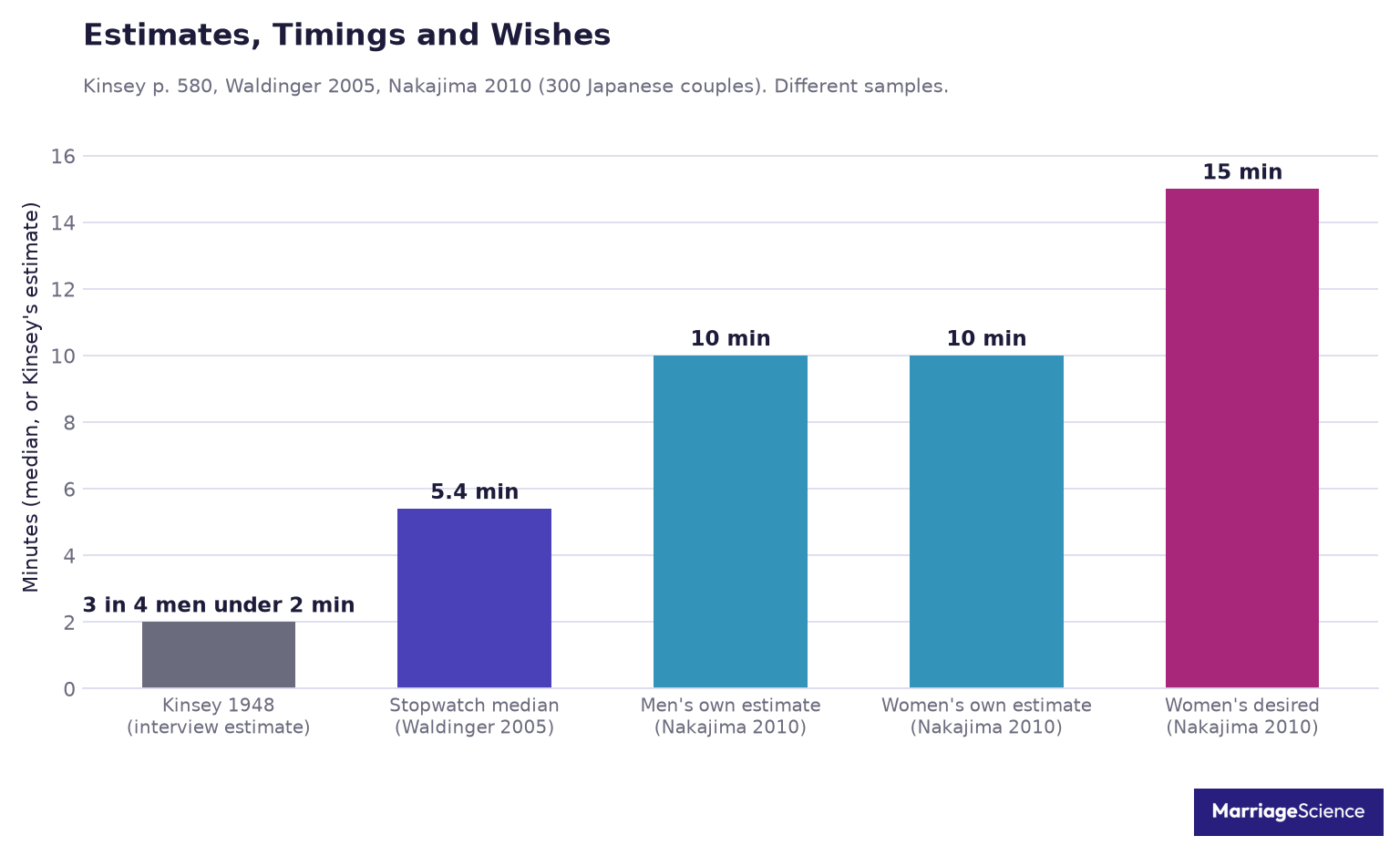
The much shorter number that circulates outside the stopwatch papers, that most men finish within two minutes, has a different origin. It traces to a 1948 estimate by Alfred Kinsey that nobody timed, which makes it a poor anchor for a factual answer.
This page keeps those distinctions in view. We cover the timed studies, what sex therapists call normal, what couples think and want, and why the answer depends on age and country.
Key Statistics on How Long Sex Lasts
These figures come from stopwatch and timer studies, surveys of sex therapists and couples, and a large U.S. survey, and each item names its study.
- Waldinger 2005 reported a median intercourse time of 5.4 minutes in 500 couples from five countries, timed by stopwatch.
- Waldinger 2009 reported a median of 6.0 minutes in 474 men timed with a blinded device.
- Waldinger 2005 found that stopwatch-recorded times ranged from 0.55 to 44.1 minutes.
- Waldinger 2005 reported a median of 6.5 minutes for men aged 18 to 30, compared with 4.3 minutes over 51.
- Waldinger 2009 found that the United Kingdom had the longest median at 10.0 minutes, while Turkey had the shortest at 4.4 minutes.
- Waldinger 2005 found that circumcision and condom use did not change the median significantly.
- Patrick 2005 reported that men without premature ejaculation had a median of 7.3 minutes in a study of 1,587 men.
- Patrick 2005 reported that men diagnosed with premature ejaculation had a median of 1.8 minutes.
- Corty and Guardiani 2008 found sex therapists rated 3 to 7 minutes adequate and 7 to 13 minutes desirable.
- Corty and Guardiani 2008 also found that therapists rated 1 to 2 minutes too short and 10 to 30 minutes too long.
- Nakajima 2010 reported that in 300 Japanese couples, women’s desired time had a median of 15 minutes.
- Nakajima 2010 found that 43.0% of women wanted intercourse to last longer than it did.
- Kinsey 1948 estimated that three-quarters of men reached orgasm within two minutes, without timing anyone.
- Frederick 2018 found that 95% of heterosexual men and 65% of heterosexual women usually or always orgasmed during sex.
How Long Does Sex Last on Average?
In the timed research, sex has a narrow definition. It means penis-in-vagina intercourse between a man and a woman, timed from the moment of penetration to the start of ejaculation.
Researchers call this interval the intravaginal ejaculation latency time, or IELT. Foreplay is not included, so these numbers do not describe the full length of a sexual encounter.
Waldinger 2005 is the best-known stopwatch study in this area. It included 500 couples from the Netherlands, the United Kingdom, Spain, Turkey and the United States, with men 18 or older in a stable heterosexual relationship of at least 6 months.
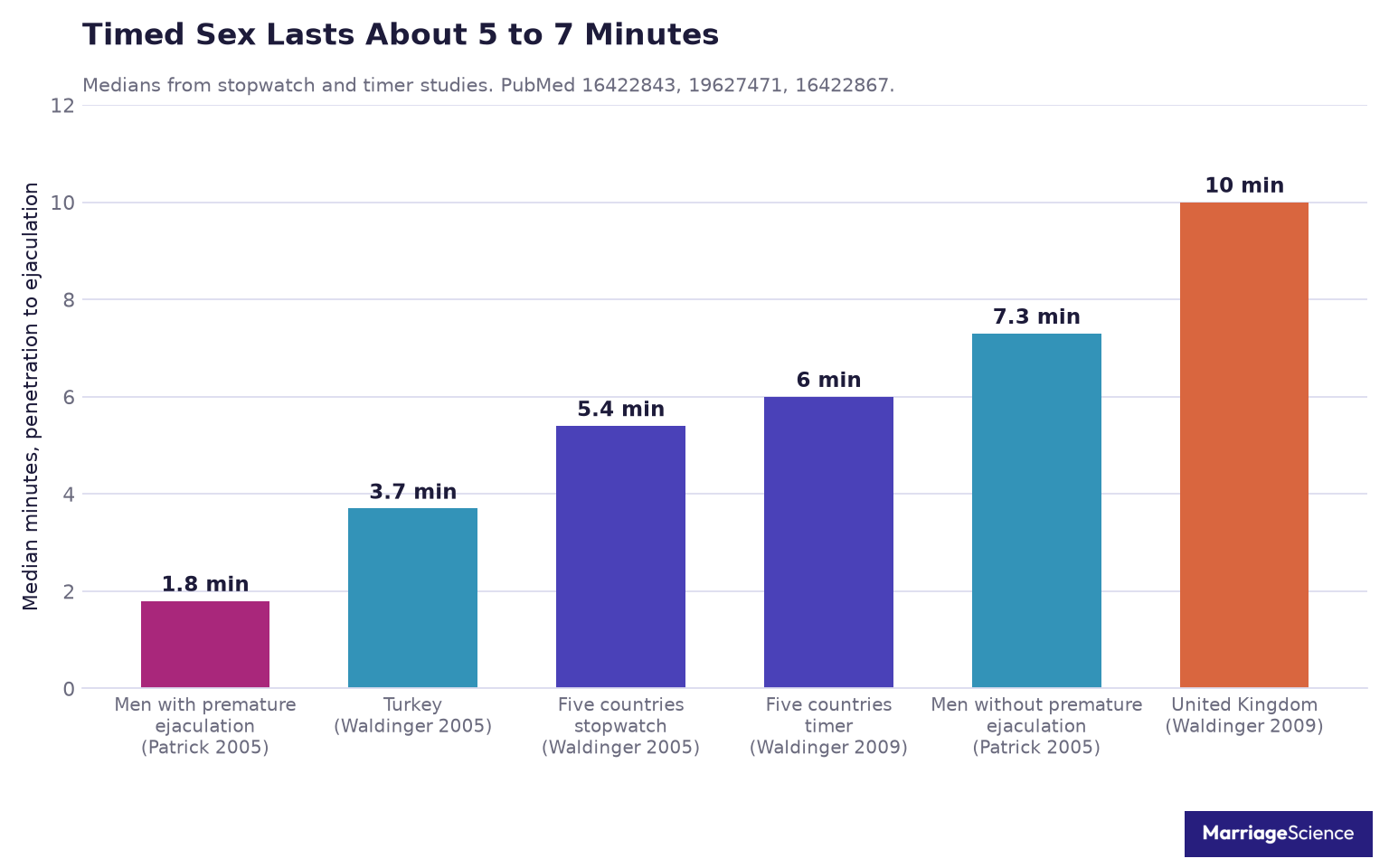
Couples timed each act with a stopwatch for 4 weeks. The median IELT was 5.4 minutes, with a range from 0.55 to 44.1.
The distribution was positively skewed, meaning a few long times pull the average up. That is why the researchers reported the median, which is a better summary of the typical timed result in this kind of data.
Waldinger 2009 used a blinded timer device instead of a stopwatch. In that study of 474 men, the median was 6.0 minutes, with a range from 0.1 to 52.1.
Patrick 2005 used a partner-held stopwatch and included 1,587 men. Among the 1,380 men without premature ejaculation, the median was 7.3 minutes.
Taken together, the timed results cluster around several minutes for intercourse as defined by IELT. They also show wide variation from act to act and from person to person, which is why the median matters more than the longest times in the range.
| Study | Men timed | Method | Median |
|---|---|---|---|
| Waldinger 2005 | 500 couples, 5 countries | Stopwatch | 5.4 minutes |
| Waldinger 2009 | 474 men, 5 countries | Blinded timer | 6.0 minutes |
| Patrick 2005, no premature ejaculation | 1,380 men | Partner-held stopwatch | 7.3 minutes |
| Patrick 2005, premature ejaculation | 207 men | Partner-held stopwatch | 1.8 minutes |
For the other number men worry about, see our penis size statistics, built from clinical measurements.
Where the Two-Minute Idea Came From
The two-minute idea can be traced to Sexual Behavior in the Human Male, Alfred Kinsey, Wardell Pomeroy and Clyde Martin, 1948. The book did not present that line as a stopwatch result.
On page 580, the authors wrote, “For perhaps three-quarters of all males, orgasm is reached within two minutes after the initiation of the sexual relation, and for a not inconsiderable number of males the climax may be reached within less than a minute or even within ten or twenty seconds after coital entrance.”
That sentence is an interview-based estimate. Its word “perhaps” matters, because the authors framed the claim as an approximate judgment from men’s recalled experience.
It was not a timed measurement. Kinsey’s team asked men to recall their experience, so the passage is different from later stopwatch studies that recorded the time from penetration to ejaculation.
The passage also sat inside an argument about education level. Kinsey’s team wrote, “At lower educational levels, it is usual for the male to try to achieve an orgasm as soon as possible after effecting genital union.”
The later stopwatch literature gives a different kind of number. More than 50 years later, timed studies put the median at 5.4 and 6.0 minutes.
That is why the old two-minute figure needs careful handling. It is often repeated, but it was never a measurement.
Why the Numbers Differ by Age and Country
The Waldinger medians shift when samples are divided by age, country, circumcision status, and condom use.
Age was a clear divider in the 2005 paper. The median was 6.5 minutes for men 18 to 30, then fell to 4.3 minutes for men over 51, so a single headline median can hide a noticeable age pattern.
Country differences were also large in the stopwatch data.
In 2005, Turkey had the lowest median at 3.7 minutes and was significantly different from each of the other four countries. In 2009, the United Kingdom had the longest median at 10.0 minutes, while Turkey had the shortest at 4.4 minutes.
Circumcision did not account for the spread in the 2005 analysis of countries other than Turkey. The median was 6.7 minutes for circumcised men and 6.0 for men who were not circumcised, a difference the study did not find significant.
Condom use also did not change the median in the 2005 paper. The 2009 study likewise found no significant effect of either circumcision or condom use.
The 2009 paper adds a useful caution about self-judgment. Men who were unhappy with their own timing had a median of 5.2 minutes, close to the overall 6.0, which means dissatisfaction did not map neatly onto the stopwatch median in that sample.
| Group | Median minutes | Study |
|---|---|---|
| Men 18 to 30 | 6.5 | Waldinger 2005 |
| Men over 51 | 4.3 | Waldinger 2005 |
| Turkey | 3.7 | Waldinger 2005 |
| United Kingdom | 10.0 | Waldinger 2009 |
| Circumcised | 6.7 | Waldinger 2005 |
| Not circumcised | 6.0 | Waldinger 2005 |
How Long Should Sex Last? What Sex Therapists Say
The 2008 study by Corty and Guardiani asked a different kind of question. It surveyed a random sample of members of the Society for Sex Therapy and Research in the United States and Canada, asking therapists how they rated different lengths of intercourse.
| Rating | Middle half of therapists’ answers |
|---|---|
| Too short | 1 to 2 minutes |
| Adequate | 3 to 7 minutes |
| Desirable | 7 to 13 minutes |
| Too long | 10 to 30 minutes |
The table shows the middle half of the therapists’ answers, so it describes a range. The categories also show that therapists did not treat one exact minute mark as the border between acceptable and concerning.
The authors’ conclusion was direct: intercourse lasting 3 to 13 minutes is normal and not a clinical concern. They also suggested that telling the public this could reduce distress, because people may carry expectations that are far outside the clinical range reported by therapists.
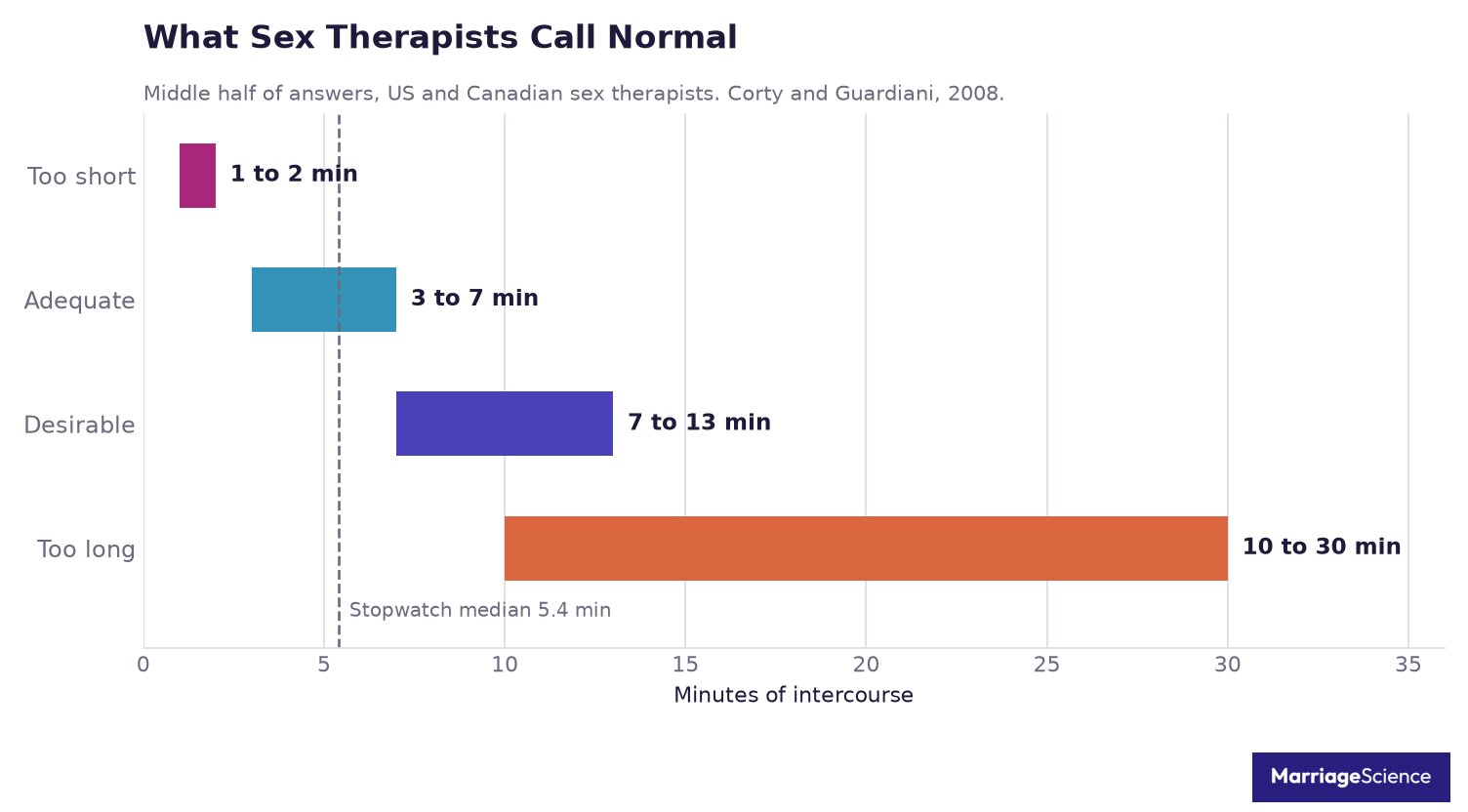
That conclusion fits closely with the stopwatch results above. The timed medians of 5.4 and 6.0 minutes fall inside the adequate range of 3 to 7 minutes.
What Couples Think It Lasts and What They Want
Nakajima and colleagues’ 2010 mail survey asked 300 married couples in Japan to estimate that interval. Men estimated a mean of 14.5 minutes, with a median of 10, while women estimated a mean of 13.6 minutes, with a median of 10.
The desired time data from women were close to the actual estimates, but higher. Women’s desired time had a mean of 15.7 minutes and a median of 15.
| Measure (Nakajima 2010, 300 Japanese couples) | Median |
|---|---|
| Men’s estimate of actual time | 10 minutes |
| Women’s estimate of actual time | 10 minutes |
| Women’s desired time | 15 minutes |
The split in women’s preferences matters because desire was not all in one direction. In the same survey, 43.0% of women wanted intercourse to last longer than it was, 38.7% wanted the same, and 18.3% wanted it shorter.
Miller and Byers reported on 152 heterosexual couples in a 2004 study and found that both men and women wanted foreplay and intercourse to last longer than they did. The paper also separated personal ideals from guesses about a partner’s ideals.
In that study, men reported a longer ideal intercourse time than their partners did. Women also underestimated how long their partners wanted it to last.
These findings cannot be subtracted from the stopwatch medians above. The self-estimates of about 10 minutes came from a different population, and estimates and timings measure different things.
The useful point is narrower. When asked to estimate duration, husbands and wives in the Japanese mail survey gave the same median, while women’s median desired duration was higher.
How often couples have sex, by age and decade, is in our analysis of how often couples have sex.
When Sex Is Very Short: Premature Ejaculation
Very short intercourse is often discussed as if a stopwatch can settle the question. Patrick 2005 shows why the clock matters, and why it cannot carry the whole diagnosis.
Patrick and colleagues followed 1,587 men and their partners for 4 weeks, used a partner-held stopwatch, and used clinician diagnosis based on DSM-IV-TR criteria.
Among the 207 men diagnosed with premature ejaculation, the median time was 1.8 minutes, with a range of 0 to 41. Among the 1,380 men who were not diagnosed with premature ejaculation, the median was 7.3 minutes, with a range of 0 to 53.
Those medians are far apart, but the ranges overlapped. The study found overlap in times between the two groups, so time alone did not define the diagnosis.
The diagnosis also lined up with reported control, satisfaction, and distress. In the diagnosed group, 72% of men rated their control over ejaculation very poor or poor, against 5% of other men.
On satisfaction with intercourse, 31% of men with premature ejaculation rated it very poor or poor, against 1%. Personal distress showed a similar separation, with 64% reporting quite a bit or extreme personal distress, against 4%.
These numbers put very short intercourse in context. In this study, a low stopwatch time came together with poor control, low satisfaction, personal distress, and clinician assessment were also part of the classification.
A doctor or urologist can assess it.
Does Longer Mean Better?
The stopwatch answer and the satisfaction answer are different questions. The timing studies capture one narrow part of sex.
Frederick and colleagues’ 2018 study of 52,588 U.S. adults in Archives of Sexual Behavior reported large differences in who usually or always orgasmed when sexually intimate. The highest figure in the data was for heterosexual men, and the lowest was for heterosexual women.
| Group (Frederick 2018) | Usually or always orgasm |
|---|---|
| Heterosexual men | 95% |
| Gay men | 89% |
| Bisexual men | 88% |
| Lesbian women | 86% |
| Bisexual women | 66% |
| Heterosexual women | 65% |
Among women in the study, those who orgasmed more often were more likely to report a longer duration of their last sex. They were also more likely to have received more oral sex.
The same paper found that women were more likely to orgasm when the last encounter included deep kissing, manual genital stimulation or oral sex in addition to intercourse. In this study, what happened around intercourse was linked with women’s orgasm as well as time.
The gap is not simply men against women. Lesbian women, at 86%, were close to gay and bisexual men, while bisexual and heterosexual women were at 66% and 65%.
So the clean answer is: longer does not automatically mean better in these data. Duration was part of the pattern for women, but the surrounding sexual behaviors were part of the pattern too.
When sex has faded from a relationship, our guide on how to rebuild intimacy covers what couples can do.
Help When Partners Want Different Things
In the Nakajima survey, 43.0% of women wanted intercourse to last longer than it did. Miller and Byers found that women underestimated how long their partners wanted it to last.
Gaps like these are hard to raise in bed. Talking them through with a couples therapist is one way to start.
OurRitual: Online Support for Couples

OurRitual is an online relationship support service. After sign-up, a specialist matches you with an expert on a video call.
Sessions last 40 minutes, and the app has exercises for the days between them. You can start alone and move to a couples plan if your partner joins later.
- Who It Is For
- Couples, or one partner alone
- How It Bills
- Monthly plan
- To Start
- Couples from $256 a month
- Sessions
- 40-minute video calls
Plans for one person start at $216 a month. Insurance does not cover it.
What These Studies Do Not Cover
The stopwatch studies use a narrow definition of sex. It measured penis-in-vagina intercourse in heterosexual couples, timed from penetration to ejaculation.
That scope matters because the numbers do not describe sex between two women or two men. They also do not describe oral sex, manual sex, or any sexual activity where ejaculation is not the endpoint being timed.
The clock also leaves out parts of sex that couples may care about most. Foreplay is outside the measurement, and everything after ejaculation is outside the measurement, so the result is an ejaculation latency measure, not a measure of the whole sexual encounter.
The samples have another limit.
Couples had to be willing to time themselves for four weeks, across five countries. That is not a random sample of the world.
Related figures on sexual history are in our average number of sexual partners statistics.
Methodology and Sources
We read every study in its original abstract on PubMed, and the full text where it is open, including Nakajima 2010. The Kinsey quotes come from the full text of Sexual Behavior in the Human Male (1948), page 580.
All medians are reported as each study published them. We did not pool or average studies, because they used different methods and samples.
We left out brand surveys by condom and sex-product companies, because they do not publish how people were recruited. That choice keeps the article focused on sources that give readers a way to judge sampling and measurement.
The core academic sources are Waldinger et al. 2005 and 2009 (Journal of Sexual Medicine), Patrick et al. 2005 (Journal of Sexual Medicine), Corty and Guardiani 2008 (Journal of Sexual Medicine), Nakajima et al. 2010 (Reproductive Medicine and Biology), Miller and Byers 2004 (Journal of Sex Research), and Frederick et al. 2018 (Archives of Sexual Behavior).
For marriages where sex has stopped, see our sexless marriage statistics.