


C.R.S. 14-2-301: Colorado’s Premarital and Marital Agreements Act
Colorado uses the Uniform Premarital and Marital Agreements Act, C.R.S. 14-2-301 to 14-2-313, for agreements signed on or after July 1, 2014. Agreements signed before that date fall under the older Colorado Marital Agreement Act.
The same act covers premarital agreements and marital agreements signed after the wedding, but it does not apply to separation agreements signed when divorce is anticipated or pending. The table below summarizes the rules that matter most before signing.
Lawyer Access and the Waiver Notice
A prenup is valid only if it is in a record and signed by both parties, and it still can be challenged under the UPMAA enforcement rules. No notary or witness requirement appears in the statute.

A Signed Record, Paper or Electronic
State law requires a record signed by both parties. A record can include an electronic record, and the UPMAA relates to the federal E-SIGN Act, so the formal rule is written or electronic form plus both signatures.

Access to Independent Counsel
State law does not make a lawyer a signing formality, but lack of access to independent legal representation is a statutory ground for unenforceability. Access means a reasonable time before signing to decide whether to hire a lawyer, find one, get advice, and consider it.
The access rule also depends on money and representation. If the other party is represented, the party challenging enforcement must be able to afford a lawyer, or the other party must agree to pay reasonable fees.
Leaving Time to Find a Lawyer
A premarital agreement becomes effective on marriage, while a marital agreement becomes effective on signing. Timing matters because a person must have reasonable time before signing for the lawyer-access process described in the statute.
Four Grounds Colorado Uses to Refuse a Prenup
A prenup gets thrown out when the party resisting enforcement proves one of the grounds in C.R.S. 14-2-309 or the term falls into a barred category. The burden is on the party against whom enforcement is sought.
Consent is the first ground if it was involuntary or the result of duress. That is a signing-process challenge, focused on whether the person’s agreement was voluntary under the statute.
The statute defines access to independent legal representation with detail. It includes time to decide whether to hire a lawyer, find one, get advice, and consider that advice before signing.
If the party did not have independent legal representation when signing, a separate rule applies. In that situation, the agreement must include the statutory notice of waiver of rights or a plain-language explanation of the marital rights or obligations being modified or waived.
Financial disclosure is another ground. Adequate financial disclosure means a reasonably accurate description and good-faith estimate of value of the other party’s property, liabilities, and income, or adequate knowledge or a reasonable basis for it.
The state also tolls statutes of limitation during marriage, while laches and estoppel remain available. Our review of 92 U.S. appellate prenup validity disputes found no appellate decision on a prenup’s validity here in that study set.
- A Colorado-licensed lawyer for each of you
- $799 per lawyer, on top of the $599 agreement
- Lack of access to counsel is its own ground to void a Colorado prenup

How Many Years Do You Have to Be Married in Colorado to Get Alimony?
Colorado’s advisory maintenance guidelines start at three years of marriage, for couples whose combined adjusted gross income is $240,000 or less. For shorter marriages and higher incomes, the court weighs the statutory factors without the guideline formula.
A prenup can address spousal maintenance, but a court can refuse to enforce that term if it is unconscionable at the time of enforcement. The same rule applies to the waiver or allocation of attorney fees.
Without an enforceable agreement changing maintenance, C.R.S. 14-10-114(3) directs the court to set a fair and equitable award. The court considers the advisory guideline amount and term, statutory factors, and whether the requesting spouse meets the threshold for an award.
The advisory guidelines apply when the marriage lasted at least three years and the couple’s combined annual adjusted gross income does not exceed $240,000. For taxable and deductible awards, the guideline amount is 40% of combined monthly adjusted gross income minus the lower earner’s monthly income, with lower percentages for non-deductible awards.
A statutory table sets the guideline term for marriages of three to twenty years. For marriages over twenty years, the court may award maintenance for a specified term or an indefinite term.
This special prenup rule is limited to maintenance and attorney-fee terms. Property terms are not subject to the time-of-enforcement unconscionability test.
Is Colorado a 50/50 Divorce State?
This is an equitable distribution state, so divorce property division is based on what the court deems just. C.R.S. 14-10-113(1) says the court sets apart each spouse’s property and divides marital property without regard to marital misconduct.
That rule does not require an equal split. The court considers each spouse’s contribution, including contributions as a homemaker, the value of property set apart to each spouse, the economic circumstances of each spouse, and other statutory factors.
State law starts with a broad marital-property presumption. Under C.R.S. 14-10-113(3), property acquired during the marriage is presumed marital regardless of how title is held.
C.R.S. 14-10-113(2) then lists the exceptions. Property acquired by gift, bequest, devise, or descent is outside marital property, as is property acquired in exchange for premarital property or for those gifts or inheritances.
Property acquired after a decree of legal separation is also excluded. A valid agreement of the parties is another exception, which is where a prenup can matter for a couple trying to classify property before a dispute begins.
Without a prenup, premarital assets can still raise tracing and classification questions when value changes, accounts are mixed, or title changes. In re Marriage of Blaine held that an interspousal transfer deed did not by itself exclude a home from the marital estate, because only the statutory exceptions overcome the marital-property presumption.
Zander, Blaine and the Marital Property Presumption
Local prenup cases worth knowing focus on signed records, the marital-property presumption, and clear drafting for maintenance after death. The cases below show how much can turn on form, classification, and exact payment language.
In re Marriage of Zander rejected an oral agreement between spouses. In re Marriage of Blaine treated a deed as insufficient by itself to overcome marital-property rules, and Estate of Williams and Perna required clear language before maintenance continued after death.
What Cannot Be Included in a Colorado Prenup?
A prenup cannot limit child support, restrict a domestic violence victim’s remedies, change the grounds for divorce, penalize a spouse for filing, or include terms that violate public policy. Parenting-time and decision-making terms are also not binding on the court.
The UPMAA notice language shows the kinds of rights a person may waive. It refers to support, ownership or control of money and property, payment of bills and debts, property rights if the marriage ends or a spouse dies, and payment of legal fees.
Property terms can be used to classify assets that would otherwise be disputed under the state’s equitable distribution system. That includes using a valid agreement as one of the statutory exceptions to the marital-property presumption.
For infidelity clauses, the statute does not name them. The state-law point is narrower: divorce property division is made without regard to marital misconduct, and any term that violates public policy is unenforceable.
Maintenance and attorney-fee terms have a special review rule. Even if the agreement is otherwise enforceable, those terms are unenforceable to the extent they are unconscionable at the time of enforcement.
Terms the Colorado Act Allows
- Classify premarital property as separate property
- Address gifts, inheritances, and exchange property
- Allocate responsibility for bills and debts
- Set rules for ownership or control of money and property
- Address spousal maintenance, subject to later court review
- Address attorney-fee allocation, subject to later court review
Barred by C.R.S. 14-2-310
- Adversely affect a child’s right to support
- Limit a remedy available to a victim of domestic violence
- Modify grounds for legal separation or dissolution, or penalize a filing
- Bind the court on parenting time or decision-making
How Much Does a Prenup Cost in Colorado?
A prenup can cost from an online package price to attorney hourly billing, depending on legal advice and drafting time. Clio reports a family law average of $312 per hour, with lawyers overall averaging $302 and typically ranging from $187 to $411.

As an illustration, eight hours of attorney time at $312 per hour equals $2,496 per lawyer. Actual time can vary with disclosure issues, negotiation, separate counsel, and revisions.
HelloPrenup lists pricing here at $599 per couple, with an attorney for each partner at $799 per partner, or $1,598 total. Its Attorney-Signed package is listed at $2,197, with e-notarization at +$50 and attorney Q&A at +$49.
The state does not require notarization for a prenup, so the e-notarization add-on is optional. Our HelloPrenup review explains how the online process works.
| Route | Cost | What you get |
|---|---|---|
| Online prenup | $599 per couple | Built for Colorado’s 2014 act, with the waiver notice and a free consultation |
| Online prenup, attorney for each partner | $2,197 per couple | Independent Colorado counsel on both sides, the cleanest answer to the lawyer-access rule |
| Single attorney add-on | $799 per partner | Counsel for one partner only |
| Hourly family lawyer | $312 per hour | Average Colorado family law rate. Two lawyers at eight hours apiece would come to $4,992, for illustration |
Home Prices and Prenups in Colorado
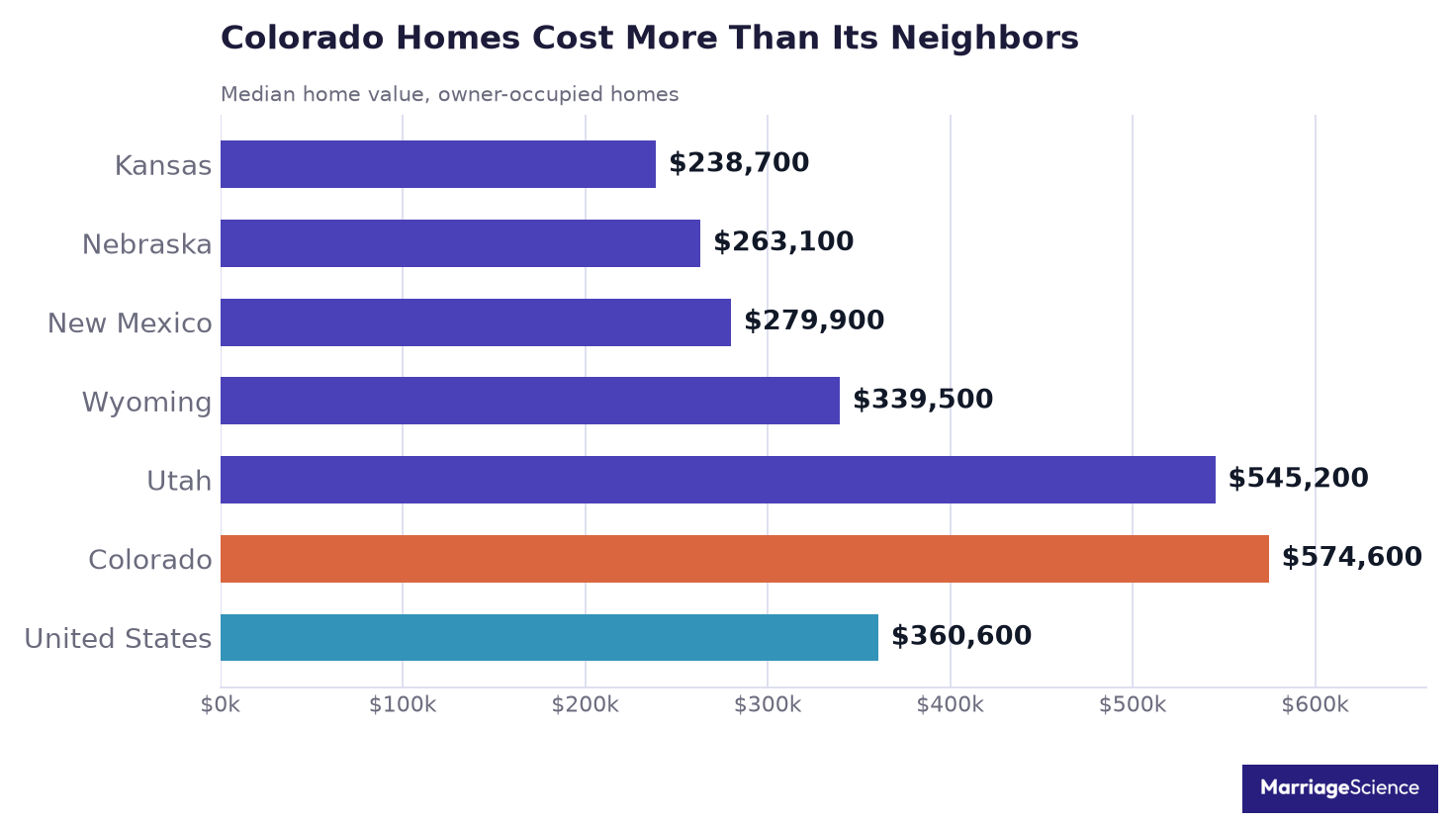
High home prices give couples here one large asset to classify. The U.S. Census Bureau reports a median home value of $574,600, the fifth highest among the states.

That housing figure matters because a home bought before marriage, during marriage, or with mixed funds can become the largest asset to classify. The median home value is also higher than Utah, Wyoming, and New Mexico in the same Census Bureau estimates.
Of Coloradans who have ever married, 22.5% have married two or more times, against 23.5% nationally. Remarriage can bring prior children, existing property, and debt expectations that are easier to state in a signed record before marriage.
The age at first marriage here is close to the national pattern, with men at 30.8 and women just under 29. That timing can mean each person has had years to build retirement savings, equity, or business interests before marriage.
Getting a Colorado Prenup Signed the Right Way
Getting a prenup here starts with a written record, financial disclosure, and enough time for each person to consider legal advice. These steps track the issues courts and statutes treat as enforcement points.
- Choose TimingA premarital agreement takes effect on marriage. Build in enough time before signing for each person to decide whether to hire a lawyer and consider advice.
- List Property and DebtsPrepare a reasonably accurate description and good-faith estimate of property, liabilities, and income. This supports the state disclosure rule.
- Decide Property TreatmentState how premarital property, gifts, inheritances, exchange property, and marital property will be handled. State law treats a valid agreement as one statutory exception to marital property.
- Address Maintenance TermsIf the agreement changes spousal maintenance or attorney-fee rights, use clear language. Those terms can still be reviewed for unconscionability at the time of enforcement.
- Review Lawyer AccessEach person should have a reasonable time to find counsel, get advice, and consider it. If one party is represented, the access rule also looks at whether the other can afford a lawyer or fees are covered.
- Sign a Written RecordBoth parties sign the record, which can be electronic. State law does not require a notary or witnesses for the prenup formality.
Marital Agreements After the Wedding
The state lets spouses use the same UPMAA framework for marital agreements signed after the wedding. A marital agreement is effective on signing, while a premarital agreement is effective on marriage.

A later change takes a new signed record that meets the same formalities and enforcement rules. That means attention to signatures, disclosure, lawyer access, and any required notice or plain-language explanation.
This act covers both prenups and postnups, but it does not apply to separation agreements signed when divorce is anticipated or pending.
Common Colorado Prenup Questions
Colorado couples ask about downsides, notaries, e-signing and postnups. Each answer points to the section of the act that settles it.
What is the downside of a prenup in Colorado?
Mostly the process. To hold up, each partner needs real time and means to get a lawyer, the statutory waiver notice or a plain-language explanation when signing without one, and full financial disclosure. Maintenance terms can also be reviewed again at divorce.
Does a Colorado prenup need a notary?
No notary requirement appears in Colorado’s prenup statute. The agreement must be in a record and signed by both parties, and electronic records can satisfy the record requirement.
Can a Colorado prenup be signed electronically?
Yes. The act asks for a signed record, and a record can be electronic. Section 14-2-313 ties the act to the federal E-SIGN law.
Does a postnup follow the same rules in Colorado?
Yes. The same act governs marital agreements signed after the wedding, with the same disclosure, lawyer-access and notice rules. A marital agreement takes effect when both spouses sign it.
Does a prenup protect you 100% in Colorado?
No. Maintenance and attorney-fee terms can still be refused if they are unconscionable when enforced, and parenting terms never bind the court. The whole agreement fails if lawyer access, the waiver notice or financial disclosure was missing.
Utah, New Mexico and Wyoming Prenup Law
Utah follows the older uniform act and New Mexico is a community property state. Check the rules where each of you lives before signing.

Sources
The Colorado Revised Statutes, two Colorado Supreme Court decisions and one Court of Appeals opinion supply the rules. The numbers come from the Census Bureau and Clio.
- C.R.S. 14-2-301 to 14-2-313, Uniform Premarital and Marital Agreements Act (Colorado General Assembly PDF)
- C.R.S. 14-2-309, enforcement (Colorado.Public.Law)
- C.R.S. 14-10-113, disposition of property (Colorado.Public.Law)
- C.R.S. 14-10-114, spousal maintenance (Colorado.Public.Law)
- In re Marriage of Zander, Colorado Supreme Court (CourtListener)
- In re Marriage of Blaine, Colorado Supreme Court (CourtListener)
- Estate of Williams and Perna, Colorado Court of Appeals (CourtListener)
- U.S. Census Bureau, American Community Survey 1-year estimates
- Clio Legal Trends, lawyer hourly rates in Colorado
- Marriage Science, Do Prenups Hold Up in Court? Appellate study
Not legal advice. This article is general information only. Prenup laws differ by state and change over time. Consult a licensed attorney in your state before acting on anything here.