


Family Code Chapter 4 and Texas Premarital Agreements
State law recognizes premarital agreements under the Texas Uniform Premarital Agreement Act, Texas Family Code chapter 4, subchapter A, sections 4.001 to 4.010. The current sections were added in 1997, and section 4.010 names the act.
A prenup must be in writing and signed by both parties, and it becomes effective on marriage. The table below summarizes the main statutory rules, including the definition of property, which includes income and earnings.
Is Texas a 50/50 Divorce State?
Texas is a community property state, but it is not an automatic 50/50 divorce state. Family Code 7.001 says the court divides the estate in a manner it deems “just and right,” with due regard for the rights of each party and any children.
That means the court divides community property in divorce, while separate property stays with the spouse who owns it. The statute does not set a fixed percentage.
Separate property includes property owned or claimed before marriage. It also includes property acquired during marriage by gift, devise, or descent, plus personal injury recoveries except for lost earning capacity during marriage.
Community property is all property other than separate property acquired by either spouse during marriage. Because state law presumes property possessed during marriage or at divorce is community property, a spouse claiming separate property must prove it by clear and convincing evidence.
Without a prenup, wages and other earnings during marriage are generally part of the community estate. That rule matters for founders, professionals, and anyone expecting income growth after the wedding.
A prenup can change that result because Family Code 4.001 defines property to include income and earnings. Under section 4.003, prospective spouses may agree about rights and obligations in property whenever and wherever acquired or located.
What Cannot Be in a Texas Prenup?
A Texas prenup cannot reduce a child’s right to support or include terms that violate public policy or a criminal statute. Most property terms are open, including keeping each spouse’s paycheck separate.
Texas Family Code 4.003 allows broad planning in a prenup. The agreement may cover property rights and obligations in property of either or both spouses whenever and wherever acquired or located.
Because the statute defines property to include income and earnings, a prenup can keep each spouse’s salary separate. Without that agreement, earnings during marriage would generally fall into community property.
The statute also allows provisions for property disposition on separation, dissolution, death, or another event. It allows a will, trust, or other arrangement to carry out the agreement.
A prenup here can modify or eliminate spousal support. It can also address life insurance death benefits and choice of law.
Personal rights and obligations may be included if they do not violate public policy or a statute imposing a criminal penalty. That is the statutory limit for any personal conduct clause, including an infidelity clause.
Including Your Paycheck
- Set rights and obligations in property owned by either or both spouses
- Keep income and earnings as each spouse’s separate property
- Plan who may buy, sell, transfer, mortgage, spend, or manage property
- State what happens to property on separation, divorce, death, or another event
- Modify or eliminate spousal support
- Use a will, trust, life insurance provision, or other arrangement to carry out the agreement
- Choose governing law and include personal obligations within statutory limits
Still Off Limits
- Adversely affect a child’s right to support
- Include a matter that violates public policy
- Include a matter that violates a statute imposing a criminal penalty
- Stay fully binding if the marriage itself turns out to be void
What Voids a Prenup in Texas?
A prenup here gets thrown out only under the defenses in Texas Family Code 4.006. Courts presume premarital agreements valid and enforceable, and the party opposing enforcement carries the burden.
Section 4.006(a) says an agreement is not enforceable if the party against whom enforcement is requested proves that the party did not sign the agreement voluntarily. That is the first statutory route.
The second route is narrower. The agreement must have been unconscionable when signed, and before signing the party got no fair and reasonable disclosure of the other side’s property or debts, signed no written waiver of further disclosure, and had no adequate knowledge of those finances.
Unconscionability is decided by the court as a matter of law. Courts have said lack of disclosure matters only if the agreement is first found unconscionable.
McDonald describes the test as a look at the entire atmosphere in which the agreement was made. Courts may consider age, maturity, business backgrounds, education, prior marriages, and reasons for the agreement, including protecting children.
Section 4.006(c) makes these remedies and defenses exclusive, including common law remedies or defenses. Section 4.008 tolls statutes of limitation during marriage, while laches and estoppel remain available to either party.
In our review of appellate prenup validity disputes, courts of appeals decided 8 cases. Six were enforced in full, none were invalidated, one was sent back undecided, and one was dismissed without reaching validity.
- Separate Texas counsel for both of you
- Each lawyer is $799 on top of the $599 agreement
- Useful when the prenup keeps paychecks separate or waives maintenance

Do Prenups Hold Up in Court in Texas?
Recent appeals say yes: every case below ended with the prenup enforced. Recent courts enforced agreements signed eight days before remarriage, the day before the wedding, and two days before the wedding.
Outcomes turned on voluntariness, disclosure, and unconscionability. The cases also show that notarization may appear in the record even though Texas Family Code 4.002 requires only writing and both signatures.
Two Signatures, No Notary: Texas Signing Rules
A prenup here is valid when it meets the statute’s signing rules and is made in contemplation of marriage. It takes effect only when the marriage occurs.

Section 4.002 in Practice
Texas Family Code 4.002 requires the agreement to be in writing and signed by both parties. It is enforceable without consideration.
The statute requires no notary and no witnesses. In McDonald and Perez, the couples did have notarized agreements, but those cases do not add a notary requirement to section 4.002.

Lawyers Are Optional in Texas
State law does not require each partner to have a lawyer for a prenup. Attorney representation is optional here.
A lawyer can still matter as evidence of process, disclosure, and understanding. Courts look at the full setting when a party later claims the agreement was involuntary or unconscionable.
Timing and the 72-Hour License Wait
State law has no fixed number of days before the wedding for signing a prenup. The agreement must be signed before marriage because section 4.004 makes it effective on marriage.
Appellate courts have enforced agreements signed close to the wedding, including the day before the wedding in Perez and two days before the wedding in Sauls. Timing still can be part of a voluntariness challenge.
Texas Maintenance Caps and Waivers
A prenup here can modify or eliminate spousal support. Family Code 4.003(a)(4) expressly allows parties to contract about that subject.
Without a prenup, spousal maintenance is limited by Family Code chapter 8. A court may order maintenance only if the spouse asking for it will lack sufficient property, including separate property, to provide for minimum reasonable needs and one of the statutory grounds applies.
Those grounds include recent family violence by the other spouse, an incapacitating disability, a marriage of 10 years or longer with inability to earn sufficient income, or custody of a child of the marriage who needs substantial care because of a disability.
Family Code 8.054 sets maximum durations based on marriage length and the family violence route, and section 8.055 caps monthly maintenance at the lesser of $5,000 or 20% of the paying spouse’s average monthly gross income.
Section 4.006 has no hardship exception allowing a court to order support when a waiver would leave a spouse eligible for public assistance. That differs from the model act and from states that kept such a provision.
Young Couples and Repeat Marriages in Texas
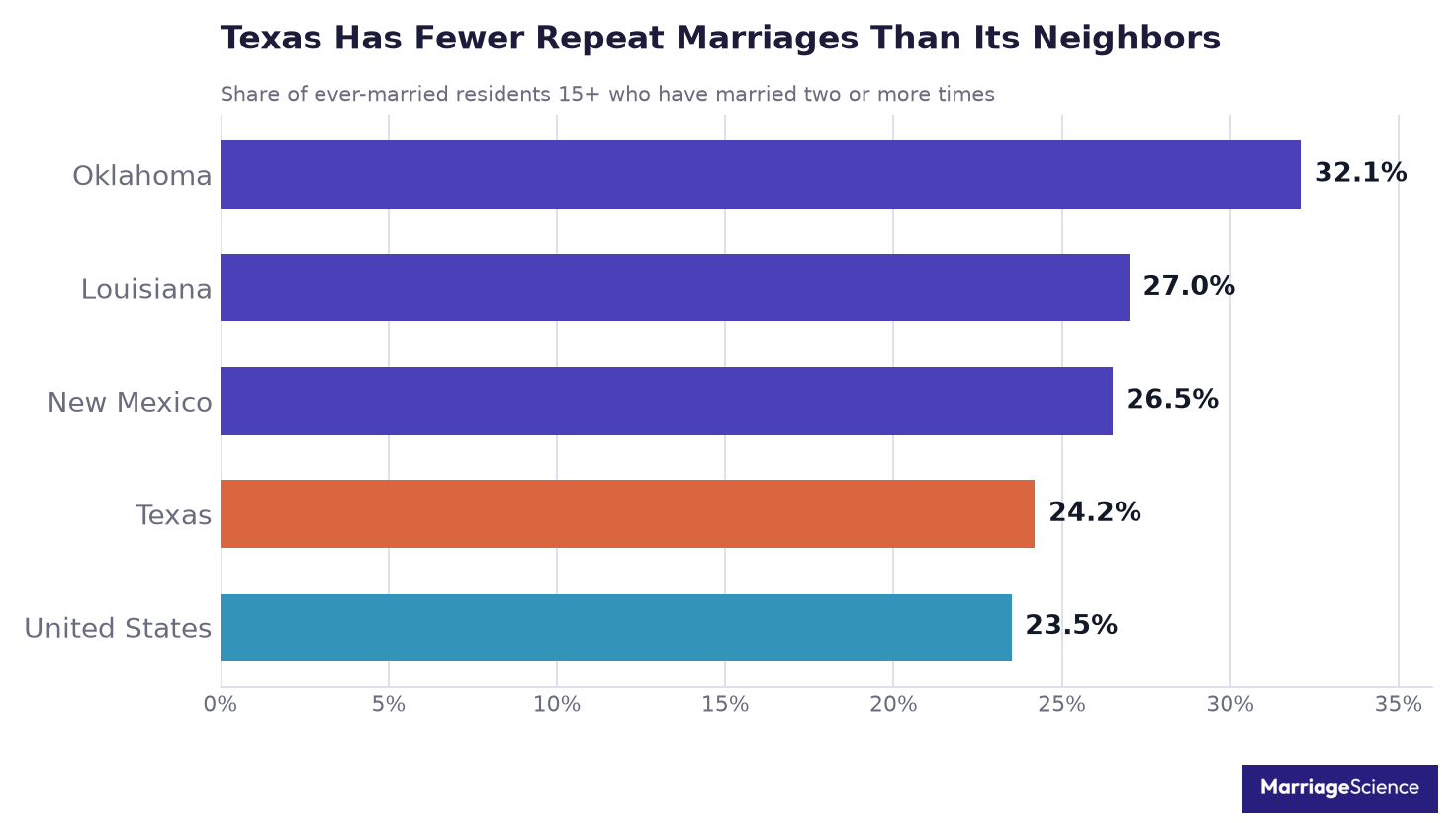
Prenups matter most here when the default community property rules do not match the couple’s plan for income, homes, family money, or a later divorce. The U.S. Census Bureau reports that 24.2% of Texans who have ever married have done so two or more times, slightly above the national 23.5% and below Oklahoma, Louisiana and New Mexico.

Remarriage can bring separate property, children from earlier relationships, and estate planning goals into the same wedding plan. A prenup can state what happens to property on separation, divorce, death, or another event.
Home equity is another reason couples may want written rules. The median home value is $313,200, and the community property presumption can make tracing a home or later improvements a serious issue.
Men and women here marry for the first time slightly earlier than the national medians. That can leave more years for salaries, retirement savings, business growth, and home equity to build during marriage.
Partition and Conversion Agreements After the Wedding
After marriage, a prenup may be amended or revoked only by a written agreement signed by the parties. Texas Family Code 4.005 says that amendment or revocation is enforceable without consideration.

State law also has marital property tools after the wedding. Spouses may partition or exchange existing or future community property, and the transferred property becomes separate property. The agreement may also make future income from that property separate.
Spouses may agree to convert separate property to community property. Anyone comparing these options can read our guide to prenups and postnups.
How Much Does a Prenup Cost in Texas?
A prenup cost here depends on attorney time, review needs, and whether the couple uses an online platform. Clio lists the average lawyer in the state at $366 per hour, compared with about $349 nationally, and family law at $375 per hour.

As an illustration, 8 hours of family lawyer time here at $375 per hour is $3,000 per lawyer. That is only a math example, since actual attorney time can vary.
HelloPrenup lists pricing here at $599 per couple. Attorney review is $799 per partner, the Attorney-Signed package is $2,197, e-notarization is an added $50, and attorney Q&A is an added $49.
Attorney representation is optional here. Couples comparing online and lawyer led options can read our HelloPrenup review before using the cost table below.
| Route | Cost | What you get |
|---|---|---|
| Online prenup | $599 per couple | Flat price for both partners, drafted for Family Code chapter 4, with a free consultation |
| Online prenup, attorney for each partner | $2,197 per couple | Texas attorney review and signature for each partner |
| Single attorney add-on | $799 per partner | Representation for one partner, added to the online agreement |
| Hourly family lawyer | $375 per hour | Average Texas family law rate. Example only: two lawyers working eight hours apiece total $6,000 |
From Property List to Signed Texas Prenup
Getting a prenup here means turning the couple’s property plan into a signed writing before marriage. The steps below track the state statute and the issues raised in recent enforcement appeals.
- Learn State DefaultsStart with community property, separate property, and the “just and right” divorce division rule. Decide which default rules the agreement should change.
- List Property and DebtsEach partner should identify property and financial obligations. Disclosure matters because section 4.006 ties one challenge route to unconscionability plus disclosure failures.
- Choose Agreement TermsDecide how to treat income, homes, businesses, gifts, inheritances, support, life insurance, and death planning. Keep child support outside any term that would adversely affect the child’s right to support.
- Draft the WritingState law requires a written agreement signed by both parties. Couples using an online process can compare steps in our online prenup guide.
- Plan Wedding TimingSign before the marriage, since the agreement becomes effective on marriage. Marriage ceremonies generally may not take place during the 72 hours after license issuance unless an exception applies, and the license expires if the ceremony is not held before the 90th day after issuance.
- Sign and Store CopiesBoth parties sign the final agreement. A notary is not required by the signing statute, though some couples still use one as part of their signing record.
More Answers for Texas Couples
Texas couples search most about community property, paychecks and maintenance. Each answer cites the Family Code section that settles it.
Can a Texas prenup protect my paycheck?
Yes. Texas Family Code 4.001 defines property to include income and earnings. Because of that definition, a prenup can keep each spouse’s salary separate, even though earnings during marriage would otherwise generally be community property.
When should we sign a prenup in Texas?
Texas does not set a fixed number of days before the wedding for signing. The agreement must be signed before marriage, since it becomes effective on marriage, and timing can still be part of a later voluntariness challenge.
Can a Texas court throw out a prenup signed without a lawyer?
Not for that reason alone. No statute requires counsel, and in McDonald (2023) the husband drafted the agreement without a lawyer and the Fort Worth appeals court still enforced it.
Does a Texas prenup cover money I inherit?
An inheritance received during the marriage is already separate property under Family Code 3.001. Income it produces during the marriage is treated as community property by default, and a prenup can keep that income separate too.
Does a prenup protect you 100% in Texas?
No. A spouse can still void it for involuntary signing, or for unconscionability combined with missing disclosure, and child support can never be limited. Those are the only defenses, though, because section 4.006(c) rules out common law ones.
Crossing Into Oklahoma, Louisiana or New Mexico
Rules change at the state line. Louisiana and New Mexico are also community property states, while Oklahoma divides property by equitable distribution, so compare before you sign.

Sources
Statutes come from the Texas Family Code, cases from the state courts of appeals, and figures from the Census Bureau and Clio.
- Texas Family Code chapter 4, marital property agreements (Texas Legislature)
- Texas Family Code chapter 3, separate and community property (Texas Legislature)
- Texas Family Code chapter 7, division of property on divorce (Texas Legislature)
- Texas Family Code chapter 8, spousal maintenance (Texas Legislature)
- Texas Family Code chapter 2, marriage license rules (Texas Legislature)
- McDonald v. McDonald, Texas Second Court of Appeals (CourtListener)
- Perez v. Perez, Texas First Court of Appeals (CourtListener)
- In re Marriage of Sauls and Worley, Texas Sixth Court of Appeals (CourtListener)
- In the Interest of P.A., Texas Fifth Court of Appeals (CourtListener)
- U.S. Census Bureau, American Community Survey 1-year estimates
- Clio Legal Trends, lawyer hourly rates in Texas
- Marriage Science, Do Prenups Hold Up in Court? Appellate study
Not legal advice. This article is general information only. Prenup laws differ by state and change over time. Consult a licensed attorney in your state before acting on anything here.