


Maybe everyone around you seems to want a boyfriend or girlfriend, but you have never felt that same pull. Maybe you enjoy flirting, kissing, or sex, or perhaps you are here because someone you care about told you they are aromantic.
Aromantic means feeling little or no romantic attraction to other people. It relates to romance only, so an aromantic person may still feel sexual attraction, or they may not.
Aromantic is a recognized orientation with its own community and research. Many aromantic people build full lives around friendship, family, and chosen partnerships, and the word can make those experiences easier to describe.
This page explains what aromantic means, how aromantic and asexual differ, and what the aromantic spectrum can include. It also looks at how common aromanticism may be, signs the word might fit, love and relationships, and the aromantic flag.
Key Takeaways
Here are the basics to keep in mind as you read.
- Aromantic means little or no romantic attraction. On its own, the term says nothing about sexual attraction, which is a separate part of identity.
- Aromantic and asexual are different orientations. Aro Census 2020 included 253 heterosexual and about 1,200 bisexual respondents alongside asexual respondents.
- Aromantic is a spectrum that includes grayromantic and demiromantic people, so the term can describe more than one experience of romantic attraction.
- No population survey has counted aromantic people, but a 2020 study found that 26% of asexual people were aromantic.
- The aromantic flag uses green, light green, white, gray, and black, and Cameron Whimsy designed it in 2014.
What Does Aromantic Mean?
Aromantic means that a person does not feel romantic attraction, or experiences it only in a limited way.
The short form is aro. The orientation is called aromanticism, while a person who identifies this way is aromantic.
Romantic attraction is the desire for a romantic relationship with a particular person. It can involve wanting to date them, become their partner, or feel in love with them.
The opposite of aromantic is alloromantic, which describes someone who does feel romantic attraction. The term can be useful because it names an experience that people often treat as the default.
Aromantic describes attraction, not behavior or worth. It does not mean someone is cold or unloving, and it does not tell you whether they want commitment, family, affection, sex, friendship, or partnership.
Aromantic people can still experience other kinds of attraction. These terms help separate feelings that people often mix together in everyday conversation.
- Aesthetic attraction means appreciating the way someone looks.
- Platonic attraction wanting to become close friends with someone.
- Sensual attraction means wanting non-sexual touch, such as hugs or cuddling.
Because attraction and behavior are different, an aromantic person might date, avoid dating, enjoy close friendship, build a household with someone, or prefer greater independence. The word aromantic describes the pattern of romantic attraction itself.
Aromantic vs Asexual: What Is the Difference?
Aromantic relates to romantic attraction, while asexual relates to sexual attraction. A person can be one, the other, or both, which is often called aroace.
Romance and sex often get discussed together, so these terms can be easy to mix up. Separating the two kinds of attraction makes it easier to understand what someone is saying about themself.
| Question | Aromantic | Asexual |
| What is little or absent? | Romantic attraction | Sexual attraction |
| Can feel the other kind? | Yes, many feel sexual attraction | Yes, many feel romantic attraction |
| Can date or have sex? | Yes, by choice | Yes, by choice |
| Common short form | Aro | Ace |
The idea that romantic and sexual attraction can point in different directions is called the split attraction model. It gives people language for experiences where romance, sex, or both do not line up in the way others might expect.
In their 2022 study, Clark and Zimmerman found that 89% of allosexual adults, meaning adults who experience sexual attraction, had matching romantic and sexual orientations, compared with 37% of asexual adults. That difference helps explain why asexual communities often talk clearly about romantic orientation as well.
In a 2020 study of 4,032 asexual people, Antonsen found that 74.0% reported romantic attraction, meaning most asexual people are not aromantic. An asexual person might be heteroromantic, homoromantic, biromantic, panromantic, aromantic, or use another term that fits better.
The reverse can also happen for aromantic people. Someone may feel sexual attraction while experiencing little or no romantic attraction, and that can influence dating, boundaries, labels, and the kinds of closeness that feel right.
Aromantic but Not Asexual
Aromantic people who feel sexual attraction are often called aromantic allosexual, or aroallo. This term can help describe an experience that sometimes gets overlooked when people assume aro always means ace.
They can be straight, gay, bisexual, or pansexual in their sexual orientation, for example, aromantic bisexual. In that phrase, aromantic describes romantic attraction, while bisexual describes sexual attraction.
Aro Census 2020 reported that 6,903 of its 9,758 respondents identified as asexual, so a large minority did not. The survey included 253 heterosexual respondents, 178 homosexual respondents, and about 1,200 bisexual respondents.
Those numbers matter because they include aro people whose sexual attraction is present, specific, or meaningful to them. They also show why aro and ace should not be treated as the same term.
Aromantic allosexual people sometimes face the unfair label of “player.” That can be especially painful when someone is being honest about what they can offer and what they do not feel.
Being honest with partners about wanting sex without romance can help. Clear conversations about feelings, expectations, exclusivity, safer sex, and affection give everyone a better chance of choosing the relationship they actually want.
The Aromantic Spectrum
The aromantic spectrum gives people a way to talk about differences in how, when, or whether romantic attraction happens. It can include people who feel no romantic attraction, people who feel it rarely, and people whose romantic interest changes.
Because aromantic is a broad term, the spectrum does not work like a ladder with some people being more aro than others. Some people choose a specific label because it matches part of their experience, while others simply use a broad term like “aro.”
- Grayromantic: This describes romantic attraction that is rare, weak, or only happens in specific circumstances.
- Demiromantic: This means romantic attraction happens only after a close emotional bond has formed.
- Lithromantic: This describes romantic attraction without wanting it returned; for some people, the attraction fades when it is returned.
- Cupioromantic: This describes experiencing no romantic attraction while still wanting a romantic relationship.
- Quoiromantic: This describes being unsure whether feelings are romantic, platonic, or something else, or feeling that the question does not apply.
- Aroflux: This describes romantic attraction that shifts over time along the spectrum.
Aro Census 2020 found that 61.3% of respondents said their romantic interest had not been stable over time, which is one reason flux labels exist. The same census reported that 55.8% considered themselves aromantic all of the time, while 21.4% did so most of the time.
A label can describe a current pattern without promising that it will stay the same. For some people, a microlabel makes conversations easier because it gives a name to a pattern they already recognize.
People can use one label, several labels, or simply “aro.” They can also use the language that fits them now and change it later if their understanding changes.
How Common Is Being Aromantic?
Nobody knows exactly how common aromanticism is because no population survey has asked about romantic attraction on its own. The available numbers provide context, but they do not give us one clear percentage for aromantic people.
Bogaert‘s 2004 analysis of a British national probability sample of more than 18,000 people, published in the Journal of Sex Research, found that about 1% reported no sexual attraction to anyone. That figure relates to asexuality, while aromanticism relates to romantic attraction.
Antonsen’s pooled 2020 study found that 26% of asexual people were aromantic. This matters because some aromantic people are asexual, while aromantic allosexual people those who experience sexual attraction are not captured by either figure.
That is why any single percentage for aromantic people would be a guess. The strongest data we have describes parts of the community, or related groups, without measuring the entire population directly.
Aro Census 2020 is the largest survey of aromantic people, with 9,758 responses. The Aromantic-spectrum Union for Recognition, Education, and Advocacy (AUREA) ran it online, and most respondents were under 30, with just over half from the USA.
Signs You Might Be Aromantic
No quiz can decide whether you are aromantic. You can try the word on, think about it, set it aside, or return to it as you learn more about your own patterns.
Uncertainty is common. In Aro Census 2020, 45% of respondents had never felt romantic attraction, 20.7% had, and 34.3% were not sure.
These signs are not a checklist you have to pass. Instead, they offer common clues that may help you compare your experience with the language aromantic people use for themselves.
- You have never had a crush, or you are not sure whether what you felt was a crush.
- Love songs and romantic films can feel as though they are about something you have only read about.
- You like the idea of someone liking you more than the reality, and your interest fades when they return that interest.
- Your closest bonds are friendships, and you do not feel a pull to turn any of them into dating relationships.
- You have dated because it seemed expected, but the experience felt like playing a role.
- You can feel sexual attraction without wanting a romantic relationship, or you feel neither kind of attraction.
- When you read how aromantic people describe themselves, the experiences feel familiar.
You might relate to one sign, several, or none of them in a clear-cut way. A label can still be useful while you sort through memories, expectations, and the difference between liking someone and wanting a romantic relationship with them.
Aromantic or Avoidant, Depressed or Autistic?
Being aromantic is an orientation and usually reflects a long-running pattern in how someone experiences romantic attraction. The National Institute of Mental Health says major depression includes a depressed mood or loss of interest most of the time for at least two weeks, so if romantic interest disappeared along with your interest in other things, it is worth discussing with a doctor.
An avoidant attachment style relates to how someone handles closeness and fear of getting hurt. It can change with time and support, and a therapist can help distinguish the two.
Some autistic people are aromantic, while many are not. One does not explain the other, and both can be true at the same time.
Can Aromantic People Fall in Love or Be in a Relationship?
What Relationships Can Look Like
Some aromantic people fall in love, some choose relationships, and many do not want a romantic partnership at all. Love can also take the form of deep friendship, family care, chosen family, sexual connection, a shared life, or devotion to a partner they love platonically.
The Aro Census 2020, with 9,758 aromantic-spectrum respondents, mostly under 30, gives a useful view of that range. At some point, 39.7% had been in a romantic relationship, while 55.6% had not.

Love, Dating, and Romantic Interest
Fewer respondents were in a relationship when they took the survey, but it still happened. At that time, 7.9% were in a romantic partnership and 10.6% were in a non-romantic partnership.
Experiences of falling in love also varied across the group. A total of 16.2% had been in love, 61.2% had not, and 22.6% were unsure.
For some aromantic people, love may be closely tied to friendship. About 21.3% said they had only ever fallen in love with a friend, and roughly a third had experienced a crush.
Wanting a romantic relationship is separate from having the capacity for care, loyalty, desire, or commitment. In the survey, 16% were sure they wanted a romantic relationship, half were not interested, and 33.5% were unsure.
When asked about a romantic relationship in general, 38.1% said they had wanted one. That can include people who want romance rarely, want it under specific conditions, are curious about it, or have wanted it at some point in their lives.
Some aromantic people choose relationships because they offer companionship, family, sex, a shared home, or a steady partner they love platonically. Interest can also develop in a specific situation: 20.5% said romantic interest appeared only after someone confessed interest in them.
Making Relationships Work
These relationships tend to work best when everyone is direct about what they want. Talk about whether romance is expected, what affection means, whether sex is part of the bond, and what kind of commitment each person is agreeing to.
Queerplatonic Partnerships
A queerplatonic partnership is a committed bond that does not have to follow the usual line between friendship and romance. The people involved decide what the bond means, what promises they are making, and how public or private they want it to be.

For some people, that may mean being life partners without calling the relationship romantic. Others may share a home, finances, parenting, daily care, or long-term plans, depending on what works for them.
The Aromantic Flag and What It Means
The aromantic flag most often used today was designed by Cameron Whimsy in 2014. The designer explained the meanings in a post published in November 2014.
The flag has five horizontal stripes, in this order: green, light green, white, gray, and black. From top to bottom, the colors represent aromantic identity, non-romantic love, and the sexuality spectrum named in the design notes.
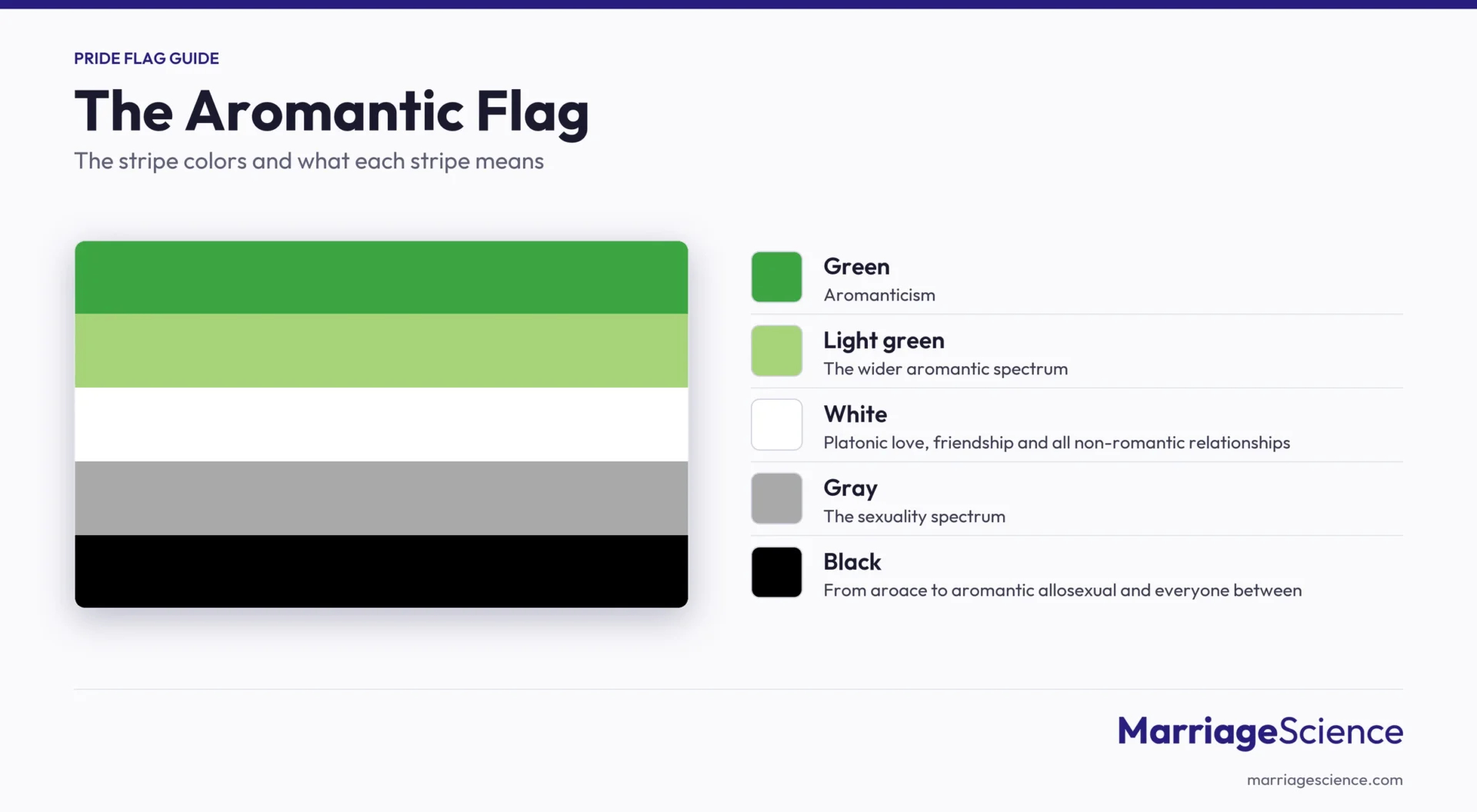
The two green stripes represent the aromantic spectrum, with green representing aromanticism itself.
White represents platonic love, friendship, queerplatonic relationships, family, and every non-romantic form of love. Gray and black represent the sexuality spectrum, which the designer described as “acknowledging aro-aces, aromantic allosexuals, and everything in between.”
Aromanticism, Stigma and Amatonormativity
Aromantic people are part of LGBTQIA+ communities. The A in LGBTQIA+ includes aromantic people, along with asexual and agender people.
Aromantic people may also encounter amatonormativity, the assumption that everyone wants and is better off in an exclusive romantic relationship. Philosopher Elizabeth Brake coined the word.
That assumption can make romance seem like the expected center of adult life. It may also leave aromantic people feeling overlooked when family, school, media, or friends treat dating and couplehood as the obvious goal.
Stigma can appear as disbelief, pressure, or unwanted advice. In Aro Census 2020, 82.4% of respondents said they had not been taken seriously, had been ignored or dismissed, and 48.3% had faced attempts or suggestions to “fix” or “cure” them.
Those reactions can hurt because they force aromantic people to defend a genuine orientation. They can also make ordinary choices, such as staying single, choosing close friendships, or setting dating boundaries, harder to explain.
Three myths come up again and again:
- That aromantic people are cold.
- That they have not met the right person.
- That they cannot have a happy life.
Myths like these reduce aromantic people to someone else’s idea of what love and happiness should look like. Aromanticism does not erase care, commitment, family, friendship, community, or the possibility of a full life.
How to Support an Aromantic Person
Supporting an aromantic person usually starts with taking their words seriously. You do not have to fully understand their inner life before you can treat them with care and respect.
- Believe them the first time. If someone tells you they are aromantic, accept that as real information about them. Avoid quizzing them, arguing, or waiting for them to prove it through future choices.
- Value your friendship with them as a relationship in its own right. Do not treat friendship as a placeholder until romance arrives. Show up, make plans, remember what matters to them, and give the bond its own weight.
- Leave out jokes and pressure about dating, weddings, or “finding someone.” These comments can make a person feel corrected instead of understood. If you slip, apologize simply and change the habit.
- If you are their partner, talk openly about what each of you wants. Discuss affection, commitment, labels, sex, living plans, public language, and boundaries. Clear agreements help both people understand the relationship they are choosing.
The goal is to listen, make room for their words, and let the people in the relationship shape it together.
Frequently Asked Questions
What Does Aromantic Mean in Simple Terms?
It means little or no romantic attraction to others.
An aromantic person may still feel deep care, attachment, sexual attraction, affection, or a wish for close partnership. The word is about the romantic pull toward other people, so it does not decide how warm, loving, social, or committed someone can be.
Do Aromantic People Fall in Love?
Some aromantic people do fall in love.
In the Aro Census 2020, 16.2% had been in love, and 61.2% had not. That range matters because aromantic does not give one shared life story, and some people use the word because romantic attraction is rare, unclear, or absent for them.
Can Aromantic People Be in a Relationship?
Yes, aromantic people can be in a relationship.
In the Aro Census 2020, 39.7% of respondents had been in a romantic relationship, and 10.6% were in a non-romantic partnership. The best word for a relationship depends on the people in it, the agreement they make, and what kind of attraction or commitment is present.
What Is the Difference Between Aromantic and Asexual?
Aromantic is about romantic attraction, while asexual is about sexual attraction.
A person may use one word, both words, or neither word, depending on what they experience. This distinction helps because romance and sex can line up for some people and feel separate for others.
Can You Be Aromantic but Not Asexual?
Yes, an aromantic person can be allosexual.
Allosexual means someone experiences sexual attraction, so an aromantic allosexual person may have a sexual orientation such as heterosexual or bisexual. In the Aro Census 2020, 253 heterosexual and about 1,200 bisexual people answered, which shows why romantic and sexual orientation are named separately.
Is Aromantic Part of LGBTQ+?
Yes, aromantic is part of LGBTQIA+.
The A in LGBTQIA+ includes aromantic people. Some people say LGBTQ+ as a shorter umbrella term, and some say LGBTQIA+ when they want the A to be named directly.
What Is a WTFromantic?
WTFromantic is another name for quoiromantic.
It can mean being unsure whether feelings are romantic, or finding that the question does not apply. A person might use this word when ordinary romance categories feel confusing, too narrow, or simply unrelated to how they understand their feelings.
How Do I Know if I’m Aromantic?
No test decides whether you are aromantic.
You can notice how the word feels, how often you experience romantic attraction, and whether romantic expectations describe your life well. In the Aro Census 2020, 34.3% of respondents were unsure whether they had ever felt romantic attraction, so doubt is normal.
What to Take Away
Aromanticism is a real orientation. If the word helps you understand your feelings, relationships, or the way romance shows up in your life, you can use it now, even if your language changes as you continue learning about yourself and what feels true.
Romance is one kind of love among many, and it does not have to be the center of a meaningful life. Friendship, family, community, care, commitment, and chosen connection can matter deeply too. You get to decide which words describe you, which relationships you want, and how much romance belongs in your life, if any.