


Maybe you have never experienced the kind of crush your friends describe, and sex feels just as optional to you. Or perhaps someone close to you has said they are aroace, and you want to understand what that means without making the conversation feel awkward or heavy.
Aroace is short for aromantic asexual. It describes people who experience little or no romantic attraction and little or no sexual attraction.
Aroace is a real, named orientation with its own community and language. Many aroace people have close, loving relationships that are not romantic, and those relationships can sit at the center of their lives.
This page explains what aroace means, how it differs from aromantic and asexual, what research and the largest community survey have found, what the aroace flag represents, how dating can look, and what signs may suggest the label fits you. The goal is to give you clear language for understanding yourself or supporting someone else with care.
Key Takeaways
Here is the short version before we get into the details:
- Aroace means aromantic and asexual: It describes little or no romantic attraction and little or no sexual attraction.
- It combines two orientations: An aroace person can still love friends, family, and partners in non-romantic ways.
- About a quarter of asexual people are aromantic: A 2020 study published in Archives of Sexual Behavior found that 26% of 4,032 asexual participants were aromantic.
- Most people in the largest aromantic survey were also asexual: The Aro Census 2020 reported that 6,903 of 9,758 respondents were also asexual.
- The aroace flag has five stripes: orange, yellow, white, light blue, and dark blue.
What Does Aroace Mean?
Aroace describes someone who is both aromantic and asexual.
“Aro” is short for aromantic, while “ace” is short for asexual. Put together, they form aroace. You may also see it written as “aro-ace” or “aro ace.” People usually pronounce it like “arrow ace.”
Aromantic describes romantic attraction, or experiencing little or no romantic attraction.
Asexual describes sexual attraction, meaning a person experiences little or no sexual attraction. An aroace person experiences both patterns, although exactly how they experience them can differ from one person to another.
Romantic attraction is the pull toward a romantic relationship with a particular person. It may involve wanting to date someone, become their partner, or feel “in love” with them.
Sexual attraction is the desire for sexual contact with a specific person. For many people, romantic and sexual attraction point toward the same person, which can make the two experiences easy to confuse.
The phrase “little or no” matters because aroace is a spectrum.
Some aroace people experience attraction rarely, weakly, or only in certain circumstances. Others use additional labels, such as grayromantic or demisexual, describe their experiences more precisely.
Aroace describes a pattern of attraction.
It does not determine whether someone has sex, dates, gets married, or has children. Those are personal choices.
Because the term covers both romantic and sexual attraction, it can help someone explain why typical dating expectations do not feel right for them. It can also help friends, partners, and parents understand that attraction, relationships, and life choices are separate parts of a person’s experience.
Aromantic vs Asexual vs Aroace
Aromantic describes little or no romantic attraction, while asexual describes little or no sexual attraction. Aroace is the term for people who experience both.
For many people, romantic and sexual attraction point toward the same person. For others, they are separate, which is why the two concepts remain distinct.
| Feature | Aromantic | Asexual | Aroace |
| Romantic attraction | Little or none | Can be present | Little or none |
| Sexual attraction | Can be present | Little or none | Little or none |
| Can date or have partners | Yes, by choice | Yes, by choice | Yes, by choice |
| Example | A bisexual man who never feels romantic love | A woman who falls in love but feels no sexual pull | Someone who feels neither, and builds life around close friends |
Separating romantic and sexual attraction in this way is called the split attraction model. In their 2022 study published in Archives of Sexual Behavior, Clark and Zimmerman found that 89% of allosexual adults, meaning people who do experience sexual attraction, had a romantic orientation that matched their sexual orientation. Among asexual adults, the figure was 37%. This difference helps explain why people keep romantic and sexual orientation separate, particularly when someone experiences one pattern for romance and another for sexual attraction.
So, aromantic people can be straight, gay, bi, or pan in their sexual orientation. Likewise, asexual people can be heteroromantic, biromantic, and so on. Aroace describes people who experience both romantic and sexual attraction as absent or rare.
How Common Is Being Aroace?
No population survey has directly measured how many people are aroace.
The best-known national estimate for asexuality comes from Bogaert. His 2004 analysis, published in the Journal of Sex Research, used a British national probability sample of more than 18,000 people. About 1% of participants reported no sexual attraction to anyone.
That finding tells us something about asexuality, but it does not tell us how many people are both aromantic and asexual. Because aroace includes both romantic and sexual attraction, figures about asexuality alone cannot give us the complete picture.
What Asexuality Research Tells Us
Antonsen offers a clearer look at asexual communities. In a 2020 study, Antonsen and colleagues at the University of British Columbia pooled seven asexuality studies covering 4,032 asexual people. The research was published in Archives of Sexual Behavior.
Within that pooled group, 74.0% reported romantic attraction. That means about 26% were aromantic asexual, or roughly one in four.
However, that percentage comes from asexual study samples. Researchers have not counted aroace people in the general population.
What the Aro Census Found
Aro Census 2020 provides another community snapshot. The Aromantic-spectrum Union for Recognition, Education, and Advocacy (AUREA) conducted the census and received 9,758 responses. Of those respondents, 6,903 identified as asexual, or about 71%.
The census took place online and in English, and most respondents were under 30. Because of that, it describes the community that responded rather than the entire population.
Put simply, aroace people appear to make up a small minority, but no one has measured the group directly through a population survey. The available figures are useful, but you should keep those limitations in mind when interpreting them.
What Being Aroace Can Feel Like
Being aroace can feel quiet, confusing, steady, relieving, or completely ordinary, depending on the person. For many people, the label helps them make sense of experiences that once seemed difficult to explain to friends, family, or partners.
Not Feeling the Crush Everyone Describes
Many aroace people say they realized later that their friends meant something literal when they talked about “having a crush.” They may have assumed people were exaggerating, copying what they saw in movies, or simply following a social script.
Films and songs about falling in love can feel like a language you understand but do not speak. An aroace person may recognize the story, gestures, and excitement surrounding romance while still feeling separate from that type of attraction.
Loving People Without Romance
Aroace people can experience deep platonic love, family love, and loyalty. A friend, sibling, parent, chosen family member, or community can matter deeply, even when romance does not form part of the relationship.

Some aroace people form queerplatonic relationships, which are committed partnerships outside traditional romance. These relationships can involve shared plans, care, closeness, household decisions, or long-term commitment, depending on what the people involved want.
This is one reason being aroace does not mean being cold, detached, or unable to form meaningful bonds. The term describes a pattern of attraction, while love and care can still play an important role in everyday life.
Sex Is a Separate Question
Being aroace does not automatically tell you what someone does or wants sexually. Some aroace people are sex-favorable, some never want sex, and others may have sex for a partner, for pleasure, or to have children.
In the Clark and Zimmerman study, 54% of asexual adults described themselves as sex-averse, while 41% described themselves as sex-neutral. These terms describe a person’s comfort and interest around sex, which can vary considerably from one person to another.
Attraction and behavior are different things. An aroace person may make decisions about sex based on comfort, boundaries, health, values, a relationship agreement, or a desire to have children.
Can Aroace People Date or Fall in Love?
Yes. Some aroace people date or fall in love in their own way, while many have no interest in doing so. Because aroace people fall on both the aromantic and asexual spectrums, dating can look very different from the romantic and sexual scripts that others may expect.
The Aro Census 2020 included 9,758 aromantic-spectrum respondents, most of whom were under 30. The census focused on aromantic people in general, and most respondents were also asexual. As a result, it can show the range of experiences within the aroace community without suggesting that every aroace person is the same.
Among respondents, 83.6% were single. Meanwhile, 7.9% were in a romantic partnership, 6.5% were in a sexual partnership, and 10.6% were in a non-romantic partnership.
Past experiences varied as well. In the same census, 39.7% had been in a romantic relationship at some point. About 16.2% said they had been in love, 61.2% said they had not, and 22.6% were unsure.
Crushes were mixed, too. About one-third said they had experienced a crush, another third said they had not, and the remaining third were unsure. The census also found that 20% were monogamous and 16.4% were polyamorous and/or polyaffectionate.
These numbers matter because dating is a behavior, while attraction is an internal experience. An aroace person might date or marry for companionship, a shared life, family, or a partner who understands how they connect.
Some aroace people enter romantic relationships without experiencing romantic attraction themselves. This can work best when both people understand what the relationship means, what kinds of affection are welcome, and what each person wants the commitment to include.
What Is a Queerplatonic Relationship?
A queerplatonic relationship is a committed, often long-term partnership that goes beyond a typical friendship but is not romantic. People of any orientation can have one, including aroace people and those who use other labels for themselves.
It can include living together, sharing money, raising children, physical affection, public commitment, or private routines, depending on the people involved. The partners define the bond together, including what care, closeness, and responsibility look like day to day.
Signs You Might Be Aroace
There is no test that can determine whether you are aroace.
The experiences below are common for some aroace people, but they are only starting points for reflection. You do not need to meet a certain number of them to use the label.

- Friends’ crushes never quite made sense to you, or you pretended to have one to fit in.
- You imagine your future with close friends, family, or on your own, and a romantic partner does not form part of that picture.
- Sex feels unimportant, unappealing, or like something you could take or leave.
- When someone shows romantic interest in you, you feel uncomfortable, or you lose interest once the feelings become mutual.
- You can admire someone’s appearance without wanting to date them or have sex with them.
- Romantic sexual scenes in movies leave you puzzled or bored.
- Reading about aromantic or asexual experiences feels like reading about yourself.
Labels are tools. You can try one, change it later, choose more specific terms, or decide not to use a label at all.
A sudden loss of interest in people who once mattered to you can have other causes. The National Institute of Mental Health lists loss of interest most of the time for at least two weeks as a symptom of major depression. If that sounds more like your experience, or if the change feels new and distressing, consider talking with a doctor or therapist. Being aroace is generally a long-term pattern rather than a sudden change.
The Aroace Flag and What It Means
The most widely used aroace flag has five horizontal stripes: orange, yellow, white, light blue, and dark blue.
Community descriptions say orange represents community, yellow represents love and relationships outside traditional romantic and sexual forms, white represents wholeness, and the two blue stripes represent the range of aroace identities and experiences.
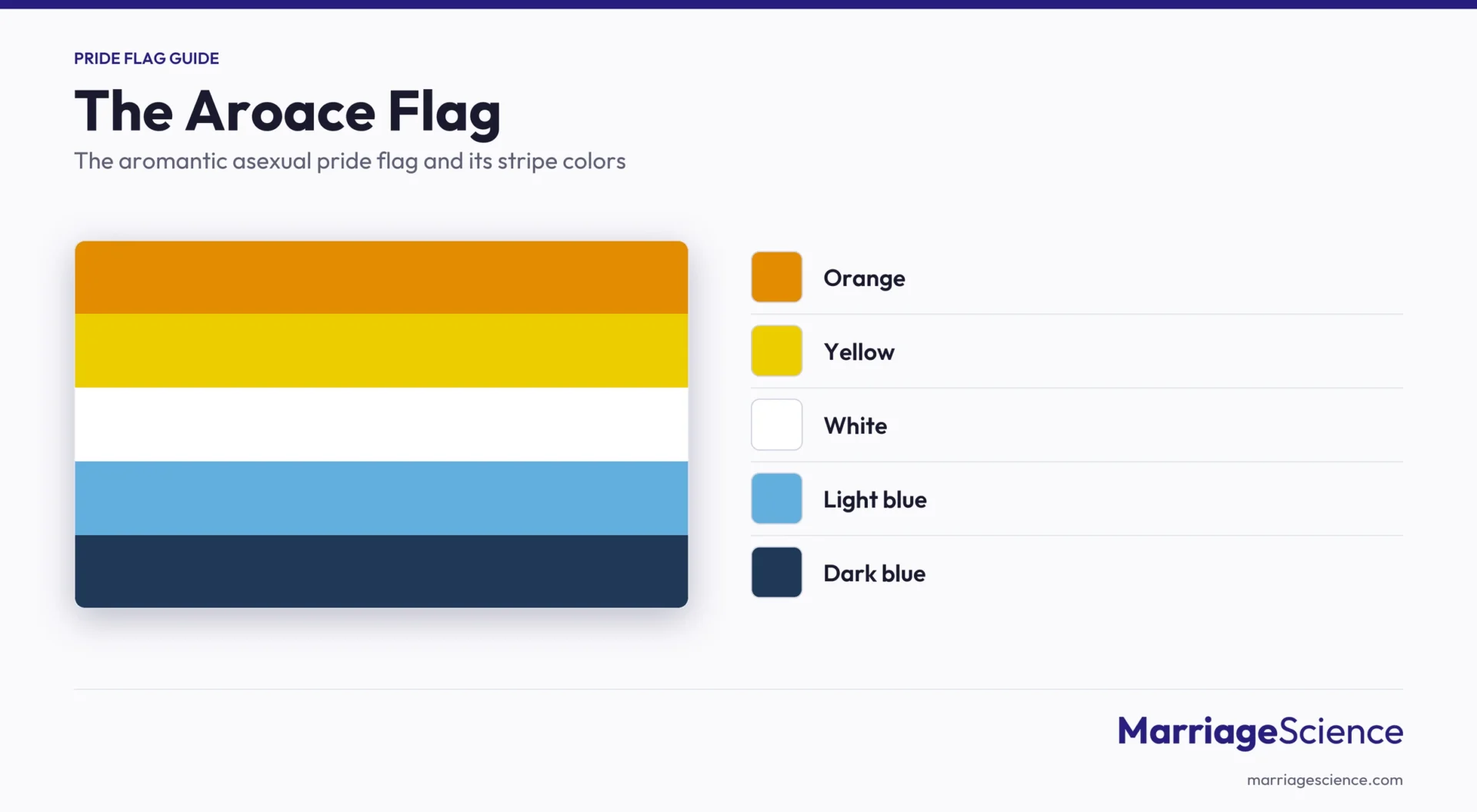
Some people noticed that the flag can resemble the old South African flag. The flag’s designer said they were not aware of the resemblance and explained that the aroace flag has more stripes and no emblem.
Is Aroace Part of LGBTQ+?
Yes.
Aroace people can be part of the LGBTQIA+ community. The “A” in LGBTQIA+ includes asexual and aromantic people, along with agender people. It does not stand for “ally,” which is a common misunderstanding.
Aroace people can face pressure from a culture that treats romance and sex as expected parts of growing up, dating, family life, and adulthood.
Amatonormativity refers to the assumption that everyone wants an exclusive romantic relationship and that everyone is better off in one. Philosopher Elizabeth Brake coined the term, which can help explain why people often misunderstand aroace experiences.
In Aro Census 2020, 82.4% of respondents said they had not been taken seriously, had been ignored, or had been dismissed. Another 48.3% said they had faced attempts or suggestions to “fix” or “cure” them. These figures describe aromantic respondents, but they also help show why inclusion and understanding can matter in everyday life.
Some aroace people feel comfortable in LGBTQ+ spaces, while others may also use more specific asexual or aromantic communities. Finding a word that fits can bring relief after years of feeling as though something was missing.
Aroace and Other Identities
Aroace can exist alongside other labels a person uses for themselves. Some aroace people also identify as lesbian, gay, bi, or queer, depending on what those terms help them describe.
For some people, the reason is community. For others, it may relate to aesthetic attraction, platonic attraction, or the kinds of people they tend to form close bonds with.
A label can describe belonging as well as attraction. An aroace person might use one term in certain settings and another with close friends because different words can describe different parts of their life.
Gender identity is separate from sexual or romantic orientation. An aroace person can be a man, a woman, nonbinary, agender, or any other gender.
The Aro Census 2020 found that, after asexual, queer was the most common sexual orientation label respondents used. This helps explain why labels often overlap in aro and ace communities, while each person still gets to choose the words that feel right for them.
How to Support an Aroace Friend or Partner
If someone tells you they are aroace, you do not need a perfect response. A steady and respectful reaction can make it easier for them to feel safe being honest with you.
- Believe them. Avoid saying, “You just haven’t met the right person,” even if you intend it as reassurance.
- Take the relationships they value seriously. Friendships, chosen family, and queerplatonic partnerships can matter just as deeply as other types of relationships.
- Do not pressure them about dating, matchmaking, or their sex life. Curiosity is understandable, but their privacy still matters.
- Ask what they want from your relationship instead of making assumptions. If you are their partner, talk openly about affection, labels, time together, boundaries, and future plans.
- Use the words they use for themselves. If their preferred terms change later, adjust your language without turning it into a debate.
Support usually comes down to listening, adjusting, and treating their orientation as real in everyday life.
Frequently Asked Questions
What Does Aroace Stand For?
Aroace stands for aromantic asexual. It usually means a person experiences little or no romantic attraction and little or no sexual attraction, though each person may describe that experience in their own words.
Can Aroace People Fall in Love?
Some aroace people describe being in love, and some do not. Some describe deep platonic love, and in the Aro Census 2020, 16.2% said they had been in love while 61.2% said they had not.
Can Aroace People Date or Get Married?
Yes, some aroace people date, get married or build long-term partnerships. Some do this for companionship, family or a shared life, and in the Aro Census 2020, 10.6% were in a non-romantic partnership.
Is Aroace the Same as Asexual?
No, aroace and asexual do not mean the same thing.
Asexual is about sexual attraction only, while aroace means little or no romantic attraction and little or no sexual attraction. Many asexual people feel romantic attraction, including 74.0% in the 2020 Antonsen study.
Do Aroace People Have Sex?
Some aroace people have sex, and some do not. Attraction and behavior are different, so the word aroace does not by itself tell you what someone does sexually.
Is Aroace Part of LGBTQ+?
Yes, aroace is part of LGBTQ+. The A in LGBTQIA+ includes aromantic and asexual people, so aroace people can be included under that wider community term.
How Do I Know if I’m Aroace?
No test decides whether you are aroace. If romance and sex both feel optional or foreign to you, and the word fits, you can use it while you learn what feels true for you.
What to Take Away
Aroace means a person is both aromantic and asexual, but the label can hold different personal meanings for different people. If it helps you describe your experience, you can use it with confidence: aroace is a real orientation with a community, a flag, and a growing body of research.
Even if the word does not fit you, learning what it means can still help you understand someone you care about. A life can be full of love, care, friendship, family, commitment, pleasure, purpose, and closeness, even when romance or sex is not at its center.