

Anxiety after a breakup is a common response to a major loss. For many people, it eases over weeks or months. However, seek professional help if it keeps you from sleeping, working, or managing daily life or if you have thoughts of harming yourself.
If you are in crisis right now, call or text 988, or text HOME to 741741. If you may hurt yourself or someone else may hurt you right now, call 911.
Is Anxiety After a Breakup Normal?
Yes. Anxiety after a breakup can be part of how your mind and body respond to loss, rejection, and sudden change.
Remember, normal does not mean easy. It also does not mean you have to handle these feelings alone.
Field, Diego, Pelaez, Deeds and Delgado (2009) studied 192 university students who had recently experienced a breakup. Students with greater breakup distress reported more intrusive thoughts, more difficulty controlling those thoughts, sleep disturbances, and higher depression and anxiety scores. Women in the study also reported higher breakup distress.
Verhallen, Renken, Marsman and ter Horst (2019) compared 71 people who had experienced a breakup within the previous six months with 46 people who were still in relationships. In the breakup group, 26.8% reported symptoms within the mild, moderate, or severe depression range.
Rhoades, Kamp Dush, Atkins, Stanley and Markman (2011) followed 1,295 unmarried adults between the ages of 18 and 35. After a breakup, distress increased in 30.7% of cases, decreased in 19.6%, and changed very little in 49.7%.
These findings show that people respond to breakups in different ways. You might feel unsettled for a few weeks, while someone else may struggle enough to need support much sooner.
Why Breakups Trigger Anxiety
A breakup can disrupt your body, daily habits, identity, and sense of safety all at once. Anxiety may be your body’s alarm system responding to a loss that it cannot quickly resolve.

Attachment Is Disrupted
Your romantic partner may be the first person you text, the person you sleep beside, or the one you turn to when life gets stressful. Once that person is no longer part of your daily routine, even ordinary moments can feel unfamiliar or unsafe.
Sbarra (2006) followed 58 young adults after a serious breakup and collected daily reports about their emotions for four weeks. The study found that acceptance of the breakup helped explain the relationship between attachment security and recovery from sadness.
This does not mean you should force yourself to accept the breakup before you feel ready. Instead, understand that the shock may ease gradually as you begin to process the loss.
Sleep Gets Worse
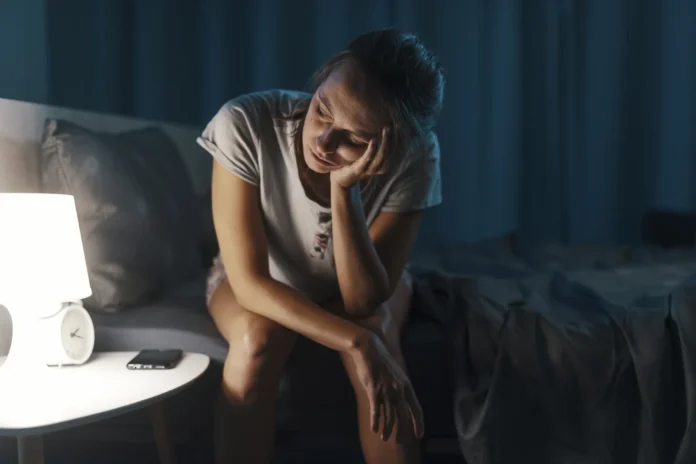
Breakup anxiety can feel more intense at night. The room grows quiet, your phone is within reach, and you have fewer distractions to take your mind off the situation.
Field, Diego, Pelaez, Deeds and Delgado (2009) found greater sleep disturbance among people with high breakup distress. Coppola and colleagues (2023) studied separated adults and found that spending more time with an ex was associated with lower sleep efficiency.
Sleep problems do not mean you are “broken.” They may signal that your body is under strain, so give your sleep routine the attention it needs.
Rumination Keeps the Alarm On
Rumination means repeatedly replaying what happened, what you might have missed, and what you wish you had done differently. This mental loop can feel productive, as though you are trying to solve the breakup. However, it can also keep your body on alert.
Verhallen, Alonso-Martínez, Renken, Marsman and ter Horst (2022) followed 87 Dutch adults for 30 weeks after a breakup. Participants in the slow-recovery and chronic-distress groups had higher levels of trait rumination than those in the resilient group.
The study does not prove that rumination causes slower recovery. Still, it reflects a familiar experience: when your mind keeps circling the breakup, it can become harder to relax and rest.
Being Left Adds Humiliation
Being left can bring feelings of loss and rejection, along with a private or public sense of humiliation. Together, these emotions can take a serious toll on your self-worth.
Kendler, Hettema, Butera, Gardner and Prescott (2003) studied 7,322 adult twins and rated life events according to loss, humiliation, entrapment, and danger. They found that separation initiated by someone else in other words, being left by a partner combined humiliation with loss and predicted depression more strongly than events involving loss alone.
This does not mean a breakup is worse than a death for everyone. It does show that being left can carry a particular emotional weight, and that experience deserves care.
Can a Breakup Cause PTSD?
A breakup can feel traumatic. Some people experience panic, nightmares, intrusive thoughts, or intense physical fear.
However, PTSD has a specific diagnostic threshold. The U.S. Department of Veterans Affairs National Center for PTSD summarizes DSM-5-TR Criterion A as exposure to actual or threatened death, serious injury, or sexual violence.
A breakup alone does not meet that exposure criterion. However, a relationship that involved violence, threats to life, or sexual violence may meet it.
Vandervoort and Rokach (2003) introduced the phrase “post-traumatic relationship syndrome” to describe people traumatized by physical, sexual, or severe emotional abuse in intimate relationships. This phrase is not a DSM-5-TR diagnosis.
Prolonged grief disorder is different as well. The American Psychiatric Association describes it as a DSM-5-TR diagnosis associated with the death of a close person, not the end of a relationship.
Adjustment disorder may be more relevant to some reactions after a breakup. The Merck Manual describes adjustment disorder as emotional or behavioral symptoms that develop within three months of a stressor. When the diagnostic criteria are met, the symptoms last no more than six months after the stressor and its consequences have ended.
A breakup can be the type of stressor that leads a clinician to assess you for adjustment disorder. Only a qualified professional can determine whether your symptoms meet those criteria or point to another condition.
Depression After a Breakup: Signs to Watch
Feeling low after a breakup can be part of the grieving process, but those feelings can also become serious. Pay attention if sadness develops into hopelessness, withdrawal, or thoughts of self-harm.
Monroe, Rohde, Seeley and Lewinsohn (1999) studied 1,470 older adolescents at two different points in time. They found that a recent romantic breakup predicted a first episode of major depressive disorder. However, it did not predict a recurrence among teenagers who had experienced depression before.
The National Institute of Mental Health identifies warning signs that call for help as soon as possible, especially when they are new or getting worse. Watch for the following:
- Talking about wanting to die, wanting to disappear, or feeling like a burden.
- Feeling hopeless, trapped, empty, extremely sad, agitated, or intensely angry.
- Withdrawing from friends, family, work, school, or activities you usually enjoy.
- Sleeping much more or much less than usual, or eating much more or much less.
- Using alcohol or drugs more often to get through the day or night.
- Making a plan, researching ways to die, saying goodbye, or giving away meaningful belongings.
The CDC lists the loss of relationships as a suicide risk factor. It also identifies support from partners, friends, and family and feeling connected to other people as protective factors.
What Helps
Breakup anxiety often improves through small, repeated experiences that help you feel safe again. Focus on reducing your daily stress and building a reliable support system.

Create Distance and Rebuild Daily Routines
- Limit contact and online checking. Sbarra and Emery (2005) found that contact with a former partner slowed the decline of love and sadness over 28 days. Marshall (2026) found that actively monitoring an ex on social media was associated with greater breakup distress, negative emotions, and jealousy. Muting or unfollowing your ex or taking a break from their profiles may help protect your emotional well-being.
- Protect your sleep. Field, Diego, Pelaez, Deeds and Delgado (2009) linked greater breakup distress with sleep disturbance. Coppola and colleagues (2023) also associated more time with an ex with lower sleep efficiency. Try keeping a simple bedtime routine, placing your phone out of reach, and avoiding late-night checking.
- Set aside time for worry. McGowan and Behar (2013) tested a daily 30-minute worry period with 53 people who had high levels of trait worry. The approach reduced worry, anxiety, negative emotions, and insomnia more than a focused-worry control. Researchers tested this method with general worriers, not people specifically dealing with breakup rumination, so consider it one tool you could try.
Lean on Support and Use Structured Tools
- Reach out to people you trust. Tran, Castiglioni, Walper and Lux (2024) studied 3,734 separation events in a German panel. Greater satisfaction with a person’s social network was strongly associated with fewer negative emotions about the separation.
- Write with care and realistic expectations. Lepore and Greenberg (2002) randomly assigned 145 undergraduates to write expressively about a breakup or write about a neutral topic. Expressive writing did not demonstrate faster recovery. However, participants in the control group experienced short-term increases in tension, fatigue, and upper respiratory symptoms, while those who wrote expressively did not.
- Consider structured support. Brodbeck, Berger, Biesold, Rockstroh and Znoj (2019) tested a guided online self-help program with 110 older adults who had experienced spousal bereavement, separation, or divorce. Compared with a wait-list control group, the program produced effects of d = 0.81 for grief and d = 0.59 for depression. Participants maintained these gains at the three-month follow-up.
For anxiety after a breakup, individual therapy is usually the better starting point. If you and your partner are still together and both feel safe, you can also explore our comparison of online therapy platforms for couples.
When to Get Help
Reach out for help sooner than you think you “deserve” it. You do not have to reach rock bottom before speaking with a licensed therapist, doctor, or crisis counselor.

Signs That You Should Seek Professional Support
Contact a professional if symptoms occur most days for two weeks or longer, or if you struggle to work, sleep, eat, parent, study, or care for yourself. You should also seek help if you experience panic attacks, use alcohol or drugs to cope, feel detached from reality, or have any thoughts of self-harm.
Insurance may cover therapy, depending on your plan and state. BetterHelp says it is in network with more than 125 health plans. Talkspace bills many insurance plans directly, while Rula says it is in network with most major insurance plans.
If you want a starting point focused on breakups, read our guide to online therapy after a breakup. A clinician can screen you for anxiety, depression, trauma exposure, substance use, sleep problems, and safety concerns.
Crisis and Immediate Safety Support
If you might harm yourself, call or text 988, or use the chat service at 988lifeline.org. You can also text HOME to 741741 to reach the Crisis Text Line. This service is free, confidential, and available 24/7 in the United States.
If you are in immediate danger, call 911. If an ex is threatening you, monitoring you, or has hurt you, contact the National Domestic Violence Hotline at 1-800-799-7233, text START to 88788, or use the live chat at thehotline.org.
Frequently Asked Questions
These answers provide general information. Only a clinician can make a diagnosis. If your symptoms feel intense or unsafe, seek professional help.
How Long Does Anxiety Last After a Breakup?
For many people, anxiety after a breakup eases over weeks or months as sleep, routines, and social support return. If it interferes with work, sleep, eating, parenting, or basic daily functioning, seek professional help now.
Why Do I Feel Sick After a Breakup?
A breakup can disrupt your sleep, appetite, attention, and sense of safety, which may make the distress feel physical. Kross, Berman, Mischel, Smith and Wager (2011) also found that unwanted rejection activated brain regions involved in the sensory aspects of physical pain.
Can a Breakup Cause Panic Attacks?
A breakup can trigger sudden waves of panic-like fear, chest tightness, shaking, or a feeling that you are losing control, especially when you are not sleeping well. If these episodes happen repeatedly or keep you from living your daily life, a clinician can assess your symptoms and recommend treatment.
Is It Normal to Feel Depressed After a Breakup?
Sadness, loss of interest, and low energy can occur after a breakup. However, if you feel hopeless or trapped, cannot function, or think about dying, call or text 988 and contact a mental health professional.
Can You Get PTSD From a Breakup?
A breakup alone does not meet PTSD Criterion A, which involves actual or threatened death, serious injury, or sexual violence. If your relationship involved violence, threats, or sexual assault, a clinician may recommend trauma-focused treatment.
Should I See a Therapist After a Breakup?
Yes, especially if anxiety, low mood, panic, sleep problems, or intrusive thoughts interfere with your life. Therapy can help you regain stability, assess risks, reduce rumination, and decide what kind of support you need next.
More guides on getting through a breakup: Breakup Recovery.