


Discernment counseling is a short process of one to five sessions for couples where one partner is leaning out and the other is leaning in, aimed at a decision about the marriage, and does not try to fix it.
This guide explains how the sessions work, what the research says, how it differs from couples therapy, what it may cost, and how to find a trained counselor.
What Is Discernment Counseling?
What is discernment counseling in one line? It is decision counseling for a mixed-agenda marriage.
Its goal is clarity and confidence about next steps, based on a better understanding of what happened in the marriage and each person’s role in the problems.
Leaning-In and Leaning-Out Partners
Discernment counseling was built for a painful mismatch. One spouse is leaning out and thinks divorce may be best, while the other is leaning in and wants to save the marriage.
That mismatch changes the work. A counselor is not asking both spouses to start repair work before both have chosen that path.
Why Regular Marriage Counseling Often Stalls Here
The University of Minnesota’s Minnesota Couples on the Brink project says, “Traditional marriage counseling may not be helpful if one of you is not sure you want to work on the marriage at this point.”
Who Developed It
Discernment counseling was developed by Bill Doherty through the Doherty Relationship Institute and the University of Minnesota.
The Doherty Relationship Institute trains professionals in the method and lists them in a directory. Referrals can come from therapists, divorce professionals, clergy, and lawyers.
How Common Mixed-Agenda Couples Are
Mixed-agenda couples are not rare in research samples. Tang, Anderson, Johnson, Harris, and Kateregga reported two useful numbers in 2026.
In the National Couples’ Health and Time Study, 147 of 1,487 couples were mixed-agenda, or 9.89%. In that study, one partner rated separation unlikely while the other rated it likely.
In a clinical sample from university-based clinics in the Marriage and Family Therapy Practice Research Network, 368 couples fell into the mixed-agenda class. That was 40.3% of the clinical sample.
The authors said the clinical number exceeds earlier estimates. Doherty and colleagues had suggested that up to 30% of couples who come to couples therapy are mixed-agenda.
For a therapy waiting room, this means roughly two in five couples may not want the same outcome. One person may be hoping for repair, while the other may be deciding whether to leave.
How Discernment Counseling Sessions Work
Discernment counseling is short by design. It can end after one session, and it lasts no more than five sessions.
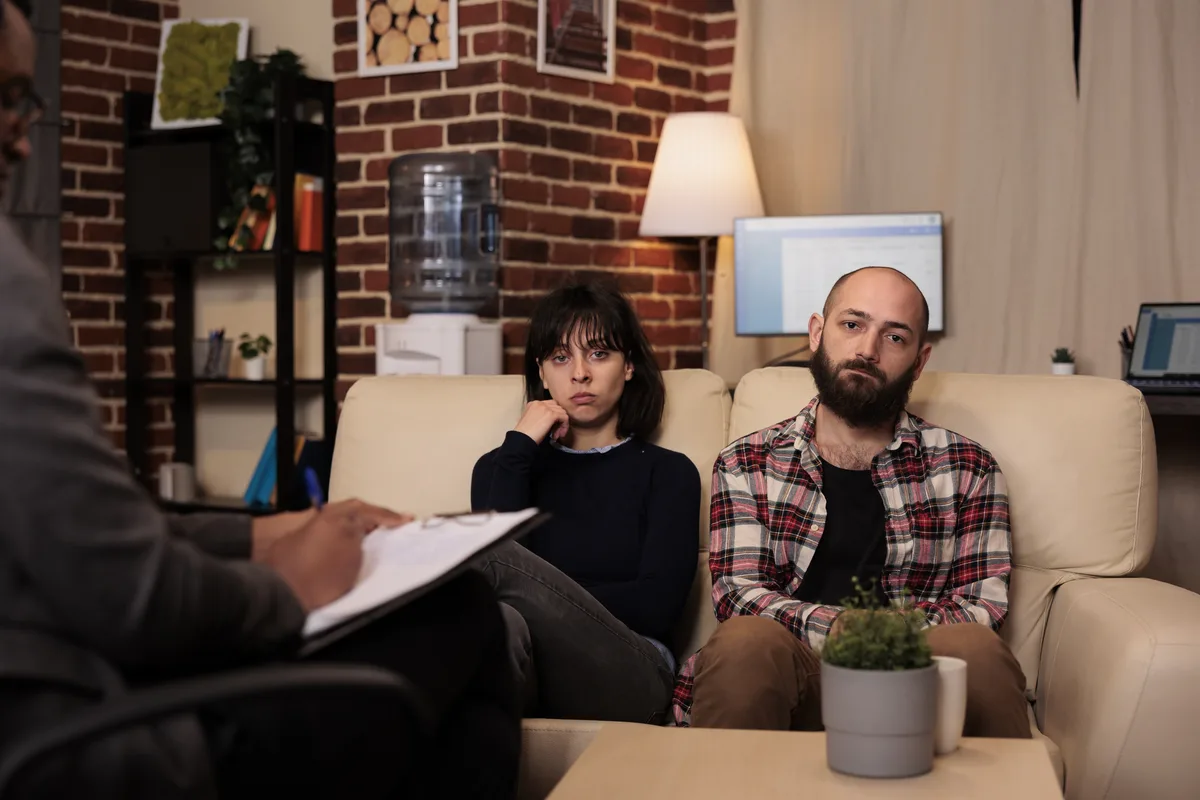
The first session is two hours. Later sessions are 1.5 hours each, if both partners choose to return.
| Session | Length | What Happens |
|---|---|---|
| Session 1 | 2 hours | Individual talks, then each partner decides |
| Sessions 2 to 5 | 1.5 hours each | More individual work and another choice |
| End | After 1 to 5 sessions | The couple picks one of three paths |
Individual Conversations
Most of the work happens in individual conversations with the counselor. There is also some time as a couple, with careful structure around what gets shared.
The Gottman Institute names this as the main way it departs from couples therapy. In discernment counseling, the intensive work occurs in separate individual conversations.
Deciding One Session at a Time
You do not sign up for five sessions at once. Each partner decides separately after each session whether to come back.
This matters when one spouse is unsure about the marriage. The process keeps the focus on choice, clarity, and responsibility.
Questions a Discernment Counselor May Ask
The exact questions can vary by counselor. The goal implies questions that look closely at what happened, what each person contributed, and what each path would require.
- What has happened in the marriage that brought you to this point?
- What have you each contributed to the problems?
- What would it mean to stay married as you have been?
- What would separation or divorce likely mean for each of you?
- What would need to change for six months of serious couples therapy to make sense?
The Three Paths
Discernment counseling ends with one of three paths. These are not graded as good or bad outcomes by the model.

The point is to make a clearer decision. That decision may be painful, but it should be less reactive and less foggy.
Path One: Stay as You Are
Path one means staying married as you have been. It is the status quo path.
This path does not mean the problems are solved. It means the couple is not choosing divorce or a full repair effort at that time.
Path Two: Separation or Divorce
Path two means moving toward separation or divorce. Discernment counseling does not give legal advice about that process.
For some couples, clarity means naming that one or both partners do not want to work on the marriage. That can still be a clearer ending than months of stalled therapy.
Path Three: Six Months of Couples Therapy
Path three means a six-month all-out effort in couples therapy. Divorce is off the table during that time.
On this path both partners commit to working on the marriage for a set period. If you choose this path and want video options, see our guide to the best online couples therapy platforms.
Does Discernment Counseling Work?
Whether discernment counseling works depends on how you define the goal. The goal is a clear decision about next steps, and reconciliation is one possible outcome.
In the 2016 Journal of Marital and Family Therapy article “Discernment Counseling for Mixed-Agenda Couples,” Doherty, Harris, and Wilde reported on 100 consecutive cases. The couples averaged 3.61 sessions.
At the end, 47% chose couples therapy to reconcile. Another 41% chose divorce or separation, and 12% chose the status quo.
Longer-term follow-up, about 28 months later, focused on couples who had chosen the reconciliation path. About 42% were reconciled, and 45% were divorced.
So the discernment counseling success rate depends on what you count as success. In this model, success means a thoughtful decision, not saving every marriage.
If you choose path three, the next question becomes how couples therapy tends to do. Our guide to marriage counseling success rates explains what to look for there.
If You Start Repair: OurRitual includes one weekly 40-minute Expert session, and the Couple plan starts at $64 a week on the 24-week package. One partner can start alone, and the Couple plan includes a free Partner account.
Discernment Counseling vs Couples Therapy
Discernment counseling vs couples therapy comes down to the goal. Discernment counseling helps a mixed-agenda couple choose a path, while couples therapy works on changing the relationship.
Both can be valuable at different moments. The wrong fit can leave one partner pushing for change while the other is still deciding whether to stay.
| Feature | Discernment Counseling | Couples Therapy |
|---|---|---|
| Goal | Clarity about next steps | Work on problems together |
| Who Is in the Room | Mostly individual conversations | Both partners together |
| Number of Sessions | One to five | Varies by couple |
| Session Length | 2 hours, then 1.5 hours | Usually shorter |
| What Counts as Success | A clear path forward | Progress on relationship goals |
The Gottman Institute explains that couples therapy usually has both partners working with the therapist together. In discernment counseling, the intensive work happens in separate individual conversations, with time to share reflections.
What Discernment Counseling Costs
There is no national price list for discernment counseling. A session is 1.5 to 2 hours, so a single session often costs more than a standard 50-minute appointment.
The whole process is short, though. It lasts one to five sessions, so the total cost may be limited compared with open-ended weekly therapy.
The figures below are an illustration only.
Open Path couples sessions cost $40 to $80. If a standard session runs 50 minutes, a two-hour first session at the same rate would be about $96 to $192.
Your actual fee may be different. Ask the counselor for the per-session fee, session length, payment timing, and whether insurance applies.
How to Find a Discernment Counselor
The University of Minnesota project and the Doherty Relationship Institute both run directories. One uses “Find a Counselor,” and the other uses “Find a Therapist.”

Before booking, ask whether the professional has completed discernment counseling training. Also ask whether the first session is two hours, whether later sessions are 1.5 hours, and how fees are charged.
You can also ask how the counselor handles video sessions. Counselors can work by video, and the directories can help you look for someone who fits your situation.
If you are the leaning-in partner and your spouse will not come, you may still want support for your own next steps. OurRitual has a start-alone option, and our OurRitual review explains the individual and couple plans.
Frequently Asked Questions
These answers cover the most common questions from couples considering discernment counseling. They are general information for planning a conversation with a professional.
What Is Discernment Counseling For?
Discernment counseling is for couples where one spouse is leaning out and the other is leaning in. Its purpose is clarity and confidence about next steps for the marriage.
What Is the Success Rate of Discernment Counseling?
In Doherty, Harris, and Wilde’s 2016 report, 47% chose couples therapy, 41% chose divorce or separation, and 12% chose the status quo. Among couples who chose the reconciliation path, about 42% were reconciled and 45% were divorced at about 28 months.
How Many Sessions Does Discernment Counseling Take?
Discernment counseling takes one to five sessions. The first session is two hours, and later sessions are 1.5 hours each.
Can We Do Discernment Counseling Online?
Counselors can work by video. The University of Minnesota project and the Doherty Relationship Institute list trained professionals through their directories.
What If My Spouse Refuses Discernment Counseling?
Discernment counseling is designed for both spouses to attend because each partner decides after each session whether to continue. If one spouse refuses, the leaning-in partner can still seek individual support, but that is different from discernment counseling.
Is Discernment Counseling the Same as Marriage Counseling?
No. The Doherty Relationship Institute says it is not couples therapy because the aim is not to solve problems together, improve communication, or get closer.