


Only you can decide whether to divorce, but research suggests many unhappy marriages improve over time, and divorce is the right answer when you are unsafe or the marriage cannot change.
This guide helps you sort safety, patterns, counseling options, money, timing, and the hard question of whether real change is still possible.
When Divorce Is the Right Answer
Some marriages can heal with time, help, and honest effort from both people. Other situations call for protection, distance, or an ending.
If You Are Not Safe
If you are being abused, safety comes first. The National Domestic Violence Hotline says emotional abuse can include yelling, name-calling, jealousy about friends, and more subtle control.
Call 800-799-7233, text START to 88788, or chat through the Hotline if you need help making a plan. If you are in immediate danger, call 911.
Leaving can be a dangerous period, so plan with an advocate before you act when you can. The Hotline also notes that internet use can be monitored, and it suggests clearing browser history.
You can read the Hotline’s description of emotional abuse at What Is Emotional Abuse?. No marriage decision process should ask you to stay unsafe.
If Nothing Can Change
Divorce may be the right answer when one partner refuses any serious effort to change. A marriage cannot be repaired by one person’s hope alone.
Repeated betrayal can also leave a person with no workable path back to trust. That can include patterns that continue after clear agreements, honest talks, or attempts at help.
Some people leave because the marriage has become a place where respect, safety, or basic care no longer exists. In those cases, the question may shift from “Can I try harder?” to “Is there anything real to work with?”
Questions to Ask Yourself Before You Decide
A divorce decision often gets clearer when you slow it down on paper. These questions are meant to help you separate pain, fear, and facts.

- Am I physically, emotionally, or financially safe in this marriage?
- Have I clearly told my spouse what needs to change?
- Has my spouse shown real action, or only short promises after conflict?
- Are our main problems about skills, stress, betrayal, abuse, addiction, or a basic mismatch in what we want from life?
- Would I still want a divorce if one or two major problems improved?
- What would divorce change for our children, housing, work, money, and daily life?
- What would staying require from me that I can no longer give?
- Have I spoken with a safe, grounded person who will not pressure me either way?
Write your answers somewhere private, then read them again after a few days. Strong feelings can be true, and they can also shift after sleep, distance, or a calm conversation.
What Happens to Unhappy Marriages That Last
One major study gives a reason to pause before assuming divorce is the only route out of misery. It does not prove every unhappy marriage should continue.

Waite, Browning, Doherty, Gallagher, Luo, and Stanley used data from the National Survey of Families and Households. Adults who said they were unhappily married in the late 1980s were interviewed again five years later.
According to the University of Florida IFAS Extension fact sheet, unhappy adults who divorced were no happier on average than unhappy adults who stayed married. Divorce did not typically reduce symptoms of depression, raise self-esteem, or increase a sense of mastery.
Two-thirds of the unhappy marriages had become happier five years later. A strong desire to stay married, a commitment to solving problems, and a commitment to finding personal happiness despite a mediocre marriage predicted the turnaround.
You can read the summary in the UF fact sheet, Does Divorce Make People Happy?. Divorce removed some stresses, but it also added others, including child custody issues and changes in financial stability.
This is one study, published in 2002, so it should not carry your whole decision. The authors also could not say whether people who divorced would have become happy if they had stayed.
The Most Common Reasons People Divorce
Divorce is often blamed on one dramatic event. For many couples, the stated reasons are quieter and more gradual.
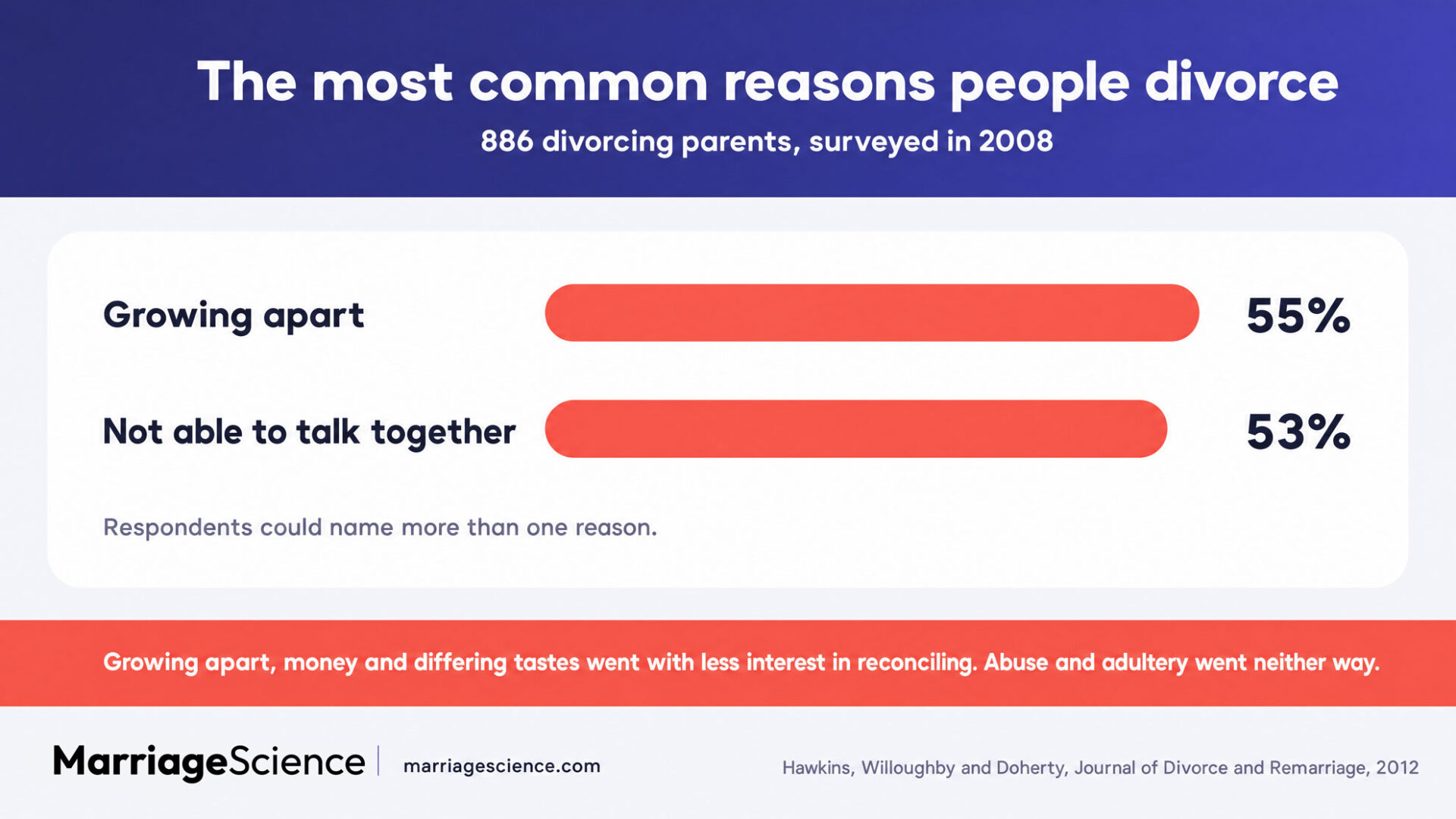
Hawkins, Willoughby, and Doherty surveyed 886 individual divorcing parents in Hennepin County, Minnesota, after mandated parenting classes in 2008. In their 2012 Journal of Divorce and Remarriage article, the most common reasons were “growing apart” at 55% and “not able to talk together” at 53%.
Growing apart, differences in tastes, and money problems were linked to less interest in reconciliation. Abuse and adultery were not linked to interest in reconciliation either way in that sample.
You can read the study page here: Reasons for Divorce and Openness to Marital Reconciliation. If you are wondering how divorce decisions often start, Marriage Science also has a guide to who initiates divorce.
When Only One of You Wants Out
Many couples are not in the same place at the same time. One spouse may be leaning out while the other is pleading for one more try.
Discernment counseling was built for that mixed-agenda moment. It is a short process of one to five sessions, with a two-hour first session and later sessions of about 1.5 hours.
The goal is a clear decision about the marriage, and repair work waits until after it. The three paths are staying as you are, separating or divorcing, or taking divorce off the table for six months while doing couples therapy.
You can find trained providers through the discernment counseling directory. This structure can help when one person wants clarity and the other wants repair.
Doherty, Harris, and Wilde published results from 100 consecutive discernment counseling cases in 2016. In those cases, 47% chose couples therapy, 41% chose divorce or separation, and 12% stayed as they were.
The average length was 3.61 sessions, according to the PubMed record for Discernment Counseling for Mixed-Agenda Couples. Those numbers describe one clinic sample and cannot predict any single marriage.
In Hennepin County, William Doherty has written that in as many as 40% of couples filing for divorce, one or both partners said they would be interested in reconciling if suitable options existed. The Institute for Family Studies discusses that finding in Are All Divorces Necessary?.
- Talk it through with a matched Expert each week
- Start alone if your spouse is not ready
- A free matching call before you choose a plan

Money, Housing and Timing
Divorce is emotional, but it is also practical. Before you decide, learn what a divorce costs and what would change in housing, insurance, debt, taxes, and child-related expenses.

Get your own legal and financial information before making promises or threats. Good information can calm panic, and it can also show you what plans need more work.
Try to separate the question “Do I want this marriage?” from “Can I survive the next six months?” Both matter, but they are different questions.
How to Decide Without Rushing
A clear decision usually needs safety, information, and time. Rushing can make you act from panic, while endless waiting can keep you stuck.
Talk to Someone on Your Own Side First
Choose someone who can hear the truth without pushing you to stay or leave. This might be a counselor, a trusted friend, a clergy member, a coach, or a family member with good judgment.
Tell them the facts you usually minimize. Include fear, loneliness, betrayal, money worries, and any times you felt unsafe.
Try a Structured Process
A structured process can keep the decision from turning into the same fight every week. Discernment counseling is one option when one spouse is leaning out and the other wants to keep trying.
Some couples also use a written trial plan with clear behaviors, dates, and check-ins. A vague promise to “do better” is hard to measure.
Give Couples Therapy a Real Window
In discernment counseling, one possible path is six months of couples therapy with divorce off the table. That window is meant to test whether both people will do the work.
If you want remote help, Marriage Science has a guide to the best online couples therapy platforms. You can also read about marriage counseling success rates before choosing a path.
OurRitual lets one partner start alone, and its Couple plan includes a free Partner account, according to its program details in our OurRitual review. Its own FAQ says it is not considered classic couples therapy, and it is not treatment for abuse or a mental health crisis.
Whatever route you choose, define what change would look like. For example, decide how you will handle conflict, money talks, parenting stress, sex, honesty, and follow-through.
Frequently Asked Questions
These answers give short, fact-based starting points. Your safety and your specific facts still matter most.
How Do I Know If I Should Get a Divorce?
Start with safety, because the National Domestic Violence Hotline recommends safety planning with an advocate when abuse is present. If you are not unsafe, write down what must change and whether both spouses are willing to act.
Is It Better to Stay in an Unhappy Marriage?
Waite and colleagues found that two-thirds of unhappy marriages in their sample were happier five years later. That study does not mean staying is best for everyone, especially when abuse or refusal to change is present.
What Are the Signs a Marriage Is Over?
A marriage may be over when one partner refuses any serious effort, betrayal keeps repeating, or safety is gone. Hawkins, Willoughby, and Doherty found that growing apart and not being able to talk together were the most common reasons divorcing parents gave.
Should I Get a Divorce If I Am Not in Love Anymore?
Feeling out of love is painful, but it is not the same as a full decision by itself. In the Waite study, a commitment to solving problems and finding personal happiness despite a mediocre marriage predicted later improvement.
Can Counseling Help If One of Us Already Wants a Divorce?
Discernment counseling was designed for couples where one spouse is leaning out and the other is leaning in. In Doherty, Harris, and Wilde’s 100 cases, 47% chose couples therapy, 41% chose divorce or separation, and 12% stayed as they were.
How Long Should You Try Before Getting a Divorce?
Discernment counseling uses one to five sessions to choose a direction, and one path is six months of couples therapy with divorce off the table. If abuse is present, the first timeline is a safety plan made with an advocate.