


Many exercises therapists use draw on research-backed approaches, including the Speaker-Listener technique, softened startups, gratitude practices, and structured questions that build closeness. Couples can try these exercises at home, too.
This guide covers simple practices you can use at home to improve communication, build closeness, repair hurt, create a greater sense of safety, and decide what to do if exercises alone are not enough.
How to Use These Exercises
Relationship exercises work best when both partners understand the goal and agree to take things slowly. Think of each exercise as practice you do together.
- Choose a calm time. Begin when neither of you feels rushed, hungry, exhausted, or already upset.
- Try one exercise at a time. Using three tools at once can make an already difficult conversation feel overwhelming.
- Pause if either of you feels emotionally flooded. Spend about 20 minutes apart doing something soothing, then return to the conversation.
- Avoid keeping score. The goal is to build a healthier pattern between you, not to prove who is right.
If one partner feels pressured to participate, the exercise may backfire. Start with the smallest practice that both of you feel comfortable trying.
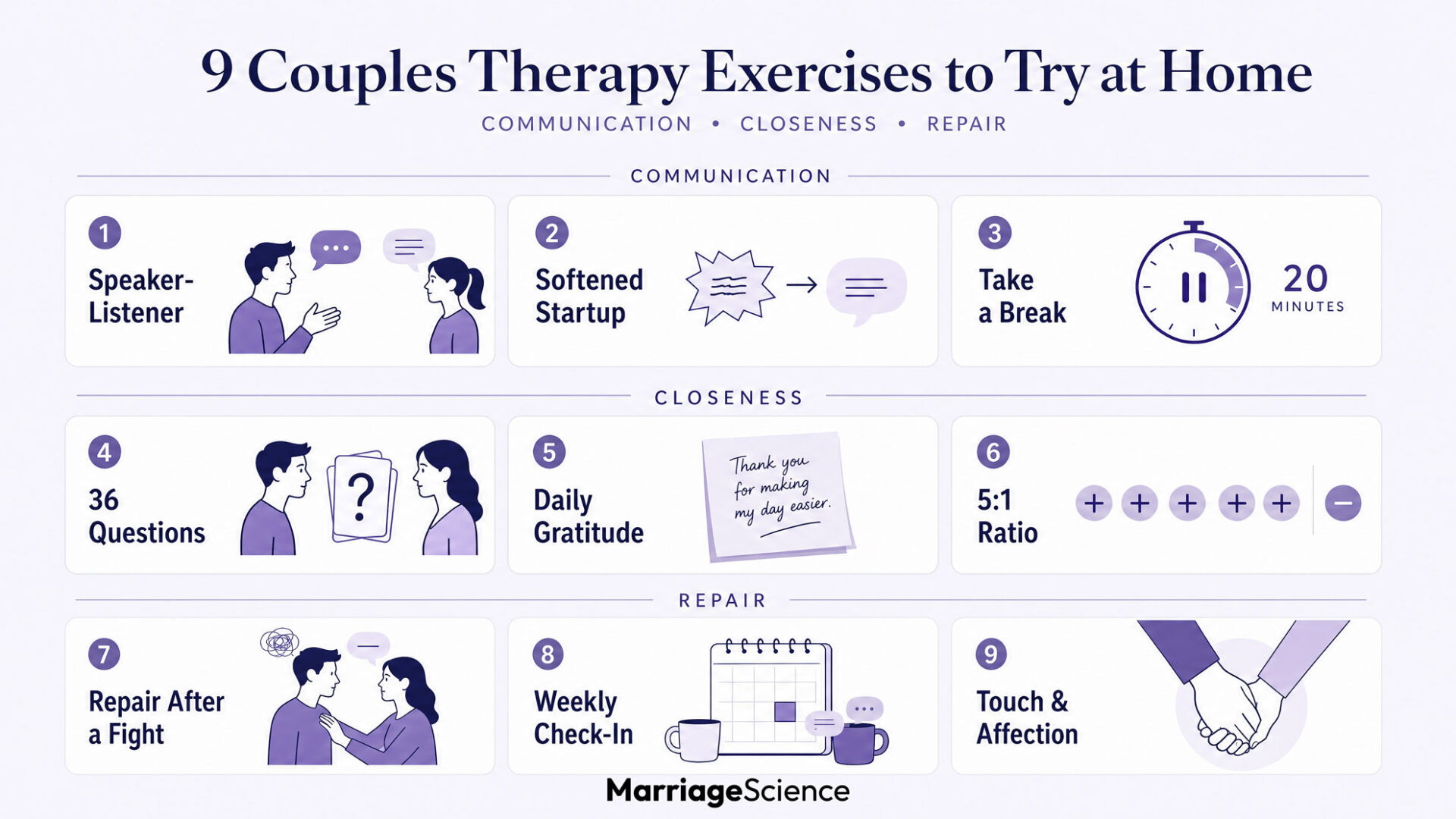
Communication Exercises
These exercises help slow conversations down so each partner has a better chance to feel heard. Focus on one topic at a time, especially if that topic often leads to tension.
1. The Speaker-Listener Technique
The Speaker-Listener technique comes from PREP work by Markman and Stanley, and the National Healthy Marriage Resource Center describes its basic format. One partner has the floor and speaks in short statements about their own feelings. The other partner paraphrases what they hear instead of arguing back.
Begin with one manageable topic, such as weekend plans or household chores. The speaker uses “I” statements, and the listener repeats the main point before offering a response.
For now, do not try to solve the problem. Once both partners have had a turn to speak and paraphrase, decide whether to continue the conversation or take a break.
Read the federal resource here: Speaker-Listener Technique.
2. Rewrite a Harsh Startup
The Gottman Institute explains that conflict discussions often end the way they begin. A softened startup lets you name a problem and explain what you need without blaming your partner.
Gottman gives this harsh example: “Could you, for once, get something done on time?” A gentler version might be: “I feel stressed when we leave late, and I need us to agree on a start time.”
Try this as a quick exercise. Each partner writes down one harsh sentence that often comes up at home, then rewrites it to include a feeling, the situation, and a clear need.
Keep the tone light if you can. The goal is to practice a better opening sentence before your next disagreement.
Read Gottman’s explanation here: Softening Startup.
3. Plan Your Break Before You Need It
Gottman’s guidance on emotional flooding recommends naming the feeling, taking about 20 minutes alone to do something soothing, and then returning. Agreeing on the words you will use ahead of time can help the break feel less like rejection.
Choose a phrase together, such as, “I’m feeling flooded, and I’ll come back in 20 minutes.” Agree that the break is for calming down, not for rehearsing your side of the argument.
During the break, do something that helps you settle. You could try breathing exercises, walking, stretching, or sitting quietly away from the conflict.
When you return, begin with one sentence from each person. Gottman connects this skill to reducing stonewalling in its article on the Four Horsemen: Recognizing Criticism, Contempt, Defensiveness, and Stonewalling.
Closeness Exercises
Closeness grows through repeated moments of attention, curiosity, warmth, and care. These exercises offer gentle ways to turn toward each other when you are not in the middle of a conflict.

4. The 36 Questions, Adapted for Couples
In 1997, Aron, Melinat, Aron, Vallone, and Bator tested a 45-minute exercise designed to build closeness. Pairs answered questions about themselves and their relationships, with the questions gradually becoming more personal.
Study 1 found that participants felt closer afterward than people who completed comparable small-talk tasks. Most of the pairs were strangers, so couples should use this as an adapted closeness exercise rather than assume the study tested established partners.
Set aside 45 minutes and take turns answering the questions. Either partner can skip a question they do not want to answer that day.
Stay curious instead of turning your partner’s answers into a debate. For more prompts, see our guide to deep questions to ask your partner.
Read the 1997 study’s DOI page here: The Experimental Generation of Interpersonal Closeness.
5. A Daily Gratitude Note
In 2010, Algoe, Gable, and Maisel studied daily diary entries from both members of cohabiting couples. They found that gratitude expressed during interactions predicted greater connection and satisfaction for both partners the next day.
Keep your note short and specific. Write one sentence about something your partner did, how it affected you, and why you appreciated it.
For example: “Thank you for making coffee before I left. It helped my morning feel less rushed.” Brief, sincere gratitude often feels more genuine than a long note that seems forced.
Read the study’s DOI page here: It’s the Little Things.
6. Count Your Five to One
The Gottman Institute describes the “magic ratio” as five or more positive interactions for every negative interaction during conflict among stable, happy couples. Positive moments can include affection, humor, interest, attempts to repair tension, or respectful behavior.
For one week, track interactions only during disagreements. Add a plus sign for each warm or respectful action and a minus sign for each hurtful or dismissive one.
Do not use the tally as a weapon. Instead, use it to ask, “How can we bring more warmth into our disagreements?”
Read Gottman’s article here: The Magic Relationship Ratio.
Repair Exercises
Repair exercises help couples reconnect after a painful moment or disagreement. They work best once both partners have calmed down enough to listen.

7. The Repair Conversation After a Fight
Start with three questions: What happened? What did each of us feel? What would each of us do differently next time? Keep the focus on understanding the pattern and learning from it.
Give each partner a turn to answer without interruption. Then, each person names one action that could help repair the situation, such as making a clearer request, taking a calmer pause, or offering a direct apology.
An apology does not have to resolve the entire fight. You can acknowledge one specific hurt and identify one specific change you will make.
If apologies feel awkward or emotionally loaded, read our guide to apologizing.
8. A Weekly Check-In
Schedule a 30-minute check-in at the same time each week. A regular conversation can stop small frustrations from building up.
Ask three questions: What felt good between us this week? What felt difficult? What do we need next week? Put your phones away unless you need them to refer to notes.
If the check-in turns into an argument, return to the Speaker-Listener rules. If the same issues keep coming up, see our guide to communication problems in relationships.
9. Rebuild Touch and Affection
After a period of distance or conflict, physical affection can feel vulnerable. Start by asking for consent and keeping the pressure low. Try asking, “Would a hug feel good right now?” or “Can I sit closer to you?”
Choose a small daily ritual, such as a six-second hug, holding hands during a walk, or sitting together after dinner. Stop if either partner feels tense or pressured.
Affection can be easier to rebuild when it feels predictable and kind. For more ideas, read our guide to rebuilding intimacy.
- A weekly 40-minute session with a matched Expert
- Guided exercises in the app between sessions
- Start alone or as a couple

Why Practicing Calm Conflict Matters
The way couples handle conflict can affect the body as well as the mood in the room. In 2005, Kiecolt-Glaser and colleagues reported that wounds in highly hostile couples healed at 60% of the rate seen in couples with low hostility.
This finding does not mean that one bad argument will cause a health problem. It does, however, help explain why it is worth practicing ways to reduce hostility during conflict.
Use this finding as a reason to slow things down early. A gentler opening, a planned break, or paraphrasing what your partner said can change the direction of a conversation.
Read the PubMed record here: Hostile Marital Interactions, Proinflammatory Cytokine Production, and Wound Healing.
When Exercises Are Not Enough
At-home exercises have limits. They cannot replace therapy when a relationship involves abuse, daily contempt, a partner who refuses to participate, or an affair that needs guided repair.
- Abuse or fear. The Hotline identifies yelling and name-calling as examples of emotional abuse.
- Ongoing contempt. Daily contempt can make relationship exercises feel unsafe or pointless.
- One partner refuses to participate. These exercises require at least some effort from both people.
- An affair. Betrayal often requires a trained professional to guide the repair process.
If you are afraid of your partner, contact The Hotline at 800-799-7233, text START to 88788, or chat at thehotline.org. Help is free, confidential, and available 24/7. Advocates can also help you plan for safety.
If you are in immediate danger, call 911. The Hotline also warns that someone may monitor your internet use and recommends clearing your browser history.
Structured Programs and Online Couples Therapy
Some couples need more structure than a list of exercises can provide. In 2016, Doss and colleagues studied OurRelationship with 300 couples and found that the program improved relationship satisfaction compared with a waitlist, with d = 0.69.
The program included eight hours online, plus four 15-minute calls. Read the PubMed record here: Doss and Colleagues 2016.
OurRitual is a structured program with coaching, app-based tools, and one 40-minute video session each week with a matched Expert. Its FAQ says it is “not considered to be classic couples therapy.” It is also not treatment for abuse or a mental health crisis.
One partner can start alone, and the Couple plan includes a free Partner account. Read our OurRitual review, or compare best online couples therapy platforms.
Frequently Asked Questions
These quick answers can help you choose an exercise to try first and recognize when you may need additional support.
What Exercises Do Couples Therapists Use?
Common exercises include the Speaker-Listener technique, softened startups, planned breaks, gratitude notes, and structured questions that build closeness. Sources discussed in this guide include PREP, the Gottman Institute, Aron’s 1997 study, and Algoe’s 2010 study.
How Often Should Couples Do Relationship Exercises?
A small daily practice can work well for gratitude, since Algoe’s 2010 study used daily diary data from both partners. For bigger topics, a weekly 30-minute check-in offers a practical routine.
What Is the 5 to 1 Rule in Couples Therapy?
The Gottman Institute describes five or more positive interactions for every negative interaction during conflict in stable, happy couples. You can track this ratio for one week while you work through disagreements.
Do the 36 Questions Work for Married Couples?
Aron’s 1997 study found greater closeness after a 45-minute task involving increasingly personal questions than after small talk. Because the original pairs were mostly strangers, married couples should treat the questions as an adapted closeness exercise.
What Can We Do While Waiting for Couples Therapy?
Try low-risk practices such as gratitude notes, a weekly check-in, softened startups, and planned 20-minute breaks when either of you feels flooded. If you experience fear or abuse, contact The Hotline. Call 911 if you are in immediate danger.
Can Couples Exercises Replace Therapy?
Exercises can help some couples practice calmer communication and build closeness at home. However, they cannot replace therapy when a relationship involves abuse, daily contempt, a partner who refuses to participate, or an affair.