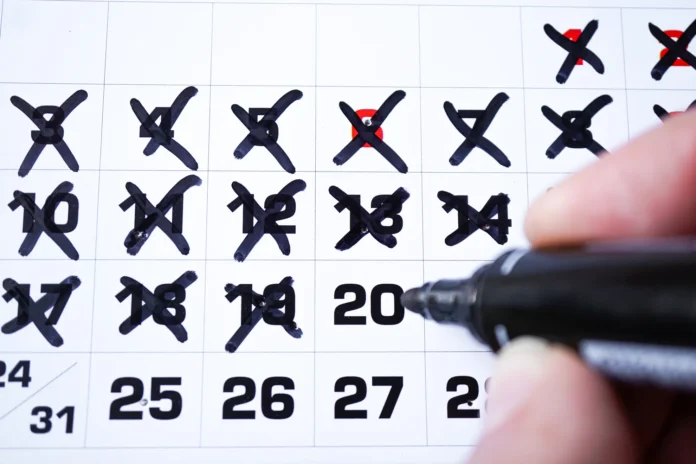


Most dating coaches recommend following the no contact rule for 30 days. However, no study has tested that exact timeframe. A more honest answer is to keep your distance until thoughts about your ex no longer take over your day. That may take several weeks or a few months.
As you count the days, pay attention to how steady you feel, too. Notice whether you check on your ex less often, spend less time bargaining with yourself, sleep better, and make more room for your own life.
How Long Should No Contact Last? The Short Answer
Dating coaches often describe 30 days as the minimum. After a long relationship or a particularly painful breakup, some recommend waiting 60 to 90 days.
Breakup studies do follow emotional distress over weeks and months. However, they do not test a 30, 60, or 90-day no contact rule.
Where the 30-Day Rule Comes From
The 30-day rule gained popularity through dating coaches, breakup forums, and online programs. It has stuck around partly because it is simple and easy to remember.
However, no study directly compares 30 days of no contact with 60 days. A more useful question is what you need the time apart to help you change.
In 2008, Eastwick, Finkel, Krishnamurti, and Loewenstein followed Northwestern first-year students who were in relationships for nine months. Of the 26 participants who went through a breakup, researchers measured their distress at the time of the breakup and again at 2, 6, and 10 weeks. Their distress declined over time.
The study also found that people tended to overestimate how badly they would feel after a breakup.
In other words, they expected the initial pain to hit harder than it did. However, they were fairly accurate when predicting how quickly that pain would fade.
A 2011 study by Rhoades, Kamp Dush, Atkins, Stanley, and Markman followed 1,295 unmarried adults ages 18 to 35 every four months over 20 months. After a breakup, 49.7% experienced little change in distress, 30.7% felt more distressed, and 19.6% felt less distressed.
These findings help explain why the same calendar-based rule may feel too short for one person and too long for another. Moving in together and planning to marry were associated with larger drops in life satisfaction. By contrast, dating someone new was associated with a smaller drop.
What the 3-Day No Contact Rule Means
The 3-day no contact rule is different from the 30-day breakup rule. People may use a three-day pause to cool down after an argument, think before sending a message, or follow the old advice to wait three days before calling someone.
No breakup study has tested whether a three-day pause helps. If you are dealing with fear, pressure, or repeated emotional ups and downs, three days may not tell you much about whether you feel stable again.
No Contact Timeline: Week by Week
Think of this timeline as a practical guide, not a proven sequence. No study has established a fixed set of stages that everyone experiences

The timeline brings together findings from breakup studies and common experiences after a split. Your own progress may move faster or take longer
| Time | What Often Happens | What Helps |
|---|---|---|
| Days 1 to 3 | You may feel an urge to explain yourself, apologize, or check on your ex.. | Mute their notifications and move the chat out of sight. |
| Days 4 to 7 | The breakup may start to feel real. Your sleep and appetite may also be unsettled. | Eat regular meals, keep a consistent bedtime, and choose one friend you can text. |
| Week 2 | Longing may come and go in waves. | Write down what you want to say, but do not send the message. |
| Weeks 3 to 4 | You may start to feel clearer, although some days can still feel harder than others. | Practice acceptance. If you keep checking on your ex, mute or hide their updates. |
| Month 2 | The hardest emotional moments may happen less often, and your distress may continue to ease. | Notice how quickly you recover when something reminds you of your ex. |
| Month 3+ | You may feel more settled. Recovering from a longer relationship can take more time. | Maintain your distance if getting back in touch starts the same painful cycle again. |
If you want labels for these emotional changes, read our guide to the stages of a breakup. The familiar five stages originally came from research involving dying patients; researchers never developed or tested them as a model of breakup recovery.
How Long Does No Contact Take to Work?
The answer depends on what you mean by “work.” You might want to feel calmer, stop checking on your ex, sleep better, or get your ex back. Those goals are not the same.
If Your Goal Is to Heal
Recovery often shows up in small, everyday ways before you notice a major change. You may still miss your ex, but those feelings no longer control your entire day.
You may notice fewer urges to check their profile, fewer imagined conversations, more interest in friends or work, and a quicker return to normal after reminders. For more signs, read our guide to the signs no contact is working.
In a 2006 study, Sbarra found that accepting the breakup helped explain how sadness changed during a four-week study that tracked participants’ daily emotions. This gives you a useful goal: work toward accepting what happened, even when sadness has not completely gone away.
If Your Goal Is to Get Your Ex Back
No study has shown that staying silent will make your ex come back. Taking a break from contact may help you avoid desperate messages, but it cannot control what another person chooses to do.
Rhoades and colleagues found that 36% of people who had broken up were dating someone new by the next four-month survey. Rather than building your plan around your ex’s reaction, focus on your own recovery.
If you eventually decide that contact makes sense, keep your message calm, clear, and respectful. Avoid using jealousy, pressure, or deliberate indifference to try to win someone back.
How Long to Wait Before Breaking No Contact
Before you breaking no contact, ask yourself whether sending a message supports your long-term well-being or simply eases a sudden wave of anxiety. In a 2005 study, Sbarra and Emery found that contact with a former partner slowed the decline of love and sadness among young adults tracked over 28 days.
O’Hara, Grinberg, Tackman, Mehl, and Sbarra (2020) found a similar pattern among separated adults without children: more face-to-face contact predicted greater distress two months later. However, Mason, Sbarra, Bryan, and Lee (2012) found an exception. In their study, contact was associated with better adjustment among people who had already accepted the separation.
- Before reaching out, make sure you could handle a warm reply, a cold reply, or no reply at all without feeling overwhelmed.
- A clear reason matters. For example, you may need to sort out shared property, bills, parenting arrangements, or send one sincere message to repair the relationship.
- Choose a time when you are sober, well-rested, and able to think clearly. Daytime is usually better than sending an emotional message late at night.
- Keep the message simple: explain what you need to say in two or three straightforward sentences.
- Prepare yourself to stop reaching out if the response is mixed, hurtful, or nonexistent.
- Most importantly, do not send the message just to find out whether your ex still cares.
When No Contact Has No End Date
In some situations, no contact needs to be permanent. If your ex has abused, threatened, or stalked you, or repeatedly pulls you into fear, guilt, or chaos, keeping your distance indefinitely may be the safest choice.
When you feel unsafe, call the National Domestic Violence Hotline at 800-799-7233 or text START to 88788. In an immediate emergency, call 911.
- A day counter that starts from your last contact
- Milestones from day 1 to day 90
- An SOS button in the Heartstreak app for the moment you want to text
Frequently Asked Questions
These answers are brief because researchers have not tested a fixed no contact period. Use them as general guidance, then pay attention to how steady you feel.
Is 30 Days of No Contact Enough?
Thirty days may give you enough time to stop texting impulsively and get through the initial shock. However, it may not be long enough if you still check on your ex constantly, look for signs that they miss you, or feel overwhelmed by small reminders.
What Is the 3 Day No Contact Rule?
The 3-day rule usually refers to taking a short break after a conflict or following the old advice to wait before calling someone. Breakup research has not tested whether a three-day pause improves recovery.
How Long Does No Contact Take to Work?
If you mean emotional stability, you may notice changes over several weeks or months. If you mean making your ex return, research does not support that promise
What Are the Stages of No Contact?
Researchers have not established scientifically proven stages of no contact. Still, many people describe a similar pattern: initial shock, urges to reach out, waves of grief, clearer thinking, and a gradual return to their usual routines.
Should No Contact Be Longer After a Long Relationship?
Often, it may need to be. A longer relationship can involve more shared routines, future plans, and changes to your sense of identity. Dating coaches may recommend 60 to 90 days, but that timeframe remains a convention rather than a research-backed rule.
Can I Break No Contact for a Birthday?
You can, but sending a birthday message may bring back hope when your main goal is to heal. If you decide to send one, keep it brief, kind, and free of expectations. Then return to the boundary you set.
More guides on getting through a breakup: Breakup Recovery.