


A sexless marriage is far more common than most couples assume. Drawing on the General Social Survey, the longest-running study of American life, researchers estimate that 15% to 20% of married couples have sex fewer than 10 times a year. Sexual frequency has also fallen sharply over the past three decades, a shift researchers now call the sex recession, and it shows up across every major national survey. Below we break down what the data says on how common sexless marriages are, how often married couples actually have sex, how the numbers differ by age, gender, and parenthood, and how the United States compares with the rest of the world. Every figure here comes from a primary source or peer-reviewed research, with the year noted so you can see how current it is.
Key Sexless Marriage Statistics
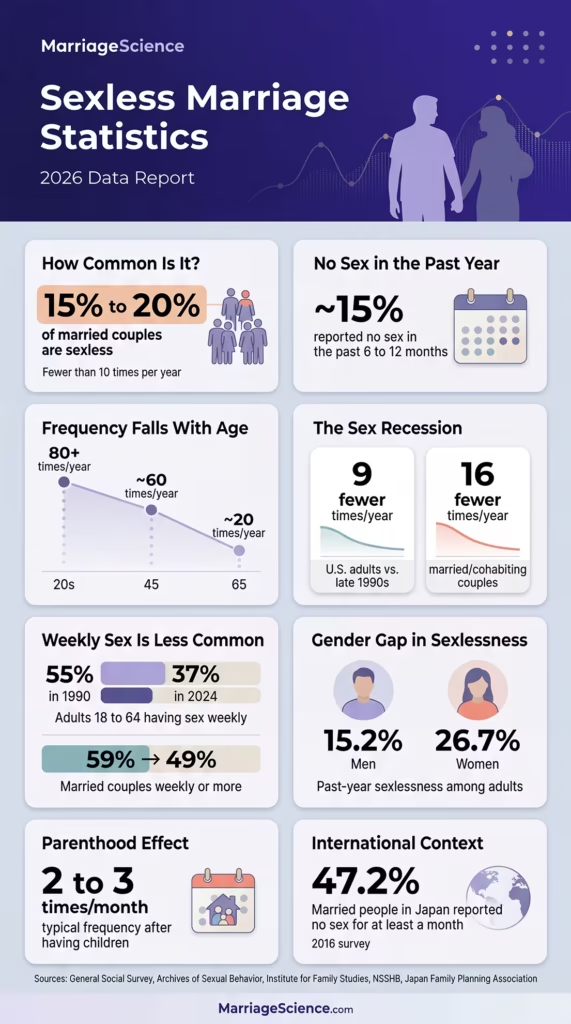
- Roughly 15% to 20% of married couples are in a sexless marriage, usually defined as having sex fewer than 10 times a year (General Social Survey, University of Chicago).
- About 15% of married couples reported no sex at all in the past 6 to 12 months (General Social Survey).
- Among married adults, past-year sexlessness climbs with age: about 6.5% at age 30, 15.6% at age 40, and 19.8% at age 45 (General Social Survey analysis, 2017).
- Across all adults aged 18 to 89, past-year sexlessness was reported by 15.2% of men and 26.7% of women (General Social Survey analysis, 2017).
- American adults had sex about 9 fewer times a year in 2010 to 2014 than in the late 1990s (Twenge et al., Archives of Sexual Behavior, 2017).
- Married and cohabiting couples saw the steepest drop, having sex 16 fewer times a year in 2010 to 2014 than in the early 2000s (Archives of Sexual Behavior, 2017).
- The share of adults reporting no vaginal intercourse in the past year rose from 24% in 2009 to 28% in 2018 (National Survey of Sexual Health and Behavior, 2021).
- The share of adults aged 18 to 64 having sex weekly fell from 55% in 1990 to 37% in 2024 (General Social Survey via Institute for Family Studies, 2024).
- Among married couples, the share having sex weekly or more fell from 59% in 1996 to 2008 to 49% in 2010 to 2024 (Institute for Family Studies, 2024).
- Married adults still have sex more often than unmarried adults, at 46% weekly versus about 34% (Institute for Family Studies, 2024).
- The share of young adults aged 18 to 29 reporting no sex in the past year doubled from 12% in 2010 to 24% in 2024 (Institute for Family Studies, 2024).
- Average sexual frequency falls with age, from more than 80 times a year in a person’s 20s to about 60 by age 45 and roughly 20 by age 65 (Archives of Sexual Behavior, 2017).
- In the 1990s married people had sex more often than never-married people, but by the mid-2000s that pattern reversed (Archives of Sexual Behavior, 2017).
- About 1 in 3 women and 1 in 6 men report low sexual interest lasting several months, one of the most common issues couples bring to therapy (national survey research).
- After having children, many couples report sexual frequency dropping to about 2 to 3 times a month (research on the transition to parenthood).
- The largest declines in frequency showed up among people in their 50s and those with school-age children (Archives of Sexual Behavior, 2017).
- Weekly in-person social time among young adults fell from 12.8 hours in 2010 to about 5 hours in 2024, one factor researchers link to falling partnership and sex (Institute for Family Studies, 2024).
- In Japan, 47.2% of married people reported no sex for at least a month in 2016, up 15.3 points since 2004 (Japan Family Planning Association).
How Common Are Sexless Marriages?
Most researchers define a sexless marriage as one where the couple has sex fewer than 10 times a year. By that measure, 15% to 20% of married couples qualify, according to data from the General Social Survey run by the University of Chicago. That makes the experience common enough that, in any room of married couples, several are likely living it.
A narrower measure tells a similar story. About 15% of married couples reported no sex at all over the previous 6 to 12 months. The exact figure moves a little year to year, but the share has stayed within a fairly stable band for decades, even as overall frequency has fallen.
It is worth saying plainly that frequency alone does not define a healthy marriage. Plenty of couples are content with infrequent sex and still report high satisfaction. The numbers here describe averages and trends, not a standard any individual couple needs to meet. For more on how relationships shift over time, see our relationship advice and the full relationship and dating statistics hub.
| Metric | Value | Source |
| Married couples that are sexless | 15% to 20% | General Social Survey |
| Married couples with no sex in past 6 to 12 months | ~15% | General Social Survey |
Where Sexlessness Sits on the Frequency Scale
Frequency across all married couples is the subject of its own page. Our analysis of how often couples have sex works through the General Social Survey microdata from 1989 to 2024, including the full distribution and a comparison of generations at the same age. What follows here is the context needed to place a sexless marriage against it.
There is no single normal. Frequency varies widely by age, health, stress, and how long a couple has been together. On average, sexual frequency declines steadily with age, from more than 80 times a year for people in their 20s to about 60 times by age 45 and roughly 20 times by age 65, based on General Social Survey data analyzed in the Archives of Sexual Behavior.
After age 25, average frequency falls by about 3.2% each year. That gradual slope is normal and does not by itself signal a problem. A common rule of thumb among therapists is that about once a week is a typical baseline for partnered couples, but the research shows enormous variation around that average.
Context matters more than any benchmark. A couple who has sex twice a month and feels close may be happier than one hitting a weekly average out of obligation. Researchers consistently find that satisfaction with sex predicts relationship happiness better than raw frequency does.
| Metric | Value | Source |
| Sexual frequency in a person’s 20s | 80+ times a year | Archives of Sexual Behavior, 2017 |
| Sexual frequency at age 45 | ~60 times a year | Archives of Sexual Behavior, 2017 |
| Sexual frequency at age 65 | ~20 times a year | Archives of Sexual Behavior, 2017 |
| Annual decline after age 25 | ~3.2% per year | Archives of Sexual Behavior, 2017 |
The Sex Recession: Frequency Is Falling Across Surveys
Americans are having less sex than they did a generation ago, and the trend appears in every major dataset. Adults had sex about 9 fewer times a year in 2010 to 2014 than in the late 1990s, and married or cohabiting couples saw the largest drop at 16 fewer times a year (Twenge et al., Archives of Sexual Behavior, 2017).
The decline has continued and broadened. The share of adults aged 18 to 64 having sex weekly fell from 55% in 1990 to 37% in 2024, and among married couples, weekly or more frequent sex slipped from 59% in 1996 to 2008 to 49% in 2010 to 2024 (Institute for Family Studies, 2024).
A separate national study confirms the pattern. In the National Survey of Sexual Health and Behavior, the share of adults reporting no vaginal intercourse in the prior year rose from 24% in 2009 to 28% in 2018. When two independent surveys move the same direction, the trend is hard to dismiss as noise.
| Metric | Value | Source |
| Adults 18 to 64 having weekly sex, 1990 | 55% | GSS / IFS |
| Adults 18 to 64 having weekly sex, 2024 | 37% | GSS / IFS, 2024 |
| Married couples, weekly or more, 1996 to 2008 | 59% | IFS, 2024 |
| Married couples, weekly or more, 2010 to 2024 | 49% | IFS, 2024 |
| Adults with no intercourse in past year, 2009 to 2018 | 24% to 28% | NSSHB, 2021 |
Sexlessness by Age and Marriage Length
Sexlessness is not evenly spread. Among married adults, the share reporting no sex in the past year rises with age, from about 6.5% at age 30 to 15.6% at age 40 and 19.8% at age 45 (General Social Survey analysis, 2017). Health conditions, medications, and the demands of midlife all play a part.
Marriage length matters too. Couples married longer are more likely to describe their relationship as sexless, a pattern researchers tie to age, health, and the routines of long-term partnership rather than to any single failing. The early-relationship surge in desire tends to settle into something steadier, and for some couples that means much less sex.
Menopause and the slower hormonal changes men experience add another layer in midlife. Lower estrogen and testosterone, along with the medications that often come with aging, can reduce both desire and comfort. Many older couples stay sexually active, but the averages bend downward with each decade.
| Metric | Value | Source |
| Married, no sex in past year, age 30 | 6.5% | GSS analysis, 2017 |
| Married, no sex in past year, age 40 | 15.6% | GSS analysis, 2017 |
| Married, no sex in past year, age 45 | 19.8% | GSS analysis, 2017 |
Sexless Marriage by Gender
Men and women report sexlessness at different rates. Across all adults aged 18 to 89, past-year sexlessness was reported by 15.2% of men and 26.7% of women (General Social Survey analysis, 2017). Part of that gap reflects that women are more likely to be older, widowed, or without a current partner.
Desire differences also show up consistently. About 1 in 3 women and 1 in 6 men report low sexual interest lasting several months. Mismatched desire, where one partner wants sex more than the other, is one of the most common issues couples bring to therapists, and it is a frequent path into a sexless stretch even in otherwise strong marriages.
The pattern is not fixed by gender, though. In a meaningful share of marriages the higher-desire partner is the woman, and assuming otherwise can leave couples misreading their own situation. What the data points to is that desire gaps, in either direction, are normal and worth talking about openly.
| Metric | Value | Source |
| Past-year sexlessness, men (all adults) | 15.2% | GSS analysis, 2017 |
| Past-year sexlessness, women (all adults) | 26.7% | GSS analysis, 2017 |
| Report low sexual interest, women / men | ~1 in 3 / ~1 in 6 | National survey research |
How Children and Parenthood Affect Sexual Frequency
Few life changes affect a couple’s sex life like having children. Between broken sleep, less free time, and the physical and hormonal changes of pregnancy and recovery, many couples report sexual frequency dropping to about 2 to 3 times a month after a baby arrives, down sharply from their pre-child routine.
The effect is durable rather than brief. The steepest declines in national data showed up among people in their 50s and among those with school-age children (Archives of Sexual Behavior, 2017), which suggests the squeeze on time and energy lasts well past the newborn years.
| Metric | Value | Source |
| Typical frequency after having children | ~2 to 3 times a month | Research on transition to parenthood |
Why Married Sex Is Declining
Researchers point to several overlapping causes rather than one. Birth cohort effects are central, meaning each younger generation starts from a lower baseline regardless of age. Layered on top are stress, longer working hours, and the steady competition for attention from phones and streaming, which crowd out the unstructured time intimacy needs.
Health and medication matter as well. Common prescriptions, including some antidepressants, can lower desire, and rising rates of anxiety and depression weigh on libido. Falling partnership and shrinking social lives play a role too: among young adults, the share living with a partner fell from 42% in 2014 to 32% in 2024, and weekly in-person social time dropped from 12.8 hours in 2010 to about 5 hours in 2024 (Institute for Family Studies, 2024).
Pornography is sometimes blamed, but the evidence is mixed. The 2017 analysis found declines were actually largest among people who did not watch pornography, which complicates the simple story. The steadier threads are time, stress, and the constant pull of screens.
| Metric | Value | Source |
| Young adults living with a partner, 2014 to 2024 | 42% to 32% | IFS, 2024 |
| Weekly in-person social time, young adults, 2010 to 2024 | 12.8h to ~5h | IFS, 2024 |
How the United States Compares Internationally
Sexless marriage is not only an American story, and other wealthy countries report even higher rates. In Japan, 47.2% of married people reported no sex for at least a month in 2016, up 15.3 points from 2004, according to the Japan Family Planning Association. Later surveys put the figure close to half of married couples.
Definitions differ, so cross-country numbers are not perfectly comparable. Japan’s measure counts a month without sex, while the common U.S. definition counts fewer than 10 times a year. Even so, the direction is the same across high-income nations, and falling birth rates have pushed the topic into mainstream policy debate abroad.
| Metric | Value | Source |
| Married people, no sex in past month, Japan, 2016 | 47.2% | Japan Family Planning Association |
| Japan, change since 2004 | +15.3 points | Japan Family Planning Association |
What Counts as Normal, and When It May Be Worth Attention
Because averages vary so widely, there is no frequency that is automatically healthy or unhealthy. The more useful question is whether both partners are content. A marriage with little sex but no distress is not a problem to be fixed. A marriage where one or both partners feel rejected or disconnected may be, regardless of the number.
Sex therapists generally suggest paying attention when a long, unwanted dry spell comes with growing resentment, avoidance, or a loss of other affection. In those cases a medical check for hormonal or medication causes, along with couples or sex therapy, tends to help more than waiting it out. The figures here are a map of the averages, not a verdict on any single relationship.
Does a Sexless Marriage Lead to Divorce?
This is the question couples ask most, and the honest answer is that there is no reliable national figure for how many sexless marriages end in divorce. Many widely shared percentages trace back to content-marketing pages with no primary source, so we leave them out.
What peer-reviewed research does show is that sexual satisfaction is one of several factors linked to overall marital satisfaction and stability, though it is rarely the only one. A drop in frequency is common and often temporary, especially around new parenthood, illness, job stress, or grief. Many couples move through a sexless stretch and come out the other side. For the wider context on marriage breakdown, see our divorce statistics, and for how intimacy and trust interact, our data on who cheats more.
Methodology and Sources
Every figure on this page comes from a named primary source or peer-reviewed research, not from content-marketing roundups. Estimates that could not be traced to a primary source were left out, including the divorce-rate percentages that circulate without citation. Figures are updated as new data is released.
- General Social Survey (GSS), NORC at the University of Chicago
- Twenge, Sherman, and Wells, “Declines in Sexual Frequency among American Adults, 1989 to 2014”, Archives of Sexual Behavior (2017)
- Herbenick et al., National Survey of Sexual Health and Behavior, Archives of Sexual Behavior (2021)
- Institute for Family Studies, sex recession analyses of General Social Survey data (2024)
- Japan Family Planning Association national sex survey (2016)