


AI companions have gone mainstream faster than almost any technology before them. AI companion apps passed 220 million downloads worldwide in 2025, nearly three in four U.S. teens have tried one, and a growing share of young men say they have talked to an AI romantic partner. This page collects more than 30 AI companion and AI girlfriend statistics on usage, demographics, engagement, the market, and the risks, drawn from Common Sense Media, the Wheatley Institute, Appfigures, and the APA. Where figures come from market-research firms or app analytics rather than peer-reviewed studies, we say so.
Key AI Companion Statistics
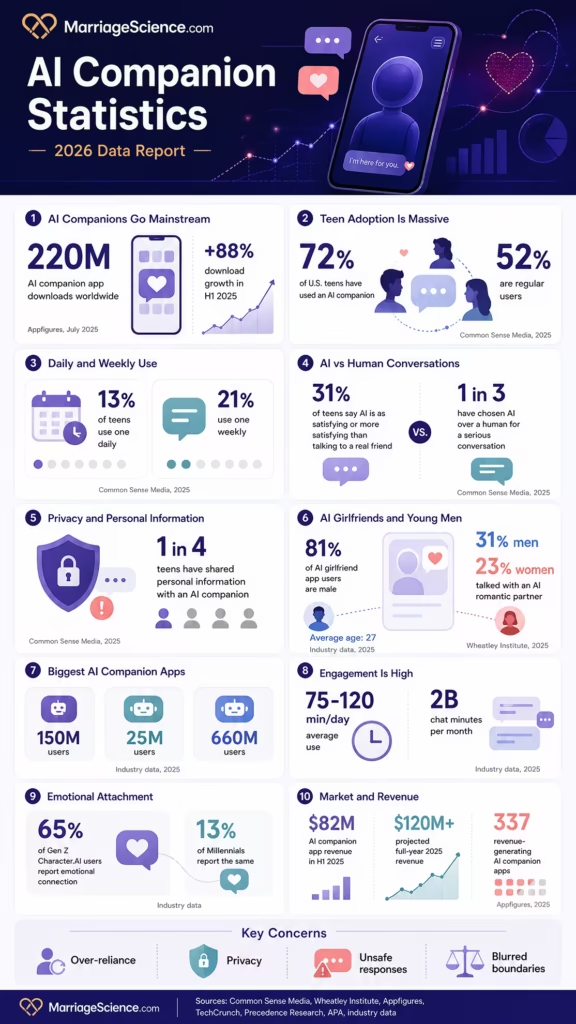
- AI companion apps had about 220 million cumulative downloads worldwide as of July 2025 (Appfigures, via TechCrunch).
- AI companion app downloads rose 88% year over year in the first half of 2025 (Appfigures).
- About 72% of U.S. teens have used an AI companion at least once (Common Sense Media, 2025).
- About 52% of teens are regular AI companion users, and 13% use one daily (Common Sense Media, 2025).
- About 31% of teens say talking to an AI companion is as satisfying or more satisfying than talking to a real friend (Common Sense Media, 2025).
- About 1 in 3 teens have chosen an AI companion over a human for a serious conversation (Common Sense Media, 2025).
- About 1 in 4 teens have shared personal information with an AI companion (Common Sense Media, 2025).
- About 31% of young adult men have talked with an AI romantic partner, compared with 23% of women (Wheatley Institute, 2025).
- Nearly 1 in 3 men aged 18 to 34 have interacted with an AI partner (Wheatley Institute, 2025).
- About 81% of AI girlfriend app users are male, with an average age of 27 (industry data, 2025).
- Character.AI users average roughly 75 to 120 minutes per day, far more than the time spent on general chatbots (industry data, 2025).
- About 65% of Gen Z Character.AI users report an emotional connection with an AI character, versus 13% of Millennials (industry data).
- Snapchat’s My AI has about 150 million users, Replika about 25 million, and China’s Xiaoice about 660 million (industry data, 2025).
- AI companion apps generated about $82 million in the first half of 2025 and were on track to pass $120 million for the year (Appfigures).
- There are about 337 actively revenue-generating AI companion apps worldwide (Appfigures, 2025).
- The global AI companion market was valued at about $37 billion in 2025 and is projected to reach $552 billion by 2035 (Precedence Research).
- About 60% of younger Gen Z, aged 18 to 22, are open to AI help with dating (Hinge, 2025).
- The Common Sense Media survey was based on a nationally representative sample of 1,060 teens aged 13 to 17 (2025).
How Many People Use AI Companions?
Adoption has been explosive. AI companion apps reached about 220 million cumulative downloads worldwide by July 2025, with downloads up 88% year over year in the first half of the year (Appfigures, via TechCrunch).
The category is crowded and growing. There are roughly 337 actively revenue-generating AI companion apps, from Replika and Character.AI to dozens of smaller AI girlfriend and AI boyfriend apps. For the products themselves, see our reviews of the best AI girlfriend apps and the full relationship and dating statistics hub.
Usage now spans every age group, but it is heaviest among teens and young adults, the same groups reporting the most loneliness and the steepest decline in dating.
| Metric | Value | Source |
| Cumulative downloads, July 2025 | ~220 million | Appfigures / TechCrunch |
| Download growth, H1 2025 | +88% YoY | Appfigures |
| Active revenue-generating apps | ~337 | Appfigures, 2025 |
AI Companions and Teens
Teen adoption is near universal. About 72% of U.S. teens have used an AI companion at least once, and 52% are regular users, according to a nationally representative survey of 1,060 teens aged 13 to 17 (Common Sense Media, 2025).
For many, it is a daily habit. About 13% of teens use an AI companion daily, and 21% use one weekly. More striking, about 1 in 3 teens have chosen an AI companion over a human for a serious conversation, and 1 in 4 have shared personal information with one.
Satisfaction is part of the draw. About 31% of teens say talking to an AI companion is as satisfying or more satisfying than talking to a real friend, a finding that has drawn concern from child-development researchers.
| Metric | Value | Source |
| Teens who have used an AI companion | ~72% | Common Sense Media, 2025 |
| Regular teen users | ~52% | Common Sense Media, 2025 |
| Daily teen users | ~13% | Common Sense Media, 2025 |
| Find AI as satisfying as real friends | ~31% | Common Sense Media, 2025 |
| Shared personal info with AI | ~1 in 4 | Common Sense Media, 2025 |
AI Girlfriends and Young Men
The romantic side of AI companionship skews heavily male and young. About 81% of AI girlfriend app users are male, with an average age of 27 (industry data, 2025).
Academic data points the same way. In a 2025 Wheatley Institute study, 31% of young adult men reported talking with an AI romantic partner, compared with 23% of women, and nearly 1 in 3 men aged 18 to 34 have interacted with an AI partner.
The pattern lines up with loneliness research. Young men report some of the highest rates of isolation, which we cover in our loneliness statistics, and AI companions are marketed directly at that gap.
| Metric | Value | Source |
| AI girlfriend users who are male | ~81% | Industry data, 2025 |
| Average user age | 27 | Industry data, 2025 |
| Young men who talked to an AI partner | 31% | Wheatley Institute, 2025 |
| Young women who did | 23% | Wheatley Institute, 2025 |
The Biggest AI Companion Apps
A few platforms dominate. Snapchat’s My AI has about 150 million users, Replika about 25 million, and China’s Xiaoice the largest of all at roughly 660 million (industry data, 2025). Character.AI, Chai, and PolyBuzz round out the most-used apps.
They differ in purpose. Some, like Replika and the many AI girlfriend apps, are built around romance and companionship, while others, like Character.AI, center on open-ended roleplay and conversation with many characters.
| Metric | Value | Source |
| Snapchat My AI users | ~150 million | Industry data, 2025 |
| Replika users | ~25 million | Industry data, 2025 |
| Xiaoice users (China) | ~660 million | Industry data, 2025 |
Engagement: How Much Time People Spend
AI companions are unusually sticky. Character.AI users average roughly 75 to 120 minutes per day, and the platform logs around 2 billion chat minutes per month (industry data, 2025), far more time than people spend on general chatbots.
The depth of engagement is the point. These apps are built to keep users talking, with always-available, responsive characters that remember past chats, which is part of why session times run well ahead of social media for heavy users.
| Metric | Value | Source |
| Character.AI time per user per day | ~75 to 120 min | Industry data, 2025 |
| Character.AI chat minutes per month | ~2 billion | Industry data, 2025 |
| Gen Z reporting emotional connection | ~65% | Industry data |
Emotional Attachment to AI Companions
Many users form real bonds. About 65% of Gen Z Character.AI users report an emotional connection with an AI character, compared with just 13% of Millennials (industry data), a generational gap that mirrors who is adopting the technology fastest.
The attachment can be intense. Users often describe genuine grief when an app changes a character’s personality or locks features behind a paywall, and researchers have documented cases where digital bonds deepened as real-world relationships weakened.
The AI Companion Market and Revenue
The money is following the users. AI companion apps generated about $82 million in the first half of 2025 and were on track to pass $120 million for the full year (Appfigures), with cumulative consumer spending around $221 million by mid-2025.
Longer-term projections are large but should be read with caution. One market-research firm valued the global AI companion market at about $37 billion in 2025 and projected roughly $552 billion by 2035 (Precedence Research), the kind of forecast that varies widely between firms.
| Metric | Value | Source |
| App revenue, H1 2025 | ~$82 million | Appfigures |
| App revenue, full-year 2025 (projected) | $120 million+ | Appfigures |
| Market size, 2025 | ~$37 billion | Precedence Research |
| Projected market size, 2035 | ~$552 billion | Precedence Research |
AI Companions and Loneliness
AI companionship is growing on the back of the loneliness epidemic. The same young men and teens reporting record isolation are the heaviest users, and about 60% of younger Gen Z say they are open to AI help with dating (Hinge, 2025).
Whether this helps or harms is the central debate. AI companions can ease short-term loneliness and offer a judgment-free space to talk, but researchers warn they may also substitute for the human relationships that protect mental health, a tension we explore alongside our Gen Z dating statistics.
Risks and Concerns
The fast adoption has outpaced the safeguards. Child-development and mental-health experts have flagged several risks, especially for teens:
- Emotional over-reliance, especially for teens and isolated users
- AI companions giving unsafe or inappropriate responses in sensitive moments
- Privacy risks from sharing personal information with apps
- Blurred boundaries between AI and human relationships
- Paywalls that exploit emotional attachment
Regulators and platforms are starting to respond with age checks, crisis redirects, and usage warnings, but oversight still lags well behind adoption.
What Reddit Users Say About AI Companions
Forums show how personal these tools have become. On Reddit communities such as r/replika and r/CharacterAI, users describe AI companions as a source of comfort during lonely or difficult periods, and many speak about their AI partner with real affection. When apps change a model or remove features, these forums fill with posts describing genuine loss, most visibly after Replika altered its romantic features in 2023. The discussions are not one-sided: many users debate whether the apps are healthy, warn each other about over-reliance, and share tips for keeping AI companionship as a supplement rather than a replacement for human contact. None of this is a representative sample, but it shows the depth of attachment behind the usage numbers above.
Methodology and Sources
Survey figures come from Common Sense Media and the Wheatley Institute, both based on representative samples. Download and revenue figures come from Appfigures app analytics. App user counts and engagement numbers come from company disclosures and market-research firms and are labeled as industry data. Market-size projections vary widely between firms and are presented as forecasts, not facts. Figures are updated as new data is released.
- Common Sense Media, teens and AI companions survey (2025, n=1,060)
- Wheatley Institute, AI romantic partners survey (2025)
- Appfigures, AI companion app downloads and revenue (via TechCrunch, 2025)
- Precedence Research, AI companion market size
- American Psychological Association, reporting on AI and emotional connection