


Domestic violence, which researchers more precisely call intimate partner violence, affects tens of millions of people in the United States. According to the Centers for Disease Control and Prevention, more than 1 in 3 women and more than 1 in 6 men experience contact sexual violence, physical violence, or stalking by an intimate partner at some point in their lives. The figures below come from the CDC National Intimate Partner and Sexual Violence Survey, the FBI, and the National Coalition Against Domestic Violence, with the year noted for each. This page is written as a plain record of the data. If you or someone you know is in danger, see the help resources near the end.
Key Domestic Violence Statistics
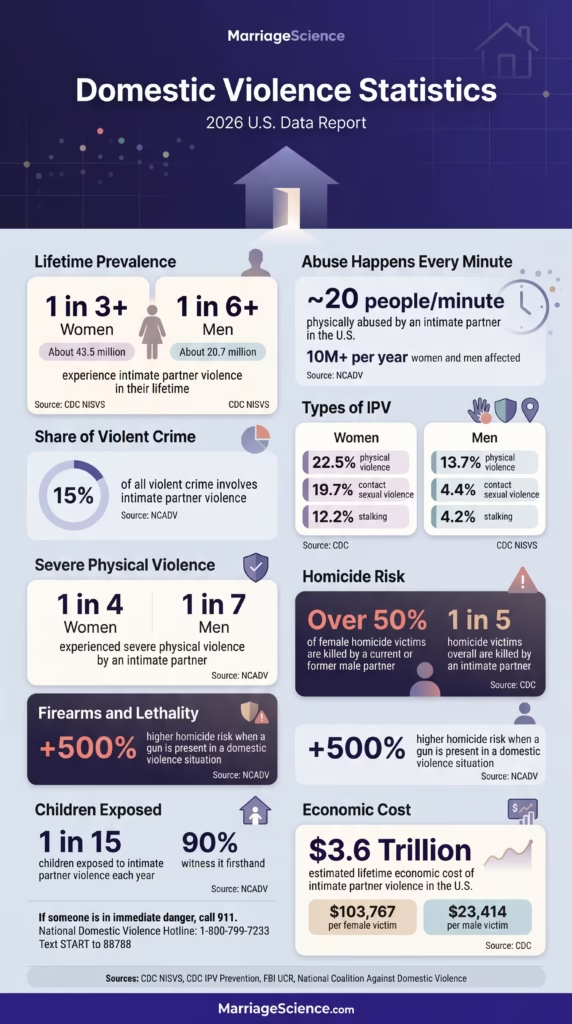
- More than 1 in 3 women (about 43.5 million) and more than 1 in 6 men (about 20.7 million) have experienced contact sexual violence, physical violence, or stalking by an intimate partner in their lifetime (CDC, NISVS, 2016/2017).
- On average, nearly 20 people per minute are physically abused by an intimate partner in the United States, which adds up to more than 10 million women and men a year (National Coalition Against Domestic Violence).
- Intimate partner violence accounts for about 15% of all violent crime (National Coalition Against Domestic Violence).
- Among women, lifetime intimate partner violence includes 22.5% who experienced physical violence, 19.7% contact sexual violence, and 12.2% stalking (CDC, NISVS, 2016/2017).
- Among men, lifetime intimate partner violence includes 13.7% who experienced physical violence, 4.4% contact sexual violence, and 4.2% stalking (CDC, NISVS, 2016/2017).
- About 1 in 4 women and 1 in 7 men have experienced severe physical violence, such as beating, burning, or strangling, by an intimate partner (National Coalition Against Domestic Violence).
- Over half of all female homicide victims are killed by a current or former male intimate partner (CDC).
- About 1 in 5 homicide victims overall are killed by an intimate partner (CDC).
- In 2021, about 34% of female murder victims were killed by an intimate partner (National Coalition Against Domestic Violence).
- The presence of a gun in a domestic violence situation increases the risk of homicide by about 500% (National Coalition Against Domestic Violence).
- About 16 million women and 11 million men first experienced intimate partner violence before age 18 (CDC, NISVS, 2016/2017).
- About 1 in 15 children are exposed to intimate partner violence each year, and roughly 90% of them witness it firsthand (National Coalition Against Domestic Violence).
- Among women, lifetime intimate partner violence affects 43.8% of lesbian women and 61.1% of bisexual women, compared with 35% of heterosexual women (CDC, NISVS, 2016/2017).
- The lifetime economic cost of intimate partner violence in the United States is an estimated $3.6 trillion (CDC, 2018).
- The lifetime cost works out to about $103,767 per female victim and $23,414 per male victim (CDC, 2018).
- The most recent NISVS cycle, collected from 2023 to 2024, surveyed 15,609 U.S. adults (CDC, 2024).
- Intimate partners commit nearly 50% of female homicides and about 10% of male homicides (National Coalition Against Domestic Violence).
How Common Is Domestic Violence?
Intimate partner violence is one of the most widespread forms of violence in the country. The CDC National Intimate Partner and Sexual Violence Survey, the standard tool for measuring it, finds that more than 1 in 3 women, about 43.5 million, and more than 1 in 6 men, about 20.7 million, have experienced contact sexual violence, physical violence, or stalking by an intimate partner in their lifetime.
The scale is easier to grasp in real time. On average, nearly 20 people a minute are physically abused by an intimate partner, which works out to more than 10 million women and men every year (National Coalition Against Domestic Violence). Intimate partner violence also accounts for roughly 15% of all violent crime.
The most recent NISVS cycle, collected from 2023 to 2024, surveyed 15,609 adults, so the estimates rest on a large and current national sample. For related figures on sexual violence, see our sexual assault statistics, and for the wider set, our relationship and dating statistics hub.
| Metric | Value | Source |
| Women with lifetime IPV | More than 1 in 3 (43.5M) | CDC, NISVS |
| Men with lifetime IPV | More than 1 in 6 (20.7M) | CDC, NISVS |
| People abused by a partner, per minute | ~20 | NCADV |
| People abused by a partner, per year | 10 million+ | NCADV |
| Share of all violent crime | ~15% | NCADV |
Domestic Violence by Type
Domestic violence is not a single act. The CDC tracks it across physical violence, contact sexual violence, and stalking, and many survivors experience more than one. Among women, 22.5% report lifetime physical violence by a partner, 19.7% contact sexual violence, and 12.2% stalking. Among men, the figures are 13.7%, 4.4%, and 4.2%.
Severity varies widely. About 1 in 4 women and 1 in 7 men have experienced severe physical violence, such as being beaten, burned, or strangled, by an intimate partner (National Coalition Against Domestic Violence). Strangulation in particular is a strong warning sign, linked to a sharply higher risk of later homicide.
Apart from these categories, advocates emphasize coercive control: a pattern of intimidation, isolation, financial control, and monitoring that may leave no physical mark. It often appears before physical violence and is now recognized in a growing number of state laws, though national data on it remains limited.
| Metric | Value | Source |
| Women, physical / sexual / stalking | 22.5% / 19.7% / 12.2% | CDC, NISVS |
| Men, physical / sexual / stalking | 13.7% / 4.4% / 4.2% | CDC, NISVS |
| Severe physical violence, women / men | 1 in 4 / 1 in 7 | NCADV |
How Often It Happens
Frequency is one of the hardest parts of the problem to convey, because much of it stays hidden. The per-minute figure, nearly 20 people physically abused by a partner every minute, is drawn from national survey estimates rather than police reports, which capture only a fraction of cases.
Repeat victimization is common. Abuse in an intimate relationship rarely happens once, and survivors frequently report escalating patterns over months or years. That ongoing nature is part of what separates intimate partner violence from many other crimes and makes leaving so difficult.
Domestic Violence and Homicide
The most severe outcomes are concentrated among women. Over half of all female homicide victims in the United States are killed by a current or former male intimate partner, and about 1 in 5 homicide victims overall are killed by an intimate partner (CDC). In 2021, about 34% of female murder victims were killed by an intimate partner (National Coalition Against Domestic Violence).
Firearms sharply raise the danger. The presence of a gun in a domestic violence situation increases the risk of homicide by about 500%. Intimate partners commit nearly 50% of female homicides and about 10% of male homicides, a gap that reflects both prevalence and severity.
Certain warning signs precede many fatal cases, including prior strangulation, threats with a weapon, and escalating control. Advocates use these markers in lethality assessments to flag the highest-risk situations and prioritize safety planning.
| Metric | Value | Source |
| Female homicide victims killed by a partner | Over 50% | CDC |
| All homicide victims killed by a partner | ~1 in 5 | CDC |
| Female murder victims killed by a partner, 2021 | 34% | NCADV |
| Gun in a DV situation raises homicide risk by | ~500% | NCADV |
Domestic Violence by Gender
Both women and men experience intimate partner violence, but the patterns differ. Women are more likely to experience severe physical violence, sexual violence, stalking, and injury, and far more likely to be killed by a partner. Men more often report being slapped, pushed, or shoved, and are less likely to report the abuse or to seek help.
These differences matter for services and policy. Male survivors face particular stigma and fewer dedicated resources, while women face higher rates of life-threatening violence. The data supports taking both seriously without flattening the real differences in severity.
Underreporting affects the gender numbers too. Because men are less likely to disclose abuse, especially sexual abuse, their true rates may be somewhat higher than surveys capture, even as the most dangerous outcomes remain concentrated among women.
Domestic Violence in LGBTQ Relationships
Domestic violence affects lesbian, gay, and bisexual people at rates equal to or higher than heterosexual people. NISVS data show that 43.8% of lesbian women and 61.1% of bisexual women have experienced rape, physical violence, or stalking by an intimate partner, compared with 35% of heterosexual women. Among men, the figures are 26% of gay men and 37.3% of bisexual men, versus 29% of heterosexual men.
Bisexual women stand out for especially high rates. LGBTQ survivors also face added barriers to help, including fear of being outed, a shortage of dedicated services, and concern that police or shelters will not take their situation seriously.
| Metric | Value | Source |
| Lifetime IPV, lesbian women | 43.8% | CDC, NISVS |
| Lifetime IPV, bisexual women | 61.1% | CDC, NISVS |
| Lifetime IPV, heterosexual women | 35% | CDC, NISVS |
| Lifetime IPV, gay men | 26% | CDC, NISVS |
| Lifetime IPV, bisexual men | 37.3% | CDC, NISVS |
When Abuse Starts: Age and Young People
Intimate partner violence often begins early. About 16 million women and 11 million men first experienced it before age 18 (CDC, NISVS, 2016/2017). Adolescence and early adulthood are the highest-risk years for a first experience, and young women aged 18 to 24 face some of the highest rates.
Teen dating violence is its own concern, linked to later depression, substance use, and repeat victimization. Early patterns of jealousy and control can carry into adult relationships, which is why prevention programs increasingly start in middle and high school.
| Metric | Value | Source |
| First experienced IPV before age 18, women | ~16 million | CDC, NISVS |
| First experienced IPV before age 18, men | ~11 million | CDC, NISVS |
Children Who Witness Abuse
Children are frequent witnesses. About 1 in 15 children are exposed to intimate partner violence each year, and roughly 90% of them see it firsthand (National Coalition Against Domestic Violence). Many live in homes where abuse is a recurring presence rather than a single event.
Exposure carries lasting effects, including higher risks of depression, anxiety, behavioral problems, and later involvement in violent relationships as either victim or aggressor. That intergenerational pattern is one reason prevention focuses so heavily on children and teens.
| Metric | Value | Source |
| Children exposed to IPV each year | ~1 in 15 | NCADV |
| Of those, who witness it firsthand | ~90% | NCADV |
The Economic Cost
The financial toll is enormous. The CDC estimates the lifetime economic cost of intimate partner violence in the United States at $3.6 trillion, counting medical care, lost productivity, and criminal justice expenses.
Per survivor, that comes to about $103,767 for each female victim and $23,414 for each male victim over a lifetime. Most of the total is medical care and lost productivity, a reminder that the harm reaches into health, work, and housing long after the immediate incident.
| Metric | Value | Source |
| Lifetime economic cost (U.S.) | $3.6 trillion | CDC |
| Cost per female victim | $103,767 | CDC |
| Cost per male victim | $23,414 | CDC |
Underreporting and Why It Stays Hidden
Official crime data understates the problem. Many survivors never contact police, for reasons that include fear of retaliation, financial dependence, concern for children, shame, and distrust of the system. Survey estimates like NISVS exist precisely because police reports miss so much.
This gap is why prevalence figures from national surveys are usually far higher than arrest or conviction counts. When reading any domestic violence statistic, it helps to know whether it comes from a survey, which captures more, or from law enforcement records, which capture less.
Leaving is also the most dangerous time. Risk of severe violence often rises when a survivor tries to end the relationship, which is why advocates stress planning an exit with support rather than acting alone.
Where to Get Help
If you are in immediate danger, call 911. For confidential support at any hour, the National Domestic Violence Hotline is available at 1-800-799-7233, or text START to 88788. Trained advocates can help with safety planning, shelter, and local resources.
More information and support are available through the National Domestic Violence Hotline and the National Coalition Against Domestic Violence. A safety plan, made with help from an advocate, is one of the most effective steps a person at risk can take.
Methodology and Sources
Every figure on this page comes from a named primary source, not from content-marketing roundups. Estimates that could not be traced to a primary source were left out. Figures are updated as new data is released.
- CDC, National Intimate Partner and Sexual Violence Survey (NISVS)
- National Coalition Against Domestic Violence (NCADV)
- CDC, Intimate Partner Violence Prevention (homicide and economic cost data)
- FBI, Uniform Crime Reporting (homicide context)