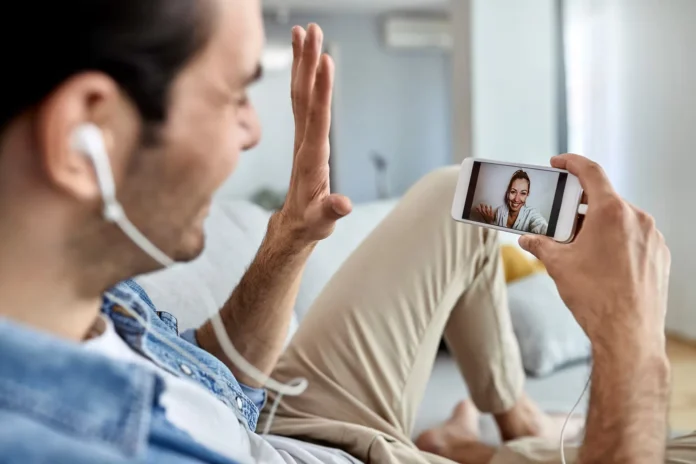


Yes, couples therapy can work when you live apart. Online counseling is the standard way to do it. You both join the same video session from your own locations, then continue the work with structured exercises between sessions.
This guide covers the logistics nobody explains, such as joining one session from two places, working asynchronously, and booking around a time-zone gap. It also looks at which services are designed for two separate locations.
Can Couples Therapy Work Long-Distance?
Long-distance couples therapy works. For many couples, it removes the biggest barrier to getting help: finding one room you can both reach.
The format is the same evidence-based work done in an office, delivered over video. Research on Emotionally Focused Therapy (EFT), summarized by its developers and the ICEEFT training body, finds that the core change happens through guided conversation. That can happen over a screen.
It works best under three conditions. Both partners commit to scheduled sessions. You have a private space and a stable connection at each end. You also treat the distance as the situation you are working within, rather than the only thing you discuss.
Distance changes the delivery, not the method. The communication patterns a therapist helps you change are the same whether you sit on one couch or two.
How Online Long-Distance Couples Counseling Actually Works
Most articles stop at “communication is key.” Here is the part that can actually trip couples up: the mechanics of doing therapy from two addresses.
Joining One Session From Two Locations
You each open the same session on your own device, wherever you are. It works much like two people joining a work video call.
Use separate devices in separate rooms rather than crowding around one camera. This lets the therapist see both faces and gives you each equal airtime.
Headphones on both ends keep the audio clean. They also help keep the conversation private if either of you has roommates or family nearby.
Pick the same hour on both calendars. Account for the time difference once, then confirm it in writing so nobody shows up an hour off.
Working Between Sessions
The session is one hour of your week. What you do on the other days is where couples usually gain or lose ground.
Good programs give you guided exercises to do between sessions. These matter more when you live apart because you cannot fall back on shared meals and daily presence to repair small ruptures.
Some of this work is asynchronous. You each complete a prompt or reflection on your own time, then review it together later. This helps when your schedules do not match.
An app that stores session summaries and assigns the next exercise keeps both partners on the same page. That is especially useful when you cannot debrief in the kitchen afterward.
Handling a Big Time-Zone Gap
A few hours apart is a scheduling note. Eight or more hours apart is a real constraint. It is also a common reason couples assume therapy is off the table.
The fix is a service with around-the-clock booking. That gives you a better chance of finding a rare window that is daytime-ish for both of you. Another option is for one partner to take an early-morning slot while the other takes an evening slot.
When no live window works in a given week, lean on the asynchronous tools. That way, progress does not stall while you wait for your calendars to line up.
What Long-Distance Therapy Can and Can’t Fix
Being honest about the limits is part of choosing well.
What it handles well: rebuilding trust, breaking negative communication cycles (the criticize-then-withdraw loop the Gottman Institute documents), and creating reconnection rituals that hold up across distance.
It is also effective for common strains that come with being apart. These include jealousy, feeling disconnected, and arguments that spiral over text because tone is missing.
What it will not do: close the distance for you. Therapy can help you decide whether and when to live in the same place. It does not solve the logistics of jobs, visas, or moving.
It also cannot substitute for in-person crisis care. For active abuse, addiction, or a mental-health emergency, the American Psychological Association advises direct, often local, professional support rather than relationship counseling alone.
Choosing a Long-Distance Couples Counseling Service
The features that matter when you live in two places are different from those that matter for couples under one roof. Use these criteria.
- Two separate logins: the platform should let each partner join from their own account and device. It should not assume you are sharing one screen.
- Flexible scheduling across time zones: 24/7 booking, not fixed business hours in a single zone, so a real session window exists for both of you.
- A start-solo option: if one partner is hesitant or harder to schedule, you want to begin alone and invite them later instead of waiting.
- Between-session tools: guided exercises and shared summaries matter more when you lack daily face time.
- Session length that fits a screen: shorter, focused sessions are often easier to schedule across a gap than a single 90-minute block.
We may earn a commission if you sign up through our links, at no extra cost to you.
OurRitual has a dedicated long-distance program built for exactly this: book live expert sessions 24/7 to work around any time-zone gap, join together or separately from your own devices, and one of you can start before the other is ready. Sessions run 20 or 40 minutes, and the app keeps both partners on the same exercises between calls.
Long-Distance Couples Therapy vs a Regular Online Platform
Plenty of online therapy services exist, but most are designed for couples in the same home and simply moved to video. A distance-specific program adds a few things that matter when you live apart.
| What you need apart | Generic online platform | Distance-built program (OurRitual) |
|---|---|---|
| Two locations, two devices | Often assumes one shared screen | Each partner joins from their own account |
| Scheduling across time zones | Set hours, one zone | Bookable 24/7 |
| Start when only one is ready | Usually needs both to enroll | One partner can start solo and invite later |
| Between-session work Matters most apart | Varies, often messaging only | App with guided exercises and session summaries |
The difference is not the video call itself. It is everything around it that keeps a relationship moving when you see each other only on a screen.
For a closer look at how the experts, app, and pricing hold up, read our OurRitual review.
Exercises for Long-Distance Couples Between Sessions
These are simple, doable-apart exercises a therapist might assign, and you can start them today. They work for couples in long-distance relationships because none of them require being in the same place.
A Daily Check-In Ritual
Pick one fixed time to connect, even ten minutes, and protect it the way you would a meeting.
Use the same two questions each day: “What was the best part of your day, and what was the hardest part?” This gives the call a shape instead of letting it drift into logistics.
Structured Weekly Questions
Once a week, trade three deeper prompts that you each answer out loud: one appreciation, one thing you missed about each other, and one thing you want to do differently the following week.
This mirrors the Gottman Institute’s emphasis on building fondness and turning toward each other. It is adapted for partners who cannot do those things in passing.
Keep one concrete shared goal visible: the next visit, the next trip, or the plan to close the distance.
Having something on the calendar gives the time apart a purpose. It also lowers the open-ended ache that can wear couples down.
Asynchronous Repair Notes
When you argue over text and the tone goes sideways, agree to pause. Each of you can write a short note about what you felt and what you meant.
Exchange them before the next call so the therapist, or just the two of you, can work from clarity instead of a misread message.
Frequently Asked Questions
How Much Is Long-Distance Couples Counseling?
It costs about the same as other online couples therapy because the format is similar. Flat-fee programs run roughly $36 to $90 per week. Per-session video platforms charge in the $90 to $230 range.
For the full breakdown by format, see our guide to how much couples therapy costs.
Does Long-Distance Couples Therapy Work If Only One of Us Joins?
Yes. Individual work focused on a relationship can be effective, and it is often the realistic start when one partner is busy in another time zone or simply not ready.
OurRitual is built for this: one person can begin solo with a vetted expert and invite their partner later, so you do not lose momentum waiting. We cover how that works in our OurRitual review.
What Platforms Support a Two-Location Setup?
Look for services that give each partner a separate login and offer 24/7 booking rather than fixed hours in one zone.
For a wider comparison of the options, see our roundup of the best couples therapy apps.
How Do We Handle Sessions Across a Large Time-Zone Gap?
Use a service with around-the-clock scheduling to find the one window that works for both of you. Rely on asynchronous exercises during weeks when no live slot lines up.