


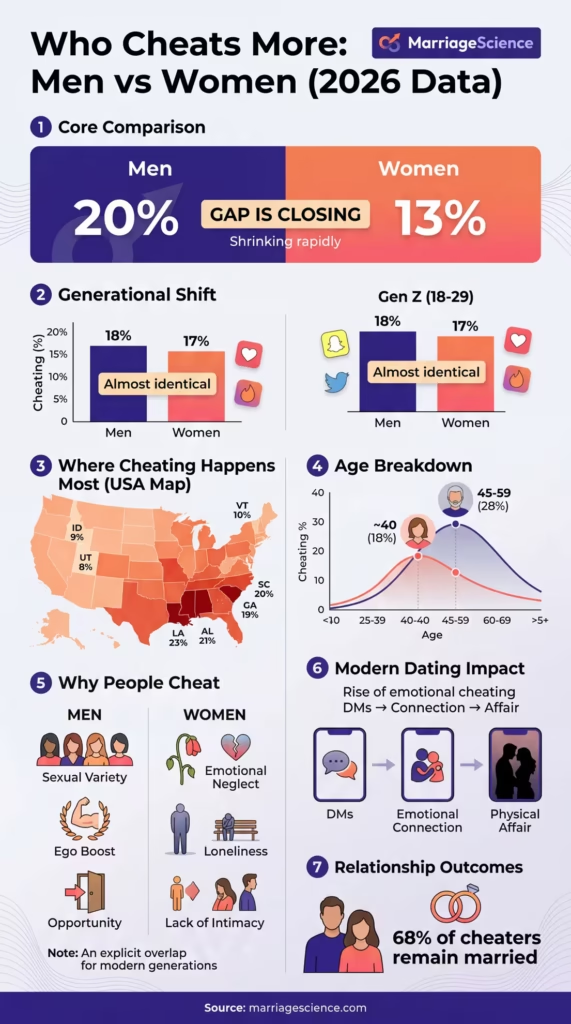
Men cheat more than women. In the General Social Survey, about 20% of married men and 13% of married women admit to having had sex with someone other than their spouse (GSS, 2022).
In the General Social Survey, 20% of men and 13% of women reported having had sex with someone other than their spouse while married.
The gap is real but shrinking. It has narrowed from roughly 15 percentage points in the 1990s to 7 to 10 points today, and among adults under 30 women now report infidelity at about the same rate as men (Institute for Family Studies analysis of GSS data).
Quick Take: Who Cheats More
- 20% of men admit to cheating at least once, compared to 13% of women
- Younger women are closing the gap – Gen Z women cheat nearly as often as men
- Southern U.S. states show the highest infidelity rates
- Cheating peaks between ages 40–59, especially among married men
- Income and education correlate with increased cheating rates
If you’ve ever thought “men cheat more,” you’re statistically right – but just barely. The landscape is rapidly shifting, especially among Millennials and Gen Z.
Key Cheating Statistics
- About 20% of married men and 13% of married women admit to having had sex with someone other than their spouse (General Social Survey, 2022).
- Across recent decades, the General Social Survey finds 20% to 25% of married men and 13% to 15% of married women report extramarital sex at some point (GSS).
- The gender gap has narrowed, from about 15 percentage points in the 1990s to roughly 7 to 10 points today (Institute for Family Studies).
- Among adults under 30, women now report infidelity at roughly the same rate as men, erasing the historical gender gap (IFS analysis of GSS, 2024).
- Men’s infidelity peaks at about 26% in their 70s, while women’s peaks at about 16% in their 60s (IFS analysis of GSS).
- In any given year, only about 3% to 4% of married adults report extramarital sex (General Social Survey).
- Men’s reported infidelity fell from about 21% in the 1990s to around 11% in 2021 to 2022, while women’s held near 14% (Institute for Family Studies).
- Americans born between 1940 and 1959, the baby boomers, report the highest lifetime rates of extramarital sex of any generation measured (Wolfinger, IFS, 2017).
- Men in prestigious occupations are more likely to report cheating than other men (Institute for Family Studies).
Do Men Cheat More Than Women?
The Institute for Family Studies conducted a 2023 survey which revealed that 20% of men in committed relationships admitted to cheating compared to 13% of women. The percentage difference between men and women who cheat has decreased throughout the years.
The infidelity rate between men and women differed by nearly double in 2000 when only 8% of women confessed to cheating.
The marital infidelity rates show the largest difference between husbands and wives since 16% of husbands cheat compared to 10% of wives.
The percentage of men and women under thirty who cheat shows a significant reduction in the gender difference since 18% of men cheat and 17% of women cheat.
The changing social values together with women’s increasing independence and dating app usage have contributed to these trends which provide equal opportunities for temptation to both genders.

| Metric | Value | Source |
| Married men who admit infidelity | ~20% | GSS, 2022 |
| Married women who admit infidelity | ~13% | GSS, 2022 |
| Lifetime extramarital sex, men | 20% to 25% | GSS |
| Lifetime extramarital sex, women | 13% to 15% | GSS |
| Gender gap, 1990s vs today | ~15 pts to ~7-10 pts | IFS |
The same discretion that makes infidelity hard to measure also shapes where it happens – a growing share plays out on platforms built specifically for privacy. If you’re researching that side of it, our guide to the best discreet dating sites breaks down how the leading options compare on anonymity and safety.
Where Do Americans Cheat the Most?
The data from U.S. states demonstrates that residential location affects the chances of cheating. The YouGov and IFS data composite index shows that southern states have the highest rates of self-reported infidelity.
Top 5 States With Highest Infidelity Rates
- Louisiana – 23% of adults admit to cheating
- Alabama – 21%
- South Carolina – 20%
- Mississippi – 20%
- Georgia – 19%
Interestingly, these same states also report higher levels of religious affiliation and divorce, which may suggest that guilt and confession play a role in these elevated numbers.
States With the Lowest Infidelity Rates
These states tend to have tighter-knit communities and stronger social pressure to remain faithful – or perhaps to simply not admit cheating.
When Do People Cheat Most Often?
Age plays a major role in infidelity. Research from Pew and the Journal of Marital Therapy shows that:
- Men are most likely to cheat between ages 45–59, peaking around age 55 (28%)
- Women tend to cheat earlier, with infidelity peaking around age 40 (18%)
Why this timing? Midlife often brings relationship fatigue, lower intimacy, or unmet emotional needs. Many in this age bracket report feeling “invisible” in long-term partnerships, seeking validation outside their marriage.
In contrast, younger adults cheat more opportunistically, often driven by emotional disconnects or temptation via digital platforms.

| Metric | Value | Source |
| Men, peak infidelity (70s) | ~26% | IFS / GSS |
| Women, peak infidelity (60s) | ~16% | IFS / GSS |
| Married adults reporting extramarital sex in the past year | 3% to 4% | GSS |
Gen Z and Millennials: A New Cheating Culture
Among younger generations, the traditional gender divide in cheating is evaporating.
- 18% of Gen Z men and 17% of Gen Z women admit to cheating – nearly identical
- Emotional infidelity and online affairs are rising among women
- Social media DMs, Instagram flirtations, and dating apps make emotional boundaries blurrier than ever
In fact, many women under 30 report that their cheating was emotional first, and only later physical – a shift from the historically physical-first pattern seen in men.
This generation also sees less stigma around sexual expression, making cheating behavior more likely to be admitted – or even normalized – in some circles.
| Metric | Value | Source |
| Men’s infidelity, 1990s | ~21% | IFS / GSS |
| Men’s infidelity, 2021 to 2022 | ~11% | IFS / GSS |
| Women’s infidelity, recent | ~14% | IFS / GSS |
| Highest-cheating generation | Baby boomers (born 1940 to 1959) | Wolfinger, IFS, 2017 |
Why Do Men and Women Cheat?
The reasons behind infidelity are as diverse as the people involved, but clear gender patterns still emerge.
- Men most often cite a desire for sexual variety, ego boost, or opportunity
- Women more frequently mention emotional neglect, lack of intimacy, or loneliness
However, the gap is narrowing. More women now report cheating due to boredom, feeling unappreciated, or disconnect, similar to men’s motives.
Interestingly, among Millennials and Gen Z, both genders increasingly cheat for the same reason: their needs aren’t being met at home, and opportunity meets motivation – often through digital channels.
Stories From the Real World
“I didn’t cheat because I was unhappy. I cheated because I felt unseen.”
– Anonymous woman, 42, Texas
“She paid attention to me. That’s all it took.”
– Man, 49, Georgia
“It started with memes and jokes in DMs. Next thing I knew, I was deleting messages before bed.”
– Woman, 28, New York
These stories echo what the data tells us: cheating is less about lust and more about connection, recognition, and validation. And today, those things are just a swipe away.

Does Cheating Lead to Divorce?
Contrary to what many believe, cheating doesn’t always end a relationship.
- 68% of married people who’ve cheated are still married
- Couples with strong communication skills and willingness to rebuild trust are more likely to survive
- Divorce is more likely when infidelity is paired with emotional detachment or long-term dissatisfaction
In some cases, cheating acts as a catalyst for deeper conversations or even marriage therapy. In others, it’s the last straw.
The Final Verdict: Who Cheats More?
While men still cheat more than women, the gap is narrowing quickly. Especially among younger generations, infidelity is becoming more equal, driven by opportunity, tech, and evolving gender roles.

If you’re in a relationship, knowing these stats can help start important conversations about trust, needs, and boundaries.
If trust has already taken a hit, rebuilding it is its own process. Our relationship advice covers how couples recover after an affair.
For some couples the financial side matters too, and a clear agreement set up in advance can take the pressure off. Here’s how a prenup works.
Methodology and Sources
Every figure added here comes from the General Social Survey and analyses of it by the Institute for Family Studies, not from detective-agency or content-marketing pages. Where older in-text numbers and newer survey figures differ, both reflect the source and year shown. Figures are updated as new data is released.
- General Social Survey (GSS), NORC at the University of Chicago
- Institute for Family Studies (IFS) analyses of GSS data
- Nicholas Wolfinger, “Want to Avoid Divorce? Wait to Get Married, But Not Too Long,” and related IFS infidelity research