




 SwingLifeStyle
3.4
SwingLifeStyle
3.4
A swinger personals board that has been running since 2001, wrapped around a forum, a 47-state group directory, 355 verified clubs and a weekly party calendar, with no membership price published anywhere on the website.
SwingLifeStyle is a real community and an old one, with 7,972 groups spread across 47 states, 101 parties listed in a single week and a forum carrying 739,083 posts. Almost all of it is readable without an account, which makes it the rare platform in this category you can evaluate properly before paying a cent, and long-term members describe a one-off membership repaying itself many times over. The trade-offs are a website that publishes no price before signup, terms that make payments nonrefundable, and an interface that has not changed much since 2001. Density also varies enormously by state, so check your own on the free directory and let that decide it.
One long-time member calls SwingLifeStyle “stuck in 2004 forever.” That is unkind, but not entirely wrong. The site launched in 2001, and the front end has not changed much since.
What it does have is a community. Beneath the dated personals are eight forum categories, 7,972 groups across 47 states, 355 verified clubs, and a party calendar that had 101 entries in the week I checked.
The awkward part is the price. The website does not tell you what a membership costs, and the only price the company actually publishes is the $24.99 monthly subscription that appears in its iPhone app.
So I went looking for the answers the site does not provide. I read the terms and privacy policy, worked through the group directory state by state, counted a full week of parties, sampled the live member counters six times over five minutes, checked both app store listings, read 65 comments from 49 accounts across three r/Swingers threads, and registered an account so I could complete a profile and explore the member settings myself.
Features scores highest because there is a lot to explore for free. Forums, groups, clubs, parties, and 16,249 stories are all available before you spend a cent.
The 3.6 Connection Success score reflects something real, and it is the rating I would pay the most attention to. Long-term members describe meeting couples through the site for years, and one calls a lifetime membership “the best $100 I ever spent.”
Pricing value and customer support are what pull the overall score down, largely for the same reason: you cannot see the membership price before signing up, and the terms say all payments are nonrefundable.
My verdict: SwingLifeStyle is a real, established community, with 25 years behind it. Its forum had a new post nine minutes before I loaded it, and the site listed 101 parties for this week alone. I would judge it by the directory because the dating features are the weaker half. The interface is about two decades old, so use the free directory first to see whether your state is one of the stronger ones.
Most dating sites sell you a search box. SwingLifeStyle is closer to a noticeboard for a scene that already exists offline.
Reviews usually focus on the personals, but they are not what keeps the community going. Beneath them are eight forum categories, a group directory the company counts at 14,894, a club database with 355 entries, a weekly party calendar, and a cruise-booking arm.
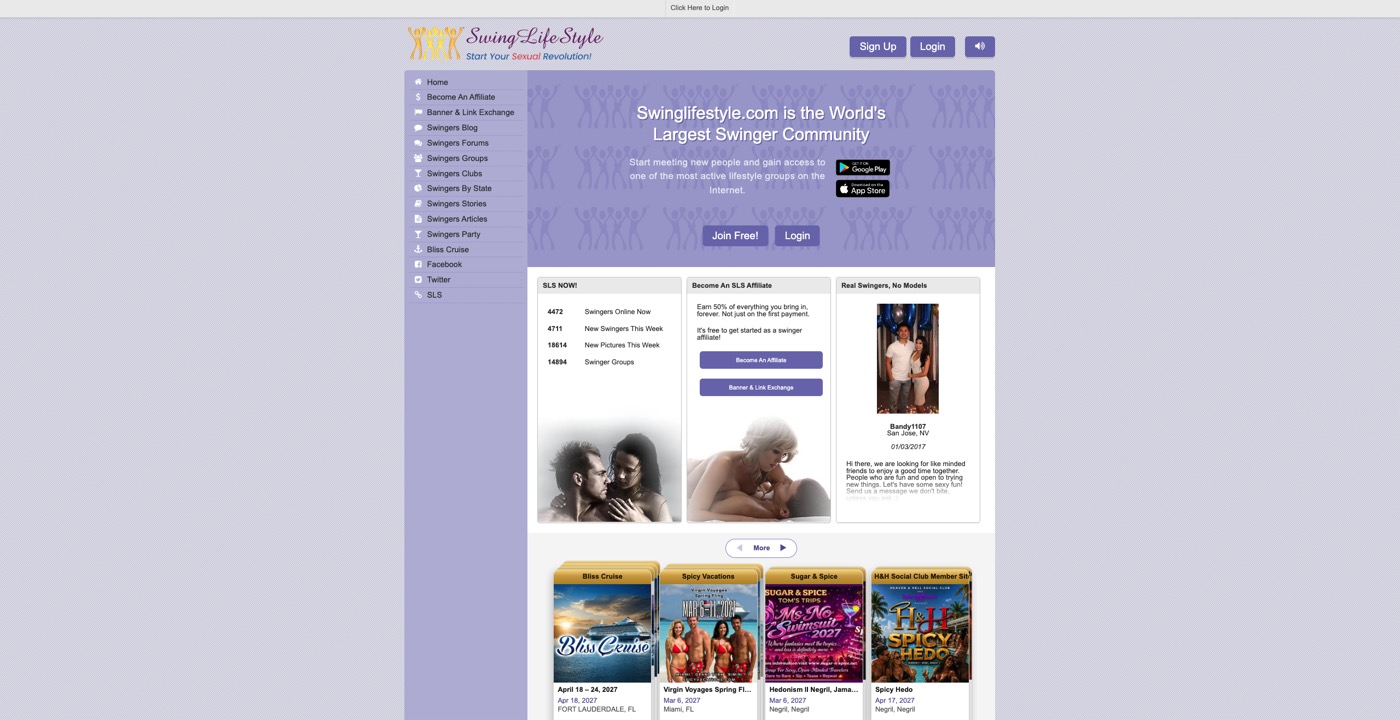
Finding all of that takes some patience. The state directory is still a clickable GIF image map of the United States, the kind of thing that stopped being common around 2004, and there is no search box.
That is unusual for this category and, in my view, the strongest reason to start here. You can see whether anything is happening near you before spending a dollar.
Before handing over your card details, it is worth knowing who is behind the service. Both the terms of use and privacy policy name DashBoard Hosting, LLC as the operator, and Florida law governs disputes in the courts covering Broward County.
The company registered its own domain, dashboardhosting.com, on 27 June 2001. It registered SwingLifeStyle’s domain the day before, on 26 June 2001, through the same registrar.
Are there actually members and activities near you? That is what determines whether a site like this is worth paying for, and I could not find another review that answered it with data. So I did the work myself.
The good news is that anyone can check this. SwingLifeStyle publishes its group directory by state, with each state page showing counts by category. I went through all 47 states listed in the national index and added the numbers together.
The total is 7,972 groups across 47 states, based on my check on August 22, 2026. If you live in Alaska, Hawaii, North Dakota, or Washington, DC, the index does not list your state.
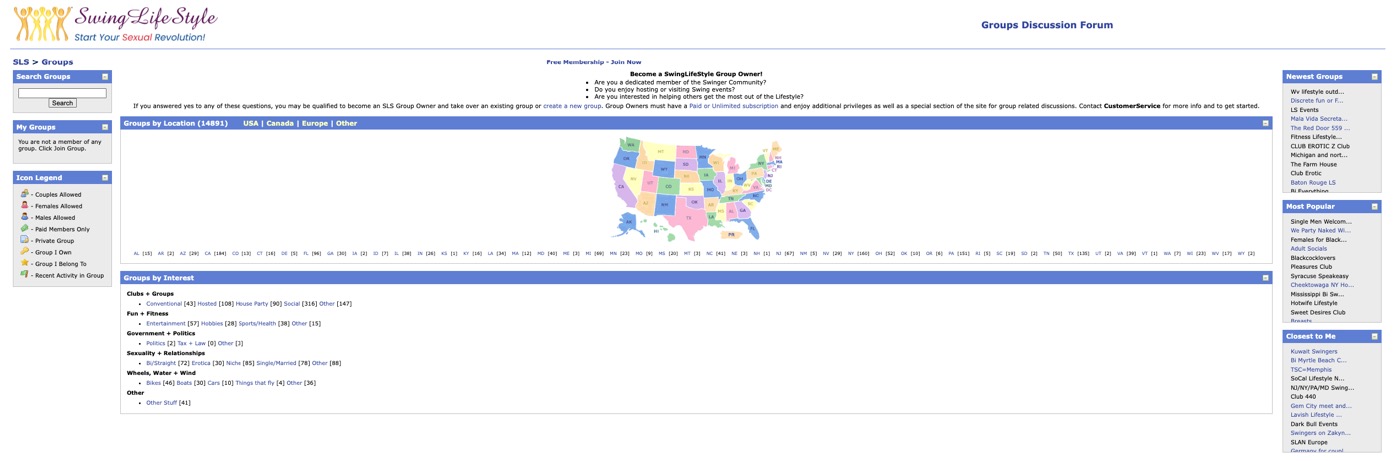
Raw counts naturally favor larger states, so I divided each state’s group count by its population using the Census Bureau’s 2023 one-year estimates. Across the 47 listed states, the national rate is 24.1 groups per million residents.
| State | Groups | Per million residents | Against the national rate |
| Pennsylvania | 789 | 60.9 | 2.5x |
| New Jersey | 477 | 51.3 | 2.1x |
| Michigan | 398 | 39.7 | 1.6x |
| New York | 768 | 39.2 | 1.6x |
| Florida | 569 | 25.2 | 1.0x |
| California | 788 | 20.2 | 0.8x |
| Texas | 466 | 15.3 | 0.6x |
| Kansas | 6 | 2.0 | 0.1x |
Pennsylvania is the surprise. It has 789 groups, compared with California’s 788, despite having roughly one-third of California’s population. That gives Pennsylvania about three times the group density.
Add New Jersey, New York, Delaware, Connecticut, and Rhode Island, and the pattern becomes hard to miss. The old Northeast corridor is the strongest part of this network, apparently because that is where the community became concentrated and stayed.
Texas ranks sixth by raw count but falls below the national average per person. If you live in Dallas or Houston, the headline number may make the local scene look stronger than it is.
At the other end, the list can get very short. Eight states have fewer than 16 groups each: Wyoming has four; Kansas and Montana have six; and Iowa and Nebraska have nine.
Kansas has 2.0 groups per million residents, just one-thirtieth of Pennsylvania’s density. In Wichita, a membership may amount to little more than access to a directory when the local scene it points to has only six groups.
Browsing by state works well. Searching by what a group actually does is much harder, because only 1,367 of the 14,891 groups have an interest tag.
The top five states account for 42.5% of all groups, while the top ten account for 64.7%. That is a strong regional bias, and the marketing language about the world’s largest swinger community does not tell you whether your state benefits from it.
The group directory tells you what exists. The party calendar gives you a better sense of whether people are actually using it right now.
On August 22, 2026, the Swinger Party List for This Week had 101 dated listings for August 21 and 22. Eighty-two named a U.S. state, covering 27 states.
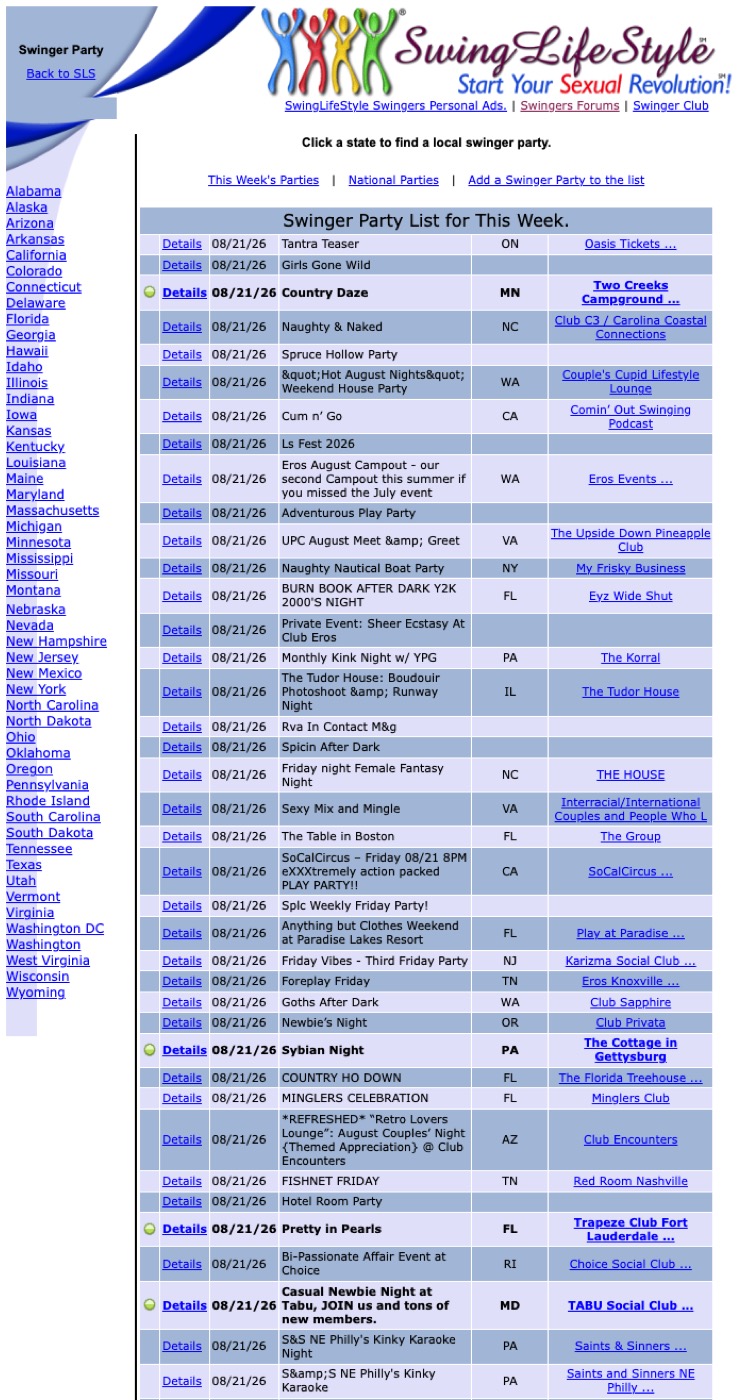
Florida led with nine, followed by Pennsylvania with eight. California and New York had six each, while Washington, Tennessee, and Texas had five. If your state appears in the group data, it is likely to appear here as well. That overlap is a useful sign that both sets of numbers reflect an active community.
Most listings name the host venue, and the club database contains 355 verified clubs. A party you can connect to a named venue in your state tells you more than a membership counter ever could.
Registration is free, and the terms describe three membership levels: Free, Paid, and Unlimited.
A free membership gives you a profile, browsing access, and use of the public areas. The site restricts group ownership, and the groups page says owners “must have a Paid or Unlimited subscription.”
What it does not give you is much of a conversation. Nine separate commenters make essentially the same point: “You aren’t going to be able to communicate with others unless you are a paid member.”
Paying members say they actually behave this way, so that should shape your expectations for a free profile. Several say they do not read, answer, or even view free accounts, and one says he received message notifications that he could not open until he paid.
That makes a free account a useful research tool. Use it to check your area first, but expect to pay if you want people to communicate with you.
Much of what makes the service worth checking is free and does not require an account. The forum, story archive, club database, and party calendar are all available while logged out.
Take advantage of that. Read through a month of forum threads from your state before deciding whether the paid tier is worth it.
Registration is free and does not require a card, but it is not the ten-second process you might expect from a swipe app.
The form asks for a profile name, password, email address, and phone number. You then choose an account type: Couple, Single Female, or Single Male. The service uses that three-way classification throughout, including for its clubs and parties.
Then comes the writing. The form requires a tagline of 10 to 250 characters, plus four separate free-text fields with a minimum of 45 characters each: Looking For, Describe Yourself, Fantasies and Experience, and Additional Information.
That means you need roughly 190 characters of profile text just to get through registration. Inside the member area, those same fields allow up to 4,000 characters each, so there is plenty of room to add more. This is not a profile you can throw together in a few seconds.
The phone-number requirement is worth considering. The site asks for it up front, before you have viewed a single profile, so decide whether you are comfortable providing it before you continue.
Once you are inside, the service feels less like a directory and more like a large settings panel. The left rail includes Who’s On, Search, Friends, Favorites, Chat, Messages, Hot Date, Events, Forums, Clubs, Groups, Travel, and Erotic Stories.
The preferences page shows both the age of the design and some of its usefulness. You choose among three levels—Watch, Soft, and Full—and each comes with a plain-English explanation.

You then set preferences separately for couples, single ladies, and single men. Each has its own dropdown, and the page explains what the two negative options actually do.
Choose “No Interest” and your profile remains visible to that group. Choose “Block Them” and the profile disappears from that group entirely. That is a genuinely useful control, particularly if unwanted attention from single men pushed you away from another site.
The profile-writing page has a red warning, and it is probably the most important rule on the screen.
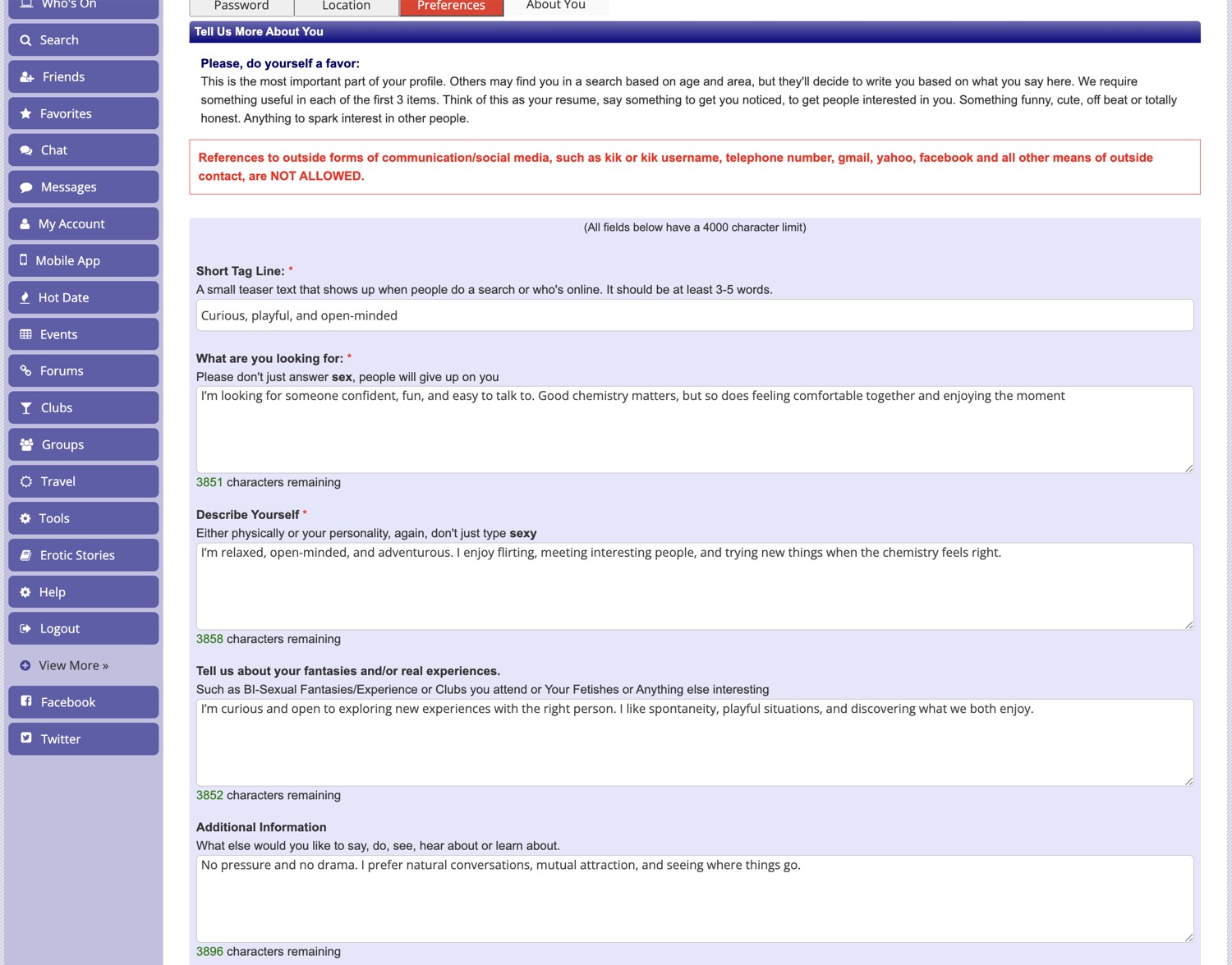
“References to outside forms of communication/social media, such as kik or kik username, telephone number, gmail, yahoo, facebook and all other means of outside contact, are NOT ALLOWED.”
The terms make the same point in more formal language, prohibiting personal identifying details such as your telephone number, street address, last name, and email address.
Put that together with the messaging paywall and the business model becomes clearer. Conversations begin on the platform and stay there unless both people decide otherwise, while a paid account is needed to start those conversations.
The form is unusually direct about the importance of your writing. It says that “this is the most important part of your profile” and makes clear that people will decide whether to contact you based on what you put in those fields.
Planning to upload a face photo? Read this section first. Photo handling matters more here than most of the feature list, and the terms spell out how it works.
Personal visual content goes into a Gallery that is “only accessible to other Members who are affirmatively given access from the uploading Member.” Access is granted one person at a time, so visitors do not automatically see the gallery when they view your profile.
The site’s own footer states that it “does not contain sexually explicit images as defined in 18 U.S.C. 2256” and that the record-keeping provisions of 2257 therefore do not apply to it. In plain terms, the public areas you browse are meant to stay short of explicit, though the site buries that where almost nobody reads it, in the compliance boilerplate.
That is also worth understanding from a legal standpoint. The terms include an arbitration clause and cap the company’s total liability at $100, meaning a privacy claim would go to an arbitrator in Florida rather than your local court.
Keep your own copies of every photo you upload. Give gallery access one person at a time, and treat a profile photo as public unless you have confirmed otherwise.
One member worried that searching a city name plus “swinger” brought up photos from the site. That was testable, so I checked it.
The good news is that the site’s robots file blocks ordinary search crawlers from member profiles. The general rules explicitly disallow access to the profile directory, which is what you would want to see.
Eight AI crawlers get their own rules further down the same file, and those rules are different. GPTBot, ChatGPT-User, ClaudeBot, Claude-Web, Google-Extended, PerplexityBot, Applebot-Extended and CCBot each receive a blanket allow, with only the two admin directories kept out.
A crawler follows the rule that specifically applies to it, so those eight do not inherit the profile restriction. In practice, member profiles are blocked from Google’s search index but allowed for crawlers that feed AI systems. That is an important distinction to understand before uploading photos to any site.
I am not going to speculate about whether that is deliberate. The important point is the choice it presents before you upload a face photo. The per-member gallery is the main control you have over who can access those images.
Free Plan: Registration is free and takes no card, and a free account gets a profile, browsing and the run of the public areas. What it does not get is a conversation, because nine separate commenters in the member discussion threads report that messaging requires a paid membership, and paying members say they do not answer free profiles. Most of the site needs no account at all, since the forums, the story archive, the club database and the party calendar are all readable while logged out.
| Plan | Price | Where it is published | What you get |
|---|---|---|---|
| Free membership | $0 | The website | Profile, browsing, forums, groups, clubs, parties, stories |
| Monthly subscription Most Popular | $24.99 | App Store listing | Full app and website access, auto-renews until cancelled |
| In-app purchases | $24.99 to $199.99 | Google Play listing | Range only, individual items are not itemised |
| Paid and Unlimited web tiers | Not published | Nowhere | Named in the terms, priced only after signup |
That table is short for a reason: you can search the website all you want and still not find a membership price.
I checked the upgrade and membership pages, the signup form, and the signup terms. The only dollar amount I found was the $100 liability cap buried in the legal text.
The strange part is that a price does exist. Apple requires one in the app listing, so you can see it there, while the company’s own website says nothing about membership pricing.
The lack of pricing transparency is a choice, and it has been around for nearly 25 years.
Apple is the only place where you can see a price before committing. The iPhone listing says, “This subscription is $24.99 per 1 month period which is recurring until cancelled.”
Google Play lists in-app purchases from $24.99 to $199.99 per item. The $199.99 ceiling could correspond to the Unlimited tier described in the terms, but the company never confirms that.
Under the terms, an Unlimited account has “no account renewal obligations” and requires no additional fees after the initial payment. If $199.99 is in fact the Unlimited price, paying it once would cost less than $24.99 a month starting in the eighth month.
Whether those two figures actually refer to the same tier is unclear, and I will not guess. Ask support to confirm the web price in writing before paying.
Section 5 of the terms settles this in one sentence: “All Membership Fee payments made to DashBoardHosting are nonrefundable and nontransferable.”
The document contains no cooling-off period, pro-rata provision, or money-back guarantee. If you subscribe through Apple, Apple’s own refund process is the only refund route available to you.
The iOS listing is clear about auto-renewal: it renews unless you turn off auto-renew at least 24 hours before the current period ends. It is worth putting that deadline on your calendar when you subscribe.
It is easy to focus a review on what a service hides. There are two areas, though, where SwingLifeStyle gives you more than most sites in this category.
First, you can investigate it before paying. Every rival I priced puts its directory behind registration, while here the forums, clubs, groups, weekly parties, and 16,249 stories can all be viewed while logged out.
Second, there is the one-time membership option, which can eliminate the monthly bill altogether. Members who bought the lifetime tier years ago say it paid for itself many times over, with one writing that it has “paid for itself over and over.”
It also gets three less obvious things right. Clubs are listed with named venues and a contact address for corrections, story submissions are held back until the community rates them, and photo galleries can be opened member by member rather than across the whole site.
Longevity matters too. Twenty-five years under one company is unusual in a category where brands can appear and disappear within a season. That history helps explain why the club and party listings still have real people and venues attached to them.
Most reviews of this service skip the exit, even though getting cancellation wrong is the part that can cost you money.
If you subscribed through the iPhone app, Apple handles cancellation, and the deadline is fixed. The listing says you must turn off auto-renew at least 24 hours before the current period ends, or Apple can charge you for the renewal.
There is no comparable published deadline for a web membership, because the website does not publish a web membership price in the first place. Ask for the cancellation process in writing when you ask for the price.
Deleting your profile is separate from cancelling your billing, and the privacy policy treats the two separately as well. It says you can “request we delete your Profile and remove your name and other Personally Identifiable Information from our databases.”
What the policy does not promise is a complete erase. It warns that “it may be impossible to completely remove all your information completely, due to backups and records of deletions,” and says de-identified and aggregate data may remain.
California residents have stronger rights. The policy gives them a statutory route to ask the company to disclose, correct, or delete the personal information it holds. If you are eligible, that is the route to use when you want a cleaner exit.
Photos are the practical concern here. Deleting a profile removes the visual content, so save anything you want to keep before deleting the account.
There are eight categories, and the activity numbers are substantial. Adding the counters on the category page gives 29,905 threads and 739,083 posts.
General Discussions alone accounts for 648,336 of those posts, or 88% of everything written there. When I checked the page, its newest post was only nine minutes old.

Activity varies a lot by category, and the gaps show where the conversation is happening. Events had a post the previous day, Travel the day before that, and Successful Swinging about 20 hours earlier.
Clubs, by contrast, has 49 threads and 1,585 posts, and its newest post was a month old. A section devoted to physical venues going quiet for that long says something about where the community’s attention has shifted.
Between the client’s screenshot earlier that day and my own check, General Discussions gained 12 posts. That kind of activity over an afternoon is about as close as you can get to a live pulse from outside the paywall.
Behind the personals is a second part of the business, and for some members it is the reason they keep their accounts.
The company runs its event directory on its sister site, swing.com, where the header claims “the largest directory of swinger and lifestyle events in the United States with 2,452 upcoming events from 218 verified venues and organizers”. A line under it counts 12 new events added in the last 24 hours.
Compare that with the 101 parties on SwingLifeStyle’s own weekly list. Both numbers are real; they simply cover different time windows. Together, they provide some of the strongest event coverage in this category.
Travel is the most commercial part of the service, and you can book directly from the menu. The Bliss Cruise page lists 12 charter sailings across 2026, 2027, and 2028, including Wonder of the Seas from Miami in November 2026 and Celebrity Silhouette from Fort Lauderdale in April 2027.
The company advertises the Silhouette charter as a sailing for 2,900 lifestyle couples. That is a full-ship buyout and a scale of operation that is unusual in this category.
Every Book Now button leads to swing.com, the same company’s booking site. A cruise booking is therefore separate from your membership, so do not assume that a paid account includes a discount.
Erotic stories can look like filler until you see the volume. The archive contains 16,249 stories across 34 categories and 53 topics, with 33 added in the previous seven days.
Members write and tag each submission themselves, and stories are held back until enough members rate them. Only stories with an average rating of 2.5 or higher are published, which is a moderation step many user-content archives skip.
Reading is free and does not require an account. The Ahrefs export supplied by the client also shows why the archive matters: “swinger stories” gets 3,400 monthly searches, and SwingLifeStyle ranks first for that term.
Thirty-three new stories in a week is a decent sign of activity for a 25-year-old archive. More importantly, you can sample it for free before deciding whether the community is right for you.
The iPhone app is the stronger of the two. It has a 4.08 rating from 5,186 ratings, which is a solid result for a niche community app and better than many mainstream dating apps manage.
Android is where things get confusing. A buyer comparing the two apps could reasonably assume they are the same product.
| Listing | Name | Rating | Last updated |
| App Store | SLS Official Swinger Community | 4.08 from 5,186 ratings | 3 February 2026 |
| Google Play | Social Lifestyle | 2.5 from 59 reviews | 16 October 2025 |
They have the same seller, Swing, LLC, but different names, a 1.6-star rating gap, and very different usage figures: Android shows 10,000-plus installs, while the iPhone app has 5,186 ratings.
Neither app had been updated recently, so do not expect a fresh build. When I checked them, the iPhone version had gone 6.6 months without an update and the Android version 10 months.
For comparison, the same lookup showed 3Fun had been updated 12 days earlier and SDC 15 days earlier. Apps in this category typically receive updates every few weeks.
Because the service gets much of its value from directories and forums, outdated apps may matter less than they would on a swipe-based app. Members also say they use the website instead and skip the app.
If using the app matters to you, install the free version first and make sure it works properly on your phone’s current OS.
Both swinglifestyle.com and sls.com publish a live activity panel for the same community. I checked them within the same minute.
| Counter | swinglifestyle.com | sls.com | Gap |
| Online now | 4,599 | 7,114 | +55% |
| New members this week | 4,779 | 8,554 | +79% |
| New pictures this week | 19,415 | 25,585 | +32% |
| Groups | 14,894 | 15,137 | +2% |
I then sampled both six times over five minutes. SwingLifeStyle’s figure changed on almost every request, ranging from 4,429 to 4,787, while sls.com returned exactly 7,114 every time.
Edge caching can freeze a number like that, so this alone is not evidence that anyone fabricated a count.
What it does show is that two websites owned by the same company are publishing materially different numbers for the same member base. Treat those counters as headline figures and rely more on the directory and forum, both of which you can inspect yourself.
The group total has the same issue. The homepage claims 14,894 groups, while the 47 state directories add up to 7,972. The second figure is the one you can actually browse.
The 65 comments came from 49 accounts across three discussion threads. The oldest thread was 11 years old, while the newest comment was posted four months ago.
The clearest pattern is that people tend to stay. Members describe using the same account for nine months, six years, eight years, and even 15 years. Several also say the one-time payment paid for itself long ago.
One couple puts the appeal simply: “SLS has the numbers and we have met so many couples (and singles) through the site.” Another calls it “perfect for the type of parties and events we like.”
The interface is the recurring complaint, appearing in 11 separate comments, and members are not shy about criticizing it. They keep paying anyway, which suggests the community matters more to them than the dated design.
Geography comes up in 23 comments, which lines up with the group data from another direction. One commenter calls Pennsylvania the strongest state in the country, and my own crawl puts Pennsylvania first by a wide margin on a per-person basis.
Thirty-three comments across the three threads mention a lifetime membership, and it is clearly an option that experienced members have bought.
Members report paying $100 several years ago, $150 around 2018, and $150 through the app in 2024, even though the same lifetime membership was listed at $250 on the website.
That last example is worth noting. The same product reportedly cost $100 more depending on where it was purchased, and neither price appears on the site today.
These are member recollections, not official pricing, so treat them as a historical range. They do, however, help explain the otherwise unexplained $199.99 ceiling on Google Play.
One detail matches the legal text closely. A member who bought in 2017 says the tier was first renamed “lifetime of site” and later “Unlimited.” The current terms use the name Unlimited Member.
An account identifying itself as SLS staff appears in one thread and says the company does not delete Unlimited accounts except in extreme cases. Whatever you think of the support operation, someone there is paying attention to Reddit.
The advice repeated by members is straightforward: buy three months without auto-renewal, see what your local area is like, and only then consider the one-time membership.
Legitimacy and quality are two different questions, and this service makes that distinction fairly clear. The business checks out on the external tests I could run, while public review sites are much harsher than the member comments.
The terms identify the operator, the domain has been registered continuously since 2001, and the corporate email and compliance contact both resolve. The company has also maintained a public X account from Florida since April 2009, with 78,300 followers.
More importantly, much of the activity can be checked directly. Party listings name real venues, the club database lists 355 of them, and forum timestamps continue to update.
Staff also appear publicly. An account identifying itself as SLS answers questions in member discussions about Unlimited accounts, which is more direct engagement than many operators in this category provide.
There are also signs of active moderation. Photo uploads go through a review step, stories need a community rating of 2.5 before appearing publicly, and the club database is described as verified, with an email address available for corrections.
Public ratings are poor, although the sample sizes need some context. Trustpilot shows 1.6 from 24 reviews on an unclaimed profile, which is too small to treat as definitive.
PissedConsumer has the larger dataset, with 309 reviews and a 1.9 average among the 79 that include a rating. Twenty percent of reviewers say they would recommend the service, while 77% of the sentiment is negative.
The recurring complaints involve billing and refunds, login and account-access problems, and slow support. Because the terms rule out refunds, a billing dispute may leave you relying on Apple or a chargeback.
Both sources also contain complaints about photos disappearing without notice. A Trustpilot reviewer in February 2026 said the site “removed all photos over 5 years old,” while PissedConsumer lists deleted photos as a complaint category.
I found no published policy confirming that practice, so treat it as a complaint pattern rather than an official rule. Keep your own copies of anything you upload.
Nobody is seriously comparing this with Tinder. The three platforms you are more likely to compare it with are below.
| Platform | Built around | iPhone app rating | Last app update |
| SwingLifeStyle | Forums, groups, clubs and local parties | 4.08 from 5,186 ratings | 3 February 2026 |
| SDC | Couple accounts, travel and events | 4.56 from 13,030 ratings | 7 August 2026 |
| 3Fun | Phone-first matching for couples and singles | 4.44 from 147,013 ratings | 10 August 2026 |
| Kasidie | Free certification, clubs and events | No iPhone app listed | None |
Every figure in that table came from the same App Store lookup on August 22, 2026. Kasidie has no iPhone app at all, which is useful information in itself.
Kasidie is the closer competitor in terms of what it offers because it also centers on clubs and events. If you travel as a couple, SDC may make more sense because it updates its app roughly every two weeks.
SwingLifeStyle wins on directory depth in its strongest states, and you can check that depth for free before paying. Our SDC review goes into the couple-account model in more detail, while the broader best dating sites hub compares the wider field.
Pennsylvania, New Jersey, New York, Michigan, and Florida are the states where this service makes the strongest case for a subscription. If you live in one of them, the group and party density is difficult to match, and the free directory lets you check that for yourself.
It is also a strong fit if you prefer forums to swiping. Nothing else in this category gives you 739,000 posts and an active conversation to browse at this scale.
Skip it if a polished mobile experience is important to you, because both apps are months behind. It is also a poor fit if you need to know the price before committing, since the website does not publish it.
If you live in a state near the bottom of the density table, spend two minutes checking your own directory before doing anything else. Six groups in Kansas is not much of a local scene, and the payment you make to discover that is not refundable.
SwingLifeStyle is a swinger community site that has been running since 2001 under DashBoard Hosting, LLC of Broward County, Florida. It combines personals with a forum, a group directory listing 7,972 groups across 47 US states, a database of 355 verified swinger clubs, a weekly party calendar and an archive of 16,249 member-written stories.
It is a real business with a named operator, a domain registered continuously since June 2001 and content you can verify from outside. Its consumer ratings are poor, at 1.6 from 24 Trustpilot reviews and 1.9 from the 79 rated complaints among 309 on PissedConsumer, with billing and account access the recurring themes.
The only price the company publishes openly is $24.99 per month, stated in its App Store listing and recurring until cancelled. Google Play lists in-app purchases from $24.99 to $199.99 per item, and the website itself shows no membership price at all before you create an account.
Registration is free and needs no card, and most of the site is readable without any account, including the forums, the club database, the weekly party list and all 16,249 stories. Messaging is not free, though. Nine separate commenters in the member discussion threads report that a free account cannot contact anyone, and paying members say they do not answer free profiles.
Long-term members say yes, with several describing a one-off payment made years ago that has repaid itself many times over. Reported prices range from $100 to $250 depending on the year and whether it was bought in the app or on the website, and the terms call the tier an Unlimited Member account with no renewal obligations. The common advice is to buy three months without auto-renewal first, then decide.
Pennsylvania leads with 789 groups, then California with 788, New York with 768, Florida with 569 and New Jersey with 477. Per head of population Pennsylvania is far ahead at 60.9 groups per million residents against a national rate of 24.1, while Kansas sits at 2.0.
No. The terms of use state that all membership fee payments “are nonrefundable and nontransferable”, with no cooling-off period or pro-rata clause anywhere in the document. If you subscribed through the iPhone app, Apple’s own refund process is the only route open to you.
There are two, both sold by Swing, LLC. The iPhone app is called SLS Official Swinger Community and rates 4.08 from 5,186 ratings, last updated 3 February 2026, while the Android app is listed as Social Lifestyle and rates 2.5 from 59 reviews, last updated 16 October 2025.
Ready to get started?
Visit Site
Marriage Science write about dating, marriage, prenups, and relationships. No one pays us for a good review. We sign up for the apps ourselves, use them properly, and then say what we found. Every statistic links to the original source.
If a relationship, a date, or an online contact has left you unsafe, scammed, or in crisis, these organizations help for free and confidentially.
Marriage Science provides independent relationship, legal, and dating information for general informational purposes only. It does not constitute legal, medical, or mental health advice. This site contains affiliate links and we may earn a commission from qualifying purchases at no extra cost to you. Compensation may influence which products appear on the site and where, but never our ratings or editorial opinions, which are our own. © 2026 Marriage Science. All rights reserved.