


Most cheaters are not caught at all. In the largest dataset on the question, 56.8% told their partner themselves, and only 21.4% were found out by a partner who went looking (Savoie, Zinck and Fisher, EvoS Journal 2023, from 94,943 responses to an online infidelity quiz).
How the truth comes out changes what happens next more than the infidelity itself does. 56% of relationships continued when the partner confessed unprompted, against 14% when the other partner found out by investigating (Afifi, Falato and Weiner, Journal of Social and Personal Relationships 2001).
34% of partnered American adults have looked through a partner’s phone without telling them, rising to 52% of those aged 18 to 29 (Pew Research Center, fieldwork October 2019).
We aggregated data from the EvoS Journal, the Journal of Social and Personal Relationships, the Pew Research Center, the General Social Survey at NORC, and clinical trial follow-ups published in Couple and Family Psychology.
Key Takeaways
- 56.8% of cheaters confessed on their own, making confession the most common way infidelity comes to light (Savoie et al., EvoS Journal 2023, self-selected online sample).
- 21.4% were caught because their partner investigated, the single most common way cheaters get caught by someone other than themselves (Savoie et al., 2023).
- 8.3% confessed only after being accused, and 8.0% were found out by accident (Savoie et al., 2023).
- Only 4.5% were exposed by a third party, far below what popular coverage of affairs implies (Savoie et al., 2023).
- No study measures how much infidelity is never discovered, so “cheaters always get caught” cannot be tested against any dataset.
- 34% of partnered U.S. adults have checked a partner’s phone without their knowledge, 42% of women against 25% of men (Pew Research Center, 2020).
- 70% of Americans say checking a partner’s phone without their knowledge is rarely or never acceptable, while a third have done it (Pew Research Center, 2020).
- 56% of relationships continued after an unprompted confession, against 14% after the partner discovered it by looking (Afifi, Falato and Weiner, 2001).
- Being caught in the act produced a 17% continuation rate, slightly better than being found out through investigation (Afifi et al., 2001).
- 20% of ever-married men and 13% of ever-married women report having had sex with someone other than their spouse (General Social Survey, via Institute for Family Studies).
- 59.6% of divorced people named infidelity as a major contributor to their divorce, third behind lack of commitment at 75% (Scott, Rhoades, Stanley and Markman, 2013, n=52).
- Kaspersky detected 31,031 stalkerware-affected devices worldwide in 2023, a count of installed monitoring software, not a measure of infidelity (Kaspersky, State of Stalkerware 2023).
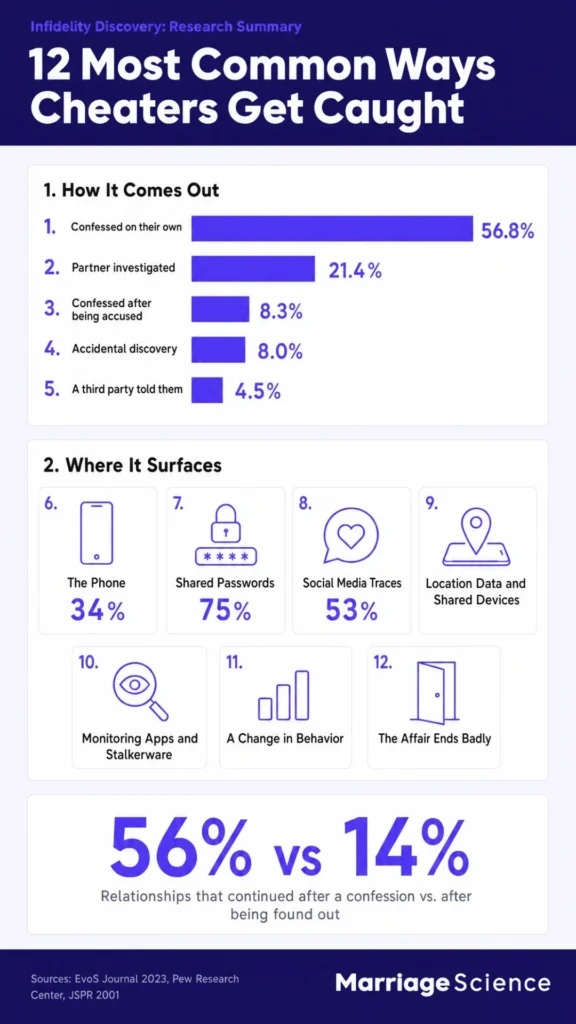
The 12 Ways Cheaters Get Caught, Ranked by the Data
One dataset dominates this question. A quiz on the now-closed Truth About Deception website asked people who had cheated how their partner found out, and 94,943 answered before researchers analyzed the results in 2023.
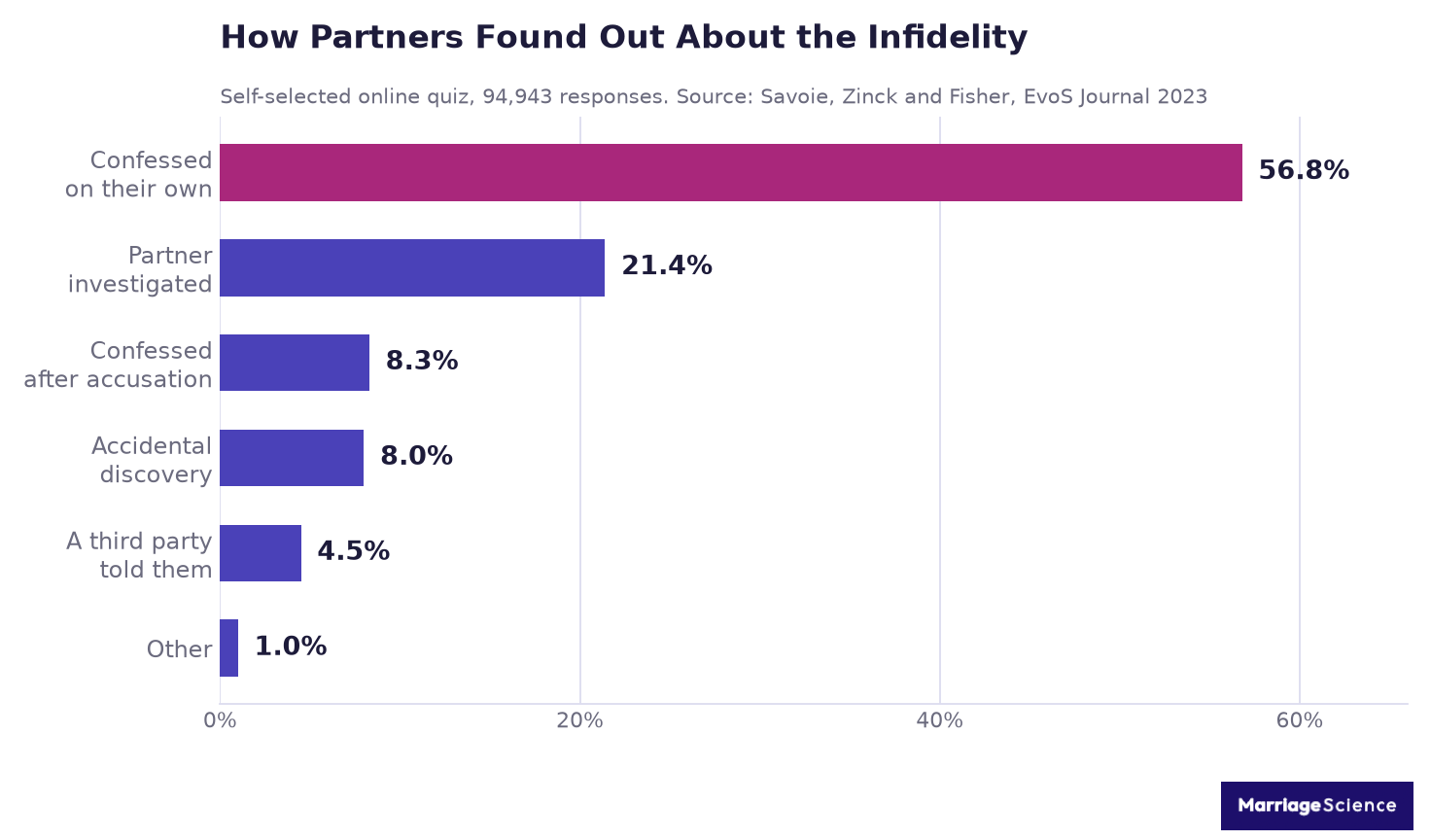
Add the two confession categories together and 65.1% of cases ended with the cheater speaking first. The five categories below are the measured routes; the seven after them are the mechanisms that sit inside the investigation and accident categories.
1. They Confess Without Being Caught (56.8%)
The most common way cheaters get caught is that nobody catches them. More than half told their partner without being accused or discovered first (Savoie, Zinck and Fisher, 2023).
2. The Partner Investigates and Finds Out (21.4%)
One in five cheaters were exposed by a partner who suspected something and went looking. This is the largest genuinely involuntary route, and everything in points 6 to 10 belongs inside it.
3. They Confess After Being Accused (8.3%)
A separate category from a cold confession, and a much smaller one. The accusation came first and the admission followed, without the partner having found proof.
4. Accidental Discovery (8.0%)
A notification on a shared screen, a receipt in a coat pocket, a partner picking up the wrong phone. Nobody was searching and nobody confessed.
5. A Third Party Tells the Partner (4.5%)
The friend who says something, the affair partner who makes contact, the colleague who mentions it. It is the version fiction reaches for most and the data reports least, at fewer than one case in twenty.
One third-party disclosure reached millions of people at once. The Ashley Madison breach in 2015 exposed about 36 million accounts by the FTC’s count, and extortion emails built on the leaked records were still reaching former users in 2020.
A leaked address proves less than it seems, because the site never verified email addresses at signup.
6. The Phone
34% of partnered U.S. adults have looked through a partner’s phone without telling them, so the tool is available in a third of relationships (Pew Research Center, 2020). No study reports what share of those searches found anything.
75% of partnered adults have shared a cellphone password, 62% an email password and 42% a social media password (Pew Research Center, 2020). Access granted during a good period does not expire when the relationship changes.
8. Social Media Traces
53% of social media users have looked up someone they used to date, rising to 70% among 18 to 29 year olds (Pew Research Center, 2020). The same behavior applied to a current partner’s activity is how a lot of point 2 begins.
Location sharing, family plans, synced calendars and car systems all produce a record. No peer-reviewed study has measured how often these expose infidelity, and anyone quoting a percentage for it is quoting something nobody has counted.
10. Monitoring Apps and Stalkerware
Kaspersky detected stalkerware on 31,031 users’ devices in 2023 and more than 34,000 in 2024 to 2025 (Kaspersky, State of Stalkerware). That counts installed software on machines running one vendor’s product, not relationships. Installing it on another adult’s device without consent is a criminal offense in many jurisdictions.
11. A Change in Behavior That Starts the Search
Suspicion precedes almost every case in point 2, and the trigger is usually a change in behavior, not a piece of evidence. The research on relational uncertainty describes this sequence but does not quantify which changes are followed by a confirmed discovery.
12. The Affair Ends Badly
Third-party disclosure at 4.5% covers this route in the data, and the subset in which the affair partner is the one who makes contact is not reported separately.
Two caveats govern all twelve. The 94,943 responses came from people who chose to take an infidelity quiz on a website about deception, which is not a probability sample of anyone, and the authors attached no demographics to these six items (Savoie, Zinck and Fisher, EvoS Journal, 2023). Readers who want the behavioral side of this can start with our guide to relationship red flags.
Do Cheaters Always Get Caught?
No, and the more useful answer is that nobody can tell you the rate. Every dataset on this page samples people whose infidelity was already known to someone, which is the one population that cannot answer the question.
Measuring undiscovered infidelity would require a survey that asks people to disclose something they are actively hiding, then verifies it against a partner who does not know. No such study exists in the peer-reviewed literature.
| Metric | Value | Source |
| Share of infidelity that is ever discovered | not measured by any study we could locate | no primary source exists |
| How discovery happened, among cases that were discovered | 56.8% confessed, 21.4% partner investigated, 8.3% confessed when accused, 8.0% accidental, 4.5% third party, 1.0% other | Savoie et al., EvoS Journal 2023 |
| Sample type behind those figures | self-selected online quiz, 94,943 responses, 66.1% women | Savoie et al., 2023 |
| Date the responses were captured | 11 January 2022 | Savoie et al., 2023 |
| Ever-married adults reporting extramarital sex | 20% of men, 13% of women | General Social Survey, via Institute for Family Studies |
| Known bias in that self-report | understates, because respondents are disclosing stigmatized behavior | standard survey methodology caveat |
The honest reading of the discovery table is narrower than it looks. It tells you how the truth surfaced in cases where it surfaced, and says nothing about the denominator.
Phone Snooping and Digital Surveillance
Pew asked 4,860 U.S. adults in October 2019 whether they had gone through a partner’s phone without that partner knowing, and separately whether they thought it was acceptable. The two answers do not match.
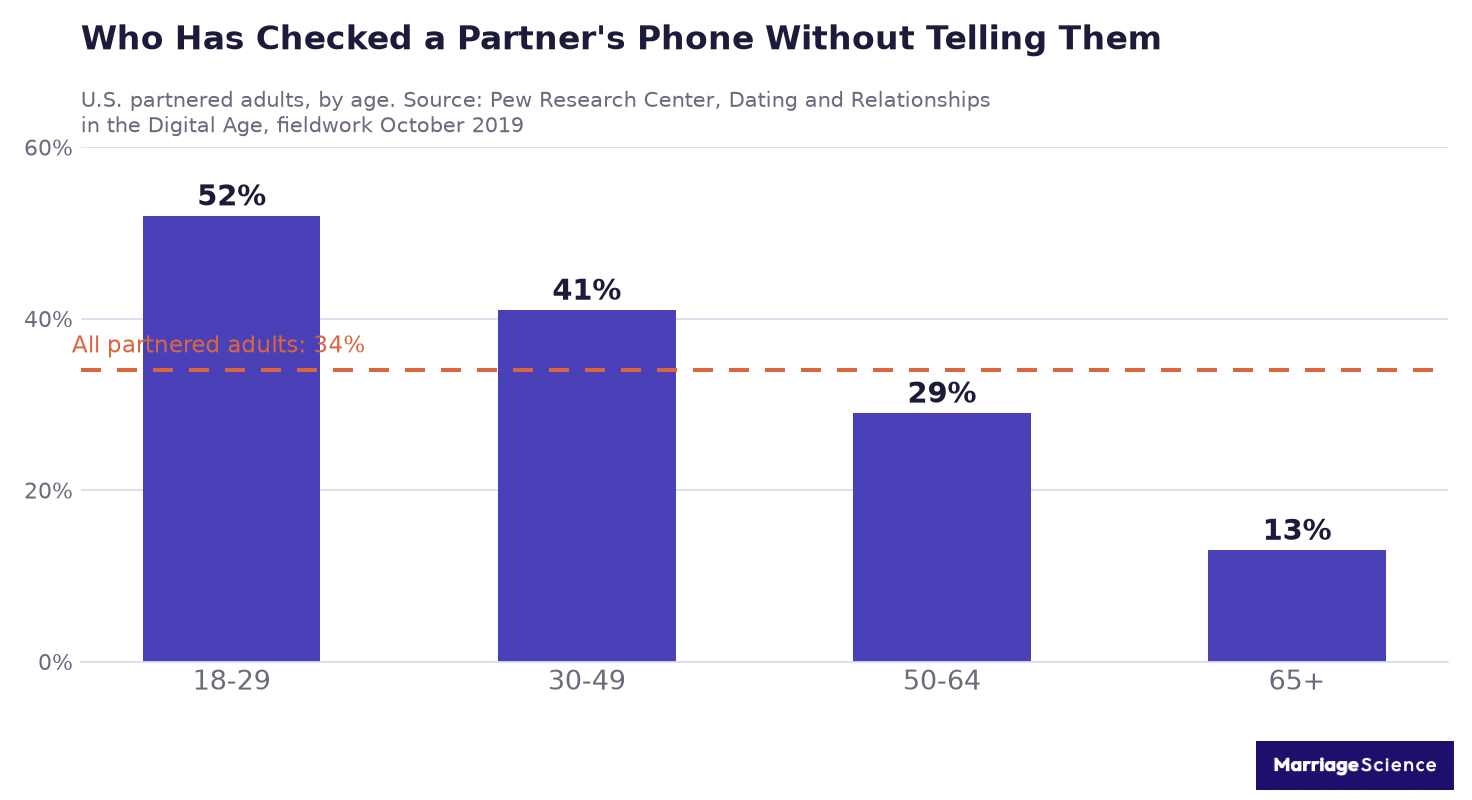
70% call the behavior rarely or never acceptable and 34% have done it. The gap is widest among the youngest group, where a majority have searched a partner’s phone.
| Metric | Value | Source |
| Partnered adults who checked a partner’s phone without their knowledge | 34% | Pew Research Center, fieldwork October 2019 |
| By sex | 42% of women, 25% of men | Pew Research Center, 2020 |
| Aged 18 to 29 and 65 or older | 52% and 13% | Pew Research Center, 2020 |
| Cohabiting, married and dating | 41%, 34% and 27% | Pew Research Center, 2020 |
| Say the behavior is rarely or never acceptable | 70% | Pew Research Center, 2020 |
| Have shared a cellphone, email or social media password with a partner | 75%, 62% and 42% | Pew Research Center, 2020 |
| Social media users who have checked up on someone they used to date | 53%, and 70% of those aged 18 to 29 | Pew Research Center, 2020 |
| Devices with stalkerware detected, 2023 and 2024 to 2025 | 31,031 and more than 34,000 | Kaspersky, State of Stalkerware |
The last row belongs to a different subject. Covert monitoring software is a tool of coercive control, its detection counts come from one security vendor’s installed base, and installing it on another adult’s phone without consent is illegal in many jurisdictions (Pew Research Center, 2020).
Anyone being monitored or controlled by a partner can reach the National Domestic Violence Hotline at thehotline.org, and the Coalition Against Stalkerware publishes guidance on detecting and removing monitoring software safely.
How the Discovery Method Changes What Happens Next
This is the finding worth carrying away from the whole topic. What predicted whether the relationship continued was not the infidelity but the route by which it reached the other partner.
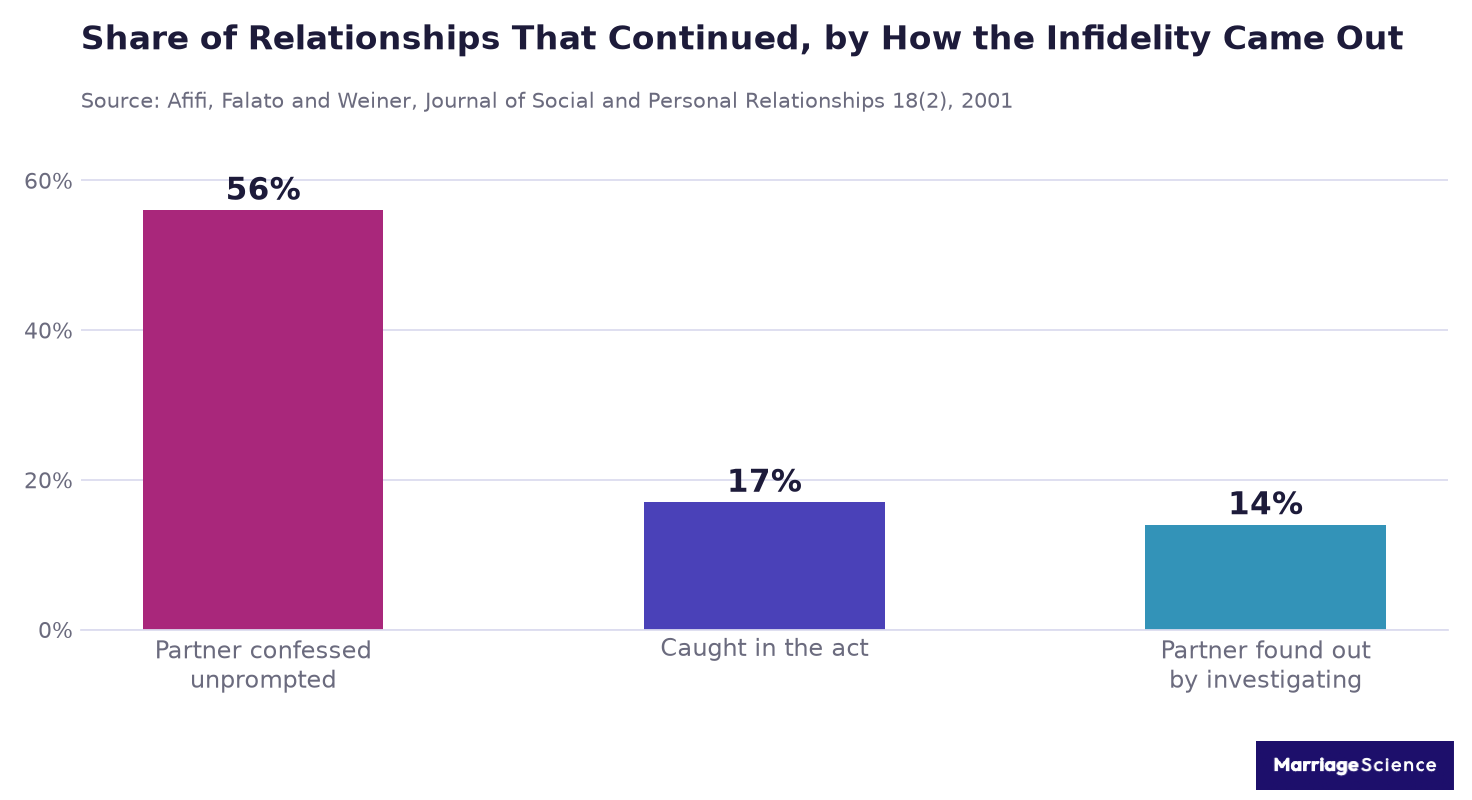
56% of relationships continued when the cheating partner disclosed it unprompted, against 14% when the other partner uncovered it by looking. Being caught in the act sat at 17%, slightly above the investigation route.
| Metric | Value | Source |
| Relationship continued after unsolicited disclosure | 56% | Afifi, Falato and Weiner, JSPR 18(2), 2001 |
| Relationship continued after being caught in the act | 17% | Afifi et al., 2001 |
| Relationship continued after the partner solicited the information | 14% | Afifi et al., 2001 |
| Divorced or separated 5 years after therapy, couples who kept the affair secret | about 80% | Marin, Christensen and Atkins, Couple and Family Psychology 2014 |
| Divorced or separated 5 years after therapy, couples where the affair was revealed | about 43% | Marin et al., 2014 |
| Divorced or separated 5 years after therapy, couples with no infidelity | about 23% | Marin et al., 2014 |
| Infidelity couples in that follow-up | 19 | Marin et al., 2014 |
Read the last row before quoting the three above it. Nineteen couples is a very small base, the couples were already in therapy, and the figures describe that clinical population rather than the general one (Marin, Christensen and Atkins, 2014).
The Afifi finding has a plausible mechanism attached: a partner who confesses gives up control voluntarily, while one who is discovered has been found to be still lying at the moment of discovery. Couples working through this stage can read our guide to rebuilding trust after infidelity.

How Common Cheating Is to Begin With
Every discovery percentage on this page is a share of a base rate, and that base rate has barely moved across decades of the General Social Survey.
20% of ever-married men and 13% of ever-married women report having had sex with someone other than their spouse. The gap closes and reverses at the young end.
| Metric | Value | Source |
| Ever-married men reporting extramarital sex | 20% | General Social Survey, via Institute for Family Studies |
| Ever-married women reporting extramarital sex | 13% | General Social Survey, via IFS |
| Ages 18 to 29 | 11% of women, 10% of men | General Social Survey, via IFS |
| Highest male rate, ages 70 to 79 | 26% | General Social Survey, via IFS |
| Highest female rate, ages 60 to 69 | 16% | General Social Survey, via IFS |
| Direction of the self-report bias | downward; respondents disclose stigmatized behavior at less than its true rate | standard survey methodology caveat |
The age pattern is the part most coverage gets backwards. The overall male excess is produced by men now in their seventies, and among adults under 30 women report slightly more infidelity than men (Institute for Family Studies analysis of GSS data). Our page on who cheats more works through the full breakdown.
From Discovery to Divorce
Infidelity ranks high among reasons people give for divorcing, and the studies establishing that are much smaller than the confidence with which the figures get repeated.
59.6% of divorced participants named infidelity as a major contributor, behind lack of commitment at 75% and communication problems at 65%. The sample was 52 people.
| Metric | Value | Source |
| Named infidelity a major contributor to their divorce | 59.6% | Scott, Rhoades, Stanley and Markman, Couple and Family Psychology 2013 |
| Named lack of commitment | 75% | Scott et al., 2013 |
| Named communication problems | 65% | Scott et al., 2013 |
| Sample size | 52 divorced individuals who had received premarital education | Scott et al., 2013 |
| Divorced or separated at 5 years, affair revealed in therapy | about 43% | Marin et al., 2014 |
| Divorced or separated at 5 years, no infidelity | about 23% | Marin et al., 2014 |
Respondents could name more than one contributor, which is why the percentages sum well above 100 and why infidelity being cited by 59.6% does not mean it caused 59.6% of divorces (Scott et al., 2013, summarised by the Institute for Family Studies). For the national rates these sit inside, see our divorce statistics.
The Cheating Statistics You Should Not Trust
This topic attracts a specific kind of bad number, because the companies with the strongest commercial interest in it sell phone monitoring software and investigative services.
| Claim | Where It Comes From | Status |
| A precise share of affairs that are eventually discovered | circulates unattributed across roundup sites | No study measures this. The population required to measure it is by definition undetected. |
| An average number of months or years before an affair is discovered | circulates unattributed | Not found in any peer-reviewed source we could trace. |
| The share of cheaters caught “by their phone” | phone-monitoring vendors | Pew measures how many people search a partner’s phone, not how many searches succeed. |
| Stalkerware detection counts presented as an infidelity rate | security-vendor telemetry, quoted out of context | Measures software installed on one vendor’s protected devices. Says nothing about infidelity prevalence. |
| Private-investigator “success rates” for infidelity cases | investigation firm marketing pages | Self-reported by the seller, with no denominator and no independent verification. |
The closest thing to a genuine answer on the discovery question remains the 94,943-response quiz, with all its sampling problems stated openly by its own authors (Savoie, Zinck and Fisher, 2023). A weak source that names its weaknesses is more useful than a confident one that names nothing.
A quick test for any figure on this topic: ask which population was sampled and how they were reached. If the answer is customers of a monitoring app or visitors to a page selling investigative services, the number describes that company’s traffic.
Watch for one more pattern. Claims about undiscovered infidelity are stated with more precision than claims about discovered infidelity, which is backwards. The harder something is to observe, the vaguer an honest estimate of it has to be.
Summary: How Cheaters Get Caught, by the Numbers
| Metric | Value | Source |
| Confessed on their own | 56.8% | Savoie et al., EvoS Journal 2023 |
| Partner investigated and found out | 21.4% | Savoie et al., 2023 |
| Confessed after being accused | 8.3% | Savoie et al., 2023 |
| Accidental discovery | 8.0% | Savoie et al., 2023 |
| A third party told the partner | 4.5% | Savoie et al., 2023 |
| Combined confession share | 65.1% | Savoie et al., 2023 |
| Share of infidelity never discovered | not measured by any study | no primary source exists |
| Relationship continued after unprompted confession | 56% | Afifi et al., JSPR 2001 |
| Relationship continued after being caught in the act | 17% | Afifi et al., 2001 |
| Relationship continued after partner investigated | 14% | Afifi et al., 2001 |
| Checked a partner’s phone without their knowledge | 34% | Pew Research Center, 2020 |
| Same, women and men | 42% and 25% | Pew Research Center, 2020 |
| Same, ages 18 to 29 | 52% | Pew Research Center, 2020 |
| Say phone-checking is rarely or never acceptable | 70% | Pew Research Center, 2020 |
| Have shared a cellphone password with a partner | 75% | Pew Research Center, 2020 |
| Ever-married men and women reporting extramarital sex | 20% and 13% | General Social Survey, via IFS |
| Ages 18 to 29, women and men | 11% and 10% | General Social Survey, via IFS |
| Named infidelity a major contributor to divorce | 59.6% | Scott et al., 2013, n=52 |
| Divorced at 5 years, affair kept secret in therapy | about 80% | Marin et al., 2014, n=19 couples |
| Stalkerware-affected devices detected, 2023 | 31,031 | Kaspersky, State of Stalkerware 2023 |
Methodology and Sources
The evidence base on this subject is thinner than on almost any other relationship topic, and we have labeled the sample type behind every figure instead of presenting them as equivalent.
- J. M. Savoie, M. Zinck and M. L. Fisher, Between the Lines of Betrayal, EvoS Journal, NEEPS XV, 2023. Self-selected online quiz, 94,943 responses captured 11 January 2022.
- W. A. Afifi, W. L. Falato and J. L. Weiner, Identity Concerns Following a Severe Relational Transgression, Journal of Social and Personal Relationships 18(2), 2001, pages 291 to 308.
- Pew Research Center, Dating and Relationships in the Digital Age. Probability sample of 4,860 U.S. adults, fieldwork 16 to 28 October 2019.
- A. Marin, A. Christensen and D. C. Atkins, Infidelity and Behavioral Couple Therapy: Relationship Outcomes Over 5 Years Following Therapy, Couple and Family Psychology: Research and Practice, 2014. Clinical trial follow-up, 19 infidelity couples.
- S. B. Scott, G. K. Rhoades, S. M. Stanley and H. J. Markman, Reasons for Divorce and Recollections of Premarital Intervention, Couple and Family Psychology, 2013. 52 divorced individuals.
- NORC at the University of Chicago, General Social Survey, analyzed by the Institute for Family Studies.
- Kaspersky, The State of Stalkerware, vendor detection telemetry, and the Coalition Against Stalkerware.
The reason this page carries so many caveats is structural. Infidelity research depends on people volunteering information about behavior they concealed, so probability samples measure the base rate reasonably well and measure discovery hardly at all, while the large discovery datasets come from self-selected web traffic.
Two releases would change this page: a probability-sample study that asks how infidelity came to light, which nobody has run, and a replication of the Afifi discovery-method finding on a sample larger than a single university cohort. We update this page annually. The rest of our research sits on the Marriage Science statistics hub.