


Prenuptial agreements have shed their old stigma and gone mainstream, especially among younger couples. About 15% of Americans have now signed a prenup, up from just 3% in 2010, and roughly half of adults say they support the idea. This page collects more than 30 prenup statistics on how common prenuptial agreements are, how fast they are rising, who signs them, and why, drawn from the Harris Poll, the American Academy of Matrimonial Lawyers, and industry data. If you are considering one yourself, see our prenup hub.
Key Prenup Statistics
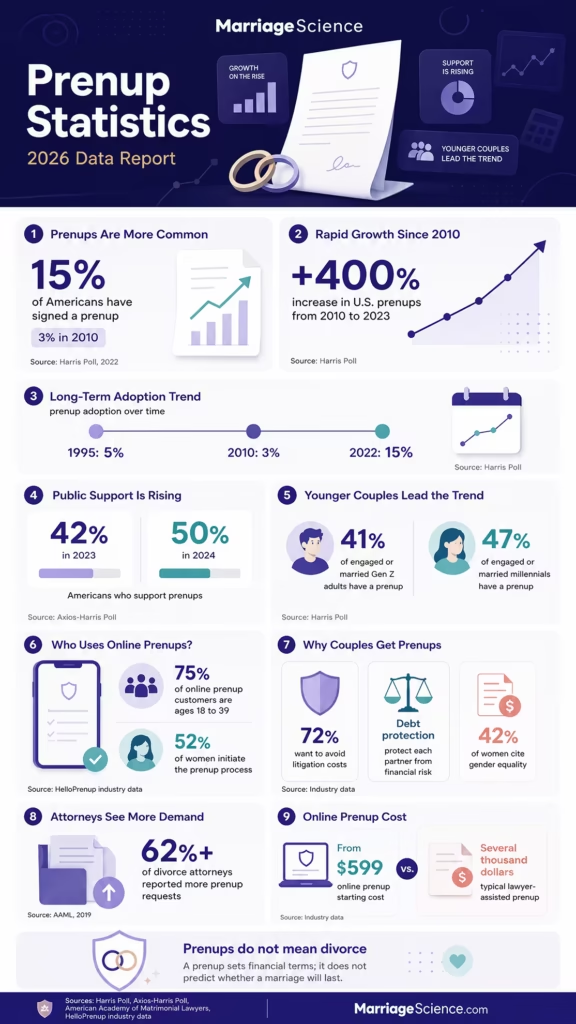
- About 15% of Americans have signed a prenuptial agreement, up from 3% in 2010 (Harris Poll, 2022).
- The number of prenups in the United States rose roughly 400% between 2010 and 2023 (Harris Poll).
- Prenup use climbed from about 5% in 1995 to 15% in 2022 (Harris Poll).
- About 50% of Americans supported the use of prenups in 2024, up from 42% the year before (Axios-Harris Poll).
- About 41% of engaged or married Gen Z adults have entered into a prenup (Harris Poll).
- About 47% of engaged or married millennials have entered into a prenup (Harris Poll).
- In the 1990s, only about 8% of couples had a prenup (Harris Poll).
- About 75% of online prenup customers are between 18 and 39 (industry data, HelloPrenup).
- About 52% of women initiate the prenup process (industry data, HelloPrenup).
- About 72% of people cite avoiding litigation costs as a reason for a prenup (industry data).
- About 42% of women cite gender equality as a reason for getting a prenup (industry data).
- Over 62% of divorce attorneys reported a rise in clients requesting prenups over three years (American Academy of Matrimonial Lawyers, 2019).
- An online prenup can start around $599, compared with several thousand dollars when working with a lawyer (industry data).
- Despite the stereotype, signing a prenup is not linked to a higher chance of divorce (legal consensus).
- In 70 appeals decided between 2021 and 2025 where a spouse attacked a prenup’s validity, 74% of the agreements survived at least in part and 61% were enforced in full (our review of court opinions).
- Spousal support waivers were the most vulnerable term, with 7 of 11 challenges to them succeeding (our review of court opinions).
How Common Are Prenups?
Prenuptial agreements are far more common than they used to be. About 15% of Americans have signed one, up from just 3% in 2010 (Harris Poll, 2022). What was once seen as something only the wealthy did is now a mainstream part of planning a marriage.
The shift is recent and steep. Prenup use climbed from about 5% in 1995 to 15% in 2022, and the total number of agreements rose roughly 400% between 2010 and 2023 (Harris Poll). For the marriage side of the data, see our marriage statistics and the full relationship and dating statistics hub.
Attitudes have moved just as fast. About half of U.S. adults now say they support prenups, a sign the stigma is fading rather than just shifting to a smaller group.
| Metric | Value | Source |
| Americans who have signed a prenup, 2022 | ~15% | Harris Poll |
| Same figure in 2010 | 3% | Harris Poll |
| Same figure in 1995 | ~5% | Harris Poll |
| Increase in prenups, 2010 to 2023 | ~400% | Harris Poll |
Prenups Are on the Rise
Every measure points the same way: prenups are growing. Support rose to 50% of Americans in 2024, up from 42% only a year earlier (Axios-Harris Poll), one of the faster swings in opinion on a family-life topic.
Demand is rising with opinion. Over 62% of divorce attorneys reported an increase in clients requesting prenuptial agreements over a three-year span (American Academy of Matrimonial Lawyers, 2019), and online prenup providers report rapid year-over-year growth.
| Metric | Value | Source |
| Americans supporting prenups, 2024 | 50% | Axios-Harris Poll |
| Same figure in 2023 | 42% | Axios-Harris Poll |
| Attorneys reporting more prenup requests | 62%+ | AAML, 2019 |
Prenups by Generation
Younger couples are driving the trend. About 41% of engaged or married Gen Z adults and 47% of millennials say they have entered into a prenup (Harris Poll), compared with only about 8% of couples in the 1990s.
The generational gap is striking. Prenups have gone from a rarity to something close to the norm among younger engaged couples, reflecting later marriage, more dual-income households, and a more practical view of money in relationships.
| Metric | Value | Source |
| Gen Z (engaged or married) with a prenup | 41% | Harris Poll |
| Millennials (engaged or married) with a prenup | 47% | Harris Poll |
| Couples with a prenup in the 1990s | ~8% | Harris Poll |
Who Signs a Prenup
Prenup signers are younger than the stereotype suggests. About 75% of online prenup customers are between 18 and 39 (industry data, HelloPrenup), the same group marrying later and entering marriage with their own savings, debt, or businesses.
Women are increasingly the ones starting the conversation. About 52% of women initiate the prenup process (industry data), a shift from the old image of prenups as a tool used mainly by wealthier husbands.
| Metric | Value | Source |
| Online prenup customers aged 18 to 39 | ~75% | Industry data, HelloPrenup |
| Women who initiate the prenup process | ~52% | Industry data, HelloPrenup |
Why People Get a Prenup
The reasons have broadened past protecting family fortunes. The most common motivations include:
- Avoiding litigation costs, cited by about 72% (industry data)
- Protecting assets owned before marriage
- Shielding each partner from the other’s debt
- Protecting a business or future inheritance
- Gender equality, cited by about 42% of women (industry data)
Underlying all of these is a desire for clarity. Couples increasingly see a prenup as a way to agree on the financial terms of their marriage in advance, rather than leaving them to a court if things go wrong.
Prenups and Divorce
One myth keeps couples away: that signing a prenup makes divorce more likely. The legal consensus is that it does not. A prenup sets the terms in advance but does not change the odds a marriage lasts.
What a prenup does change is what happens if a marriage ends. It can reduce conflict, legal costs, and uncertainty during a divorce, which is part of why attorneys report rising demand. For the breakup side of the data, see our divorce statistics.
Do Prenups Hold Up in Court?
Yes, prenups usually hold up in court. In our review of contested appeals, 52 of 70 prenups survived at least in part, or 74%, and 43 were enforced in full, or 61%.
Those figures describe the small share of prenups that end up in a courtroom fight.
To get there, we searched CourtListener, the Free Law Project’s open archive of US court opinions, for every opinion filed 2021 to 2025 that mentions a “prenuptial,” “premarital” or “antenuptial” agreement. The search returned 464 opinions, and we read 460.
We kept disputes where one side argued a civil premarital agreement was invalid or unenforceable, set aside religious marriage contracts and fights that were only about what an agreement means, and counted each case once. That left 92 cases from 33 states.
How Often Courts Throw Out a Prenup
For outcomes, we focused on the 70 cases where the appellate court settled whether the prenup stood. The other 22 were sent back for more findings or dismissed on procedure, so they do not answer the enforceability question.
The agreement was thrown out entirely in 18 cases, or 26%. In the 70 decided cases, the wife was the spouse attacking the agreement in 59 cases, or 84%, while husbands did so in 9.
| Outcome | Cases | Share |
| Prenup enforced in full | 43 | 61% |
| Enforced in part, one or more terms struck | 9 | 13% |
| Thrown out entirely | 18 | 26% |
| Survived at least in part | 52 of 70 | 74% |
People often ask what percentage of prenups fail. No court system or agency keeps that count, and the figures that circulate online have no traceable source.
Which Challenges Win
The argument raised most often was duress or pressure to sign, in 34 cases, and it won twice.
Spousal support waivers were the weakest part of a prenup in this set, with 7 wins in 11 attacks. Partial outcomes usually meant a court struck the support waiver or an attorney fee term and kept the property terms.
| Challenge | Raised | Won | Win Rate |
| Duress or pressure to sign | 34 | 2 | 6% |
| Unconscionable or unfair terms | 33 | 10 | 30% |
| Signed too close to the wedding | 27 | 4 | 15% |
| No independent lawyer | 27 | 5 | 19% |
| Missing financial disclosure | 23 | 6 | 26% |
| Fraud or misrepresentation | 11 | 0 | 0% |
| Spousal support waiver | 11 | 7 | 64% |
The same complaint can end very differently. In Law v. Law, the Tennessee Court of Appeals upheld an agreement signed the day before the wedding.
A 27-year marriage changed the result in Rudnick v. Rudnick. The Massachusetts Appeals Court threw out the agreement because enforcing it would leave the wife “with no marital assets and no alimony.”
Support drove the outcome in New York too. In McEvoy v. McEvoy, the New York Appellate Division set the agreement aside as unconscionable because enforcement risked leaving the wife a public charge.
What the Law Requires
Every state now allows at least some divorce-focused premarital agreements to be enforced, according to the Uniform Law Commission. Standards vary greatly from state to state.
The 1983 Uniform Premarital Agreement Act (UPAA) had been adopted by 26 jurisdictions by 2012, roughly half with significant amendments.
Under the UPAA model, used by California Family Code section 1615, a prenup is unenforceable if the challenger proves they did not sign voluntarily.
It can also be unenforceable if it was unconscionable when signed and, before signing, the challenger got no fair and full disclosure of the other’s property and debts, did not waive disclosure in writing, and had no adequate knowledge of them.
California adds its own safeguards on top of that model. The state rules are set out in our guide to California prenup rules.
- For agreements signed on or after January 1, 2020, California requires at least seven calendar days between first seeing the final agreement and signing it, with or without a lawyer.
- California Family Code section 1612 says a prenup cannot adversely affect a child’s right to support.
- A spousal support term is not enforceable in California if the spouse had no independent lawyer when signing, or if it is unconscionable at the time of enforcement.
Missing disclosure, a rushed signing and no independent lawyer all won cases in our review. HelloPrenup builds a financial disclosure step into its questionnaire and lets each partner download the draft for their own lawyer to check.
The Cost of a Prenup
Cost is less of a barrier than it once was. An online prenup can start around $599, compared with several thousand dollars when working with a lawyer (industry data), which has opened the option to couples with modest assets.
Most younger signers are not wealthy. A large share of online prenup customers hold less than $500,000 in liquid assets, which underlines that prenups are now used for clarity and debt protection, not only to guard large fortunes.
| Metric | Value | Source |
| Online prenup, starting cost | ~$599 | Industry data |
| With a lawyer | Several thousand dollars | Industry data |
Attitudes Toward Prenups
Public opinion has flipped within a few years. Support rose from 42% to 50% of Americans between 2023 and 2024 (Axios-Harris Poll), and younger adults are the most open of all.
The framing has changed alongside the numbers. Rather than a sign of distrust, a prenup is increasingly described as a practical, even romantic, act of honesty about money before marriage. Couples considering one can start with our prenup hub.
| Metric | Value | Source |
| Americans supporting prenups, 2023 | 42% | Axios-Harris Poll |
| Americans supporting prenups, 2024 | 50% | Axios-Harris Poll |
Methodology and Sources
Headline figures come from the Harris Poll and Axios-Harris Poll surveys and the American Academy of Matrimonial Lawyers. Figures drawn from prenup providers are labeled as industry data, since they reflect those companies’ own customers rather than the full population. Figures are updated as new data is released.
- Harris Poll and Axios-Harris Poll surveys on prenuptial agreements
- American Academy of Matrimonial Lawyers (AAML) attorney survey
- Industry data from online prenup providers (HelloPrenup)
- Our review of state appellate opinions filed 2021 to 2025 in the CourtListener archive, each coded for outcome and grounds, with every outcome checked by hand
- Uniform Law Commission and California Family Code for the legal standards