

A sleep divorce means a couple choosing to sleep in separate beds or rooms so both sleep better. The relationship continues, and the change is about sleep.
The best single answer is that 13.6% of partnered adults sleep apart every night in our analysis of the raw data from FiveThirtyEight’s 2014 SurveyMonkey poll of 1,079 adults who were married or living with a partner.
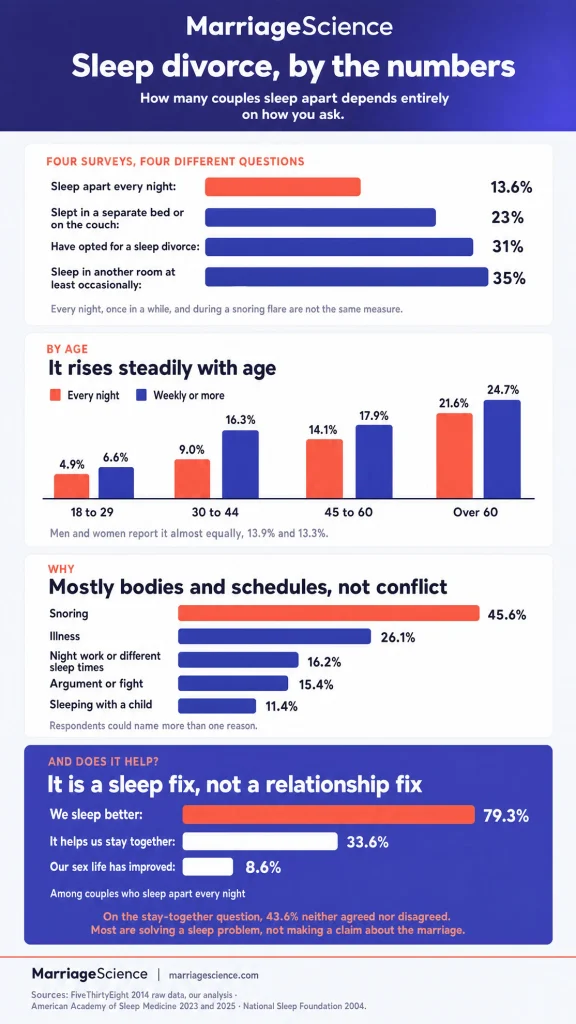
The share gets larger when surveys ask about any use of separate beds. 45.7% had slept apart at least once, while the American Academy of Sleep Medicine reported 35% sleeping apart at least occasionally in its 2023 survey and 31% in its 2025 survey.
That spread is the point. Sleeping apart every night, sleeping apart during a snoring flare, and moving to another room once in a while all get described as sleep divorce online, but they measure different behavior.
We also treat one common housing claim with caution: that 60% of custom homes would have two master bedrooms by 2015. It was a home builders’ forecast quoted in 2010, we found no report behind it, and it never counted couples.
This page compares every survey, who sleeps apart and why, whether couples say it helps, and what sleep lab research has measured.
What the Data Says About Sleep Divorce
Unless another source is named, every figure below is our analysis of the raw data from FiveThirtyEight’s 2014 poll of 1,079 adults who were married or living with a partner. The rest come from sleep organizations and sleep lab studies.
- 13.6% of partnered adults sleep apart every night when both are home.
- 45.7% have slept apart at least once.
- 35% of U.S. adults sleep in another room at least occasionally to accommodate a bed partner (American Academy of Sleep Medicine, 2023).
- 31% have tried a sleep divorce, counting a separate bed in the same room (American Academy of Sleep Medicine, 2025).
- 23% of married or cohabiting adults slept in a separate bed or on the couch in the National Sleep Foundation’s 2004 poll.
- Over 60s sleep apart every night at 21.6%, adults 18 to 29 at 4.9%.
- After more than 20 years together, 16.2% sleep apart every night, against 9.3% at one to five years.
- Men and women report it equally, 13.9% and 13.3% every night.
- Snoring is the top reason, named by 45.6% of those who sleep apart.
- 16.2% blame night work or different sleep times, and 15.4% an argument.
- 38.4% go to another bedroom and 30.9% to the couch.
- 79.3% of every-night separate sleepers say they sleep better.
- Only 33.6% of them say it helps them stay together, and 8.6% say their sex life improved.
- Couples sharing a bed in a sleep lab had about 10% more REM sleep (Drews and colleagues, 2020).
What Is a Sleep Divorce
Sleep divorce is a plain term for sleeping apart while the relationship continues. The couple stays married or together.
The word “divorce” is a media label, which is why it can sound more dramatic than the actual arrangement.
The American Academy of Sleep Medicine defines it as sleeping in another bed in the same bedroom or in another space in the home to accommodate a bed partner. That definition includes changes inside a shared bedroom as well as a move to another part of the home.
In the 2023 release, Dr. Seema Khosla, a pulmonologist, said, “Getting a good night’s sleep is important for both health and happiness, so it’s no surprise that some couples choose to sleep apart for their overall well-being.”
The label can cover several setups. It can mean separate rooms, separate beds in one room, one partner moving to the couch, or different bedtimes.
The shared feature is that sleep is separated while the relationship remains intact.
Related habits also sit near this topic. In its 2025 data, 37% go to sleep at a different time than they want to accommodate a partner, and 15% use a silent alarm.
Those figures describe adjustments inside a shared household, even if the couple does not use the phrase sleep divorce.
This breadth is the main reason sleep divorce statistics can differ from source to source. Some surveys count a nightly separate room.
Others include the odd night on the couch or a shift in bedtime. In the figures below, the definition behind each question matters as much as the headline percentage.
How Many Couples Sleep Apart
The cleanest nightly estimate in our data is 13.6%. In our analysis of the raw data from FiveThirtyEight’s 2014 SurveyMonkey poll of 1,079 adults who were married or living with a partner, that was the share who said they slept apart from their partner every night.
That is the basis for the headline figure, about one in seven couples. It is a narrower measure than “sleep divorce” as a casual search term, because it asks about every night, not occasional moves to another room, a couch, or a guest bed.
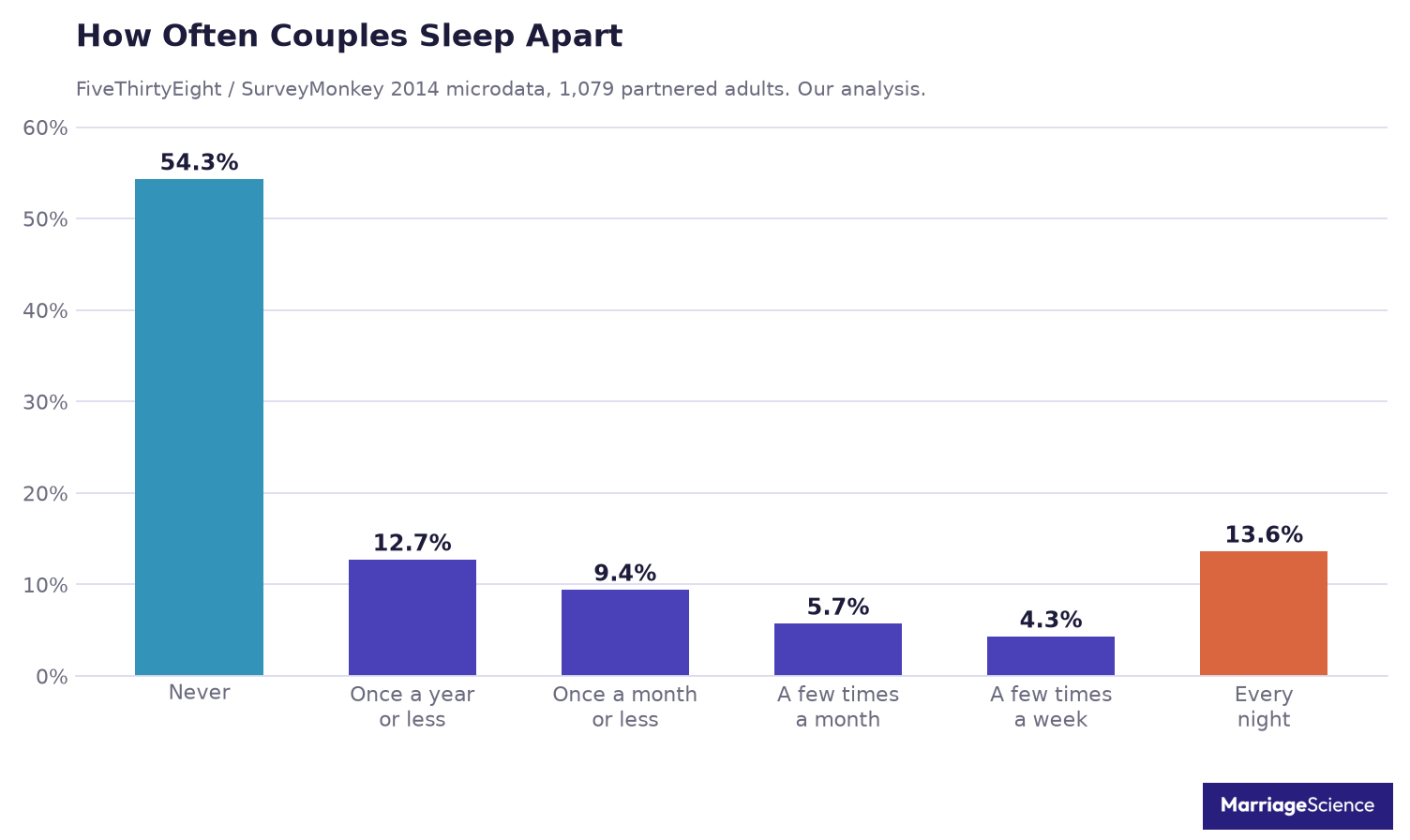
The same raw data show a much larger group that sleeps apart sometimes. In that poll, 54.3% said never, 12.7% said once a year or less, 9.4% said once a month or less, 5.7% said a few times a month, and 4.3% said a few times a week.
Our re-run reproduces every figure the original publisher reported.
The American Academy of Sleep Medicine gives a broader recent measure. In its 2023 online survey of 2,005 adults by Atomik Research, 35% said they sleep in another room occasionally or consistently.
The release split that into 20% occasionally and 15% consistently.
That makes “sometimes” close to about one in three adults in that source. It also shows why separate beds can look common or uncommon depending on the question.
A nightly measure is smaller, while an occasional measure captures people who move only during snoring, illness, shift work, a hot room, or a restless night.
The AASM’s 2025 survey found a similar but slightly lower headline share. In that survey of 2,007 adults in June 2025, 31% said they had opted for a sleep divorce.
The same release reported 39% for ages 35 to 44 and 18% for adults 65 and older.
Older national data point in the same direction. The National Sleep Foundation survey fielded in 2004 found that 23% of married or cohabiting respondents slept in a separate bed or on the couch.
That question did not ask why people slept apart or how often they did it.
The table below keeps the main estimates separate, because they are measuring different things. The AASM surveys ask all U.S. adults, and their releases do not say how single people were handled.
The partner-only poll is cleaner for couples, while the AASM figures are useful for the wider public conversation about sleep divorce.
| Survey | Who Was Asked | Measure | Share |
| 2014 SurveyMonkey poll | 1,079 adults who were married or living with a partner | Sleep apart every night | 13.6% |
| AASM 2023 | 2,005 adults | Sleep in another room occasionally or consistently | 35% |
| AASM 2025 | 2,007 adults | Have opted for a sleep divorce | 31% |
| National Sleep Foundation 2004 | Married or cohabiting respondents | Slept in a separate bed or on the couch | 23% |
These figures are estimates from online panels. The one in seven nightly figure comes from an online opt-in panel, and the about one in three “sometimes” figure comes from another online opt-in panel.
Together, they suggest that nightly separate sleep is a minority pattern, while occasional sleeping apart is common enough to be visible in multiple surveys.
Who Sleeps Apart
The clearest pattern in sleep divorce data is age. In our analysis of the raw data from FiveThirtyEight’s 2014 SurveyMonkey poll of 1,079 adults who were married or living with a partner, nightly separate sleeping rises across the age groups, from 4.9% among adults 18 to 29 to 21.6% among adults over 60.
The same pattern appears when the threshold is broader. Sleeping apart a few times a week or more rises from 6.6% among adults 18 to 29 to 24.7% among adults over 60.
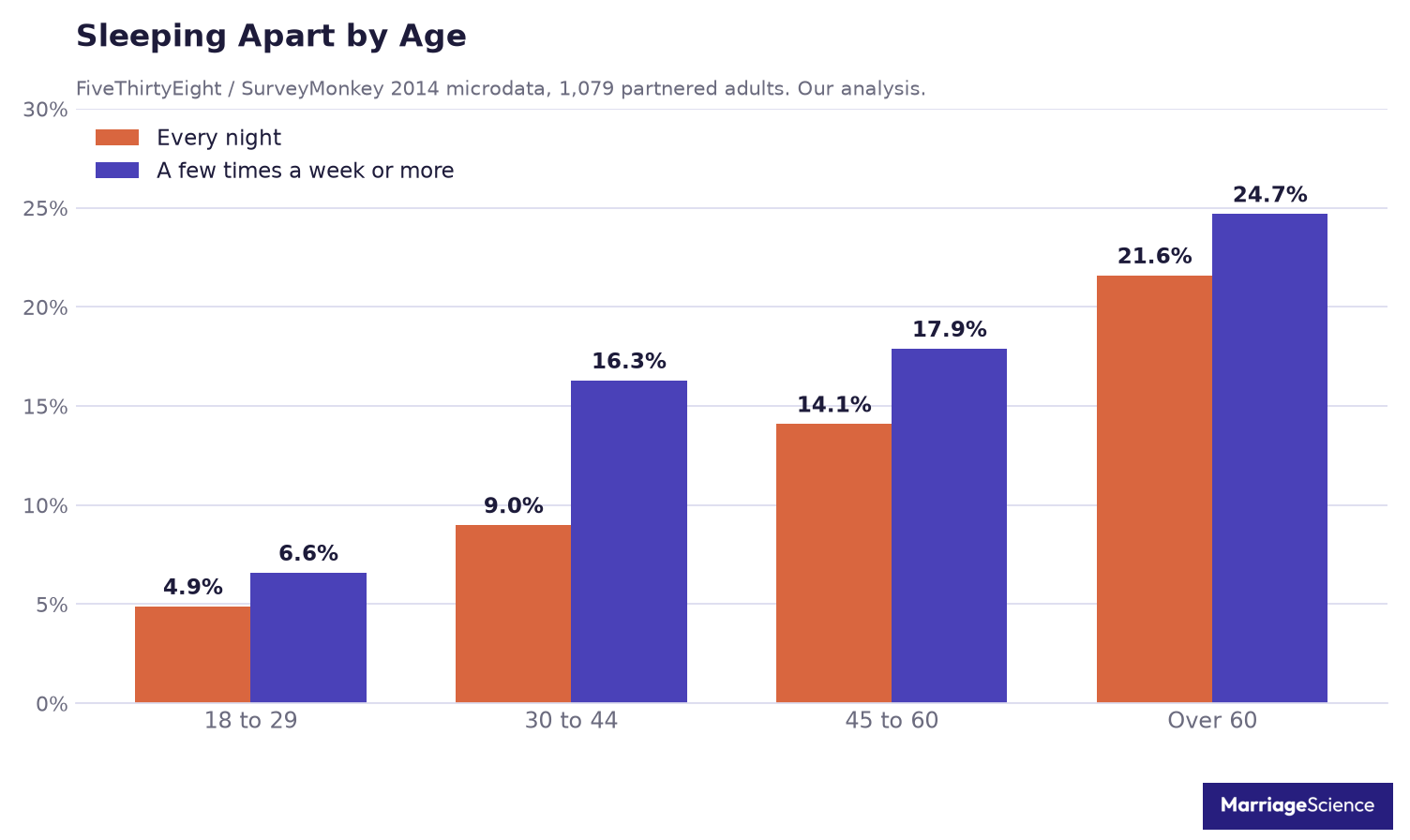
The middle age groups sit between those points.
| Age | Every Night | Weekly or More |
| 18 to 29 | 4.9% | 6.6% |
| 30 to 44 | 9.0% | 16.3% |
| 45 to 60 | 14.1% | 17.9% |
| over 60 | 21.6% | 24.7% |
Time together points in the same direction. Couples together one to five years reported sleeping in separate beds every night at 9.3%.
The figure was 9.1% for six to ten years, 13.8% for 11 to 15 years, 16.3% for 16 to 20 years, and 16.2% for more than 20 years.
The data do not say that age or years together cause separate sleeping, but both are linked with higher nightly rates.
Having ever slept apart has a different age shape. In the same FiveThirtyEight data, it peaks at 30 to 44, at 50.7%, compared with 36.9% at 18 to 29.
That suggests occasional sleeping apart is common before it becomes a nightly routine for some couples.
By sex, our analysis found very similar nightly rates: 13.9% for men and 13.3% for women. By relationship status, married adults were also close to cohabiting unmarried adults, at 14.0% and 12.5%.
Household income did not show a clear pattern in the FiveThirtyEight data.
AASM 2023 gives a different view because it asked about sleeping apart at least occasionally. In that survey, millennials were highest at 43%, followed by Gen X at 33%, Gen Z at 28%, and boomers at 22%.
AASM also reported a large sex gap, with 45% of men and 25% of women saying they had slept in another room to accommodate a bed partner.
That sex gap does not appear in our FiveThirtyEight analysis, which asked about the couple’s sleeping arrangement the same way for men and women. The safest reading is that the two surveys measure related but different behaviors: a regular arrangement in one case, and at least occasional sleeping apart in the other.
How long marriages last in the first place is set out in our analysis of average marriage length.
Why Couples Sleep Apart
Among the 482 people in our sample who sleep apart, the answers point first to bodies, sleep timing, and household routines. Because respondents could choose more than one reason, these shares overlap.
Separate beds usually come from a cluster of practical sleep interruptions.
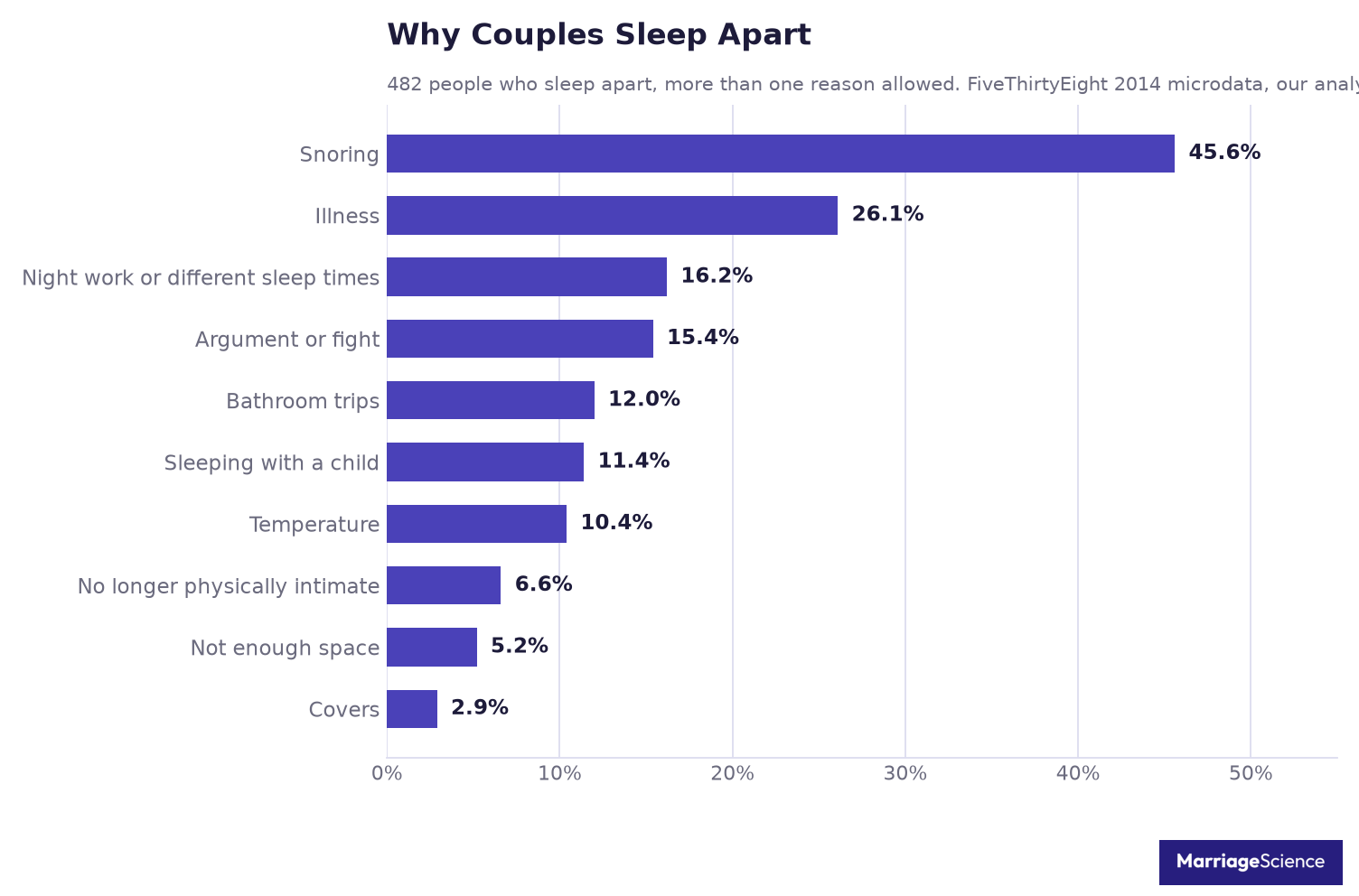
Snoring led the list at 45.6%, followed by illness at 26.1%. Night work or different sleep times came next at 16.2%, then argument or fight at 15.4%.
Bathroom trips, sleeping with a child, and temperature also sat in the practical category, at 12.0%, 11.4%, and 10.4%.
Conflict plays a smaller part in these responses. Argument or fight was named by 15.4%, which makes it a real reason for some couples, but a minority reason in the sample.
No longer physically intimate was selected by 6.6%. Readers asking about that part of the data can compare it with our sexless marriage statistics.
| Reason | Share of Those Who Sleep Apart |
| Snoring | 45.6% |
| Illness | 26.1% |
| Night work or different sleep times | 16.2% |
| Argument or fight | 15.4% |
| Bathroom trips | 12.0% |
| Sleeping with a child | 11.4% |
| Temperature | 10.4% |
| No longer physically intimate | 6.6% |
| Not enough space | 5.2% |
| Covers | 2.9% |
The table also shows why sleep divorce is a blunt label. It groups together partners managing medical symptoms, parents making room for a child, shift workers living on different clocks, and couples who are cooling off after a fight.
The same sleeping arrangement can carry very different meanings from one household to the next.
The wording of the question allowed more than one answer because couples rarely have tidy explanations for where they sleep. A person may cite snoring and illness, or night work and a child in the bed, within the same household.
The lower ranked answers still help explain the feel of sleeping apart. Not enough space was 5.2%, and covers was 2.9%.
Those are small shares beside snoring, yet they are concrete examples of how minor nightly friction can sit behind a move to another bed or room.
Where They Sleep and When It Starts
Where couples sleep on nights apart says a lot about what sleep divorce looks like in ordinary homes. In our analysis, sleeping apart is usually practical and close by.
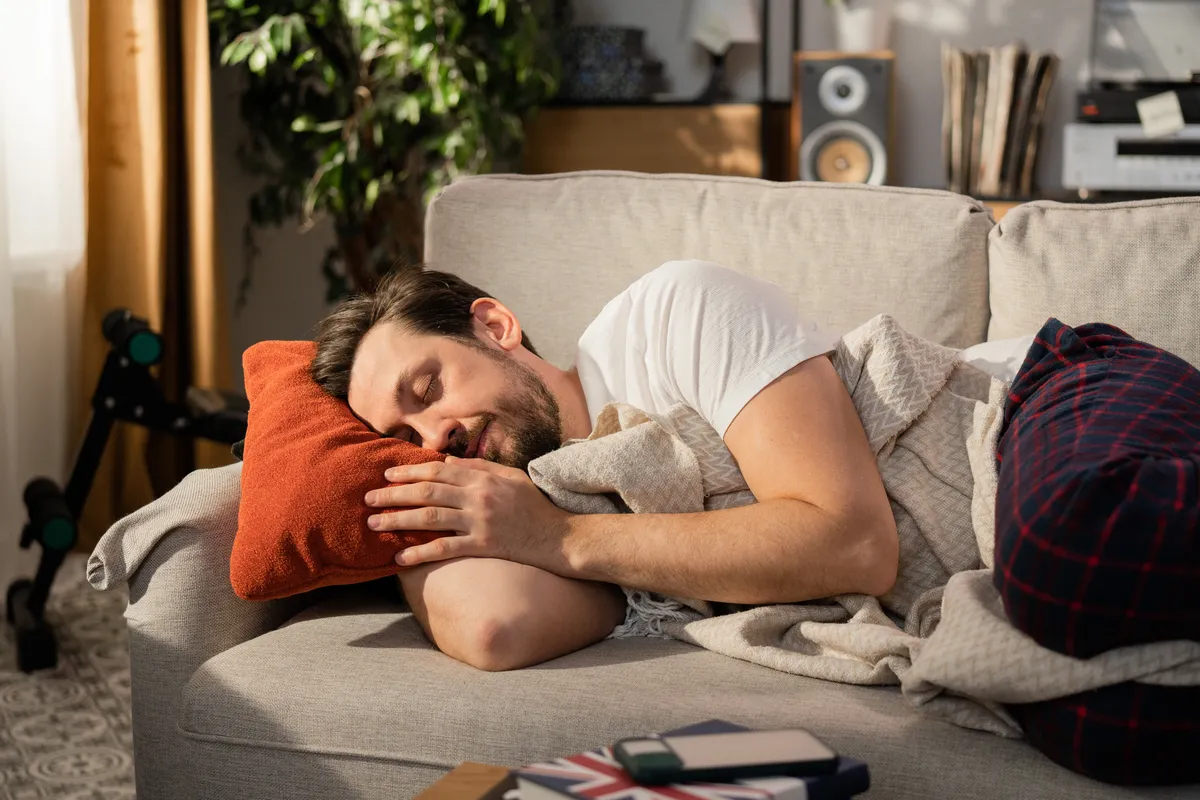
It often means using whatever space is available inside the home.
The most common place is another bedroom, at 38.4%. A couch or chair follows at 30.9%.
A couch is nearly as common as a spare room, which makes separate beds look less like a formal bedroom split and more like an improvised sleeping arrangement.
Another 22.0% stay in the shared bed while the partner leaves. Same room different bed is rare, at 2.5%, and other arrangements account for 5.6%.
The twin beds of old sitcoms are almost gone in this sample, replaced by spare rooms, sofas, chairs, and one partner keeping the main bed.
The timing points in the same direction. The largest group first slept apart within the first five years, at 42.1%, and six to ten years accounts for 18.3%.
Sleeping apart can begin early, before a couple has spent decades building fixed sleep habits together.
| When They First Slept Apart | Share |
| Within the first five years | 42.1% |
| Six to ten years | 18.3% |
| 11 to 15 | 13.3% |
| 16 to 20 | 6.0% |
| After 20 years | 16.4% |
| Always | 3.9% |
Later starts are still part of the pattern. Some couples first sleep apart after 20 years, while others report that they always slept this way.
That range matters because it keeps sleep divorce from being read as a single stage of a relationship.
Taken together, the place and timing data show a modest, flexible pattern. Sleeping apart often starts early, and the location is usually nearby.
For many couples in this survey, the separate sleep space is a room down the hall, a couch, or the original bed with one partner absent.
Does Sleeping Apart Help the Relationship
In this section, we read “help” as the respondents’ own report of what sleeping apart goes with in their relationship. The survey separates sleep, the relationship, and sex, because those answers do not move together.
Sleep divorce looks much stronger as a sleep story than as a broad relationship story.
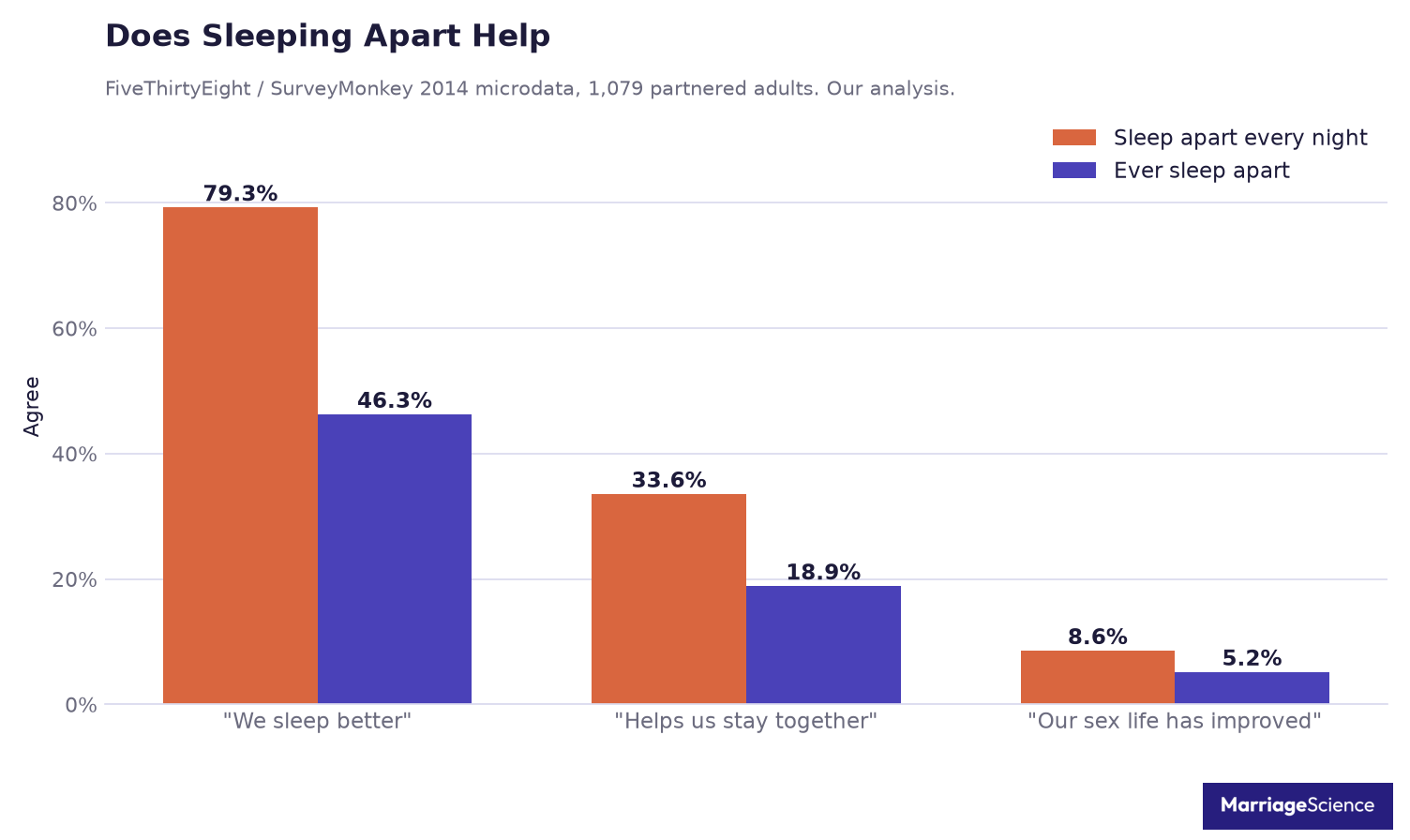
Among respondents who slept apart every night (140), 79.3% agreed strongly or somewhat with “we sleep better.” That is the clearest result in this part of the survey.
For people already using separate beds every night, better sleep is the main benefit they report.
The relationship finding is more modest. Among the same every night group, 33.6% agreed strongly or somewhat that “sleeping in separate beds helps us to stay together.”
Another 43.6% neither agreed nor disagreed on that stay together statement.
That middle response matters. It suggests that a large share of nightly separate sleepers do not describe the arrangement as clearly good or clearly bad for staying together.
Their answers fit a more limited reading: separate sleeping may solve a sleep problem without becoming a relationship claim.
The sex finding is smaller again. Among every night separate sleepers, 8.6% agreed strongly or somewhat that “our sex life has improved.”
Sex frequency itself is covered in our analysis of how often couples have sex.
The wider group gives the same pattern at lower levels. Among everyone who ever sleeps apart (481), 46.3% agreed strongly or somewhat that “we sleep better,” 18.9% agreed that “sleeping in separate beds helps us to stay together,” and 5.2% agreed that “our sex life has improved.”
Occasional separate sleepers appear less likely to attach large benefits to the arrangement.
These are self reports from people who chose, accepted, or at least used sleeping apart. They do not show what would happen for couples who have never tried it.
The safest reading is simple: separate beds are most often linked to better sleep, less often linked to staying together, and only rarely linked to an improved sex life.
Couples who want outside help with the relationship side can look at what the evidence says about marriage counseling success rates.
Couples who would like to talk it through from home can compare prices and session formats in our guide to the best online couples therapy services.
What Sleep Lab Research Found
The sleep lab research does not give a simple verdict on sleep divorce. It shows a tradeoff: sharing a bed can go with richer REM sleep, while the same bed can also bring noise, movement, and awakenings from a partner.
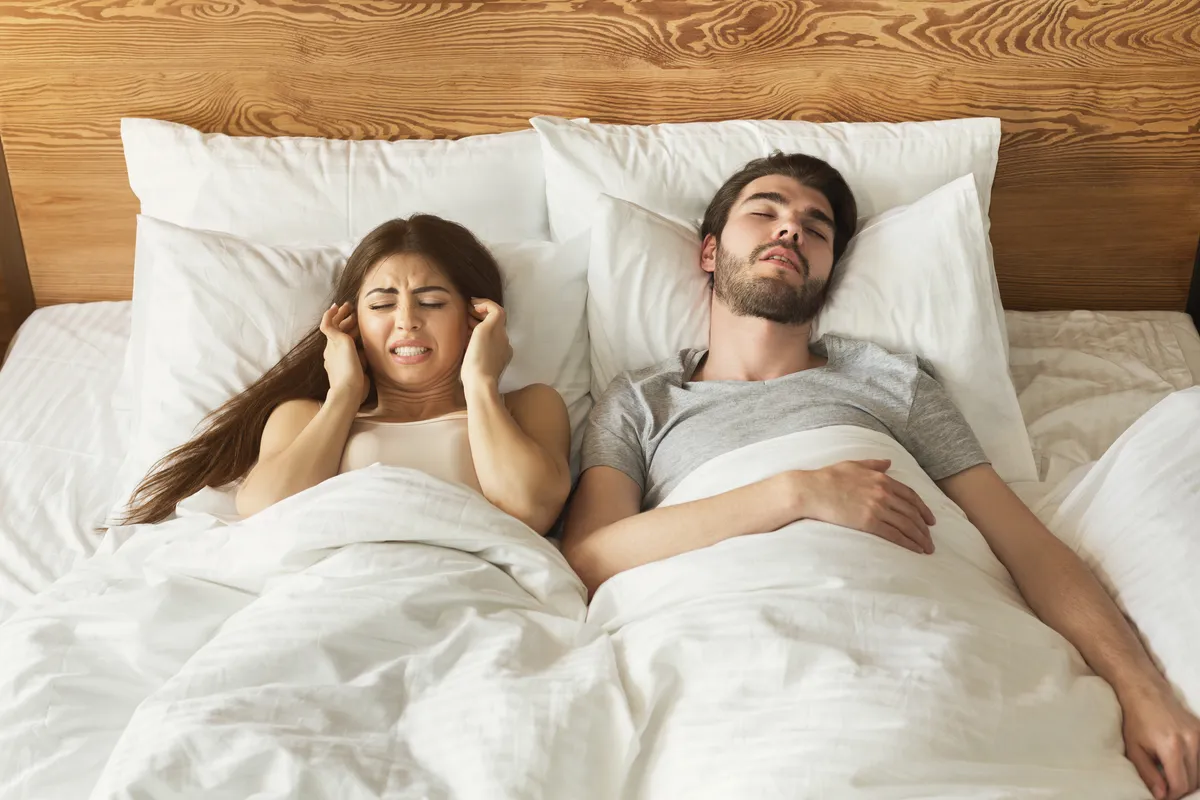
Drews and colleagues, writing in Frontiers in Psychiatry, studied young healthy couples who slept in a lab both together and apart. When they slept together, they had about 10% more REM sleep, less broken REM, more synchronized sleep stages between partners, and more limb movements.
The closer the relationship, the more synchronized their sleep stages were.
A follow-up using the Sleep Heart Health Study matched 69 married with 69 never-married adults. The married group had more REM sleep.
The disturbance side is clearest in the Beninati and colleagues study in Mayo Clinic Proceedings. It measured 10 married couples for one night in the lab, with the husband suspected of having sleep apnea.
When his snoring was treated with CPAP partway through the night, the wife’s arousals fell from 21 to 12 an hour and her sleep efficiency rose from 74% to 87%.
A 2026 systematic review in Sleep Health pulled the pattern together. All four studies measuring partner disturbance found it, and two of three found more REM when sharing a bed. Samples were small.
These studies also explain why survey numbers on sleeping apart can look different from lab findings. A survey asks where partners slept.
A sleep study measures what happened after lights out. Lab findings say nothing about how many couples use separate rooms.
The strongest evidence is about overnight measurement and small samples, so it is better for describing mechanisms than for ranking one sleeping arrangement for every couple. Sharing a bed is linked to both more disturbance and more REM sleep.
A partner’s untreated snoring or apnea is a medical problem with a medical fix, and a separate room is one response.
| Study | Who | Finding |
| Drews and colleagues, 2020 | Young healthy couples slept in a lab both together and apart | Together they had about 10% more REM sleep, less broken REM, more synchronized sleep stages between partners, and more limb movements |
| Drews and Drews, 2021 | Sleep Heart Health Study follow-up matching 69 married with 69 never-married adults | The married group had more REM sleep |
| Beninati and colleagues, 1999 | 10 married couples, one night in the lab, with the husband suspected of having sleep apnea | After CPAP, the wife’s arousals fell from 21 to 12 an hour and her sleep efficiency rose from 74% to 87% |
| 2026 systematic review | Studies on partner disturbance and REM sleep when sharing a bed | All four studies measuring partner disturbance found it, and two of three found more REM when sharing a bed |
The Dual Master Bedroom Forecast
A 2010 New York Times column by Bruce Feiler said the National Association of Home Builders “says it expects 60 percent of custom homes to have dual master bedrooms by 2015.” That line became one of the most repeated numbers in coverage of sleep divorce, separate beds, and couples who sleep in different rooms.
The problem is that the number is a forecast about custom home design. It never surveyed couples or counted how often partners sleep apart.
2015 has passed, and we could not find any National Association of Home Builders report containing that figure.
That matters because this topic is often framed as a fast moving change in marriage. The most quoted “trend” number in the sleep divorce conversation is a prediction with no document behind it.
Even taken at face value, it says something about what builders expected to put into custom homes, not how many couples actually sleep apart.
Methodology and Sources
Every figure in the article is tied to a named source, and we used the most direct version of the source we could check. For survey data, that means raw files when available and the issuing organization’s release when raw files were not part of the public record.
We downloaded the raw responses FiveThirtyEight published on GitHub for its 2014 poll and reran the tables. Our rerun matches every figure FiveThirtyEight reported, 14% every night, 22% of over 60s, 5% of 18 to 29, and snoring 46%.
We then added the cuts FiveThirtyEight did not publish.
The poll is an unweighted SurveyMonkey Audience panel of 1,079 partnered adults. It describes those respondents and only roughly the country.
We treat our added cuts as descriptive results from that file.
AASM figures are from its own releases. Both surveys were online panels run by Atomik Research.
We used only the figures in those releases, which keeps the sleep divorce and sleeping apart numbers tied to what AASM publicly reported.
We separated peer-reviewed sleep research from polling and media reporting. The research papers help explain how shared sleep, separate beds, snoring, and sleep disruption have been measured.
The polls supply the prevalence figures used in the article.
Several items were left out. We excluded mattress and bedding company surveys, a claim that couples who sleep apart divorce more because no source was found, and an unverified account of what the home builders’ survey asked.
Those exclusions kept the article focused on traceable data and clearly named sources.
- FiveThirtyEight, sleeping-alone-data (2014)
- American Academy of Sleep Medicine, sleep divorce surveys 2023 and 2025
- National Sleep Foundation, Sleep in America poll (2004 fieldwork)
- Drews and colleagues, Frontiers in Psychiatry, 2020
- Drews and Drews, Frontiers in Psychiatry, 2021
- Beninati and colleagues, Mayo Clinic Proceedings, 1999
- Rayward, Green and Little, Sleep Health, 2026
- Feiler, New York Times, 2010