


TL;DR: Four out of five American marriages now begin with the couple already living together. Whether that raises the odds of divorce has been argued in the same journal for twenty years without resolution, and anyone who tells you the question is settled is quoting one side.
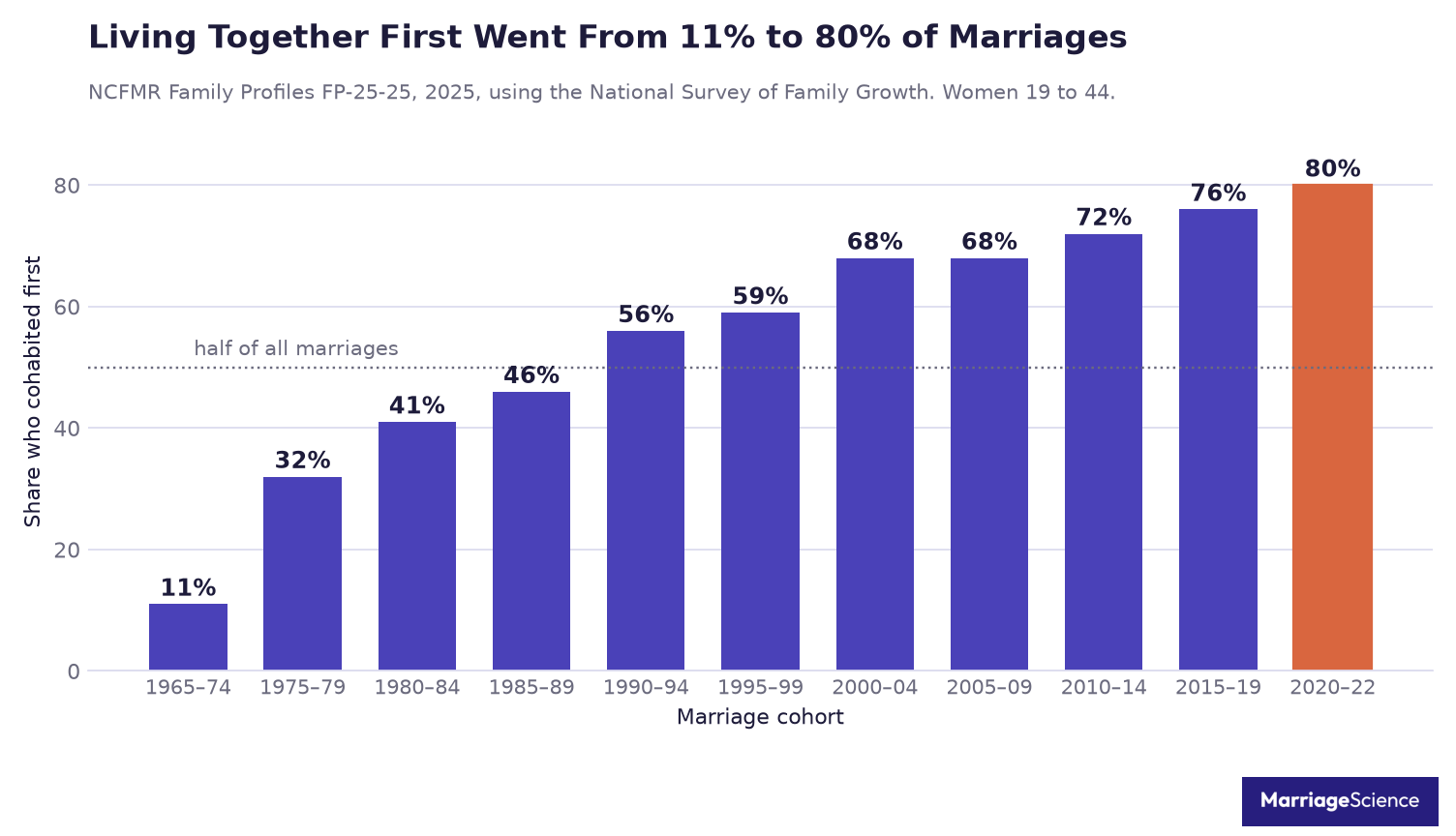
80% of marriages formed between 2020 and 2022 were preceded by cohabitation, up from 11% for marriages formed between 1965 and 1974 (NCFMR, Family Profiles FP-25-25, 2025, using the National Survey of Family Growth).
Moving in first went from unusual to standard inside a single lifetime.
Nearly half of Americans think it improves the odds of a lasting marriage. The research does not support that, and it does not clearly support the opposite either.
What follows comes from federal survey data and from three peer-reviewed papers published in the Journal of Marriage and Family that reach different conclusions from the same dataset. We set out what each one found and why they disagree, because that disagreement is the actual state of the evidence.
Key Living Together Before Marriage Statistics
- 80% of marriages formed in 2020 to 2022 were preceded by cohabitation (NCFMR FP-25-25, 2025).
- That figure was 11% for marriages formed in 1965 to 1974 and crossed 50% with the 1990 to 1994 cohort (NCFMR, 2025).
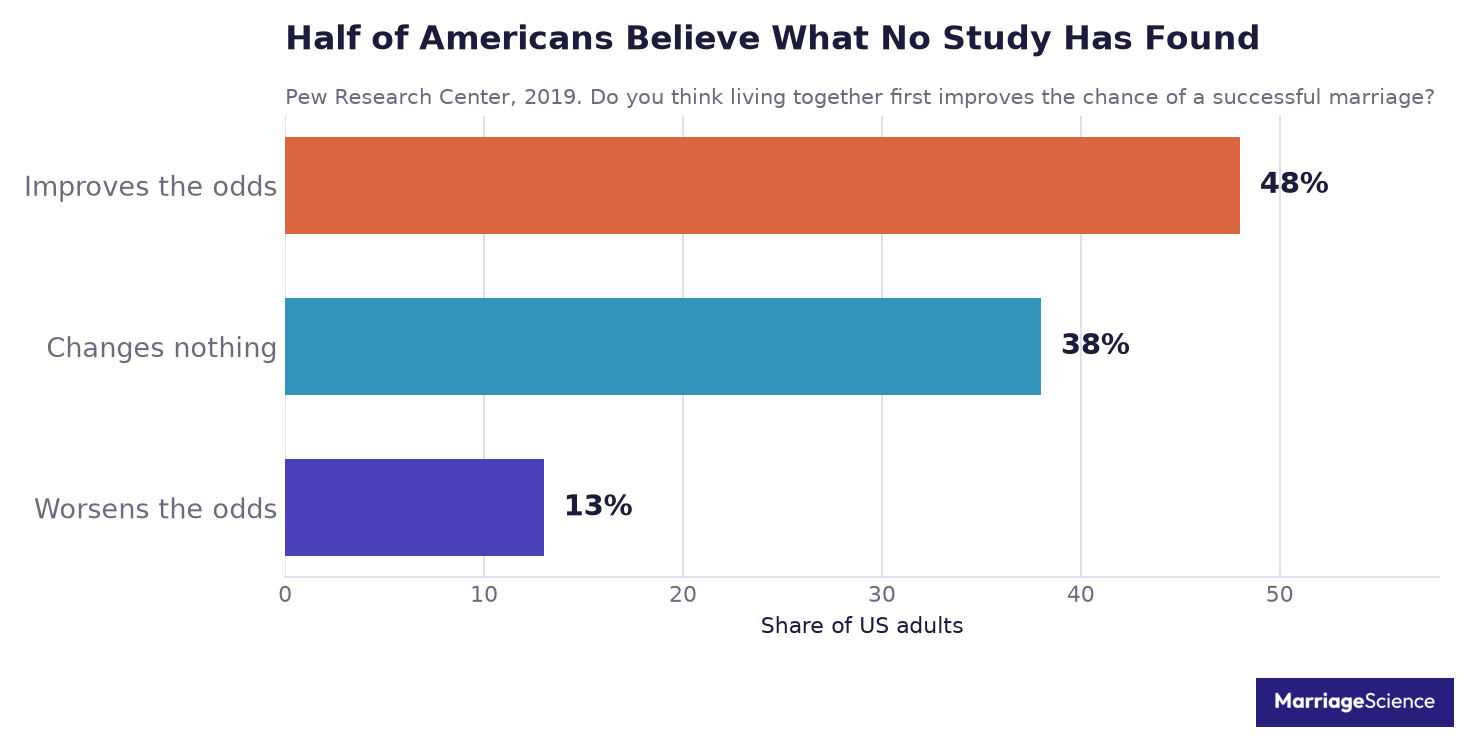
- 48% of Americans think living together first improves the chance of a successful marriage, 13% think it hurts and 38% say it changes nothing (Pew Research Center, 2019).
- 59% of adults aged 18 to 44 have ever cohabited, more than the 50% who have ever married (Pew Research Center, 2019).
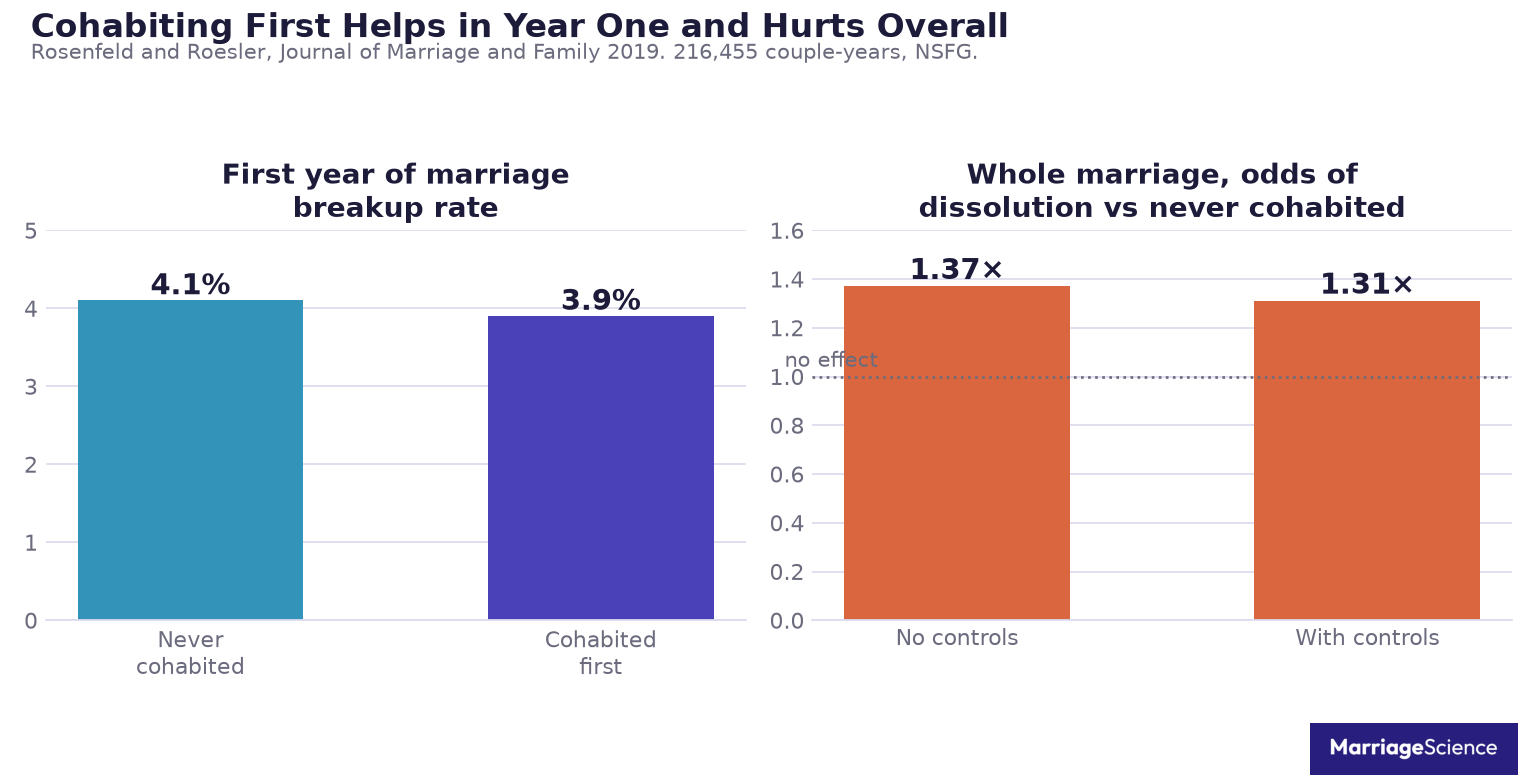
- Premarital cohabitation is associated with 1.31 times higher odds of marital dissolution once controls are added, across the whole dataset (Rosenfeld and Roesler, Journal of Marriage and Family 2019, 216,455 couple-years).
- In the first year of marriage the pattern reverses. Couples who never cohabited broke up at 4.1% and couples who had cohabited at 3.9% (Rosenfeld and Roesler, 2019).
- That early advantage is statistically significant only up to six months of marriage and gone by twelve (Rosenfeld and Roesler, 2019).
- Couples who cohabited first do not reach their peak breakup rate until two to five years into the marriage, while couples who did not show steadily falling rates from the wedding onward (Rosenfeld and Roesler, 2019).
- Three researchers published a formal comment arguing those models contain too many overlapping measures of time to support what it claims (Manning, Smock and Kuperberg, Journal of Marriage and Family 2021).
- Controlling for age at moving in together rather than age at the wedding makes the association disappear in some cohorts and reverse in recent ones (Kuperberg, Council on Contemporary Families, 2018).
- Women who cohabited before marrying wed at a median age of 27, against 26 for women who did not (NCFMR, 2025).
- Non-cohabiting women’s median age at marriage rose from 23 to 26 in fifteen years, closing most of the gap with cohabiters (NCFMR, 2025).
- 7% of American adults are currently living with an unmarried partner, up from 3% in 1995 (Pew Research Center, 2019).
- 69% of Americans say cohabiting is acceptable even with no plans to marry, and only 14% say it is never acceptable (Pew Research Center, 2019).
- 58% of married adults say things are going very well in their relationship, against 41% of cohabiting adults (Pew Research Center, 2019).
Four in Five Marriages Now Start With Living Together
The National Survey of Family Growth has tracked this by marriage cohort for half a century, and the line goes one way.
Among women who married between 1965 and 1974, 11% had lived with their husband first. By the 1990 to 1994 cohort that had passed half at 56%, and among women who married between 2020 and 2022 it reached 80%.
The steepest climb came early. The share tripled between the 1965 to 1974 cohort and the 1975 to 1979 cohort, from 11% to 32%, then added another nine points by the early 1980s and five more by the late 1980s.
The one flat stretch is worth noting. The share sat at 68% for both the 2000 to 2004 and 2005 to 2009 cohorts before resuming its climb.
Cohabiting has also spread across education levels. NCFMR reports that the gap between education groups narrowed, driven mainly by college graduates catching up with everyone else.
The wider population moved the same way. 7% of all American adults were living with an unmarried partner by 2019, against 3% in 1995, while the married share fell from 58% to 53% across the same period.
Among adults aged 18 to 44 the two experiences have swapped rank. 59% have lived with a partner and 50% have married, where in 2002 it was 54% and 60%.
One limit is worth stating plainly. These figures come from women aged 19 to 44 who have ever married, in different-sex couples, so they describe the road into marriage and not cohabitation in general.
| Marriage cohort | Cohabited first | Source |
| 1965 to 1974 | 11% | NCFMR FP-25-25, 2025 |
| 1980 to 1984 | 41% | NCFMR FP-25-25, 2025 |
| 1990 to 1994 | 56% | NCFMR FP-25-25, 2025 |
| 2000 to 2004 | 68% | NCFMR FP-25-25, 2025 |
| 2010 to 2014 | 72% | NCFMR FP-25-25, 2025 |
| 2015 to 2019 | 76% | NCFMR FP-25-25, 2025 |
| 2020 to 2022 | 80% | NCFMR FP-25-25, 2025 |
What Americans Believe About It
Belief and evidence have come apart on this question, which is unusual and worth sitting with.
48% of Americans say living together first improves the chance of a successful marriage. Only 13% say it hurts, and 38% say it changes nothing.
No study in the peer-reviewed literature supports the 48% position. The findings range from a modest raised risk of divorce to no measurable effect at all, and the best case anyone has made is that the association vanishes once you measure age correctly.
Acceptance is a separate matter and it is close to universal. 69% of adults say cohabiting is fine even when a couple has no plans to marry, and only 14% call it never acceptable.
The generational spread on acceptance is narrower than most people assume. 78% of adults under 30 call it acceptable, and 63% of adults over 65 say the same.
What couples think they are doing when they move in also differs by where they stand. Two thirds of married adults who had lived together before getting engaged say they saw it as a step toward marriage, against 44% of people currently cohabiting without an engagement.
Americans are split on whether any of it matters to society. 53% say the country benefits when long-term couples marry, and 46% say society is just as well off if they do not.
| Belief or measure | Share | Source |
| Living together first improves the odds | 48% | Pew Research Center, 2019 |
| It worsens the odds | 13% | Pew Research Center, 2019 |
| It changes nothing either way | 38% | Pew Research Center, 2019 |
| Cohabiting acceptable with no marriage plans | 69% | Pew Research Center, 2019 |
| Never acceptable | 14% | Pew Research Center, 2019 |
| Adults 18 to 44 who have ever cohabited | 59% | Pew Research Center, 2019 |
Does Living Together Before Marriage Raise the Divorce Risk?
The raw association says yes, and it has said yes for decades.
It was not always expected to. Before anyone had data, the assumption ran the other way, that a trial run would sort out incompatible couples and lower divorce. The first evidence overturned that, and the raised-risk finding has been reported so consistently since that it acquired a name, the cohabitation effect.
Rosenfeld and Roesler built a harmonized dataset from six waves of the National Survey of Family Growth, covering 216,455 couple-years of married life among women aged 44 and under in first marriages. It is one of the largest treatments of the question anyone has published.
Across that whole dataset, couples who had cohabited before marrying had 1.37 times the odds of the marriage ending. Adding controls brought it to 1.31 times.
Their paper also argued against the popular claim that the effect has faded for younger couples. They found the association has not changed across marriage cohorts, and that studies concluding otherwise were being misled by the shape of the first year.
A ratio of 1.31 is worth putting in proportion. It is a raised risk and not a doubling, and it is an odds ratio rather than a share, so it does not tell you what percentage of either group divorces.
That is one paper. Two years later the same journal published a formal comment rejecting the method, and then a reply defending it.
Very little in social science gets that treatment. A comment and a reply printed back to back is what a field does when a result is important enough to argue over and not solid enough to accept.
| Measure | Value | Source |
| Odds of dissolution, no controls | 1.37 times higher | Rosenfeld and Roesler, 2019 |
| Odds of dissolution, with controls | 1.31 times higher | Rosenfeld and Roesler, 2019 |
| Couple-years analysed | 216,455 | Rosenfeld and Roesler, 2019 |
| Data source | Six waves of the NSFG | Rosenfeld and Roesler, 2019 |
The Case That the Effect Is a Measurement Artifact
The counter-argument is technical, and it is strong enough that no honest summary can leave it out.
Arielle Kuperberg’s version concerns what you hold constant. Most studies control for age at marriage. That compares a couple who moved in together at 21 and married at 24 against a couple who married at 24 having never lived together, so the first couple was committed three years earlier at a younger and riskier age.
Control instead for age at moving in together, which is when the relationship actually became a shared household, and the association disappears in some cohorts. In very recent cohorts it turns the other way, with cohabiters divorcing less.
She tested it on two federal datasets, the 1988 National Survey of Families and Households covering marriages from 1956 to 1985 with 3,594 women, and the National Survey of Family Growth covering 1986 to 2015 with 9,420. Both were restricted to women under 36 at first marriage.
Manning, Smock and Kuperberg made a separate objection in their published comment. They argued that the Rosenfeld models carry too many overlapping indicators of time, since calendar year, marital duration and marriage cohort are arithmetically bound to one another, and that this leaves the finding unsafe.
Rosenfeld and Roesler replied in the same issue, arguing that cohort-based analysis is exactly what creates the false impression that the association has vanished.
Nobody won. Three papers, one journal, one dataset, and the field still splits on how to measure time.
| Paper | Position | Citation |
| Rosenfeld and Roesler, 2019 | Effect is real and has not faded | JMF 81, 42 to 58 |
| Manning, Smock and Kuperberg, 2021 | Too many measures of time to trust it | JMF 83, 260 to 267 |
| Rosenfeld and Roesler, 2021 | Cohort analysis creates the illusion | JMF 83, 268 to 279 |
| Kuperberg, 2018 | Control for age at moving in, not at marriage | Council on Contemporary Families |
The First Year Advantage, and Why It Fades
Buried inside the paper that found a raised divorce risk is a finding that runs the other way, and it is the most useful number on this page.
In the first year of marriage, couples who had never lived together broke up at 4.1%. Couples who had cohabited broke up at 3.9%.
Living together first protects a marriage at the start. The authors read this as practical experience, since a couple who already shares a home has done the adjusting that others do after the wedding.
The advantage is short. It holds up statistically for the first six months and is gone by twelve, because by then the couples who did not cohabit have caught up on the same practical learning.
Two tenths of a percentage point is a small edge, and the authors are careful about it. What makes it matter is the direction, because it is the opposite of what the headline association predicts and it comes from the same paper.
After that the two groups diverge in shape. Couples who never cohabited show steadily falling breakup rates from the wedding onward. Couples who cohabited first do not hit their peak breakup rate until somewhere between two and five years of marriage. Our page on average marriage length covers how those durations play out overall.
That crossover is the whole argument in miniature. Depending on which stretch of marriage a study looks at, cohabitation appears protective, neutral or harmful, using the same couples.
| Marital stage | Who does better | Detail |
| First 6 months | Cohabited first | Statistically significant advantage |
| First year overall | Cohabited first | 3.9% versus 4.1% breakup rate |
| At 12 months | No clear gap | Advantage no longer significant |
| 2 to 5 years | Never cohabited | Cohabiters peak here, others keep falling |
Cohabiters Marry Later, but the Gap Is Closing
Age sits underneath this whole argument, so it is worth seeing the numbers directly.
Women who lived with their partner before marrying did so at a median age of 27 in the most recent cohort. Women who did not cohabit married at 26.
Fifteen years earlier that comparison was 27 against 23. The women who skip cohabitation used to marry four years younger, and now they marry one year younger.
The direction of that convergence is the interesting part. Cohabiters did not start marrying later. The women who skip cohabitation moved three years up the age scale in fifteen years and met them.
This matters because marrying young is one of the most reliable predictors of divorce there is, as our divorce statistics page sets out. If non-cohabiters were once much younger at the wedding and are no longer, then any comparison between the two groups is measuring something that has changed underneath it.
Our page on the average marriage age covers the wider trend, which has moved in the same direction for everyone.
| Marriage cohort | Cohabited first | Did not cohabit |
| 2005 to 2009 | 27 | 23 |
| 2020 to 2022 | 27 | 26 |
Married and Cohabiting Couples Report Different Things
Comparing people who are currently married with people who are currently cohabiting is a different question again, and the answers are consistent.
58% of married adults say things are going very well in their relationship. Among cohabiting adults it is 41%.
Married adults also report higher trust in their partner on fidelity, honesty and money.
The exception is telling. Reported sexual satisfaction is the one measure where the two groups match, at about a third of each saying they are highly satisfied, which is hard to square with any account in which married couples are simply happier across the board.
| Measure | Married | Cohabiting |
| Say things are going very well | 58% | 41% |
| High sexual satisfaction | About a third | About a third |
| Higher trust on fidelity, honesty and money | Yes | Lower |
None of that establishes that marriage is what produces the gap. Cohabiting couples include people at the start of a relationship, people who have decided against marrying and people whose relationship is ending, while married couples have already passed a filter.
What the Research Cannot Tell You
None of these studies randomly assigned anyone to live together, and none of them could.
People who cohabit differ from people who do not on religion, income, education, family background and how young they paired up. Every study tries to control for some of that, and the entire argument between these researchers is about which controls are the right ones.
The datasets carry their own limits on top of that. The NSFG interviews women aged 44 and under, so a marriage cannot be observed past roughly fourteen years of duration, and the long marriages that would settle the question are simply absent.
So the question a reader actually has, whether moving in together will make their own marriage more or less likely to last, has no answer in this literature. What it can tell you is that the effect either way is small, and that it is dwarfed by things like the age you commit at.
| Limit | What it means | Source |
| No random assignment | No study can show cause | All three papers |
| NSFG interviews women 44 and under | Marriages past about 14 years are unobserved | Rosenfeld and Roesler, 2019 |
| Sample is ever-married women | Says nothing about couples who never marry | NCFMR FP-25-25, 2025 |
| Different-sex couples only | NSFG data constraint | NCFMR FP-25-25, 2025 |
We excluded the advocacy sites that dominate this search result, which quote the raw association and omit twenty years of argument about whether it means anything. For the wider set of research summaries see our marriage statistics page and the statistics hub.
Methodology and Sources
Prevalence figures come from NCFMR Family Profiles FP-25-25, which analyses female data files from the National Survey of Family Growth. The sample covers women aged 19 to 44 who have ever married, in different-sex couples, so it describes the path into marriage and not cohabitation across the whole population.
Divorce risk figures come from Rosenfeld and Roesler in the Journal of Marriage and Family, volume 81, pages 42 to 58, read from the authors’ own copy. The counter-arguments come from Manning, Smock and Kuperberg in volume 83, pages 260 to 267, and the reply in the same volume, pages 268 to 279.
Attitude and prevalence figures for the general population come from the Pew Research Center’s 2019 report on marriage and cohabitation, which draws on its own survey plus the National Survey of Family Growth and the Current Population Survey.
We excluded advocacy organizations, content-marketing statistics pages and every claim of causation in either direction. Where a number could only be found on those, we left it out and said so.